Home ›
Cookware › Why a Stainless Pot Bottom Turns Rainbow
Cookware
Why a Stainless Pot Bottom Turns Rainbow
PBy the Pickpedia Team·5 picks compared·Last verified October 2026
Affiliate disclosure: As an Amazon Associate, Pickpedia earns from qualifying purchases. Links on this page are paid links, and we may earn a commission at no extra cost to you. This never affects our picks or scores.
This page contains affiliate links. If you buy through one we may earn a
commission, at no cost to you.
It is not a residue and nothing has been left behind on it. The rainbow is the
steel's own protective film, grown thicker by heat until it became thick enough to
interfere with visible light, and the whole thing is somewhere between forty and
seventy nanometres deep. On a six quart pot base the entire rainbow weighs about ten
milligrams.
That matters practically, because it changes what will take it off and it explains
the thing people find strangest: why it appeared after a sauté and not after a month of
pressure cooking.
The film has no colour of its own
Every piece of stainless steel is already covered in a chromium rich oxide, one to
three nanometres thick, and that film is the entire reason the alloy is called
stainless. At that thickness it is invisible, because it is far thinner than any
wavelength of light.
Heat it in air and the film thickens. Nothing about it changes except its depth, and
at some point the depth starts to matter optically. Light arriving at the surface splits
in two: part reflects off the top of the film, and part goes through, bounces off the
metal underneath and comes back out. The second part has travelled an extra distance of
twice the film thickness, multiplied by the film's refractive index of about 2.5
because light moves more slowly inside it.
When that extra path amounts to half a wavelength, the two reflections cancel and
that wavelength goes missing from what reaches your eye. So the first order condition is
the thickness equal to the wavelength divided by four times the refractive index, and
the arithmetic is a single division:
Remove blue at 450 nanometres and the film is 45 nanometres thick, and the surface
looks straw or pale gold. Remove green at 550 and the film is 55, and the surface looks
magenta or purple. Remove red at 650 and the film is 65, and the surface looks blue.
Which is the surprise. There is no colour at all until about forty nanometres, the
whole visible sequence happens in the next thirty, and past about a hundred nanometres
several orders of interference overlap, no wavelength is cleanly removed, and the
surface just goes a washed out grey. A pot goes from looking new to looking ruined
across a thickness change smaller than one three thousandth of a sheet of paper.
The interference condition and the square root growth law are standard optics and
standard oxidation kinetics. A refractive index of 2.5 for the film, a density of 5.22
grams per cubic centimetre and 68.4 percent chromium by mass are handbook figures for
chromium oxide, not product figures. The 18 percent chromium and 8.0 grams per cubic
centimetre are for 304 stainless, which is the alloy our own stainless cutting board
listing publishes. The 2 millimetre base thickness is representative: the only stainless
thickness published anywhere in our catalogue is that board's 14 gauge. The 0.0356 square
metre base area is the six quart figure worked out on our pressure cooker height page
from an assumed pot proportion. Real temper films are mixed iron and chromium oxides
rather than pure chromium oxide, so treat the 136 nanometres and the 10 milligrams as
the right order rather than as measurements. The thirty nanometre window is the part
that does not move.
How little metal it took
Work out the mass, because the proportion is the useful thing to carry away.
Chromium oxide has a density of 5.22 grams per cubic centimetre and is 68.4 percent
chromium by weight. A film 55 nanometres thick therefore weighs 0.2871 grams per square
metre and holds 0.19637 grams of chromium per square metre.
Where did that chromium come from? From the steel directly underneath. A
RIZIZMVG oversized 304
stainless steel cutting board is the one item in our catalogue that states its alloy
and its thickness in plain prose, "food-grade 304 stainless steel" over a "heavy-duty
14-gauge core", and that lets this arithmetic be anchored rather than assumed. Grade 304
is 18 percent chromium at 8.0 grams per cubic centimetre, which is 1.44 million grams of
chromium per cubic metre. Divide 0.19637 by that and the chromium came out of the top
136 nanometres of the steel.
Against a pot base a couple of millimetres thick, 136 nanometres is 68 parts per
million. And spread over the 0.0356 square metre base of a six quart inner pot, which
is the figure our own page on
why a pressure cooker is
tall and its pot is not works out from the capacity, the whole rainbow comes to
about ten milligrams of oxide.
So the honest description of a tempered pot bottom is that about a seventh of a
micron of its surface has rearranged itself into the compound it was already covered
in.
Why it appeared after sautéing and not after pressure cooking
This is the part that makes it diagnosable, and it falls out of a temperature that
is not free to vary.
While there is water in a sealed cooker the surface is pinned near the saturation
temperature, which our page on
why steam cannot get hotter
than 100 degrees puts at 117 degrees Celsius at the usual operating pressure. That
is far too cool to grow a visible oxide; temper colours on stainless want somewhere in
the region of 200 to 400 degrees in air, for minutes. You could pressure cook for years
and never see a rainbow.
Sauté has no liquid in it. Nothing pins the plate, so the only thing limiting its
temperature is how fast the heat can leave, and on an empty base that is slow. An
Instant Pot Pro 6 Qt 10-in-1
electric pressure cooker publishes 1200 watts, and spread over that same 0.0356
square metre base the flux is 33.7 kilowatts per square metre. With nothing absorbing
it, that base is in temper colour territory within minutes.
Which means the function that produces the mark is named on every one of these
records. An
Instant Pot Duo 6 Qt 7-in-1
electric pressure cooker has an 18/8 stainless inner pot whose tri-ply bottom, says
its own record, "spreads heat evenly and supports searing and sauteing right in the
pot", and its performance text adds that "Browning works well on the saute function".
Both statements are true and both describe the exact condition that tempers the steel.
No record in the category joins the two.
And it slows down, which is why it seems to stabilise
People notice the rainbow after the first few uses and then report that it stops
getting worse, which sounds like wishful thinking and is actually the kinetics.
The film grows by oxygen diffusing through the film that already exists, so the
thicker it gets the slower it grows. Thickness goes as the square root of time, which
means time goes as the square of thickness. Going from 45 nanometres of straw to 65
nanometres of blue is a factor of 1.44 in thickness and therefore 2.09 in time. Getting
to 90 nanometres and grey takes 4.0 times as long as the straw took.
So the first short dry run gives you most of the colour you are ever going to get
from ordinary use, and the same property that produced the mark, the film blocking its
own growth, is the property that stops it. That is also, not coincidentally, how the
alloy protects itself in the first place.
Two of our own pages, one half wrong and one right for the wrong reason
Our guide to
stainless steel versus nonstick
cookware gives this advice: "if you see cloudy white spots or a rainbow tint, a
splash of vinegar or a stainless cleaner brings it back". That sentence has two soils
and two reagents in it and they do not pair up the way the sentence implies.
Cloudy white spots are mineral deposit, mostly calcium carbonate dried out of the
water. Acetic acid dissolves carbonate briskly, so vinegar is the correct reagent and
the advice is right.
A rainbow tint is chromium oxide, and chromium oxide is one of the most acid
resistant oxides in common use. That resistance is not incidental, it is the whole
mechanism by which stainless steel survives a tomato sauce. Asking household vinegar to
dissolve it is asking it to perform precisely the attack the alloy was formulated to
shrug off. It will not work, and the reason it will not work is the reason you bought
the pan.
The other half of that same sentence, "or a stainless cleaner", is correct, and it
is correct because those powders are built around oxalic acid rather than acetic.
Oxalic acid attacks iron and chromium oxides by binding the metal ion as it comes off,
which is a different chemistry from simply donating a proton. Our page on
why one cleaner
cannot cut grease and dissolve limescale already sets out properly why a reagent for
one soil does nothing for another, and this is the same argument on a third pair of
soils. Credit where it belongs, and this page will not repeat the chemistry.
Our page on
whether you can use
metal utensils on stainless steel cookware suggests "a paste of baking soda" for
"rainbow-colored discoloration". That one does work, and not for any chemical reason:
sodium bicarbonate is an alkali and will not touch chromium oxide either. What it does
is abrade. A paste of a mildly hard, finely divided powder removes a fifty nanometre
film mechanically, which is the correct approach, and the page arrives at the right
answer by the wrong route. Worth knowing which, because it tells you that pressure and
a soft cloth matter more than dwell time, and that leaving the paste to sit will achieve
nothing at all.
Telling it apart from the thing it is confused with
An iridescent film on stainless is not always temper colour. A thin mineral or
protein film dried onto the surface can also produce interference colours, by exactly
the same optics in a different material, and the two look similar in a photograph.
They are easy to separate by geography rather than by chemistry. Heat tint appears
only where the metal got hot, so on a cooker base it follows the footprint of the
element underneath and stops at its edge, usually as a ring or a disc with a defined
boundary. A deposit film follows the water instead, so it appears at the old water line,
in streaks down the sides, or over the whole wetted interior. If the mark has a sharp
circular edge in the middle of the base, it is the steel. If it fades out at a
horizontal line, it is not.
And one honest consequence of the thinness: a mark that comes off with light abrasion
in a few passes was a deposit. A mark that needs real work was in the metal, and taking
it out means removing that top layer of steel, which is why heavy polishing leaves a
visibly different finish where you worked.
What the records do and do not say
A
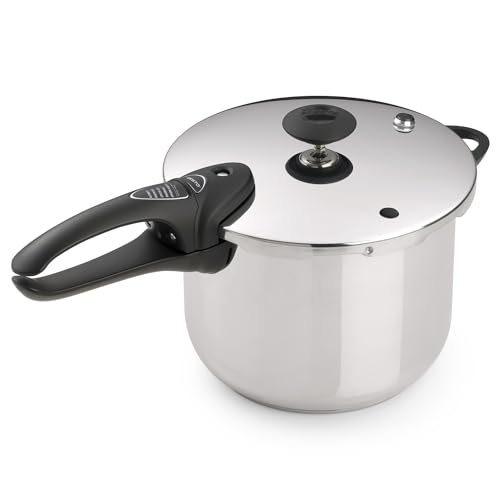
Presto 01365 6 quart stainless
steel pressure cooker describes its material the way almost every listing does:
stainless steel is "known for durability and resistance to staining and corrosion".
That is accurate and it is also why a buyer has no way to anticipate this. Heat tint is
not a stain, because nothing was deposited, and it is not corrosion, because nothing was
lost. It is the protective film working, made visible. A sentence about staining and
corrosion cannot warn you about it because it is neither.
The closest any record in our catalogue comes to naming the phenomenon is an
All-Clad D3 stainless steel 12
inch frying pan, whose own drawbacks say it "Requires more maintenance to keep
shiny". That is the honest version of what owners actually experience with bare
stainless at searing temperatures, and it earns the product its place here, because it
is the one listing that concedes the surface is a thing you will be managing rather than
a thing that stays as supplied. Its performance text is also right that "High-heat
methods like searing and sauteing are where the D3 shines", which is true and is the
same condition described above.
What no record states, anywhere in the category, is a maximum dry surface
temperature. Every cooker and pan publishes a wattage or an oven rating, and the oven
rating is for a cavity rather than for a plate with a heating element pressed against
it. The figure that decides whether a surface will temper is how hot the metal itself
gets with nothing in the pan, and that is not a number anyone publishes, which is why
the arithmetic on this page has to go through flux instead.
The honest limit
The optics are solid and the metallurgy is approximate.
The interference condition and the square root growth law are standard and they do
not depend on anybody's pan. The refractive index of 2.5, the oxide density of 5.22 and
the 68.4 percent chromium are handbook values for pure chromium oxide. Real temper films
are not pure chromium oxide: they are mixed iron and chromium oxides whose composition
shifts with temperature and time, with more iron in them at the hotter end. So read the
136 nanometres of depleted steel and the ten milligrams of film as the right order of
magnitude rather than as measurements. If the film were half chromium oxide and half
iron oxide, both figures would shift by a few tens of percent and nothing on this page
would change.
The thirty nanometre window is the number to keep. It is the reason this particular
cosmetic complaint is so common and so alarming: the material has no intermediate
appearance between untouched and lurid, and the step between them is a distance you
cannot see, cannot feel, and cannot avoid if you intend to brown anything in a bare
steel pan.
Why a Stainless Pot Bottom Turns Rainbow at a glance
Instant Pot Pro 6 Qt 10-in-1 Electric Pressure Cooker
Families and meal preppers who want a versatile, fast cooking appliance.
10 cooking functions in one device 28 one-touch smart programs Cooks up to 70% faster than slow methods 6-quart capacity for up to 6 servings 1200 watts for quick preheating UL and ULC listed for safety
Bulky and heavy, requires ample storage Many programs can be confusing initially Some functions (sterilize, yogurt) may be rarely used Not ideal for small households or singles
Instant Pot Duo 6 Qt 7-in-1 Electric Pressure Cooker
Families and meal preppers who want a versatile, reliable multi-cooker.
7-in-1 functionality replaces multiple appliances Cooks up to 70% faster than slow cooking Stainless steel pot with tri-ply bottom for even heating and searing 6-quart capacity fits up to 6 servings 13 one-touch smart programs for convenience Easy to clean and maintain
Manual pressure release requires attention Interface is basic compared to newer models No Wi-Fi or app connectivity Slow cook function may not be as precise as dedicated slow cookers
Home cooks who want fast, efficient stovetop cooking and don't mind manual control.
Cooks 3-10x faster than traditional methods Includes stainless steel rack and 64-page recipe book Fully immersible and dishwasher safe 12-year limited warranty Stainless steel construction is durable Simple, classic design
Stovetop only, requires manual heat adjustment No digital controls or preset programs May have a learning curve for beginners Takes up stovetop space
Home cooks and professionals who want a versatile, high-performance frying pan for searing, sautéing, and more.
Tri-ply construction for even heat distribution Included lid for steaming and simmering Made in the USA with global components Oven safe and induction compatible Classic riveted handle for balance and control Praised by Bon Appétit as the one pan to keep for life
Stainless steel surface can stick if not used correctly Heavier than some other pans Requires more maintenance to keep shiny Lid adds extra weight and storage needs
Why you can trust this guide
We compared these picks using verified manufacturer specifications, current retailer listings, and patterns in owner feedback, alongside editorial research. We focus on measurable differences such as performance, capacity, usability, and build quality. Pickpedia does not present editorial research as laboratory testing, and we do not claim hands-on testing unless it was actually performed.
Best for Baking, pastry, raw-meat hygiene and counter protection
9.0/ 10 Pickpedia editorial score
An oversized food-grade 304 stainless steel cutting board with a heavy 14-gauge core, a naturally cool non-stick surface for baking, a 1-inch anti-slip lip and included silicone mat, rounded safe corners and a non-porous sanitary surface, available in multiple sizes.
BrandRIZIZMVG
TypeStainless steel cutting and pastry board
MaterialFood-grade 304 stainless steel
ThicknessHeavy-duty 14-gauge core
Sizes11.8x15.7 up to 19.6x31.5 inches
Stability1-inch folded anti-slip lip plus silicone mat
DesignDouble-sided, rounded R-corners
HygieneNon-porous, non-toxic, easy clean
ColourSilver
Pros
Heavy 14-gauge 304 steel, will not warp
Naturally cool surface, superb for baking
Most sanitary, non-porous surface for raw meat
Anti-slip lip and silicone mat included
Safe rounded corners, doubles as a heat shield
Essentially lifetime durable
Cons
Dulls knife edges faster than wood or plastic
Heavy and, in big sizes, large to store
Best paired with a softer board for daily chopping
Best for Families and meal preppers who want a versatile, fast cooking appliance.
8.8/ 10 Pickpedia editorial score
The Instant Pot Pro 6 Qt is a multi-functional electric pressure cooker with 10 cooking functions and 28 smart programs, making it a strong contender for family meals. It promises faster preheating and cooking compared to slow methods, and its 6-quart capacity suits up to six servings. While it excels in versatility, its size and feature set may be overkill for small households or beginners.
10 Cooking FunctionsPressure cook, slow cook, sous vide, sauté, steriliz
Customizable Smart ProgramTackle every recipe with 28 one-touch options coveri
Good Food Done FasterPreheat 20% faster and cook up to 70% faster compare
Family-Sized CapacityThe 6-quart capacity is perfect for up to 6 servings
Power Packed Performance1200 watts, 120 V 60 Hz, UL & ULC Listed
Pros
10 cooking functions in one device 28 one-touch smart programs Cooks up to 70% faster than slow methods 6-quart capacity for up to 6 servings 1200 watts for quick preheating UL and ULC listed for safety
Cons
Bulky and heavy, requires ample storage Many programs can be confusing initially Some functions (sterilize, yogurt) may be rarely used Not ideal for small households or singles
Best for Families and meal preppers who want a versatile, reliable multi-cooker.
8.8/ 10 Pickpedia editorial score
The Instant Pot Duo 6 Qt is a popular multi-cooker that combines seven cooking functions into one appliance. It offers 13 smart programs for one-touch cooking, and its stainless steel pot is durable and good for searing. The 6-quart size suits families or meal preppers. However, it lacks some advanced features like Wi-Fi or a sous-vide mode, and its interface may feel basic to some.
7 Cooking FunctionsPressure cook, slow cook, sauté, steam, make rice, y
Customizable Smart ProgramTackle every recipe with 13 one-touch options, from
Good Food Done FasterCook up to 70% faster compared to slow cooking metho
Pro-Grade Cooking PotCrafted from stainless steel (18/8) with a tri-ply b
Family-Sized CapacityThe 6-quart capacity is perfect for up to 6 servings
Pros
7-in-1 functionality replaces multiple appliances Cooks up to 70% faster than slow cooking Stainless steel pot with tri-ply bottom for even heating and searing 6-quart capacity fits up to 6 servings 13 one-touch smart programs for convenience Easy to clean and maintain
Cons
Manual pressure release requires attention Interface is basic compared to newer models No Wi-Fi or app connectivity Slow cook function may not be as precise as dedicated slow cookers
Best for Home cooks who want fast, efficient stovetop cooking and don't mind manual control.
8.8/ 10 Pickpedia editorial score
The Presto 01365 is a 6-quart stainless steel pressure cooker designed for fast, efficient cooking. It promises meals 3 to 10 times faster than traditional methods, which is a significant time-saver. It comes with a stainless steel rack and a 64-page recipe guide, and it is fully immersible and dishwasher safe for easy cleaning. The 12-year limited warranty offers peace of mind, though it's important to note that this is a stovetop model requiring a compatible burner.
Fast & Efficient CookingCooks 3, 10x faster than traditional methods, saving
Includes Rack & Recipe BooComes with stainless steel rack and 64-page instruct
12-year Limited WarrantyLong-lasting performance backed by extended manufact
Pros
Cooks 3-10x faster than traditional methods Includes stainless steel rack and 64-page recipe book Fully immersible and dishwasher safe 12-year limited warranty Stainless steel construction is durable Simple, classic design
Cons
Stovetop only, requires manual heat adjustment No digital controls or preset programs May have a learning curve for beginners Takes up stovetop space
Best for Home cooks and professionals who want a versatile, high-performance frying pan for searing, sautéing, and more.
8.8/ 10 Pickpedia editorial score
The All-Clad D3 12-inch frying pan with lid is a tri-ply stainless steel workhorse, praised by Bon Appétit as the one pan to keep for life. Its aluminum core ensures even heating, while the stainless steel surface delivers excellent searing. Made in the USA, it's designed for professional kitchens but equally loved by home cooks. The included lid adds versatility for steaming and simmering, making it a true all-rounder.
FeatureThe Only Pan You Need. The D3 12" Fry Pan with lid s
FeaturePremium 12-inch stainless steel fry pan with a lid
FeatureBuilt for professional kitchens & cherished by home
FeatureD3 Stainless is the original fully bonded tri-ply co
FeatureInspired by professionals, D3 Stainless features a c
Pros
Tri-ply construction for even heat distribution Included lid for steaming and simmering Made in the USA with global components Oven safe and induction compatible Classic riveted handle for balance and control Praised by Bon Appétit as the one pan to keep for life
Cons
Stainless steel surface can stick if not used correctly Heavier than some other pans Requires more maintenance to keep shiny Lid adds extra weight and storage needs