PBy the Pickpedia Team·6 picks compared·Last verified October 2026
Affiliate disclosure: As an Amazon Associate, Pickpedia earns from qualifying purchases. Links on this page are paid links, and we may earn a commission at no extra cost to you. This never affects our picks or scores.
This page contains affiliate links. If you buy through one we may earn a
commission, at no cost to you.
They are not, and the part of the machine you are blaming is the short part. The
cooking pot inside a 6 quart electric pressure cooker is wider than it is deep. What
is tall is everything that is not the pot: a base holding an element and a control
board underneath it, and a domed lid above it that has to be a dome rather than a
plate.
The reason you cannot simply flatten the whole thing into a casserole is one
equation with no diameter in it. The force trying to lift the lid is the operating
pressure times the volume divided by the depth. Halve the depth and you double the
force, and you double it on the locking ring, the lid and the handle, which are the
three parts of a pressure cooker that exist for no other purpose.
Start with the shape the pot actually is
Work it from the capacity, because the capacity is almost the only figure this
category publishes. Six US quarts is 5.678 litres. Take a cylinder whose depth is
three quarters of its diameter, which is the ordinary proportion for a cooking pot,
and the arithmetic gives a diameter of 212.8 mm and a depth of 159.6 mm. That is 8.4
inches across and 6.3 inches deep. The base area is 0.0356 square metres.
So the pot is a third wider than it is deep, and a 6 quart appliance that stands
roughly a foot tall is carrying 160 mm of pot and about 150 mm of other things. The
tallness is not in the vessel. It is in the stack.
And the stack is where the pressure bill is paid. An
Instant Pot Pro 6 Qt 10-in-1
electric pressure cooker publishes 1200 watts and a 6 quart capacity, and its own
drawbacks say it is "Bulky and heavy, requires ample storage". That wattage is the one
number in this whole argument that comes from a listing rather than from an
assumption, and it earns the product its place here, because it turns a geometry
question into an arithmetic one.
The equation with no diameter in it
A pressure cooker's lid is a plug in a hole, and the pressure underneath pushes it
out with a force equal to the pressure times the area of the hole. Our own page on
why steam cannot get hotter
than 100 degrees establishes the operating band properly and this page will take
its figure rather than re-derive it: 11.6 pounds per square inch of gauge pressure,
which is 79.98 kilopascals, is the top of the usual electric range.
Multiply that by a lid area of 0.0356 square metres and the force is 2,845 newtons.
That is 640 pounds trying to lift the lid off a domestic appliance, on every cook, and
it is held by a ring of lugs you turn with one hand.
Now the useful substitution. At a fixed volume the base area is simply the volume
divided by the depth, so the lid force is the pressure times the volume divided by the
depth. The diameter disappears. Three shapes of the same 5.678 litres:
A pot 240 mm deep is 173.6 mm across, has a lid area of 0.0237 square metres, and a
lid force of 1,892 newtons, which is 425 pounds. A pot 159.6 mm deep is 212.8 across,
0.0356 square metres, 2,845 newtons, 640 pounds. A pot 80 mm deep, the casserole you
were imagining, is 300.6 across, 0.0710 square metres, 5,676 newtons, 1,276
pounds.
Squash the pot to half its depth and the latch load exactly doubles. There is no
clever geometry that avoids it, because the relationship is a plain inverse and it has
only one variable in it.
Lid force is the operating pressure times the lid area, and at a fixed volume the lid
area is the volume divided by the depth, which is why the force is an exact inverse of
the depth and the diameter drops out. The 1200 and 700 watt figures are the only two
wattages our pressure cooker listings publish. Everything geometric here is an
assumption, because not one listing we carry states an external or internal dimension:
the height to diameter ratio of three quarters is taken from the shape of a 6 quart
pot, the wall is taken as 1 mm, the flat lid as 2 to 3 mm, the dome radius as 1.41
times the lid radius, and 11.6 pounds per square inch comes from our own page on why
steam cannot get hotter than 100 degrees rather than from any record. The ratios
between the bars and the slopes of the two lines hold whatever the real dimensions are.
Only the absolute newtons and kilowatts move.
Two things that looked like the answer and were not
This is worth saying plainly because both were my first guesses and the arithmetic
threw both out.
The first was hoop stress in the pot wall. A thin walled cylinder under internal
pressure carries a circumferential stress of the pressure times the diameter divided
by twice the wall thickness. At a 1 mm wall, the ordinary shape gives 8.5 megapascals
and the flattened shape gives 12.0. Annealed 304 stainless yields somewhere around 205
megapascals. That is a factor of seventeen at the worst shape, so the wall is nowhere
near its limit and never becomes the reason for anything. Pressure cooker walls are as
thick as they are for spreading heat and surviving being dropped, not for holding
pressure.
The second was the idea that taller is simply better, which the lid arithmetic
seems to say. It is not, because the heat has to get in through the base, and the base
is the thing you just made smaller. At the 1200 watts that listing publishes, the flux
through the base is 16.9 kilowatts per square metre in the flat shape, 33.7 in the
ordinary one, and 50.7 in the tall one. Flux goes up as the pot gets narrower, in
exact proportion to the depth, and our page on
why boiling milk breaks an
electric kettle sets out what a high surface flux does to anything that bakes onto
it. Even the tall shape here is at about half of the 97.5 kilowatts per square metre
that page works out for a kettle element, which is reassuring, and the direction is
still the wrong way.
So the shape is a crossing rather than a direction, and the category sits where the
two lines meet.
The lid cannot be a plate, and that is where the height went
Here is the part that answers the original question. Take that 640 pound force and
try to carry it on a flat disc. A circular plate under uniform pressure, supported at
its rim, develops a maximum stress of about 1.2375 times the pressure times the radius
squared divided by the thickness squared. For a lid radius of 106.4 mm, a 2 mm plate
reaches 280 megapascals, which is past yield. A 3 mm plate reaches 125. The thinnest
plate that stays under 205 megapascals is 2.34 mm.
Do it again for the flattened pot, lid radius 150.3 mm, and the minimum goes to
3.30 mm. Thickness scales with the radius, so it scales with the inverse square root
of the depth, and the mass of the lid scales with thickness times area, which is the
depth to the power of minus one and a half. Flattening a 6 quart pot from 160 mm to 80
mm multiplies the mass of a flat lid by 2.83.
Nobody builds that, and the escape is to curve the lid. A dome under internal
pressure carries it as membrane tension rather than bending, at a stress of the
pressure times the dome radius divided by twice the thickness. At a dome radius of 150
mm and a thickness of 1 mm that is 6.0 megapascals: one twentieth of the flat plate's
stress at a third of its thickness. That is why the lid is shaped the way it is, and
it is the single best structural decision in the appliance.
But a dome occupies height. A spherical cap over a lid radius of 106.4 mm with a
150 mm radius of curvature rises 44.3 mm above the rim. Keep the same proportion of
curvature and the flattened pot's wider lid rises 62.5 mm. So you flatten the pot by
79.6 mm, the dome grows 18.2 mm to span the wider opening, and the net height you save
is 61.4 mm, in exchange for twice the latch load and nearly three times the lid if you
had tried to keep it flat. That is a poor trade, and it is why nobody offers it.
The counter-example is on the stove
If the stack is really what makes an electric cooker tall, then taking the stack
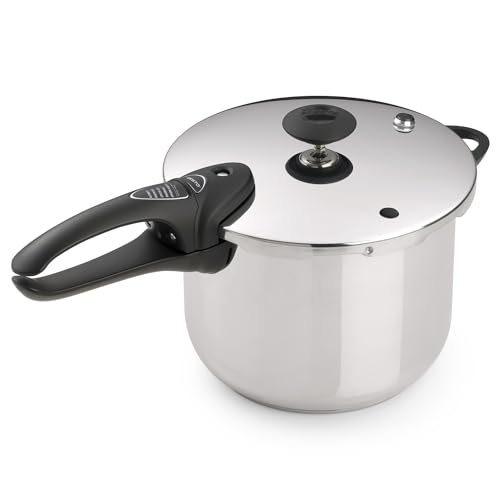
away should make a visibly shorter machine, and it does. A
Presto 01365 6 quart
stainless steel pressure cooker is the same 6 quarts with no base, no element and
no control board, because the heat comes from a burner underneath. Its record notes it
is "fully immersible and dishwasher safe", which it can be precisely because there are
no electronics to protect, and that single property is the tell: everything an
electric cooker puts under the pot is absent.
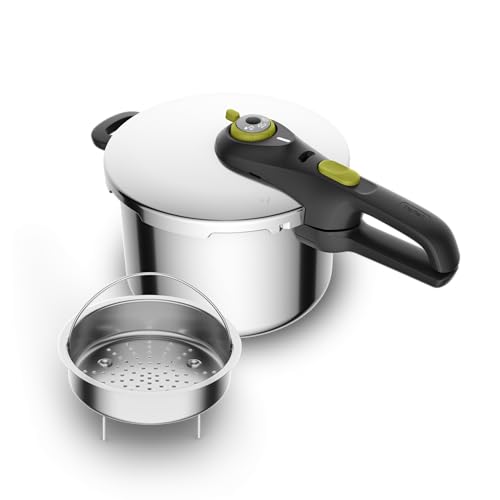
A
T-Fal Secure stainless steel
stovetop pressure cooker is the same idea at 6.3 quarts and adds the detail that
matters for the lid argument: its "rotating open/close mechanism clicks audibly when
locked and sealed". That click is the sound of the mechanism that holds the several
hundred pounds computed above, and on a stovetop pot it is the only pressure bearing
structure in the whole object. Its record also says it works on induction cooktops,
which for a ferrous stainless pot is a consistent claim rather than a surprising
one.
Neither of these can be flat either. The lid force does not care what the heat
source is.
The one number this category does not publish, and it is a length
Everything geometric above is an assumption, and that is a finding rather than an
apology. Not one pressure cooker listing we carry states an external or internal
dimension. Not a diameter, not a height, not a pot depth, not a lid clearance.
A
Ninja HyperHeat 9-in-1
pressure cooker is the most honest record on the shelf about it. Its own text says
to "confirm the dimensions and weight on the listing if counter space is tight". That
is a product record telling you it does not contain the answer, which is a far better
state of affairs than a record that invents one, and it earns the product its place
here. The record does give a 6.5 quart capacity and says the pot fits a 4 pound
chicken or a 5 pound roast, which is a volume described by what goes in it rather than
by a measurement.
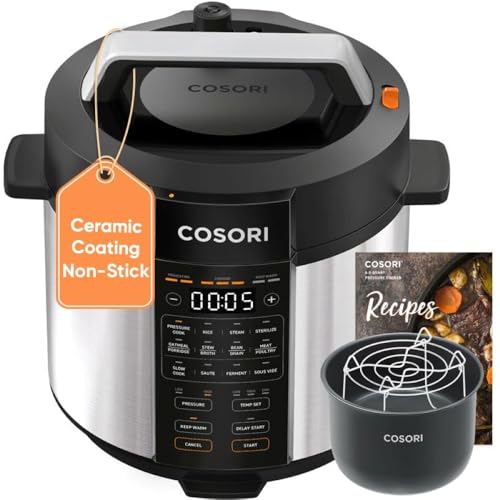
The only linear figure in the entire category belongs to a
Cosori 6QT pressure
cooker, whose record says the "pot gap is widened by 0.5 inches" to make the rim
easier to clean, and the only angle belongs to the same record, whose steam release is
"angled 30 degrees backward". A half inch of rim clearance and a thirty degree vent
are real, specific, useful figures. They are also the whole geometric content of seven
listings. The same record's drawbacks state that there is "No explicit mention of
pressure levels or wattage", which our steam page already credited and which deserves
crediting again, because a record that names its own gap is more use than one that
does not.
Our own electric pressure cooker
roundup inherits the problem rather than causing it. It tells you one model "takes
more counter space" and another has a "small footprint on the counter", both of which
are true and neither of which is a number. Counter space is the one thing a buyer with
a tape measure can check in advance, and it is the one thing the category declines to
state.
A drawback stated against the wrong baseline
One more correction, and it falls out of the base area arithmetic rather than
needing anything new. An
Instant Pot Duo 7-in-1 Mini
electric pressure cooker publishes 700 watts and 3 quarts, and lists among its
drawbacks that "700-watt power may heat slower than higher-watt models".
That is true only if you put the same amount of food in both, and you cannot,
because the small one holds half as much. Run it at a proportionate fill. Our steam
page works out that 1.5 litres of water plus about a kilogram of stainless pot needs
667 kilojoules to reach 117 degrees, which at 1200 watts is 9.3 minutes. Half that
load, 0.75 litres and a half kilogram pot, needs 334 kilojoules, which at 700 watts is
8.0 minutes. The small cooker gets to pressure sooner, not later.
The base flux says the same thing from the other side. At the same three quarter
proportion, a 3 quart pot is 168.9 mm across with a base of 0.0224 square metres, so
700 watts is 31.2 kilowatts per square metre against the larger model's 33.7. The two
appliances run within 8 percent of the same surface intensity. The 700 watt figure is
not a weaker element, it is the same element density scaled to a smaller disc, and the
drawback as written invites exactly the wrong conclusion.
The honest limit, and the number to take to the shop
The soft parts of this page are all geometric and all stated. The three quarter
depth to diameter proportion is representative of cooking pots rather than published
anywhere. The 1 mm wall, the 2 to 3 mm flat lid and the dome radius at 1.41 times the
lid radius are all representative. The 205 megapascal yield for annealed stainless is
a materials figure, not a product figure. And the 11.6 pounds per square inch is taken
from our own steam page's operating band, because the listings do not state it.
What does not move is the shape of the result. The lid force is an exact inverse of
the depth, the base flux is exactly proportional to it, and a flat lid's mass goes as
the depth to the power of minus one and a half. Change every assumption above and
those three relationships are unchanged. Only the absolute newtons and kilowatts
shift.
There is also a ceiling nobody mentions, and it is architectural rather than
mechanical. A standard kitchen leaves about 18 inches between the countertop and the
upper cabinets, and a cooker has to open its lid in that gap. So height is not free
either, which is why these machines come out looking squat and heavy instead of tall
and slim: they are pinned between a lid force that punishes width and a cabinet that
punishes height. That 18 inches is a building convention, not a specification from any
record, so measure your own.
And the practical move, since the category will not tell you: the figure that
decides whether a cooker fits is the height with the lid open, which is the pot depth
plus the dome plus the swing of the hinge. None of our records state it and neither
does the capacity. If a listing gives you only quarts, the useful question to ask a
seller is not how big the pot is. It is how tall the appliance stands with the lid
up.
Why a Pressure Cooker Is Tall and Its Pot Is Not at a glance
Instant Pot Pro 6 Qt 10-in-1 Electric Pressure Cooker
Families and meal preppers who want a versatile, fast cooking appliance.
10 cooking functions in one device 28 one-touch smart programs Cooks up to 70% faster than slow methods 6-quart capacity for up to 6 servings 1200 watts for quick preheating UL and ULC listed for safety
Bulky and heavy, requires ample storage Many programs can be confusing initially Some functions (sterilize, yogurt) may be rarely used Not ideal for small households or singles
Home cooks who want fast, efficient stovetop cooking and don't mind manual control.
Cooks 3-10x faster than traditional methods Includes stainless steel rack and 64-page recipe book Fully immersible and dishwasher safe 12-year limited warranty Stainless steel construction is durable Simple, classic design
Stovetop only, requires manual heat adjustment No digital controls or preset programs May have a learning curve for beginners Takes up stovetop space
Home cooks who want a safe, stovetop pressure cooker for faster meals and meal prep.
Cooks up to 2x faster than conventional methods. 5-point security system with audible lock confirmation. Two simple cooking settings for vegetables and meat. Includes a steam basket for added versatility. Stainless steel construction is durable and induction compatible. 6.3 quart capacity suits family meals and meal prep.
Stovetop use requires monitoring and adjusting heat. Only two cooking programs, less versatility than multi-function electric models. No built-in timer or automatic shutoff. May be heavier and bulkier than some electric models.
Busy families who want quick, versatile meals without multiple appliances.
9-in-1 versatility replaces multiple appliances HyperHeat cooks up to 2x faster than traditional slow cooking 6.5-qt capacity fits a 4-lb chicken or 5-lb roast PFAS-free ceramic nonstick pot for easy cleanup Fast rice and grains: white rice in 8 minutes, quinoa in 5 minutes Space-saving design for everyday meals
Nonstick coating may wear over time Rice and grain times exclude pressure build/release No stainless steel pot option Some functions may require trial and error
Small to medium households wanting a versatile, safe, and easy-to-clean multi-cooker.
13 cooking functions in one appliance Safety-focused design with angled steam release and 12 safety features Ceramic-coated inner pot is non-stick and dishwasher-safe Fingerprint-resistant stainless steel housing Widened pot gap for easier cleaning Includes sous vide and ferment modes, which are uncommon at this level
Ceramic coating is less durable than stainless steel 6-quart capacity may be small for large households No explicit mention of pressure levels or wattage; check listing for details Dishwasher-safe parts may still require hand washing to preserve ceramic coating
Instant Pot Duo 7-in-1 Mini Electric Pressure Cooker
Singles, couples, and small households
Seven cooking functions in one compact unit 11 one-touch smart programs for easy operation Cooks up to 70% faster than slow cooking Stainless steel inner pot with tri-ply bottom for even heating Includes free app with over 1900 recipes UL and ULC listed for safety
3-quart capacity is small for larger meals 700-watt power may heat slower than higher-watt models Slow cooker function is limited by small size No advanced features like Wi-Fi or Bluetooth
Why you can trust this guide
We compared these picks using verified manufacturer specifications, current retailer listings, and patterns in owner feedback, alongside editorial research. We focus on measurable differences such as performance, capacity, usability, and build quality. Pickpedia does not present editorial research as laboratory testing, and we do not claim hands-on testing unless it was actually performed.
Best for Families and meal preppers who want a versatile, fast cooking appliance.
8.8/ 10 Pickpedia editorial score
The Instant Pot Pro 6 Qt is a multi-functional electric pressure cooker with 10 cooking functions and 28 smart programs, making it a strong contender for family meals. It promises faster preheating and cooking compared to slow methods, and its 6-quart capacity suits up to six servings. While it excels in versatility, its size and feature set may be overkill for small households or beginners.
10 Cooking FunctionsPressure cook, slow cook, sous vide, sauté, steriliz
Customizable Smart ProgramTackle every recipe with 28 one-touch options coveri
Good Food Done FasterPreheat 20% faster and cook up to 70% faster compare
Family-Sized CapacityThe 6-quart capacity is perfect for up to 6 servings
Power Packed Performance1200 watts, 120 V 60 Hz, UL & ULC Listed
Pros
10 cooking functions in one device 28 one-touch smart programs Cooks up to 70% faster than slow methods 6-quart capacity for up to 6 servings 1200 watts for quick preheating UL and ULC listed for safety
Cons
Bulky and heavy, requires ample storage Many programs can be confusing initially Some functions (sterilize, yogurt) may be rarely used Not ideal for small households or singles
Best for Home cooks who want fast, efficient stovetop cooking and don't mind manual control.
8.8/ 10 Pickpedia editorial score
The Presto 01365 is a 6-quart stainless steel pressure cooker designed for fast, efficient cooking. It promises meals 3 to 10 times faster than traditional methods, which is a significant time-saver. It comes with a stainless steel rack and a 64-page recipe guide, and it is fully immersible and dishwasher safe for easy cleaning. The 12-year limited warranty offers peace of mind, though it's important to note that this is a stovetop model requiring a compatible burner.
Fast & Efficient CookingCooks 3, 10x faster than traditional methods, saving
Includes Rack & Recipe BooComes with stainless steel rack and 64-page instruct
12-year Limited WarrantyLong-lasting performance backed by extended manufact
Pros
Cooks 3-10x faster than traditional methods Includes stainless steel rack and 64-page recipe book Fully immersible and dishwasher safe 12-year limited warranty Stainless steel construction is durable Simple, classic design
Cons
Stovetop only, requires manual heat adjustment No digital controls or preset programs May have a learning curve for beginners Takes up stovetop space
Best for Home cooks who want a safe, stovetop pressure cooker for faster meals and meal prep.
8.8/ 10 Pickpedia editorial score
The T-Fal Secure 6.3 qt pressure cooker promises faster cooking with a 5-point safety system and simple controls. It includes a steam basket and offers two cooking programs to preserve nutrients and tenderize meat. While it requires stovetop supervision, its robust stainless steel build and induction compatibility make it a versatile kitchen tool.
Dinner In Half The TimeCook up to 2x faster* with our Secure 6.3 quart pres
Designed With Your Safetythe Secure pressure cooker features a 5-point securi
Easy To UseTwo simple cooking settings optimize the cooking tem
Pros
Cooks up to 2x faster than conventional methods. 5-point security system with audible lock confirmation. Two simple cooking settings for vegetables and meat. Includes a steam basket for added versatility. Stainless steel construction is durable and induction compatible. 6.3 quart capacity suits family meals and meal prep.
Cons
Stovetop use requires monitoring and adjusting heat. Only two cooking programs, less versatility than multi-function electric models. No built-in timer or automatic shutoff. May be heavier and bulkier than some electric models.
Best for Busy families who want quick, versatile meals without multiple appliances.
8.8/ 10 Pickpedia editorial score
The Ninja HyperHeat 9-in-1 Pressure Cooker combines multiple cooking functions in one appliance, promising faster cooking times with its HyperHeat technology. It has a 6.5-quart capacity, a PFAS-free ceramic nonstick pot, and can handle everything from pressure cooking to sous vide. While it excels at speed and versatility, its nonstick surface may be a concern for those who prefer stainless steel. It's a solid choice for families needing quick, everyday meals.
All-in-one Electric PressuReplace multiple appliances with one 9-in-1 multi co
Cook Up To 2x Faster*HyperHeat technology builds pressure quickly to spee
Family-sized 6.5 Qt CapaciCook for a crowd with a large-capacity pot that fits
Fast Rice And GrainsMake white rice in as little as 8 minutes or quinoa
Easy Cleanup, Pfas-free NoThe removable ceramic nonstick pot is made 100% PFAS
Pros
9-in-1 versatility replaces multiple appliances HyperHeat cooks up to 2x faster than traditional slow cooking 6.5-qt capacity fits a 4-lb chicken or 5-lb roast PFAS-free ceramic nonstick pot for easy cleanup Fast rice and grains: white rice in 8 minutes, quinoa in 5 minutes Space-saving design for everyday meals
Cons
Nonstick coating may wear over time Rice and grain times exclude pressure build/release No stainless steel pot option Some functions may require trial and error
Best for Small to medium households wanting a versatile, safe, and easy-to-clean multi-cooker.
8.8/ 10 Pickpedia editorial score
The Cosori Pressure Cooker 6QT offers a wide range of cooking functions, from pressure cooking to sous vide, in a single appliance. Its ceramic-coated inner pot and dishwasher-safe parts make cleanup easier, while the angled steam release and 12 safety features aim to reduce risk. However, the 6-quart capacity may not suit larger families, and the ceramic coating requires gentle handling to avoid chipping.
𝗦𝗮𝗳𝗲𝗿 𝗩𝗲𝗻𝘁𝗶𝗻𝗴 𝗗𝗲𝘀𝗶𝗴𝗻The Seal/Vent button away from the steam release val
𝗘𝗮𝘀𝘆 𝗧𝗼 𝗖𝗹𝗲𝗮𝗻Stainless steel, fingerprint-resistant housing, the
𝟭𝟮 𝗦𝗮𝗳𝗲𝘁𝘆 𝗙𝗲𝗮𝘁𝘂𝗿𝗲𝘀The pressure cooker is designed with a double-layer
Pros
13 cooking functions in one appliance Safety-focused design with angled steam release and 12 safety features Ceramic-coated inner pot is non-stick and dishwasher-safe Fingerprint-resistant stainless steel housing Widened pot gap for easier cleaning Includes sous vide and ferment modes, which are uncommon at this level
Cons
Ceramic coating is less durable than stainless steel 6-quart capacity may be small for large households No explicit mention of pressure levels or wattage; check listing for details Dishwasher-safe parts may still require hand washing to preserve ceramic coating
The Instant Pot Duo 7-in-1 Mini is a 3-quart electric pressure cooker that combines seven cooking functions in one appliance. It features 11 one-touch smart programs and a stainless steel inner pot, making it versatile for small households. While it cooks up to 70% faster than slow cooking, its small capacity limits batch cooking. It includes a free app with over 1900 recipes to help you get started.
7 Cooking FunctionsPressure cook, slow cook, sauté, steam, make rice, y
Compact Yet CapableA 3-quart capacity makes it perfect for small househ
Good Food Done FasterCook up to 70% faster compared to slow cooking metho
Pro-Grade Cooking PotCrafted from stainless steel (18/8) with a tri-ply b
Power-Packed Performance700 watts, 120 V 60 Hz, UL & ULC Listed.
Pros
Seven cooking functions in one compact unit 11 one-touch smart programs for easy operation Cooks up to 70% faster than slow cooking Stainless steel inner pot with tri-ply bottom for even heating Includes free app with over 1900 recipes UL and ULC listed for safety
Cons
3-quart capacity is small for larger meals 700-watt power may heat slower than higher-watt models Slow cooker function is limited by small size No advanced features like Wi-Fi or Bluetooth