Home ›
Home & Kitchen › Why One Cleaner Cannot Cut Grease and Dissolve Limescale
Home & Kitchen
Why One Cleaner Cannot Cut Grease and Dissolve Limescale
PBy the Pickpedia Team·4 picks compared·Last verified October 2026
Affiliate disclosure: As an Amazon Associate, Pickpedia earns from qualifying purchases. Links on this page are paid links, and we may earn a commission at no extra cost to you. This never affects our picks or scores.
This page contains affiliate links. If you buy through one we may earn a
commission, at no cost to you.
Neither, and the question only looks answerable because it assumes cleaning is one
job with a difficulty setting. It is at least two jobs, and they need reagents of
opposite sign. Grease is a fat, and an alkali converts it into something that
rinses. Limescale is a carbonate, and only an acid takes it apart. The strongest
alkali in the cupboard will not shift a gram of limescale, and the sharpest acid will
not touch baked on fat. So "stronger" is the wrong axis entirely, and a bottle that
claims both jobs has either picked one and kept quiet, or combined them, in which
case it has neither, because the two reagents destroy each other on contact.
Before anything else: never mix cleaning products. The chemistry below is the
mildest thing that can happen when you do, and it is a complete waste of both. Other
combinations are not mild. Use one product, rinse, then use the other if you need
it.
The grease job, and why alkali is not just a strong cleaner
Cooking grease is mostly triglyceride: a glycerol backbone with three fatty acid
chains hung off it by ester bonds. Those chains are long hydrocarbons, which is
exactly why water will not touch them, and it is why rinsing a greasy pan with hot
water moves the grease around rather than away.
An alkali does something more interesting than dissolving it. The hydroxide ion
attacks each ester bond and cuts it, releasing the glycerol and leaving three fatty
acid chains each carrying a charged carboxylate head. A long tail and a charged head
is the definition of a soap. So the alkali does not wash the grease off. It turns the
grease into the thing that washes, and then that washes itself away. The reaction is
called saponification, and it is the same reaction that makes bar soap out of fat in
a factory.
That gives you a quantity, which is the part no bottle will tell you. The alkali
demand of a fat is published as its saponification value, the milligrams of potassium
hydroxide needed per gram, and common cooking fats sit near 190. Convert to sodium
hydroxide by the ratio of the molar masses, 40.0 over 56.1, and you get about 135
milligrams of sodium hydroxide per gram of fat. So ten grams of baked on grease, which
is a thin film across an oven floor, is a demand for roughly 1.35 grams of alkali.
Not a strength. An amount.
Two consequences follow and both are practical. The reaction is consumed, so a
thin smear of a strong cleaner can run out of alkali before the grease runs out, and
a second application does more than a longer wait. And the rate rises steeply with
temperature, which is the whole reason a warm surface degreases faster than a cold
one, and the reason an oven's own cleaning cycle works with no chemistry at all.
The scale job, and why no alkali will ever do it
Limescale is calcium carbonate, which has left the water and crystallised onto a
surface. It is not stuck on. It is a solid in its own right, and the only way to
remove it chemically is to convert it back into something soluble.
An acid does that in one step. Protons meet the carbonate ion, carbonic acid forms
and immediately falls apart into water and carbon dioxide, the gas leaves, and the
calcium is left dissolved in the water with nothing to pair with. The fizz on a
kettle element is the carbon dioxide. Once the gas has gone, the reaction cannot run
backwards, which is why an acid soak genuinely finishes rather than reaching an
equilibrium.
Alkali cannot do any part of that, and the reason is not that it is too weak. It
is that calcium carbonate is already the product of a base reacting with an acid.
Adding more base gives the carbonate nothing to react with. If anything it pushes the
wrong way, because carbonate is more soluble in acid and less soluble in base, so
alkali makes scale slightly more stable rather than less. The answer to whether
sodium hydroxide removes limescale is no, by the structure of the problem rather than
by degree.
And again the quantity is what matters. Citric acid is triprotic, with a molar
mass of 192.12, and three calcium carbonates at 100.09 each take two of those
molecules. So 384.24 grams of citric acid dissolve 300.27 grams of scale, which is
0.78 grams of scale per gram of acid.
Worked from published molar masses and standard saponification values, with the
descaler dose taken from our own Renuv listing, which states a 2 pound bag and about
25 uses. No listing we carry publishes a concentration or a pH, so the alkali figures
are for sodium hydroxide as a reference base rather than for any particular bottle.
What happens in one bottle, with the exchange rate written out
Now combine them, which is what an honest "all purpose" product would have to do.
Citric acid at 192.12 grams per mole releasing three protons is 15.62 millimoles of
acid per gram. Sodium hydroxide at 40.0 grams per mole is 25 millimoles of base per
gram. So one gram of the base is cancelled by 1.60 grams of the acid, and the
arithmetic runs in both directions at once.
Take a real dose. Our Renuv listing states a 2 pound bag, which is 907 grams, and
about 25 uses, so a dose is about 36 grams. That dose carries 36 times 15.62, which
is 567 millimoles of acid. Enough base to cancel it is 567 millimoles of sodium
hydroxide, which is 22.7 grams. And 22.7 grams of sodium hydroxide, at 135 milligrams
per gram of fat, would have saponified 168 grams of grease.
So pouring the two together destroys the capacity to deal with 168 grams of fat
and 28 grams of scale, and produces water, a salt, and some gas. Nothing is cleaned.
That is the mild outcome, and it is the entire reason no product honestly does both
jobs from one bottle. A product that claims to has usually dropped both reagents and
kept only a surfactant, which lifts loose soil, holds it in suspension and is genuinely
useful, but will not saponify a fat or dissolve a carbonate. "All purpose" most often
means neither purpose, done gently.
A flush our own site reports, with its own stoichiometry
We should correct ourselves before correcting any listing. Our
guide
to keeping a kitchen sink clog free says, in a list of things that help: "Many
people run a periodic flush of baking soda followed by vinegar and then hot water as
a gentle maintenance rinse."
The page is reporting a practice rather than endorsing it, and the sentence sits in
good company, because everything around it is sound: hot water, a plunger, a drain
snake, and taking the trap off, which is the only one of the four that actually
removes anything. But a reader will take it as advice, so here is what it does.
A tablespoon of baking soda is about 18 grams. Sodium bicarbonate is 84.01 grams
per mole, so that is 214 millimoles of base. A cup of ordinary 5 percent vinegar is
about 250 grams, so 12.5 grams of acetic acid at 60.05 grams per mole, which is 208
millimoles of acid, and the reaction is one to one. The two are a matched pair to
within 3 percent. Both reagents are consumed completely. The products are water,
sodium acetate, which is a near neutral salt with no cleaning action, and 214
millimoles of carbon dioxide, which at room temperature is 5.2 litres of gas.
Now the cost, because the fizz looks like work being done. A cup of vinegar used
on its own carries 208 millimoles of acid, and two protons take one calcium
carbonate, so it would have dissolved 104 millimoles of scale, which is 10.4 grams.
Add the baking soda first and it dissolves none. The bubbles are the sound of a
working descaler being switched off. And bicarbonate on its own is a weak base,
nowhere near alkaline enough to saponify a fat, so its real contribution to cleaning
is mechanical, as a mild abrasive. Use one or the other. The combination is the only
version that does nothing.
Reading four of our own listings in this light
Start with the honest one, because it is honest in an unusual way. A
Renuv citric acid cleaner
and descaler publishes a single ingredient, 100 percent food grade citric acid,
in a 2 pound bag with about 25 stated uses and a mix, soak overnight and rinse
method. It is the only cleaning product on this site that tells you what is in it,
and it is also the only one that tells you what it cannot do: its own record lists
as a drawback that it targets mineral scale and not grease, and says plainly that it
is not for cutting grease or biological grime. Those two facts are the same fact. A
product that names its active ingredient has already told you the sign of its
chemistry, and the sign is the limit. Full record in our
Renuv
citric acid descaler review, and the method is in our
guide to
descaling a water distiller, which gets the chemistry right and says so: citric
acid dissolves mineral scale, mixed with water for an overnight soak, where the
extended contact time lets the acid work. Both halves of that sentence are correct
and the second is the one most pages miss.
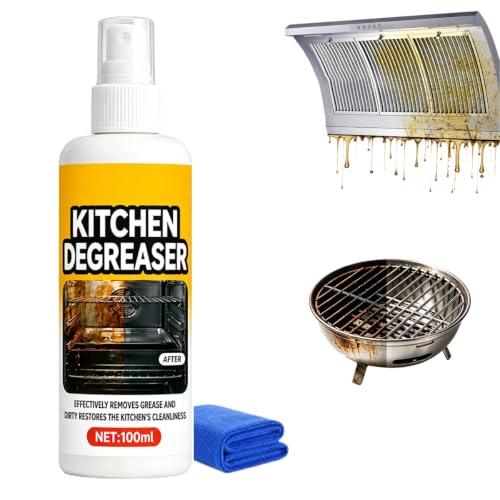
Then the silence. A
heavy duty kitchen degreaser
and grease cleaning spray is sold for exactly the alkaline job, across counters,
stovetops, oven interiors and grill grates, and its record is clear that the facts are
maker stated and that no volume, ingredients or dwell time are listed. So there is no
way to know its alkalinity, which is the only property that decides whether it can do
what its name says. The claim worth correcting is in its own list of advantages: "One
bottle can replace several cleaners." For the grease family that is reasonable, because
an oven, a stovetop and a grill grate all carry the same deposit. Across the two
families it is not available at any strength, because the second family needs the
opposite reagent. Our
kitchen
degreaser review records what is published, and the sequence to use it in is in our
guide to degreasing an
oven, stovetop and grill, which is right about everything it covers, cool, test,
apply, dwell, wipe, rinse, and never names the word alkaline once. That is the gap
this page fills rather than a mistake.
Then the one that claims both. A pack of
dishwasher cleaner and
deodorizer tablets states three actions in one tablet: cleans, descales,
deodorizes. Only one of those three is chemically specific, and descaling requires an
acid, so the honest reading of the tablet is that it is an acid carrier with a
surfactant and a fragrance, and that the deep clean is the surfactant rather than a
degreaser. That is an inference and should be read as one, because the record
publishes no ingredient at all beyond "non toxic, eco friendly", which is not a
chemical statement about anything. To be fair to it, the record is unusually clear
about what the product is for, listing as a drawback that it is a machine cleaner and
not a dish detergent, and that it works best as a monthly habit rather than a one
off. Both are true and both are about the format rather than the chemistry. See our
dishwasher cleaner tablets
review.
And the product that closes the loop, which belongs here for a reason its listing
does not give. A
linseyCove makeup brush
cleaner soap and silicone pad is a solid cleansing soap with a low friction
ridged pad. A solid soap is the output of the reaction at the top of this page: a
fat already saponified in a factory, sold as the finished surfactant. So a degreaser
spray and a bar of soap are two points on the same reaction, one that runs it on your
oven floor and one that ran it before packaging. Which is also why the pad matters as
much as the soap: brush bristles hold pigment and oil in a dense bundle where the
limit is getting the surfactant into contact, not having more of it. The record is
candid that cleaning is hands on rather than automatic, that the soap is a consumable
and that brushes still need flat drying. Details in our
linseyCove
brush cleaner review.
The page of ours that already had this right
One of our guides reached the correct conclusion before we had the vocabulary for
it, and it deserves saying. Our
guide
to cleaning different floor types says that natural stone needs pH neutral,
stone safe products and no acids, and warns that acidic cleaners, including many
vinegar based ones, can etch it.
That is exactly right and it is the same chemistry read in reverse. Marble,
limestone and travertine are calcium carbonate, which is the mineral this page spends
half its length dissolving on purpose. An acid cannot tell the difference between
scale on a tap and the floor the tap is standing over, and the etch mark on a stone
worktop is the descaling reaction working perfectly on the wrong carbonate. So the
hardest case in cleaning is the bathroom, where limescale sits directly on stone, and
there the answer is not a product at all. It is a cloth, water and keeping the
surface dry, because any reagent that would remove the deposit will also remove some
of the floor.
Worth separating this from a neighbouring argument so the two do not blur. Our
piece on
why one detergent sheet
cannot fix hard water is about the opposite tactic on the same mineral:
sequestration, where a builder grabs calcium while it is still dissolved and holds it
in solution so it never deposits and never spends your surfactant. That is prevention
and it happens in the wash water. This page is about demolition, after the mineral
has already crystallised onto a surface. The reagents differ, the reactions differ,
and a sequestrant will not remove scale that has already formed, which is why a
descaler and a water softener are not substitutes for each other.
Problems in our own records
Two worth reporting rather than burying.
The first is category wide. Not one of the 21 cleaning products we publish states
a pH, a concentration, or an active ingredient, with the single exception of the
Renuv bag, whose active ingredient is its entire contents. So for twenty of
twenty one products, the property that decides whether the product can do the job on
its label is absent from the label. That is not a failing of any one listing, and it
is the reason this page had to be worked from molar masses rather than from the
catalogue.
The second is smaller and is about a phrase rather than a fact. "Non toxic" and
"eco friendly" appear on the dishwasher tablets and "biodegradable, non toxic" on the
Renuv bag, and in both cases the record carries them as published claims, which is
correct handling. Worth flagging because those phrases sit where an ingredient should
be, and a reader hunting for the chemistry will read them as if they were it. Citric
acid is genuinely a single named compound and genuinely food grade. The tablets say
nothing comparable.
The honest limit, and the free technique that beats the purchase
The specification that would settle every question on this page is a pH and a
concentration, and the category does not publish either. So you cannot compare two
degreasers on the axis that matters, and you cannot tell whether a descaler contains
enough acid for the scale you have. What you can do is read the name as a declaration
of sign, treat anything that claims both jobs as claiming neither, and stop buying a
third product to do the two jobs the first two already cover.
Then two techniques that cost nothing, one for each job, and both follow directly
from the arithmetic.
For grease: heat and time, in that order. Saponification is a chemical reaction,
so its rate rises steeply with temperature, and a warm surface will degrease in
minutes what a cold one takes an hour to do. Which means the free move is to work on
a surface that is warm rather than cold, and the second free move is to apply twice
rather than to wait longer, because the alkali is consumed stoichiometrically and a
film that has run out of it will not do any more work no matter how long it sits.
For scale: quantity beats strength, and this is the genuinely non obvious one. The
amount of carbonate an acid removes is set by the total protons you supply, not by
how aggressive the acid is. A weak acid and a strong one at the same molar
concentration dissolve the same mass of scale; the strong one simply gets there
faster. So a long soak in plenty of a mild acid removes more scale than a short wipe
with a fierce one, and the thing to increase is the volume and the contact time, not
the ferocity. Which is why our distiller guide's overnight soak is the right
technique and why a spray is the wrong format for scale: a spray cannot hold enough
acid against the surface for long enough, a point we take apart separately in the
rheology of a cleaner that will not stay on a wall. And it is why the single most
effective anti scale measure in a kitchen is drying surfaces after use, which supplies
no reagent at all and prevents the deposit from forming.
Why One Cleaner Cannot Cut Grease and Dissolve Limescale at a glance
linseyCove Makeup Brush Cleaner Soap and Silicone Pad
Deep-cleaning makeup brushes at home
Deep-cleans caked makeup brushes
Solid soap is a consumable you replace
Why you can trust this guide
We compared these picks using verified manufacturer specifications, current retailer listings, and patterns in owner feedback, alongside editorial research. We focus on measurable differences such as performance, capacity, usability, and build quality. Pickpedia does not present editorial research as laboratory testing, and we do not claim hands-on testing unless it was actually performed.
Best for routine distiller and appliance descaling
8.6/ 10 Pickpedia editorial score
Renuv is a 2 lb bulk bag of 100 percent food-grade citric acid powder for cleaning and descaling water distillers. The maker says it removes limescale, mineral deposits, and hard water buildup to restore performance. You mix it with water, let it sit overnight, then rinse. Biodegradable and non-toxic, it also handles kettles, humidifiers, coffee makers, and more, with about 25 uses per bag.
Best for spray-and-wipe grease cleanup on cooking surfaces
8.2/ 10 Pickpedia editorial score
This heavy duty kitchen degreaser spray targets grease across cooking areas. Use it on counters, stovetops, oven interiors, and grill grates, then wipe or rinse as needed. The maker states it helps lift grease with less rubbing on ovens, stoves, grills, trays, and racks. Positioned for both indoor and outdoor cooking cleanup, it fits a spray-and-wipe routine before and after busy cooking sessions.
Best for Keeping a dishwasher clean, descaled and fresh
9.0/ 10 Pickpedia editorial score
A one-year supply of drop-and-go dishwasher cleaning tablets that descale, tackle musty odours and deep clean into hidden corners, with a non-toxic, eco-friendly formula.
A makeup brush cleaning set pairing a solid cleansing soap with a low-friction textured silicone pad that lifts out old makeup and oil from brushes while keeping the bristles soft.
BrandlinseyCove
TypeMakeup brush cleaning soap and pad
IncludesSolid cleansing soap and silicone cleaning pad