PBy the Pickpedia Team·8 picks compared·Last verified October 2026
Affiliate disclosure: As an Amazon Associate, Pickpedia earns from qualifying purchases. Links on this page are paid links, and we may earn a commission at no extra cost to you. This never affects our picks or scores.
This page contains affiliate links. If you buy through one we may earn a
commission, at no cost to you.
It is normal, and the scratches are not wear. They are the record of the one thing
a cutting board is for. Elm is soft, so it gives way early and visibly, and every
groove in it is a contact your edge did not have to absorb.
The useful version of that is arithmetic rather than reassurance, because hardness
is not a score. It is a pressure: the pressure at which a material stops resisting an
indenter and starts flowing under it. So when a steel edge meets a board, the two
hardnesses are two pressures, and the ratio between them is the ratio in which they
share the contact. Elm gives way about 165 times more readily than the steel in a
good kitchen knife. That is why you can see it.
Put every board material on one scale
Hardness scales do not convert cleanly into each other, which is why this is worth
doing carefully. Our own page on why
you cannot drill out a broken tap already establishes the right move and this page
will borrow it rather than re-argue it: work in Vickers, where the number is linear in
indentation pressure, and multiply by 9.807 to get megapascals.
Do that to everything a kitchen board is made of and the spread is four decades
wide. American elm comes out near 42 megapascals. High density polyethylene is 64.
Hard maple is 74. Flat laminated bamboo is about 78, and strand woven bamboo roughly
doubles that to 152. Compressed wood fibre composite is near 294. Commercially pure
titanium is 1,422. Cold rolled 304 stainless sheet is about 1,765. Tempered soda lime
glass is 5,394.
And the edge. A
three piece plastic, bamboo
and stainless steel cutting board set is the most useful single listing in this
whole argument, because it puts three rungs of that ladder in one box and publishes
the thickness of each: the bamboo board at 15 by 10.2 by 0.82 inches, the stainless at
13.4 by 9 by 0.32, the plastic at 12 by 7.2 by 0.32. Its own drawbacks say the "steel
surface can be harder on knife edges", which is the belief this page is going to test,
and it is the only listing we carry that lets you test it without changing brands.
A sharpened edge is a wedge, and a wedge sinks until it fits
Here is the mechanism, and it needs one equation. An edge is a wedge of some half
angle. When it lands on a board it penetrates until the width it has opened up,
multiplied by the length in contact, multiplied by the board's indentation pressure,
equals the force you are pushing with. So the depth is the force divided by twice the
pressure times the contact length times the tangent of the half angle.
Take a firm push of 50 newtons, about 11 pounds, with 50 millimetres of edge
touching down, at the 15 degree half angle one of our knives publishes. The depths
follow directly. On elm the edge sinks 44.3 micrometres. On hard maple, 25.4. On
polyethylene, 29.3. On flat bamboo, 23.8, and on strand woven bamboo 12.3. On
composite fibre, 6.35. On titanium, 1.31. On 304 steel, 1.06.
Now the part that matters, and it is about the tip rather than the wedge. A freshly
sharpened kitchen edge has an apex radius of roughly half a micrometre. Compare that
with the depths above. On elm the apex ends up buried 89 of its own radii below the
surface, which means it is not carrying the load at all: the flanks of the wedge are,
spread over 44 micrometres of contact. On titanium it is buried 2.6 radii. On steel,
2.1.
That is the whole protection mechanism, stated as a number. A soft board does not
cushion the edge in any springy sense. It swallows the apex so that something other
than the apex takes the force.
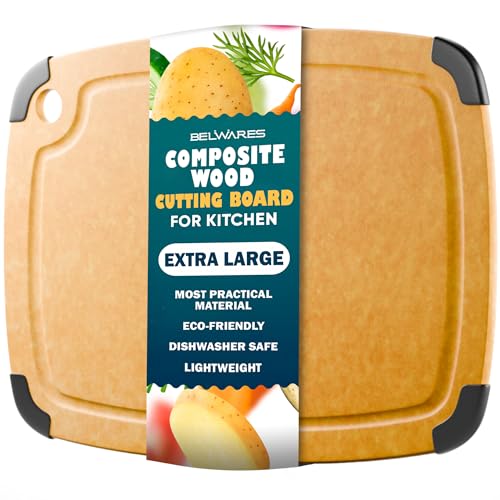
An
extra large 18 by 12 inch
composite wood cutting board with a juice groove sits in the interesting middle of
that range. Compressed wood fibre is roughly four times harder than the hardwood it
imitates, so it records a 3.4 micrometre groove where a maple board records 13.6 and
an elm board records 23.7. Its record is candid that "composite fiber behaves
differently from solid hardwood, and knife feel is a matter of taste", and the
arithmetic says what that difference is: it is four times less willing to take its
share. Its drawbacks also note there is "no listed weight or thickness figure", which
matters here only because thickness is the one board property that has nothing to do
with the edge.
Hardness is defined as the pressure a material resists indentation at, so converting
every figure to megapascals makes the ladder directly comparable and makes the ratio
between two rungs the ratio in which they share a contact. The edge figure is the 60
to 61 Rockwell C one of our own santoku listings publishes, converted to Vickers and
then to megapascals. Every board figure is a materials reference rather than a product
figure, because not one board listing we carry publishes a hardness: the wood values
come from Brinell tests scaled by Janka ratings, the titanium is commercially pure
grade 2, the steel is cold rolled 304 sheet, and the silica is the middle of the Mohs
5.5 to 6.5 band our juicer auger page establishes. The 50 newton push, the 50
millimetres of edge in contact and the half micrometre apex radius are all
representative. The 15 degree half angle is published, by the knife. Change any input
and the depths move together while every ratio on the ladder stays exactly where it is.
The thesis I started with was wrong, and the metal boards are the reason
I expected this page to end up as a case against metal boards. It does not, and the
arithmetic is not close.
The rule the broken tap page sets out is that a cutting tool needs around one and a
half times the hardness of what it is cutting, in Vickers. Turn it round and it
becomes a rule about boards: an edge is safe indenting anything at least 1.5 times
softer than itself. The edge in question is 6,963 megapascals, so the threshold sits
at 4,642.
Titanium at 1,422 is 4.90 times softer than the edge. Cold rolled 304 at 1,765 is
3.94 times softer. Both clear the threshold comfortably. Tempered glass at 5,394 does
not clear it at all: the edge is only 1.29 times harder, which puts the two materials
inside each other's margin, and that is the one genuine failure in the category.
So titanium is the softest metal anyone makes a board out of, and it is softer than
the stainless it is usually lumped with. A
large double sided 100 percent
pure titanium cutting board states exactly that, and it is the only comparative
hardness claim in the whole category: its record says the surface is "said to maintain
blade sharpness longer than stainless steel and reduce dulling". That claim is
correct. Pure titanium runs near 145 Vickers against roughly 180 for 304 sheet, so it
is about 20 percent softer, and it will take about 24 percent more penetration per
contact. The record also says fine scratches are normal and cosmetic rather than
flaking, and the arithmetic agrees for a different reason than the one given: the
groove is 0.70 micrometres wide, which is right at the limit of what scatters visible
light, so you are looking at the shallowest mark that can be seen at all.
The record that needs correcting is the one that argues with itself. A
Homaider pure titanium double
sided cutting board lists among its strengths a "knife-friendly surface per maker"
and then, among its drawbacks, that "metal feels harder than wood", with its own
performance text adding that titanium "is hard, which can be less forgiving on knife
edges". Both halves cannot be right, and the arithmetic says the strength is the true
one. Titanium is the gentlest metal on this ladder by a clear margin. What the
drawbacks are actually describing is stiffness and sound, not hardness, and those are
real: this board publishes 0.06 inches of thickness, which is 1.52 millimetres of
metal, so it rings and it does not feel like a block. Hardness and feel are different
properties and the listing has merged them.
Glass is the one that fails, and it fails by leaving no mark
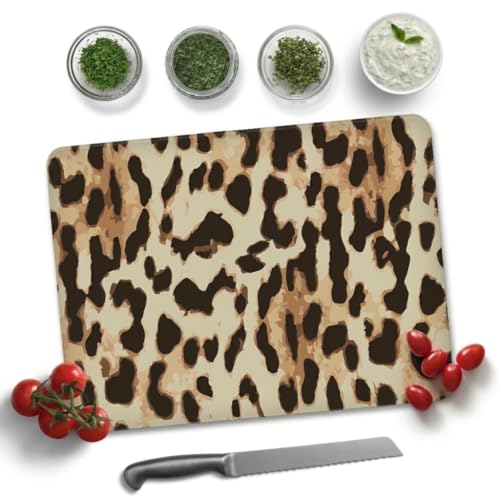
A
leopard tempered glass cutting
board, 16 by 12 inches is the honest end of this. Its own record says the surface
is "more scratch resistant than plastic, per the maker" and, two lines later, that
"hard glass can dull knives faster". Both are true and they are the same sentence said
twice, because scratch resistance and edge wear are the same transaction seen from
opposite sides.
Work the depth for glass and you get 0.35 micrometres, which is less than one apex
radius, so the tip never gets buried. Except the figure is worse than that, because
glass does not do what the equation assumes. Metals and woods flow plastically under
an indenter, which is what makes the calculation meaningful. Tempered glass does not
flow. It holds elastically and then cracks. So there is no groove to form and no share
for the board to take, and the full 50 newtons stays on the apex.
What happens next is that the apex itself yields, because it is the only thing in
the contact that can. Press 50 newtons through 50 millimetres of edge and the steel
stops flowing once the contact has flattened to 0.144 micrometres wide, which is 29
percent of a fresh apex radius. That is a single full force contact.
And here is where this page stops, deliberately. I am not going to turn that into a
blunting rate, because the honest version needs the force of every individual contact
and no listing publishes any of it. A chopping stroke, a slicing stroke and a scrape
are three different forces and they differ by more than an order of magnitude, so a
strokes to dull figure derived from one of them would be fiction. The thing you can
measure is on the board: elm records 23.7 micrometres, titanium records 0.70, glass
records nothing. The mark is the measurement, and no mark is not the board winning.
The most honest record in the category is a steel one
A
RIZIZMVG oversized 304
stainless steel cutting board says the thing outright instead of hedging:
"chopping directly on it dulls your knife edges noticeably faster. That is the nature
of any metal board, not a flaw here." It then recommends the correct remedy, which is
to use it as "a baking and pastry surface, for raw-meat hygiene, and as a counter
protector" and keep something softer for knife work.
That is right, and the arithmetic adds one thing to it. Steel at 3.94 times softer
than the edge is not in the glass regime. It is in the regime where the board takes
its share, just a quarter as much of it as composite fibre does and a twenty fourth as
much as maple. It is a board you can cut on and a board that will cost you sharpenings,
and those are compatible statements.
The record also publishes a real figure almost nothing else here does: a 14 gauge
core, which is about 1.9 millimetres of stainless, against the "flimsy 18 or 20-gauge
sheets that warp, dent and ring". That is a stiffness and ringing figure rather than a
hardness one, and it is the correct answer to the complaint the titanium listing
mislabelled as hardness.
Bamboo, where our own page has the right answer and the wrong reason
Our page on why kitchen
knives get dull so quickly gets the practical advice entirely right, and the four
habits it names, cut on wood or soft plastic, hone regularly, hand wash and dry, store
so the edge touches nothing hard, are the four that matter. Two of its explanations
need correcting, and both corrections come out of the ladder above.
The first: it says "Glass, granite, marble, and ceramic are harder than steel".
Tempered glass is not. At 550 Vickers against 710 for a 60 HRC edge it is about 23
percent softer. The conclusion that glass wrecks edges is correct, but the reason is
not that glass outranks the steel. It is that glass is close enough to be inside the
1.5 times margin and, unlike every other board, will not deform at all.
The second: it says "Bamboo is popular but noticeably harder and more abrasive than
most wood, so it dulls knives faster than a soft maple or walnut board." Harder is the
wrong word and abrasive is the right one, and they are separate mechanisms. Flat
laminated bamboo sits at roughly 78 megapascals against hard maple's 74, which is a
five percent difference and not worth a sentence. What bamboo actually has is opaline
silica grown inside the plant, and our page on
why a juicer auger shows wear
after one use already puts the number on it: Mohs 5.5 to 6.5. Converted, that is
roughly 600 to 1,100 Vickers, which brackets the edge and in its upper half exceeds
it. The ratio at the middle of that band is 0.835, meaning the grain is harder than
the steel and abrades it rather than the reverse. So bamboo is not a hard board. It is
a soft board with hard particles in it, and the particles are the only thing on this
entire page that beats a knife outright.
Which makes a
small glue free bamboo cutting
board, 14 by 10 inches and 0.8 inches thick an interesting test case rather than a
contradiction. Its record claims a "pre-oiled surface resists knife marks" and that it
"helps protect blade sharpness during use", and on bulk hardness it is right: the
board is maple's equal and will swallow an apex 47 radii deep. The oiling claim is
also doing something real, because a filled surface keeps grain exposure down. The
listing and our own page are each half right, and the half each gets wrong is the
other one's half.
What the knife brings to it, and why the geometry pulls the other way
Every figure above used an edge at 6,963 megapascals and a 15 degree half angle,
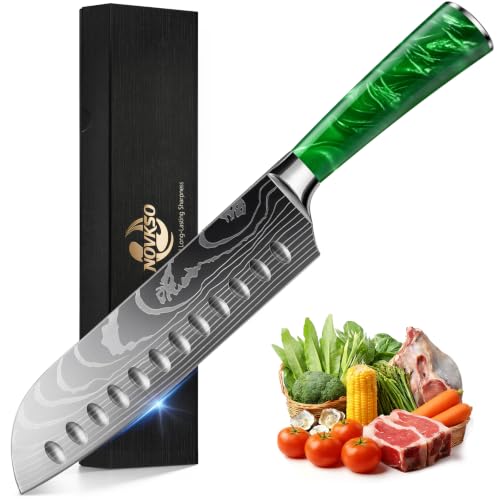
and both of those come from a product rather than from me. A
NOVKSO 7 inch santoku in high
carbon steel publishes "HRC 60 to 61" and "a hand-polished 15-degree edge per
side" on a 2 millimetre blade, which is two of the three numbers this page needs and
more than most knives state.
The angle has a consequence that runs opposite to the one you would expect, and it
is worth spelling out because our own page on
why a knife edge fails on
geometry, not hardness establishes the other direction so firmly. That page shows
apex strength goes as the square of the tangent of the half angle, so going from 20
degrees to 15 costs 45.8 percent of the edge's capacity. True, and this page takes it
rather than re-deriving it.
But penetration depth goes as one over the tangent of the same angle. So the same
move from 20 degrees to 15 makes the edge sink 1.358 times deeper into any board that
will yield, which buries the apex 36 percent further and hands 36 percent more of the
contact to the wedge flanks. A more acute edge is weaker and better protected at the
same time, and which of the two dominates is decided entirely by the board. On elm,
where the apex is already 89 radii down, the protection is total and the acute edge is
free. On glass, where it is 0.7 radii down, the protection is nil and the acute edge
pays the full 45.8 percent penalty with nothing to show for it. That is the real
argument for matching an acute knife to a soft board, and it is stronger than the
usual version.
Our comparison of
wood, plastic
and stainless steel boards sets the three materials out properly in words and this
page is the arithmetic underneath it. One thing to add to it: polyethylene at 64
megapascals comes out softer than hard maple at 74, so on indentation alone plastic
protects an edge slightly better than maple does, by about 15 percent of penetration
depth. It loses on other grounds, and a plastic board's grooves hold what they catch
in a way wood's do not, which is a hygiene argument rather than an edge one.
The honest limit, and what to do about the elm
The soft inputs here are all about contact and all stated. The 50 newton push is
representative of a firm chop and nothing publishes it. The 50 millimetres of edge in
contact is representative. The half micrometre apex radius is a materials figure for a
freshly sharpened kitchen edge, and a dull one is four to ten times that, which
changes the burial counts and not the depths. Every board hardness is a materials
reference rather than a product figure, because not one board listing we carry
publishes a hardness, and the wood values in particular are Brinell numbers scaled by
Janka ratings, which is a reasonable conversion and not an exact one. The wedge model
also ignores everything about the bevel above the apex, and real edges are not perfect
wedges.
What survives all of that is the ladder. The depths are all proportional to the
same force and the same contact length, so every ratio between two of them is
unchanged by any of those assumptions. Elm will always take about 1.74 times the
penetration of hard maple, because that is the Janka ratio. Titanium will always take
about 24 percent more than 304, because that is the Vickers ratio. And tempered glass
will always sit inside the 1.5 times margin, because 5,394 and 6,963 are what they
are.
So: the elm board is working. If the scratching bothers you aesthetically, sand and
re-oil it, which is a thing you can do to elm precisely because it is soft. If it
bothers you because you think it signals damage, it does not, and the board that would
have reassured you by staying unmarked is the one that would have been quietly
spending your edge instead. The only change worth making is the one nobody sells: put
the soft board under the knife and the hard board under the pastry, the hot pot and
the raw meat, and let each surface take the job it is physically suited to.
Why a Cutting Board Is Supposed to Scratch at a glance
We compared these picks using verified manufacturer specifications, current retailer listings, and patterns in owner feedback, alongside editorial research. We focus on measurable differences such as performance, capacity, usability, and build quality. Pickpedia does not present editorial research as laboratory testing, and we do not claim hands-on testing unless it was actually performed.
This three-piece cutting board set pairs plastic, bamboo, and stainless steel boards with a storage holder. Each material suits different tasks, helping separate meat, fruit, and vegetables. The plastic board has a juice groove, bamboo resists nicks, and 304 stainless steel stays hygienic. All are dishwasher safe. Listed sizes range from 12 to 15 inches for flexible daily prep.
Set3 boards plus holder
Bamboo board15 x 10.2 x 0.82 in
Stainless board13.4 x 9 x 0.32 in
Plastic board12 x 7.2 x 0.32 in
Steel grade304 stainless steel
Plastic featureDeep juice groove
CleaningDishwasher safe
StorageIncluded holder
Pros
Three materials separate meat, produce, and serving
Plastic board juice groove keeps counters clean
Bamboo surface resists nicks and gouges
304 stainless steel wipes clean and resists stains
Best for Home cooks wanting a large, easy-clean prep board
8.6/ 10 Pickpedia editorial score
This composite wood cutting board gives you an 18 by 12 inch surface for carving, slicing, and serving. Made from high density compressed wood fiber, it resists warping while staying thin and light. A deep juice groove catches liquid, non-slip rubber feet add stability, and the non-porous surface is dishwasher safe. It suits daily cooks who want hardwood strength with easier cleanup.
Surface size18 x 12 inches
MaterialHigh density composite wood fiber
Juice grooveDeep integrated channel
FeetNon-slip rubber
SurfaceNon-porous, moisture resistant
CareDishwasher safe
ProfileThin and lightweight
StorageDrawer, cabinet, or hang
Pros
Large 18 x 12 inch prep surface
Deep juice groove captures liquids
Non-slip feet improve stability
Non-porous, dishwasher-safe cleanup
Slim profile stores and hangs easily
Composite fiber resists warping, per maker
Cons
Durability claims are maker-stated, not lab-tested
Best for cooks wanting a large, low-maintenance hygienic board
8.4/ 10 Pickpedia editorial score
This is a large titanium cutting board built from 100% pure titanium with no chemical coatings, aimed at cooks who want a hygienic, low-maintenance surface. The maker states it resists odors, rust, warping, and mold, and stays gentle on knife edges. A double-sided layout keeps produce and meat apart. It is dishwasher safe for quick, residue-free cleaning.
Homaider's cutting board is made from pure titanium, marketed as non-toxic, BPA-free, and microplastic-free. The non-porous surface rinses clean, resists odors, and is dishwasher safe. A double-sided layout separates raw meat from produce to reduce cross-contamination. It measures 13.4 by 9.0 inches at 0.06 inch thick, giving more prep room and stability than many standard plastic or wooden boards.
This is a large tempered glass cutting board measuring 16 by 12 inches, with a decorative leopard print. It suits cooks who want a non-porous surface that doubles as a serving board. The maker states it will not absorb odors or stains, resists heat, and stays put on rubber feet. It wipes clean fast and is described as scratch resistant versus plastic.
MaterialTempered glass
Size16 by 12 inches (about 40 by 30 cm)
DesignLeopard print, decorative
FeetNon-slip rubber
SurfaceNon-porous, stain resistant
HeatHeat resistant
Pros
Large 16 by 12 inch non-porous surface
Doubles as a stylish serving board
Non-slip rubber feet keep it steady
Heat resistant and can guard countertops
Wipes clean and resists odors and stains
More scratch resistant than plastic, per the maker
Best for Baking, pastry, raw-meat hygiene and counter protection
9.0/ 10 Pickpedia editorial score
An oversized food-grade 304 stainless steel cutting board with a heavy 14-gauge core, a naturally cool non-stick surface for baking, a 1-inch anti-slip lip and included silicone mat, rounded safe corners and a non-porous sanitary surface, available in multiple sizes.
BrandRIZIZMVG
TypeStainless steel cutting and pastry board
MaterialFood-grade 304 stainless steel
ThicknessHeavy-duty 14-gauge core
Sizes11.8x15.7 up to 19.6x31.5 inches
Stability1-inch folded anti-slip lip plus silicone mat
DesignDouble-sided, rounded R-corners
HygieneNon-porous, non-toxic, easy clean
ColourSilver
Pros
Heavy 14-gauge 304 steel, will not warp
Naturally cool surface, superb for baking
Most sanitary, non-porous surface for raw meat
Anti-slip lip and silicone mat included
Safe rounded corners, doubles as a heat shield
Essentially lifetime durable
Cons
Dulls knife edges faster than wood or plastic
Heavy and, in big sizes, large to store
Best paired with a softer board for daily chopping
Best for compact prep in small kitchens and travel
8.6/ 10 Pickpedia editorial score
This small bamboo cutting board uses a glue-free construction that relies on bamboo's natural strength. Measuring 14 by 10 inches and 0.8 inches thick, it suits quick prep, small kitchens, RVs, dorms, and picnics. Made from organic moso bamboo and pre-oiled, its smooth surface protects blade sharpness. The maker states a dishwasher-safe upgrade after internal field testing.
Best for precise slicing of meat, vegetables and fruit
8.6/ 10 Pickpedia editorial score
This is a 7-inch Japanese-style Santoku knife from NOVKSO, forged from high-carbon stainless steel at HRC 60 to 61. Its 2mm blade carries a hand-polished 15-degree edge per side and a hollow oval groove that keeps food from sticking. A patterned resin handle is balanced, non-slip and moisture-proof. It arrives in a matte black gift box. Good for home and light commercial prep.