Home ›
Juicers › Why a Juicer Auger Shows Wear After One Use
Juicers
Why a Juicer Auger Shows Wear After One Use
PBy the Pickpedia Team·6 picks compared·Last verified October 2026
Affiliate disclosure: As an Amazon Associate, Pickpedia earns from qualifying purchases. Links on this page are paid links, and we may earn a commission at no extra cost to you. This never affects our picks or scores.
This page contains affiliate links. If you buy through one we may earn a
commission, at no cost to you.
The question has the wrong units in it, and fixing them answers most of it. "One
use" sounds like a single event. For an auger it is about a hundred metres of sliding
contact under roughly seven hundred and fifty newtons of drag, and the right way to
think about a juicing screw is in metres rather than in sessions.
What that still does not tell you is whether the mark you are looking at matters,
and the honest reason is that the one quantity needed to work it out spans three orders
of magnitude and nothing on any listing narrows it. So the second half of this page
turns the question round and uses your observation as the measurement.
How far the auger actually travels
A cold press auger is a tapering screw turning inside a stationary screen, with the
pulp squeezed in the gap. The flight tip is the fastest moving part, and its distance
per revolution is simply its circumference.
Take a 65 millimetre outer diameter, which is representative of the class and is not
published by anybody. The circumference is 0.2042 metres. A
Nama J3 compact cold press
juicer publishes a 130 watt motor running at 50 revolutions a minute, which puts the
flight tip at 10.21 metres a minute. Ten minutes of juicing is 102 metres.
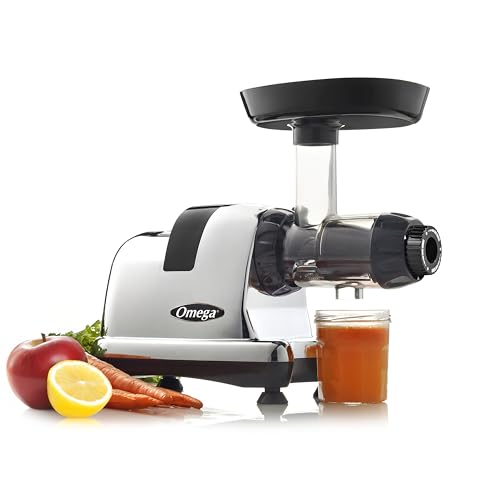
An Omega cold press juicer
machine publishes 80 revolutions a minute, which is 16.34 metres a minute, so 163
metres in the same ten minutes. Juice daily and the yearly figures are 37.3 and 59.6
kilometres.
That is what "one use" means in the units the wear process cares about. Nobody looks
at a shoe sole after a hundred metres and calls it one use.
And how hard it is pressing while it does that
The force comes free from the published figures, because torque is power divided by
angular speed. At 50 revolutions a minute the shaft turns at 5.236 radians a second, so
the Nama's 130 watts is 24.83 newton metres. At 80 revolutions a minute the Omega's 200
watts is 23.87.
Those are nearly the same number, and that is the first useful finding. The wattage
spread across cold press juicers is a speed choice, not a strength difference. Our own
roundup of masticating juicers already says
the right thing in words, that "torque, not raw wattage, decides how well the auger
pushes through fibrous greens and hard roots". This is that sentence with numbers in
it.
Which makes one drawback on our own shelf questionable. A
Ninja NeverClog cold press
juicer publishes a "150-watt high-torque motor" and lists among its drawbacks that
the "150-watt motor may be underpowered for tough produce". Its record never publishes a
speed, which is the other half of the torque, so the drawback is an inference from half
the equation. Run the numbers across the plausible band: 150 watts at 50 revolutions a
minute is 28.65 newton metres and at 70 revolutions a minute it is 20.46. Both published
machines sit inside that. On the evidence available, the 150 watt motor is not weaker,
and the figure that would settle it is the one the record leaves out.
Divide 24 newton metres by a 32.5 millimetre radius and the tangential force at the
flight tip is about 750 newtons. A worm or planetary reduction returns perhaps 60 to 80
percent of the motor's torque, so call the real figure 450 to 600 newtons. Either way it
is of the order of a hundred pounds of drag, continuously, for a hundred metres.
The rotation speeds, wattages and the 12,000 to 18,000 revolutions a minute centrifugal
range are figures our own juicer listings publish. The 65 millimetre auger diameter, the
70 millimetre basket diameter, the 800 square millimetre contact band and the 180
megapascal polymer hardness are all representative: not one juicer listing we carry
states an auger material, an auger diameter or a pressure. The torque figures assume a
lossless gearbox, so they are ceilings, and a real worm or planetary reduction returns 60
to 80 percent of them. The log scale on the second panel is there because the two designs
differ by more than two orders of magnitude and a linear axis would hide the auger
entirely. The speed independence of sliding distance per litre, the 258 to 388 ratio and
the thousandfold spread in the third panel are all ratios and survive every assumption
above.
The result that needs no assumptions at all
Here is the one piece of this that no missing specification can spoil, and it is
counterintuitive enough that the three lines of algebra earn their keep.
Sliding distance is the tip speed times the time. Tip speed is proportional to the
rotation rate. Throughput is also proportional to the rotation rate, because each
revolution of a screw moves a fixed volume forward, so the time to produce a litre is
inversely proportional to the rotation rate. Multiply those two and the rotation rate
cancels.
So the sliding distance per litre of juice is the auger circumference divided by its
displacement per revolution, and it does not depend on the speed. A 50 revolution per
minute juicer and an 80 revolution per minute juicer of the same geometry put the same
number of metres on the auger for every litre they make. The slow one is gentler per
minute and identical per litre, which are different claims and only one of them is the
one you care about.
The quantity that does change wear per litre is the geometry, and that points at a
feature nobody frames as a trade. A
Brecious slow masticating
juicer publishes an "upgraded 7-stage auger" and a claimed 90 percent yield. More
compression stages means the pulp is worked more times on its way through, which is
exactly how you get the extra yield and exactly how you get more sliding per litre. Its
record also publishes a reverse function to clear clogs, and reversing changes the
direction of the rubbing without subtracting any of it: a clearing cycle adds distance,
it does not refund it. None of which is a criticism of the machine, and all of which is
absent from the listing as a consideration either way. Its own drawbacks are honest
about a different gap, that there are "No speed settings specified", and the design_build
notes the auger does the work in place of blades: "No sharp blades appear; the auger
crushes produce instead".
The spinning kind travels twenty six kilometres
For scale, do the same sum on a centrifugal juicer, where the pulp is pressed against
a spinning mesh basket rather than squeezed by a screw.
A Mueller Ultra Power
juicer publishes speeds in the 12,000 to 18,000 revolutions a minute range. At a
representative 70 millimetre basket, the circumference is 0.21991 metres, so 12,000
revolutions a minute is 43.98 metres a second and 18,000 is 65.97. Over the same ten
minute session that is 26.4 and 39.6 kilometres: between 258 and 388 times the distance
the auger covered.
That is not a verdict against the design, and it would be lazy to read it as one. The
basket is steel, not polymer, and the pulp is held against it by centrifugal force at a
small fraction of the pressure a screw develops, so load and hardness both move the other
way. The honest reading is that the two architectures do not differ in how gently they
treat their parts. They differ in which part is sacrificial and what it is made of. On an
auger machine it is a polymer screw. On a basket machine it is a steel mesh, and a
Hamilton Beach centrifugal
juicer machine at 800 watts puts a great deal more energy through that mesh than a
130 watt screw puts through its auger. Both of our own centrifugal listings flag
"Plastic construction" among their drawbacks, which is about the housing rather than
about the working surface, and the working surface is the one this arithmetic is
about.
Two records that do not survive a check
While working through the torque, two published claims fell over, and both are worth
flagging precisely because this page depends on figures from the same records.
The Mueller's two speed settings are not overlapping, they are inverted. Its record
states the high speed as 12,000 to 15,000 revolutions a minute and the low speed as
15,000 to 18,000. The low range lies entirely above the high range except at the single
point where they touch. The record notices that something is wrong and describes it as
an overlap, saying "the real difference may be minimal", which is generous: as printed,
selecting low selects the faster setting. Credit for catching it; the description
understates it.
The Omega's performance text says it has "A 200-watt motor with gear reduction
equivalent to a 2HP motor". Two horsepower is 1,492 watts. Gearing multiplies torque and
divides speed; it cannot multiply power, so as a statement about power the claim is out
by a factor of 7.5. Read charitably as a torque comparison it is arguable, because 200
watts delivered at 80 revolutions a minute is 23.87 newton metres while an ungeared two
horsepower motor at a typical 3,450 revolutions a minute delivers only 4.13, so the
geared machine is 5.8 times stronger at the shaft. But that is a comparison between two
different shaft speeds, which is the whole trick, and the sentence as written invites a
reader to think the machine has two horsepower in it. The same record's drawbacks say
the "200-watt motor may be less powerful than expected", which is the honest counterpoint
sitting four lines below the claim.
What cannot be computed, and why that is the real answer
Abrasive wear follows Archard's relation: the volume lost is a wear coefficient times
the load times the sliding distance, divided by the hardness of the softer surface.
Three of those four are now in hand. Load about 750 newtons, distance 102 metres, and a
high performance polymer has an indentation hardness in the region of 180
megapascals.
The wear coefficient is the problem. For polymers against a mild abrasive it runs
anywhere from about one ten millionth to one ten thousandth depending on the counterface,
the abrasive and the presence of water. Put the three ends of that range through the
equation, over a contact band taken as 800 square millimetres:
At one ten millionth, the loss is 0.0425 cubic millimetres a session, which is 0.053
of a micron of depth. You would never see it and the part would outlive the motor. At one
hundred thousandth it is 4.25 cubic millimetres and 5.3 microns, which would consume a
one millimetre land in 189 sessions. At one ten thousandth it is 42.5 cubic millimetres
and 53 microns, and the land is gone in nineteen.
Nineteen sessions or forever, from the same equation. And nothing published narrows
it: no juicer listing in our catalogue states the auger polymer, its diameter, the width
of the land that contacts the screen, or the compression pressure. Anyone who answers
this question with a number has either measured your machine or guessed.
So invert it. The observation is the measurement. If you can see a wear band after a
single session, the depth is of the order of microns, which puts the coefficient at the
middle of that range and gives the part a few hundred sessions. If you cannot see
anything, it is at the low end and the part has thousands. Six months of daily juicing
or five years, and the mark on the auger tonight is the only instrument you have.
And the most likely reading of what the question describes is not wear at all. A
moulded polymer part leaves the tool with a fine surface texture, and the first time it
runs under load the high spots of that texture are flattened. That is running in, it
costs a micron or two of asperity height rather than any real thickness, it looks exactly
like a polished band because that is what it is, and it stops almost immediately. A part
that looks burnished after one use and the same after twenty is behaving correctly. A
part that keeps changing is the one to watch.
The abrasive is in the produce, which decides which juices matter
What does the abrading is not the pulp's fibre but the silica in it. Plants deposit
solid opaline silica inside their tissue, and it survives into the juicer unchanged.
Grasses carry the most, somewhere in the range of one to three percent of dry mass, while
roots and stalks carry a small fraction of that.
Opaline silica sits around 5.5 to 6.5 on the Mohs scale, which is tens of times
harder than any polymer, and our page on
why you cannot drill out a broken
tap already works through properly what a hardness ratio like that means for a
cutting or rubbing contact. The practical consequence is narrow and useful: the produce
that wears an auger fastest is the grassy, high silica material, which is precisely what
the category is marketed on. Our guides to
juicers for leafy greens and
juicers for celery are both about the hardest
duty these machines see, and celery, being a stalk rather than a grass, is a milder diet
for the auger than wheatgrass is.
The honest limit, and the thing to ask a seller
Everything geometric and material here is representative and stated as such: the 65
millimetre auger, the 70 millimetre basket, the 800 square millimetre contact band and
the 180 megapascal hardness. The torque figures assume a lossless gearbox and are
therefore ceilings. The silica content of produce varies by more than a factor of ten
between species and even between growing conditions.
The ratios survive all of it. Sliding distance per litre is speed independent; the
centrifugal basket covers two and a half orders of magnitude more distance; and the depth
per session spans a thousandfold because the wear coefficient does.
One tension to end on, because it is the only thing in these records that bears
directly on the question. The Nama publishes a fifteen year warranty, which its record
calls durability backing. A fifteen year warranty on a machine with a polymer sacrificial
surface is either a strong statement that the wear is genuinely at the slow end of the
range above, or a warranty that excludes the wear parts. The record does not say which,
and that is the single sentence that would answer the original question outright. If you
are choosing between two of these machines, the useful thing to establish is not the
wattage, the stage count or the revolutions a minute. It is whether the auger is a
warranted part or a consumable, and whether a replacement is available on its own.
Why a Juicer Auger Shows Wear After One Use at a glance
Nama J3 - Compact cold press juicer - Hands-free - Black
Small kitchens, travelers, and busy individuals who want hands-free juicing.
Hands-free self-feeding hopper saves time Compact and portable design fits small spaces Quiet operation at 50 RPM 15-year warranty for peace of mind Includes essential accessories (containers, strainers, brush, recipe book) Easy cleanup with quick-release parts
Compact capacity may require multiple batches for large recipes 130 W motor may not handle very hard produce as efficiently as higher wattage models No explicit pulp control settings (only strainers provided) Travel-ready but may still be bulky for carry-on luggage
Slow 80 RPM preserves nutrients Adjustable end cap with 3 pressure settings Automatic pulp ejection for continuous juicing High torque equivalent to 2HP motor Extra-large feed tray Built-in handle for portability
200-watt motor may be less powerful than expected Accessories for nut butter, pasta, sorbets not confirmed Chrome finish may show fingerprints No exact juice yield or pulp dryness specs
Individuals or small households wanting a compact, low-speed juicer with customizable pulp.
Two interchangeable pulp filters for texture control Simple one-touch programs with reverse function Low-speed cold press extraction minimizes foam Includes 24 oz juice jug and 36 oz pulp container Comes with Inspiration Guide with 15 recipes Compact design suitable for small kitchens
Short cord length (31.5 inches) 150-watt motor may be underpowered for tough produce 24 oz juice jug may be small for large batches Plastic components may not be as durable as metal
Families and health-conscious users who value quiet operation and safety.
Quiet motor under 60 dB Cold press technology preserves nutrients Up to 90% juice yield Reverse function clears clogs BPA-free materials No sharp blades for safety
Small feed chute requires more prep Actual yield may vary by produce Cleaning multiple parts can be time-consuming No speed settings specified (only 2 speed modes mentioned in title, but not detailed in specs)
Quick juicing of whole fruits and vegetables with minimal prep.
3-inch wide feed chute reduces prep time Dual speeds for different food textures Large 34 oz juice jug and 68 oz pulp container Overload protection auto shut-off for safety Locking arm keeps lid secure Includes helpful equivalents chart
Plastic construction may not be as durable Centrifugal juicers can be noisy Cleanup may require hand washing (not specified) Speed ranges overlap, so settings may not be distinct
Busy individuals who want to juice whole fruits and vegetables quickly without pre-cutting.
Extra-large 3-inch chute fits whole produce, saving prep time 800-watt motor for efficient juicing 80-ounce pulp bin reduces emptying frequency Dishwasher-safe removable parts for easy cleanup 3-year limited warranty from a trusted brand America's #1 juice extractor brand claim adds confidence
Centrifugal juicers can be noisy and produce foam May not extract as much juice from leafy greens Plastic construction may feel less durable Large footprint may take up counter space (size not specified)
Why you can trust this guide
We compared these picks using verified manufacturer specifications, current retailer listings, and patterns in owner feedback, alongside editorial research. We focus on measurable differences such as performance, capacity, usability, and build quality. Pickpedia does not present editorial research as laboratory testing, and we do not claim hands-on testing unless it was actually performed.
Best for Small kitchens, travelers, and busy individuals who want hands-free juicing.
8.8/ 10 Pickpedia editorial score
The Nama J3 is a compact masticating juicer designed for smaller kitchens and travel. Its self-feeding hopper allows you to load all your produce at once and walk away, saving time. With a 130 W motor and 50 RPM operation, it runs quietly and efficiently. It includes essential accessories and a 15-year warranty, but its compact size may limit batch juicing.
Compact & PortableThe Nama J3 is a perfect compact juicing machine for
Save TimeSay goodbye to adding your produce one by one. The s
Durable & Efficient DesignPowered by a 130 W motor, this masticating juicer ma
Easy Cleanup & AssemblyOur juice extractor machine simplifies your routine
Pros
Hands-free self-feeding hopper saves time Compact and portable design fits small spaces Quiet operation at 50 RPM 15-year warranty for peace of mind Includes essential accessories (containers, strainers, brush, recipe book) Easy cleanup with quick-release parts
Cons
Compact capacity may require multiple batches for large recipes 130 W motor may not handle very hard produce as efficiently as higher wattage models No explicit pulp control settings (only strainers provided) Travel-ready but may still be bulky for carry-on luggage
Best for Nutrient-focused juicing with tough ingredients
8.8/ 10 Pickpedia editorial score
The Omega Cold Press Juicer Machine is a slow masticating juicer that operates at 80 RPM to minimize heat and oxidation, preserving nutrients. It features an adjustable end cap with three pressure settings for maximum juice extraction, and an automatic pulp ejection for continuous juicing. The motor is rated at 200 watts but is described as having a gear reduction equivalent to a 2HP motor, providing high torque. It also comes with an extra-large feed tray and a built-in handle for convenience. However, the specifications do not include details on included accessories like nut butter or pasta screens, so verify those separately.
Cold Press Slow JuicerThis juice maker machine operates at a slow 80 RPMs
Adjustable End CapFeatures 3 pressure settings designed to ensure maxi
Easy To UseEquipped with a powerful but quiet gear reduction eq
Pros
Slow 80 RPM preserves nutrients Adjustable end cap with 3 pressure settings Automatic pulp ejection for continuous juicing High torque equivalent to 2HP motor Extra-large feed tray Built-in handle for portability
Cons
200-watt motor may be less powerful than expected Accessories for nut butter, pasta, sorbets not confirmed Chrome finish may show fingerprints No exact juice yield or pulp dryness specs
Best for Individuals or small households wanting a compact, low-speed juicer with customizable pulp.
8.8/ 10 Pickpedia editorial score
The Ninja NeverClog Cold Press Juicer is a 150-watt masticating juicer designed for high-yield extraction with minimal foam and clogging. It includes two pulp filters for texture control, a 24 oz juice jug, and a 36 oz pulp container. Its simple one-touch programs make it easy to use, though the motor is modest and the cord is short. Ideal for those who want fresh juice with customizable pulp.
Customize & Control PulpIncludes 2 interchangeable pulp filters so you can c
Simple One-touch ProgramsEasy operation with 2 convenient programs: Start/Sto
Power150-watt high-torque motor rotates the auger at low
What's Included150-watt motor base with auger, (2) interchangeable
Pros
Two interchangeable pulp filters for texture control Simple one-touch programs with reverse function Low-speed cold press extraction minimizes foam Includes 24 oz juice jug and 36 oz pulp container Comes with Inspiration Guide with 15 recipes Compact design suitable for small kitchens
Cons
Short cord length (31.5 inches) 150-watt motor may be underpowered for tough produce 24 oz juice jug may be small for large batches Plastic components may not be as durable as metal
Best for Families and health-conscious users who value quiet operation and safety.
8.8/ 10 Pickpedia editorial score
The Brecious Slow Masticating Juicer is a cold press juicer designed to extract up to 90% juice yield while preserving nutrients. It features a quiet motor (under 60 dB), a triple-layer filter for smooth juice, and a reverse function to clear clogs. The BPA-free construction and small feed chute make it a safe choice for families.
Powerful & Quiet MotorEquipped with a high-performance motor that operates
3-Section Super Filter & RThe triple-layer filtration system ensures silky-smo
Safe & Family-Friendly DesMade from 100% BPA-free materials with no sharp blad
Pros
Quiet motor under 60 dB Cold press technology preserves nutrients Up to 90% juice yield Reverse function clears clogs BPA-free materials No sharp blades for safety
Cons
Small feed chute requires more prep Actual yield may vary by produce Cleaning multiple parts can be time-consuming No speed settings specified (only 2 speed modes mentioned in title, but not detailed in specs)
Best for Quick juicing of whole fruits and vegetables with minimal prep.
8.8/ 10 Pickpedia editorial score
The Mueller Ultra Power Juicer is a centrifugal juicer that promises quick juicing with a wide 3-inch feed chute and dual speed settings. It includes a 34 oz juice jug and a 68 oz pulp container, plus safety features like overload protection and a locking arm. While it handles whole fruits and vegetables efficiently, its plastic build and higher noise levels may not suit everyone. This review is based solely on the provided specifications.
FeatureDUAL SPEEDS , Live a healthier lifestyle by consumin
Feature3" WIDE FEED CHUTE & SAFETY , Use the convenient pus
FeatureJUICE & PULP SEPARATED , Includes a 34 oz (1 liter)
Pros
3-inch wide feed chute reduces prep time Dual speeds for different food textures Large 34 oz juice jug and 68 oz pulp container Overload protection auto shut-off for safety Locking arm keeps lid secure Includes helpful equivalents chart
Cons
Plastic construction may not be as durable Centrifugal juicers can be noisy Cleanup may require hand washing (not specified) Speed ranges overlap, so settings may not be distinct
Best for Busy individuals who want to juice whole fruits and vegetables quickly without pre-cutting.
8.8/ 10 Pickpedia editorial score
The Hamilton Beach Centrifugal Juicer Machine with a 3-inch feed chute is designed to save prep time by letting you juice whole fruits and vegetables. With 800 watts of power and a large 80-ounce pulp bin, it aims to handle both hard and soft produce efficiently. While it offers convenience and a solid warranty, its centrifugal design and plastic construction may not suit every user's needs.
America's #1 Juice ExtractThis durable juicer is backed by a 3-year limited wa
Compare And Choose With CoCompare the competition to our extra-large 3" chute
Save Time And Effort WithSince the centrifugal juicer chute fits a whole appl
Maximum Juice Yield From HThis electric juicer has a 800 watt rated power moto
Pros
Extra-large 3-inch chute fits whole produce, saving prep time 800-watt motor for efficient juicing 80-ounce pulp bin reduces emptying frequency Dishwasher-safe removable parts for easy cleanup 3-year limited warranty from a trusted brand America's #1 juice extractor brand claim adds confidence
Cons
Centrifugal juicers can be noisy and produce foam May not extract as much juice from leafy greens Plastic construction may feel less durable Large footprint may take up counter space (size not specified)