PBy the Pickpedia Team·7 picks compared·Last verified October 2026
Affiliate disclosure: As an Amazon Associate, Pickpedia earns from qualifying purchases. Links on this page are paid links, and we may earn a commission at no extra cost to you. This never affects our picks or scores.
This page contains affiliate links. If you buy through one we may earn a
commission, at no cost to you.
Not with any bit sold for the job, and the obstacle is a single number you can
read off our own listings. A hand tap is hardened to 62 to 65 on the Rockwell C
scale. The left hand drill bits in the extractor sets people reach for publish 63 on
that same scale. A cutting tool needs to be meaningfully harder than the thing it
cuts, and at 63 against 63 the margin is zero.
So the question splits in two. Removing it is an abrasive problem rather than a
cutting one, or a chemical one where hardness never appears at all. And the reason it
broke is unrelated to any of that: it is a cube law, and at small sizes the force that
snaps a tap is under a fifth of a kilogram at each handle.
The hardness ladder, from figures our own records publish
Rockwell C numbers are convenient but they are not proportional, so the comparison
has to be done in Vickers, where the scale is linear in indentation hardness. The
standard conversion puts 62 HRC at 746 HV, 63 at 772, 65 at 832 and 67 at 900. Mild
steel, the stuff most people are tapping into, is around 130 HV.
Our page on knife
steel and hardness explains the scale correctly and gives the anchor worth
holding on to: kitchen knives run 50 to 62 HRC, and the hardest knife steel in our
catalogue is listed at 57 to 58. A broken tap is harder than every knife on this
site, which is the first clue that the usual toolkit is out of its depth.
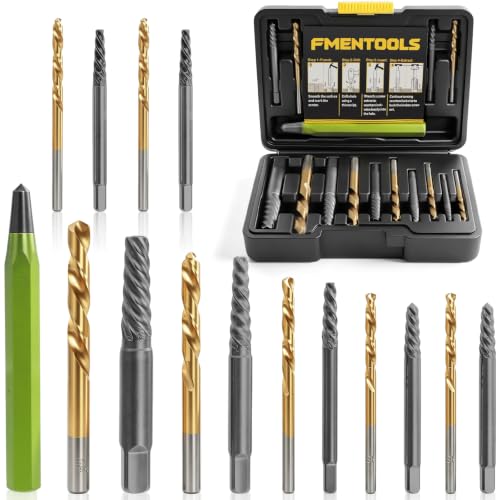
Now the tools, in the order people try them. A
15 piece stripped screw
extractor set with left hand bits is the standard answer, and its record is
unusually forthcoming about the one figure that settles this: seven "6542 HSS
left-hand drill bits" with "hardness up to 63 HRC". 6542 is the designation for an
ordinary molybdenum high speed steel, and 63 HRC is 772 HV. The tap is 772 HV. The
hardness ratio is 1.00.
A ratio of 1.00 does not mean it cuts slowly. It means the edge yields at the same
load as the material it is pressed into, so the bit rounds over, polishes the tap,
work hardens the surface it failed to cut, and then snaps off inside the hole on top
of the tap, which is a strictly worse problem than the one you started with. The
working minimum for a cutting tool is around 1.5 times the workpiece in Vickers, and
the handbook version of the same statement is that anything above 45 HRC wants carbide
or ceramic.
Where our own guide gets the test wrong
We have a page on this and its advice is right for screws and wrong for taps, in a
way that is worth quoting exactly because the error is in the kind of test it
proposes. Our
guide to removing
a stripped or broken screw says: "Standard extractor bits handle carbon steel,
cast iron, copper, and aluminum. Very hard alloys and 440-series stainless resist
them, so identify the fastener before you commit."
Identify the fastener is good advice. Identifying it by alloy family is the wrong
test, and a tap is the case that proves it. A hand tap is carbon steel or high speed
steel by composition, which puts it squarely on the handled list. What makes it
uncuttable is not its composition but its heat treatment: it has been quenched and
tempered to 62 to 65 HRC because a thread cutting edge has to hold its geometry.
Hardened 440C stainless, the material that page names as the hard case, is around 620
HV. The tap is 772, a quarter harder again than the example given as the limit.
So the test that works is hardness, not alloy. The same page's advice to drill
counterclockwise and run slow is correct and useful, and the bits it proposes are the
right bits for a snapped mild steel screw, where the ratio is 772 over 130 and nothing
about this page applies.
The obvious upgrade, which also fails
If plain high speed steel will not do it, cobalt is the next shelf up. A
19 piece M35 cobalt stepped
point drill bit set publishes an M35 grade, which carries about 5 percent cobalt
and reaches 65 to 67 HRC, so call it 870 HV. Against the tap that is a ratio of 1.13.
It is a real improvement and it is still well short of 1.5. In practice you get a
little further into the job before the same failure.
That record also contains a defect that matters more here than it would anywhere
else, and to its credit it reports the defect itself. Its own drawbacks note that the
"Listing mixes M35 and M2 grade references". Those are not neighbouring grades for
this purpose. M2 lands at roughly 63 HRC, which is a ratio of 1.00 and hopeless, while
M35 lands at 65 to 67, which is 1.13 and merely insufficient. The listing cannot tell
you which hardness turned up in the box, and on this job that ambiguity spans the
whole difference between failing immediately and failing shortly afterwards.
Hardness figures are Vickers conversions of the Rockwell C values our own listings
publish, using the standard conversion table: 62 HRC is 746 HV, 63 is 772, 65 is 832
and 67 is 900. Mild steel, hardened 440C, carbide, aluminium oxide and diamond are
handbook values for the materials rather than product claims. Breaking torque is the
torsional strength times pi times the cube of the core diameter over sixteen, taking
the core at 0.57 of nominal for a four flute hand tap and 1,200 megapascals for
hardened high speed steel in torsion. That strength figure is the one real assumption
here and it is representative rather than published, so read the ratios between the
bars rather than their absolute values.
What actually gets through it
Three materials clear the line, and each one has a different reason it may still
not help you.
Tungsten carbide is the first. An
11 piece carbide masonry
drill bit set publishes YG6X carbide, which runs around 1,600 HV for a ratio of
2.07, comfortably over the threshold. The problem is the shape rather than the
material. These are brazed spear tips ground with a blunt, negative rake to crush
brittle mineral, not to shear metal, and the record is honest about where that leaves
them: "Not suitable for hard tile" and "Needs water cooling during use". Carbide is
also brittle, and a broken tap sitting in a hole is a geometry that side loads
whatever you put against it. The right carbide tool for this is a solid burr in a die
grinder, and that is a shape our catalogue does not carry. We have the correct
material in the wrong form.
Diamond is the second, and it is the one genuinely interesting exclusion on the
chart. A 24 piece diamond
drill bit set for glass carries diamond grit at something like 9,000 HV, a ratio
of 11.7, which makes it eleven times harder than its problem and completely useless
against it. Carbon dissolves into hot iron. Above roughly 700 degrees Celsius, which
dry grinding reaches in the contact patch without trying, the diamond grit simply
diffuses into the steel and disappears. The wear is chemical, not mechanical, and no
amount of hardness touches it. Notice what that listing does and does not claim: sea
glass, shells, gemstones, ceramic and stone, with no mention of steel anywhere, and a
drawback that says "Hard material grinds slowly". That omission is correct and it
deserves the credit. The hardest abrasive on this site is the one material on the
chart that cannot be used.
Which leaves conventional abrasive, and it works. Aluminium oxide sits around 2,050
HV for a ratio of 2.66, it is bonded into a wheel rather than brazed to a tip so a
fractured grain exposes a fresh one, and a
4-1/2 inch 9 amp angle
grinder spinning a disc to 11,800 RPM will grind a hardened tap away without
complaint. Its own record is appropriately blunt that it is "a genuinely dangerous
tool that demands respect and safe technique", and our
guide
to using an angle grinder safely covers the handling.
The catch is geometric and it is absolute. A grinder can only reach a tap that
stands proud of the surface. If the break is flush or below flush, which is the common
case because the tap usually snaps where the torque is highest and that is at the
workpiece face, then the one tool whose hardness is sufficient is the one tool that
physically cannot get to the work. Everything that fits down the hole is too soft, and
everything hard enough is too big.
The method where hardness does not appear at all
So stop fighting on that axis. If the tap is steel and the part it is stuck in is
aluminium, the long standing shop answer is alum: potassium aluminium sulfate, the
same compound sold for pickling, dissolved to saturation in water held near boiling.
The solution is acidic and attacks iron and steel while leaving aluminium largely
alone, because aluminium is protected by its own oxide and because the solution is
already saturated with aluminium ions. The tap turns to sludge over hours to days and
you rinse it out.
That approach is worth understanding as a category rather than a trick. Hardness
is a mechanical property and it has no bearing on a chemical reaction rate, so by
switching the mechanism you have deleted the entire obstacle rather than overpowering
it. It also needs no tool at all, which is why it survives in machine shops that own
every tool.
Its limits are real and worth stating plainly. It does nothing useful on a
stainless tap, whose chromium oxide layer resists it. It will attack a steel or cast
iron workpiece as readily as the tap, so it is only viable when the part is aluminium
or brass. It is slow and the rate is unpredictable. And it wants a hot solution and
ventilation, so it is a bench job rather than a kitchen one.
Why it broke, which is a cube law
None of the above explains the actual event, and the explanation is worth having
because it is the only part of this you can prevent. A tap fails in torsion, and
torsional capacity depends on the polar section modulus, which is pi times the cube of
the core diameter divided by sixteen. The core at the flutes is roughly 0.57 of the
nominal size on a four flute hand tap, so the torque a tap survives scales with the
cube of its diameter.
Taking 1,200 megapascals as the torsional strength of hardened high speed steel,
that gives 0.175 newton metres for a 1/16 inch tap, 1.16 for an M3, 2.87 for an M4,
5.45 for an M5, 9.26 for an M6, and 302 for a 3/4 inch tap.
Look at the span. A 4 piece
adjustable tap wrench set publishes a range of "1/16 inch up to 3/4 inch", which
is a size ratio of 12 and therefore a torque ratio of 12 cubed, exactly 1,728. One
set of four handles covers a range over which the number you must not exceed changes
by a factor of seventeen hundred, and the set publishes no torque figure anywhere,
for any of the four. Nor does any other tap or tap wrench listing we carry.
Then convert the small end into something a hand can feel. A T bar wrench applies
torque as two equal forces at the handle radius, so on a 100 mm span the 0.175 newton
metres that breaks a 1/16 inch tap is 1.75 newtons at each hand. Under a fifth of a
kilogram. Nobody can meter that, nobody can sense the approach of it, and the dual
handle design that the record correctly praises for clamping "taps firmly" is the
thing that makes the limit invisible, because a symmetric grip feels controlled right
up to the moment the tap is in two pieces.
At the other end an M10 tap wants about 44 newton metres, which is a genuine heave,
and that is why large taps rarely break and small ones break constantly. The ceiling
falls as the cube of the size. The handle gets shorter roughly in proportion to the
first power. And the strength of a hand does not change at all.
What pushes the torque over the edge
One more piece of arithmetic, because it names the moment of failure. A tap has to
store its own chips. Cutting an M6 by 1 thread through 12 mm of plate removes an
annulus of pi over four times 36 minus 25 square millimetres, which is 8.64 square
millimetres of section, or 103.7 cubic millimetres of metal over that depth. A four
flute M6 tap offers perhaps 6 square millimetres of flute cross section in total,
which over the same 12 mm is around 72 cubic millimetres of space. Swarf is loose and
bulks up at least twofold against solid metal.
So the flutes are something like three times over capacity before the thread is
finished. Once they pack, the chips are no longer being carried out, they are being
compressed between the tap and the thread it just cut, and the torque climbs steeply
for no change in cutting. That is the spike that finds the cube law. Backing off every
half turn is not superstition, it is the only way to empty a container that was
never large enough, and the flute cross section is an estimate because no tap listing
publishes one.
The prevention is already in the catalogue, sold for something else
Put the two sets of numbers side by side and one tool in our catalogue turns out to
be the right instrument for a job it is not advertised for. A
90 piece master torque
screwdriver set publishes a 1/4 inch driver with a "10 to 70 in-lb range in 0.5
in-lb steps" and an audible click at the preset. Convert that: 10 in-lb is 1.13 newton
metres and 70 in-lb is 7.91, in steps of 0.057.
Against the ladder above, the mapping is exact. At its full scale of 7.91 newton
metres it is below the 9.26 that breaks an M6, so on an M6 tap the tool is physically
incapable of breaking it no matter how you lean on it. Set to 20 in-lb, which is 2.26
newton metres, it sits at 79 percent of an M4's limit. Set to 40 in-lb it protects an
M5. Below M3 it cannot help at all, because its minimum setting of 1.13 newton metres
is already 97 percent of the 1.16 that destroys an M3, and the whole 1/16 inch end of
the range is two orders of magnitude below anything it can read.
The listing's own stated uses are "gunsmithing, scope mounting, and bicycle repair",
and tapping is not among them. Its drawbacks say it is "Overkill for casual assembly
tasks", which is true of assembly and the opposite of true here.
The honest limit
The weak number on this page is the torsional strength of the tap. 1,200
megapascals is a representative figure for hardened high speed steel in torsion and no
tap listing publishes a strength, a hardness, a core diameter or a torque rating, so
every value in the lower panel of the figure rests on it. Scale it up or down and all
six bars move together, which is why the ratios between them, and the 1,728 across one
wrench set, are the trustworthy part.
The hardness side is firmer, because the 63 HRC that makes the whole argument is
printed in our own extractor listing rather than assumed, and a ratio of 1.00 does not
need precision to be conclusive.
And the technique that beats every purchase on this page needs nothing: tap the
hole with the tap held in a drill chuck or a tapping block so it starts square, then
use a tap one size up in two stages on anything below M4, and back off half a turn
every half turn. Alignment and chip clearance are free, they address the two causes
above directly, and they are the only part of this problem that is still open once the
tap is already broken off below the surface.
We compared these picks using verified manufacturer specifications, current retailer listings, and patterns in owner feedback, alongside editorial research. We focus on measurable differences such as performance, capacity, usability, and build quality. Pickpedia does not present editorial research as laboratory testing, and we do not claim hands-on testing unless it was actually performed.
Best for removing stripped or broken everyday fasteners
8.4/ 10 Pickpedia editorial score
This 15-piece kit targets stripped, broken, and damaged screws, studs, and bolts that a screwdriver can no longer grip. It pairs seven 6542 HSS left-hand drill bits with seven spiral-flute extractors, plus one center punch. The maker cites hardness up to 63 HRC and 35# CR-MO steel extractors. Coverage spans roughly M3 to M18. It is built for automotive, maintenance, and heavier DIY removal jobs.
Best for self-centering starts in metal and acrylic
8.2/ 10 Pickpedia editorial score
KAKILFOB's 19-piece set brings stepped point drill bits with a storage case for drilling acrylic, steel, brass, and other hardened metals. The stepped design is described as four times sharper, cutting faster with less heat. A 135 degree split point self-centers and starts with less pressure, while the twist flutes lift shavings clear. A blue Onyx oxide coating helps prevent chip build-up.
This 11-piece carbide masonry set covers five sizes from 5mm to 12mm for tile, brick, glass, ceramic and thin metal. Each bit uses YG6X carbide with a reinforced head and a ground spear tip that reduces skating. A 1/4-inch hex shank locks into most quick-change chucks. The maker warns against hard tile and advises keeping bits cool with water.
Best for beginners and volume makers drilling sea glass
8.4/ 10 Pickpedia editorial score
This is a 24-piece diamond drill bit kit for glass and stone, bundled with four brass collets so bits fit a rotary tool right away. Sizes span 1mm, 1.5mm, 2mm, and 2.5mm, the most-used jewelry range. Each 1/8 inch shank works with Dremel tools and flex shafts. Diamond-coated tips grind sea glass, shells, gemstones, ceramic, and stone.
Best for Versatile cutting, grinding and polishing for DIYers and tradespeople
9.0/ 10 Pickpedia editorial score
A 4-1/2 inch corded angle grinder with a 9-amp, 1100-watt motor at up to 11,800 RPM, a compact 3.5-pound slim body, spindle lock and lock-on switch, a two-position side handle, two adjustable safety guards, reinforced gears with dustproof and brush cut-off protection, and a six-piece set of grinding, cutting and flap discs, for cutting, grinding and polishing metal, tile and wood.
BrandDCK
Type4-1/2 in corded angle grinder
Motor9 amp, 1100 W
SpeedUp to 11,800 RPM
Weight3.5 lbs, slim body
Safety2 adjustable guards, brush cut-off
Spindle7/8 in arbor, 5/8 in 11 thread
Included6 discs + handle, wrench, brushes
Pros
Powerful 9-amp, 1100-watt motor at up to 11,800 RPM
Compact 3.5-pound slim body is easier to control
Spindle lock and lock-on switch for quick, convenient use
Comes with grinding, cutting and flap discs for versatility
Two adjustable safety guards plus durability protections
Generous accessory set to start a range of jobs
Cons
A genuinely dangerous tool that demands respect and safe technique
Guards and proper protective equipment are essential every time
Corded, so you manage a cable and need mains power
A versatile general-purpose grinder, not a specialized industrial machine
Best for Hand threading across a range of tap sizes
8.2/ 10 Pickpedia editorial score
The Olutacot 4 Piece Adjustable Tap Wrench Set gives hand-threaders a graduated range of holders for tap sizes from 1/16 inch up to 3/4 inch. Each wrench pairs a rigid and adjustable handle to clamp tools firmly. Black oxide coating resists rust, while hardened carbon steel sliding blocks add strength. Plastic dipped handles keep grip secure around fluid and moisture.
Best for repeatable spec torque on scopes and bikes
8.8/ 10 Pickpedia editorial score
The YIYEIE set centers on a 1/4-inch torque screwdriver with a 10 to 70 in-lb range in 0.5 in-lb steps. A click signals when you hit the preset value, preventing overtorque. The 90-piece kit adds 84 S2 steel bits, an extension, adapter, T-bar ratchet, magnetic collector, and case. It suits gunsmithing, scope mounting, and bicycle repair.