PBy the Pickpedia Team·6 picks compared·Last verified October 2026
Affiliate disclosure: As an Amazon Associate, Pickpedia earns from qualifying purchases. Links on this page are paid links, and we may earn a commission at no extra cost to you. This never affects our picks or scores.
This page contains affiliate links. If you buy through one we may earn a
commission, at no cost to you.
Yes, but not in the way the question means, and the distinction is the whole answer.
Two different things get called sharpness. One is the radius of the very tip, which
decides how little force it takes to start a cut. The other is the angle between the
bevels, which decides how much sideways load the tip can survive. They are set
independently, they are not traded against each other, and only the second one has a
penalty.
That penalty is a square law, and it is large enough to settle an argument. Going from
20 degrees per side to 15 removes 45.8 percent of the edge's lateral strength. The entire
hardness range the kitchen knife category offers, from about 50 Rockwell C up to 61, buys
back 40.4 percent. Five degrees of geometry outweighs every steel in the shop.
Sharp and acute are not the same specification
Picture the last micron of an edge. Two ground faces come together, and where they
meet there is a rounding, because no two surfaces meet at a mathematical line. That
rounding is the apex radius, and on a well finished edge it is a few tenths of a micron,
while on a tired one it is tens.
The apex radius is what you feel. The force to start a cut in a soft solid scales with
it, which is why a freshly finished knife bites a tomato skin and a dull one slides. And
it has nothing to do with the angle: you can bring a 25 degree edge to the same apex
radius as a 10 degree one. It takes the same abrasives and the same care.
So a knife cannot be made too sharp in the sense of the radius. What it can be is too
acute, and that is a separate dial on the same tool. Our own guide to
honing versus sharpening is careful and correct
about the related point: the very tip is "thin and slightly flexible", it "rolls or leans
to one side" in use, and a rod straightens it without removing metal. This page is about
how much load that tip can take before it does that, and the answer is almost entirely
geometric.
The square law
Treat the apex as a wedge. At a depth z behind the tip, the thickness of steel across
the wedge is twice z times the tangent of the per side angle. At 20 degrees per side that
is 0.728 of z. At 15 degrees it is 0.536. So the finer edge has 26 percent less material
at every depth, which sounds modest.
It is not modest, because what resists a sideways load is a bending section, and a
bending section's capacity goes as the square of its thickness. Square the tangent and
you have the whole relationship: the lateral load an apex can carry is proportional to
the square of the tangent of its angle.
Run the angles knives are actually ground to, all relative to 20 degrees per side. Ten
degrees carries 23.5 percent. Fifteen carries 54.2. Sixteen carries 62.1. Seventeen
carries 70.6. Eighteen carries 79.7. Twenty five carries 164.
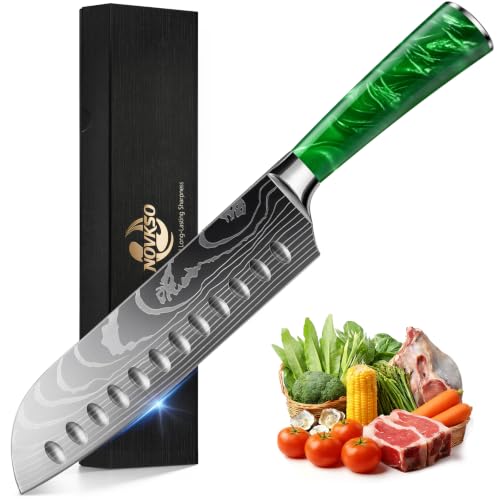
A NOVKSO 7-inch santoku
knife publishes both numbers that matter, which almost nothing in this category does:
a hardness of HRC 60 to 61 and a "15-degree per side edge", on a 2 mm blade. Its own
record says the edge is "geared toward precise, effortless cuts", which is exactly right
and exactly what the geometry delivers. It also publishes, among its drawbacks, that the
"Thin blade not for chopping bone", which is the same arithmetic stated as a warning.
The square law comes from treating the apex as a bending wedge, where section thickness
goes as the tangent of the angle and capacity as its square. The Rockwell to Vickers
conversions are the standard table and the yield estimate is the Tabor relation, yield
about a third of indentation hardness, which is an approximation good to perhaps ten
percent for hardened steel. The hardness and angle figures for all four knives are
published by our own listings; the 17 degrees used for the 16 to 18 degree knife is the
midpoint of its own stated band. The strength index is a comparative quantity, not a
force: it has no units and only its ratios mean anything. Real apex failure is a mixture
of plastic rolling and microfracture whose balance shifts with hardness, so the index
ranks edges rather than predicting when one will fail.
Hardness is linear, and the range is narrower than it looks
Now the other variable, worked the same way so the two can be compared.
The yield strength of hardened steel tracks its hardness closely. Convert Rockwell C
to Vickers with the standard table and then use the Tabor relation, that indentation
hardness is roughly three times yield. Fifty Rockwell is 513 Vickers and about 1,677
megapascals. Fifty six is 613 and 2,004. Fifty eight is 653 and 2,135. Sixty one is 720
and 2,354.
From the softest kitchen knife steel to the hardest, that is a gain of 40.4 percent.
Not nothing. But it is less than the 45.8 percent you give away by taking five degrees
off the bevel, and it is a long way short of the 76.5 percent you give away going from 20
degrees to 10.
Which means one line on our own
guide to knife steel
and hardness needs correcting. It says of the Rockwell figure that "That single
figure drives the most important trade-off in any knife". It does not. It drives the
second most important one. The same page is right about everything else, including the
part people get wrong: that hard steel chips while soft steel rolls, and that "Sharper is
not automatically better". The correction is one of rank, not of fact, and the rest of
that page stands.
It is worth being precise about what hardness actually decides, because it is not the
load. It decides the failure mode. A softer, tougher apex yields plastically and bends
over, which is the rolled edge a honing rod puts back. A harder apex has less capacity to
deform and fractures instead, which leaves a chip that honing cannot touch. So hardness
decides whether a failure is recoverable, and angle decides at what load it happens. Two
jobs, routinely described as one.
Our own catalogue proves it, and gets the credit backwards
Multiply the two together and you get a comparative index for the apex: the square of
the tangent of the angle, times the yield strength. It has no units and only its ratios
mean anything, but the ranking it produces is instructive.
A Dalstrong 8 inch chef knife
in forged German steel publishes "56+ HRC" and a "hand-polished 16-18° edge per
side". Take the midpoint, 17 degrees, and its index is 187.3. That is the highest of the
three knives in our catalogue that publish both figures, and it is the one with the
softest steel of the three.
The santoku above, at 15 degrees and HRC 60 to 61, scores 166.1, which is 11 percent
below it. And a
TILIBEIKA 6-piece knife set
publishes "15-degree factory edges" in 3Cr13Mov, which sits around 50 Rockwell, giving an
index of 120.4: 36 percent below the Dalstrong despite having exactly the same bevel
angle as the knife that is eleven points harder.
So the softest published steel on our shelf has the toughest edge on our shelf, by a
margin the hardness figures would never predict. And here is where the records get it
backwards. The Dalstrong's own drawbacks list "16-18° edge angle is less acute than some
Japanese knives" as a weakness. On this arithmetic it is the single strongest thing about
the knife, and the reason its edge survives the rock chopping its own performance text
describes it as built for. The listing has correctly identified its most durable feature
and filed it under problems.
The knife that leaves out the bigger variable
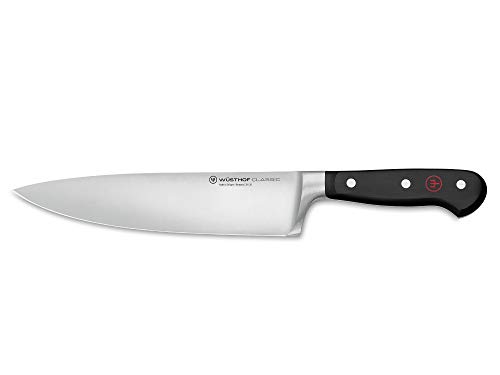
A WÜSTHOF Classic 8 inch
chef's knife publishes a hardness, "tempered to 58 HRC", and a sharpness claim, that
its edge technology "is claimed to make the blade 20% sharper than previous models and
hold its [edge longer]". What it does not publish anywhere in prose is an angle.
Put that through the index. At 58 Rockwell and 15 degrees per side it scores 153.3. At
58 Rockwell and 20 degrees it scores 282.8. The unpublished figure moves the answer by 84
percent, which is more than twice the span of the entire hardness range this page started
with. The number the listing does give you resolves the smaller half of the question.
That is not a criticism of the knife, which by reputation is ground somewhere in the
middle of that range. It is a criticism of what a specification sheet chooses to carry. A
hardness without an angle is like a wire gauge without a length: it is one of the two
numbers you need and it is not the dominant one.
Two more records concede the gap outright rather than papering over it. A
Victorinox Fibrox Pro 8 inch
chef's knife lists among its drawbacks that the "Exact blade steel not specified",
and a
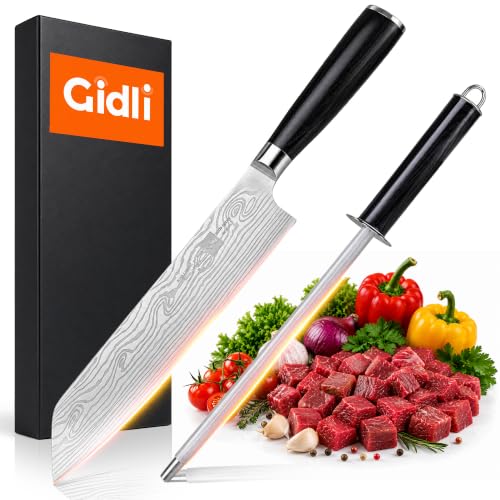
Gidli 8-inch chef knife set with
diamond sharpener says plainly that "Blade thickness and hardness are not stated".
Both of those are honest, and both are more use to a reader than a confident number with
no provenance. Across seven knives in this catalogue, two publish an edge angle, and one
of those two publishes it as a band spanning 22 percent of its own strength.
Why going finer always buys less than it costs
The reason there is an optimum, rather than a direction, is that the benefit and the
cost have different exponents.
The force to drive a wedge into a soft material has a component proportional to how
far sideways the material must be pushed per unit of depth, which is the tangent of the
angle. So the cutting benefit of a finer edge goes as the tangent, while the strength
cost goes as the tangent squared.
Put numbers on the usual step. Going from 20 degrees per side to 15 reduces the
wedging force by 26.4 percent and the apex strength by 45.8. Going on from 15 to 10 buys
another 34.2 percent off the force and costs another 56.7 percent of what is left. The
ratio of what you gain to what you pay is one over the tangent of the angle, so it gets
steadily worse the finer you go, and there is no angle at which it turns around.
Which gives the real answer to whether a knife can be too sharp. Yes, and the
threshold is not a number of degrees. It is wherever the lateral loads of your actual
cutting exceed what the apex carries. If you push sideways through a squash, twist out of
a cut, or scrape the board to gather what you chopped, you are applying exactly the load
this arithmetic is about, and no steel in the category supplies enough margin to make a
15 degree edge behave like a 20 degree one.
The micro bevel, and what it is actually doing
There is a way to have both, and the arithmetic explains why it works rather than
sounding like a compromise.
Grind the blade at 15 degrees per side, then put two or three passes at 20 degrees on
the very apex. The result is a tiny 20 degree facet a few microns deep sitting on a 15
degree primary. Because the strength of the apex is governed by the material in the first
few microns, the apex now behaves like a 20 degree edge: full strength restored. And
because the wedging work of the cut happens over tens and hundreds of microns of depth,
the 15 degree primary still governs how easily the blade passes through the food.
So a micro bevel is not a dulling step and it is not a hedge. It is the only move
available that separates the two variables this page has been separating all along, and
it is why it keeps turning up in sharpening practice without a stated reason. Our page on
keeping
scissors and garden tools sharp is right that "each blade has a specific bevel" and
that matching it matters, which is the same principle in a tool where the bevel is set by
the manufacturer and not by you.
That last point has a practical consequence on our own shelf. The TILIBEIKA set
publishes a 15 degree factory edge and, as a feature, a storage block with a built in
pull-through sharpener, and its record is honest that the "Built-in sharpener is
pull-through, for upkeep not precision". A pull-through imposes its own fixed angle on
whatever you draw through it. If that angle is wider than 15 degrees, and on general
purpose devices it usually is, then the set's published factory geometry survives a few
passes and then becomes the block's geometry instead. That is not a fault. By the index
above it raises the apex strength by up to 85 percent, which on a mid range steel is
probably the right trade. But the two features are being sold as complementary when one
of them overwrites the other, and nobody says so.
The honest limit
The wedge model is first order. A real apex does not fail cleanly in bending: it
rolls, microfractures, or both, and the balance shifts with hardness in a way a single
section modulus cannot capture. Treat the index as a ranking rather than a prediction of
when something will fail.
The Tabor relation between hardness and yield is good to perhaps ten percent for
hardened steel, and the Rockwell to Vickers conversion is a standard table rather than a
measurement of any particular blade. The apex radii quoted, tenths of a micron for a good
finish and tens for a worn edge, come from edge metrology rather than from any product
record, and no knife listing we carry publishes one. Nor does any publish a micro bevel.
Those are the two figures that actually determine how sharp a knife is, and the category
publishes neither.
What survives all of that is the exponents. Strength goes as the square of the angle,
cutting benefit goes as the angle, hardness enters linearly and spans only 40 percent
across the whole category. Change every constant on this page and a knife ground at 15
degrees still has an edge that fails at about half the sideways load of one ground at 20,
and no steel will rescue it.
Why a Knife Edge Fails on Geometry, Not Hardness at a glance
Home cooks and BBQ pitmasters who prefer a heavier, Western-style chef's knife for rock-chopping and heavy prep.
Full-tang forged German stainless steel for durability 56+ HRC hardness for good edge retention Comfortable G-10 handle with triple rivets and hybrid bolster NSF certified for professional use Versatile 8-inch blade handles a wide range of tasks Backed by US-based customer support and 3,200+ reviews
Heavier weight may not suit all users 16-18° edge angle is less acute than some Japanese knives No specific dimensions or weight provided May require regular honing to maintain edge
Everyday chopping, mincing, slicing, and dicing for home cooks who appreciate German craftsmanship.
Precision forged from high carbon stainless steel Tempered to 58 HRC for good edge retention PEtec edge claims 20% sharper and twice the edge retention Ergonomic synthetic handle resists fading Full bolster and finger guard for safety Made in Solingen, Germany with over 200 years of tradition
Full bolster can hinder sharpening Handle may be short for larger hands Not dishwasher safe; requires hand washing Weighs 8.5 oz, which may feel heavy for some
Dishwasher safe for easy cleaning Lifetime warranty against defects Trusted Swiss quality Stainless steel blade Ergonomic Fibrox Pro handle (based on product line) Versatile 8-inch chef's knife size
Exact blade steel not specified Handle material not detailed May require regular sharpening (sharpeners sold separately) Not a premium knife for enthusiasts
Gidli 8-Inch Chef Knife Set with Diamond Sharpener
home cooks upgrading from starter knives
Arrives factory-sharp and ready to use
Wooden handle needs hand washing and drying
Why you can trust this guide
We compared these picks using verified manufacturer specifications, current retailer listings, and patterns in owner feedback, alongside editorial research. We focus on measurable differences such as performance, capacity, usability, and build quality. Pickpedia does not present editorial research as laboratory testing, and we do not claim hands-on testing unless it was actually performed.
Best for precise slicing of meat, vegetables and fruit
8.6/ 10 Pickpedia editorial score
This is a 7-inch Japanese-style Santoku knife from NOVKSO, forged from high-carbon stainless steel at HRC 60 to 61. Its 2mm blade carries a hand-polished 15-degree edge per side and a hollow oval groove that keeps food from sticking. A patterned resin handle is balanced, non-slip and moisture-proof. It arrives in a matte black gift box. Good for home and light commercial prep.
Best for Home cooks and BBQ pitmasters who prefer a heavier, Western-style chef's knife for rock-chopping and heavy prep.
8.8/ 10 Pickpedia editorial score
The Dalstrong 8" Chef Knife is a full-tang forged German stainless steel blade with a 56+ HRC hardness and a hand-polished 16-18° edge per side. Its triple-riveted G-10 handle and hybrid bolster provide a balanced, comfortable grip for long prep sessions. Designed for rock-chopping and heavy tasks, it's NSF certified and comes with dedicated US-based support. While it's heavier than some, that heft suits cooks who prefer a substantial feel.
For Daily Home Cooking, BbThe 8" Gladiator Elite is the Western-style workhors
For The Cook Upgrading FroFull-tang forged high-carbon German stainless steel
For Pinch-grip Control AcrTriple-riveted G-10 handle with hybrid bolster deliv
For The Bbq Pitmaster, HomSlices through a pork shoulder, breaks down a whole
Gift-ready Packaging, DediEvery Dalstrong knife is backed by a dedicated US-ba
Pros
Full-tang forged German stainless steel for durability 56+ HRC hardness for good edge retention Comfortable G-10 handle with triple rivets and hybrid bolster NSF certified for professional use Versatile 8-inch blade handles a wide range of tasks Backed by US-based customer support and 3,200+ reviews
Cons
Heavier weight may not suit all users 16-18° edge angle is less acute than some Japanese knives No specific dimensions or weight provided May require regular honing to maintain edge
Best for A complete, low-maintenance everyday kitchen set or gift
8.8/ 10 Pickpedia editorial score
A six-piece kitchen knife set in rust-resistant 3Cr13Mov stainless steel with 15-degree factory edges and ergonomic handles, including a chef knife, meat cleaver, paring knife, butcher knife and scissors, in a stainless block with a built-in sharpener and a 12-month guarantee.
Best for Everyday chopping, mincing, slicing, and dicing for home cooks who appreciate German craftsmanship.
8.8/ 10 Pickpedia editorial score
The WÜSTHOF Classic 8" Chef's Knife is a precision-forged, full-tang knife made from high carbon stainless steel, tempered to 58 HRC. It features an ergonomic synthetic handle that resists fading, and the PEtec edge technology claims to deliver 20% sharper blades with twice the edge retention. This knife is designed for all-purpose tasks like chopping, mincing, slicing, and dicing. While it is a solid performer, its full bolster can make sharpening slightly more challenging, and the handle may not suit all hand sizes.
FeatureKITCHEN WORKHORSE , The WÜSTHOF 8" Classic Chef's Kn
FeatureCHEF'S KNIFE , Features an 8" long blade, 5" long ha
FeaturePRECISION FORGED , The 8" Chef's Knife is forged fro
FeatureCENTURIES OF TRADITION , Family owned for seven gene
Pros
Precision forged from high carbon stainless steel Tempered to 58 HRC for good edge retention PEtec edge claims 20% sharper and twice the edge retention Ergonomic synthetic handle resists fading Full bolster and finger guard for safety Made in Solingen, Germany with over 200 years of tradition
Cons
Full bolster can hinder sharpening Handle may be short for larger hands Not dishwasher safe; requires hand washing Weighs 8.5 oz, which may feel heavy for some
The Victorinox Fibrox Pro 8 Inch Chef's Knife is a straightforward, functional kitchen tool backed by Swiss craftsmanship. It features a stainless steel blade and a handle designed for dishwasher safety, making cleanup simple. While it lacks the prestige of high-end knives, it offers reliable performance for everyday tasks. Its lifetime warranty against defects adds peace of mind.
FeatureKnife Dimensions. Blade made out of stainless steel
FeatureTrusted Swiss quality. Expertly crafted in Switzerla
FeatureKeep your Victorinox knives maintained with our knif
Pros
Dishwasher safe for easy cleaning Lifetime warranty against defects Trusted Swiss quality Stainless steel blade Ergonomic Fibrox Pro handle (based on product line) Versatile 8-inch chef's knife size
Cons
Exact blade steel not specified Handle material not detailed May require regular sharpening (sharpeners sold separately) Not a premium knife for enthusiasts
The Gidli chef knife is an 8-inch, factory-sharpened blade in German carbon stainless steel, paired with a diamond sharpener. It slices meat, seafood, vegetables, and fruit cleanly and handles chopping, dicing, and mincing. A natural wooden handle with non-slip grip suits pinch and handle holds. The steel resists rust with hand washing and prompt drying. Sold in a gift box, it targets home cooks upgrading from starter knives.