PBy the Pickpedia Team·9 picks compared·Last verified October 2026
Affiliate disclosure: As an Amazon Associate, Pickpedia earns from qualifying purchases. Links on this page are paid links, and we may earn a commission at no extra cost to you. This never affects our picks or scores.
This page contains affiliate links. If you buy through one we may earn a
commission, at no cost to you.
Start by throwing out the part of the standard advice that does not work. You will have
been told three things: do not fill the jar more than halfway, leave the lid vented, and hold
a towel over the top. Two of those are right. The fill level has no effect on the pressure
whatsoever, and understanding why tells you what actually does.
Seal a liter of soup at 85 degrees Celsius into a blender jar and the gauge pressure
inside reaches 78.92 kilopascals. Our page on
what a pressure cooker's
minimum liquid is really for puts the top of the usual electric pressure cooker band at
79.98 kilopascals gauge. The jar on your counter is 1.35 percent below a pressure cooker, and
it is held shut by a plastic rim and your hand.
Where 78.92 kilopascals comes from
Two things happen when you close the lid, and they are not the same size.
The first is the one everyone thinks of. The air trapped above the soup warms up, and at
constant volume its pressure rises in proportion to absolute temperature. Sealing in a 20
degree kitchen at about half humidity traps dry air at 100.16 kilopascals. Warm it to 85
degrees, which is 358.15 kelvin against 293.15, and it becomes 122.37 kilopascals. That is a
rise of 22.21.
The second is the one that does the damage. The space above a hot liquid does not stay
dry. It fills with water vapor until it reaches the saturation pressure for that temperature,
and the saturation pressure of water at 85 degrees is 57.87 kilopascals. Subtract the 1.17
that was already there as room humidity and that is a rise of 56.70.
Add them: 122.37 plus 57.87 is 180.24 kilopascals absolute, so 78.92 above the room. The
vapor is 71.9 percent of it.
And the vapor term is the one that moves. Saturation pressure climbs about half again for
every 10 kelvin in this range: 19.95 kilopascals at 60 degrees, 31.19 at 70, 47.41 at 80,
57.87 at 85, 70.18 at 90 and 101.325 at 100. The trapped air does nothing so dramatic,
because it is only following a ratio of absolute temperatures and 358 over 293 is a modest
number.
What that is in pounds on the lid
A pressure is an abstraction. A force on a lid is not. Take a lid 100 millimeters across,
which is 7.854 thousandths of a square meter, and the force trying to lift it is the gauge
pressure times that area.
At 60 degrees it is 255 newtons, so 57 pounds. At 70, 370 newtons, 83 pounds. At 85, 620
newtons, 139 pounds. At 95, 856 newtons, 192 pounds. At boiling, 1,001 newtons, 225
pounds.
Which is why "let it cool first" is the one instruction that earns its place. Going from
85 degrees to below 60 removes 58 percent of the force, a factor of 2.43, and it is the only
intervention on this page that costs nothing.
One honest caveat on that 100 millimeters: not one of the nine blenders in this catalogue
publishes a lid diameter, and the force goes as its square. An 80 millimeter lid sees 397
newtons at 85 degrees and a 120 millimeter lid sees 892. So treat the pounds as proportional
to an assumption and the kilopascals as firm.
The pressure arithmetic is exact and the forces inherit one assumption. Dry air at constant
volume follows the ratio of absolute temperatures, and the water vapor sits at its
saturation pressure as long as liquid remains, so 122.37 plus 57.87 is not an estimate. The
saturation values of 19.95, 31.19, 47.41, 57.87, 70.18 and 101.325 kilopascals at 60, 70,
80, 85, 90 and 100 degrees Celsius are standard. The published inputs are the 64 ounce
pitcher, the 72 ounce pitcher with its 64 ounce liquid maximum, the 2 ounce measuring cap,
the 6 cup Boroclass jar, the 1200 watt and 2.2 horsepower motors, and the vented lid cap.
Representative rather than published: the lid diameter of 100 millimeters, which no listing
in the category states and which the force depends on as its square, so read every pound
figure as proportional to that assumption and the pressures as firm; the 50 percent indoor
humidity, which moves the result by under a kilopascal; the 200 gram lid mass; the fractions
of motor power reaching the liquid; and the glass strengths of 30 to 50 megapascals behind
the thermal shock comparison, where the ratio of 3.07 between the two glasses is exact and
the absolute kelvin figures are not. The 1,641 watt shaft equivalent of 2.2 horsepower and
the 79.98 kilopascal pressure cooker figure are taken from our own pages rather than
recomputed.
The one listing that names the mechanism
A
Nutribullet Full-Size Blender
Combo publishes 1200 watts, a 64-ounce pitcher, a 32-ounce and a 24-ounce cup, a
footprint of 7.75 by 8.07 by 16.97 inches, and the detail that matters here: "A vented lid cap
comes on the 64-ounce pitcher." Its performance text then says, in one sentence, the thing
every other listing in the category leaves out: "Hot liquids like soups are fine, but mind the
vented lid to avoid splatters."
That is correct and it is the whole answer. A vent does not reduce the pressure, it
prevents it. Saturation pressure is a property of a closed space, and a hole in the lid means
there is no closed space, so the 620 newtons never exists. What is left is the splatter the
sentence names, which is kinetic rather than pneumatic, and a towel genuinely helps with
that.
The catalogue has two more openings described without being called vents. A
Cuisinart Velocity Ultra Trio
publishes "a 2-ounce measuring cap in the tight-seal lid" that "lets you add ingredients while
running", alongside a 56-ounce jar, a 3-cup processor, 1 horsepower and a 3-year warranty. And
the Ninja below publishes "a pour spout cover on the lid" for the same purpose. Both are
vents. Neither is sold as one, and neither publishes the one figure that would let you tell a
vent from a plug, which is the aperture. A 2-ounce cap tells you the volume of the measuring
cup and nothing about the size of the hole it leaves.
Three machines that invite hot liquid in
A
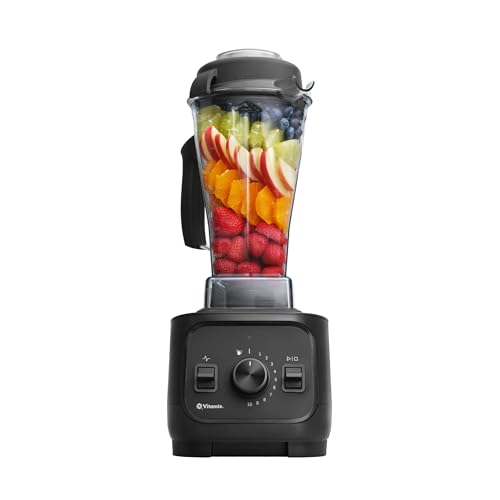
Vitamix VX1 professional-grade
blender publishes a 64-ounce container, stainless blades, an included tamper, a 5-year
limited warranty and the line "Everything from smoothies to hot soups is possible", with
"Versatile for hot and cold recipes" among its strengths. What it does not publish is a lid,
a vent, a maximum liquid temperature or a pressure rating. The capability is stated and the
precaution is absent.
A
Vitamix Explorian with programs
goes further and publishes a hot soup program on a 2.2 HP motor with a 64-ounce
low-profile container and 10 variable speeds. This is the most interesting listing in the
group, because the program means the machine is not merely tolerating hot liquid. It is
manufacturing it.
Run the number. Our page on
why blender rpm needs a blade diameter
establishes that 2.2 horsepower is 1,641 watts at the shaft, and this page takes that figure
rather than re-deriving it. Essentially all of it ends up as heat in the liquid, because that
is where the blade's work goes. With 70 percent reaching 1.2 liters of contents, that is 1,149
watts into 5.02 kilojoules per kelvin, so 0.229 kelvin a second, or 13.7 kelvin a minute. A
five to six minute hot soup cycle therefore lifts room-temperature ingredients by 68 to 82
kelvin, landing somewhere between 88 and 102 degrees.
The program is internally consistent, which is the point. It is designed to deliver
exactly the temperature at which a closed jar carries 139 to 225 pounds on its lid, and it
does so over five minutes with the lid on. A machine built for that must have a vent and a
positive lid retention, and our record for it mentions neither.
The same effect runs on every machine here, smaller. On the Nutribullet's published 1200
watts, with half of it reaching 1.2 liters of 85 degree soup, one minute of blending adds 7.2
kelvin and 21.1 kilopascals. That is 37 more pounds on the lid, generated by the appliance,
after you did the sensible thing and let the soup cool.
The only published headspace in the catalogue
A
Ninja Professional Plus blender
publishes 1400 watts, three Auto-iQ presets, and the figure nobody else gives: a 72-ounce
Total Crushing Pitcher "marked with a 64-ounce maximum liquid capacity". Eight fluid ounces of
mandated headspace, which is 236.6 milliliters and 11.1 percent of the vessel.
Its own explanation is right, and it is right for a reason worth spelling out: "the
64-ounce liquid capacity is the practical limit to avoid overflow". Overflow. Not pressure. If
you read that limit as a pressure precaution you have it backwards twice over.
First, the pressure does not depend on the fill level at all. A saturation pressure is set
by temperature and does not care how much space sits above the liquid, and a fixed quantity of
trapped air at constant volume follows the same temperature ratio whatever its volume. Fill the
jar to 1.2 liters or to 0.95 and both reach 78.92 kilopascals at 85 degrees. Identical.
Second, on the quantity that fill level genuinely does change, more headspace is worse. The
work available when a seal gives way is the absolute pressure times the headspace volume times
the natural logarithm of the pressure ratio. For 1.2 liters of soup in a 1.893 liter jar that
is 71.9 joules. For 0.95 liters it is 98.3 joules, which is 37 percent more. As an upper bound,
71.9 joules is the kinetic energy of a 200 gram lid at 26.8 meters a second.
So the half-full rule is a splash rule and a sensible one. It is not a pressure rule, and
the Ninja's record is the only one in the category that gets the reason right.
It is worth saying clearly what does not happen, because the pressure cooker
comparison invites it. Soup at 85 degrees is below its boiling point at atmospheric pressure,
so when the lid releases nothing flashes to steam. The liquid stays liquid. The hazard is the
gas expanding and dragging liquid with it, which is violent enough and is a different
mechanism from a pressure cooker vented hot.
The glass claim, and what it is worth
An
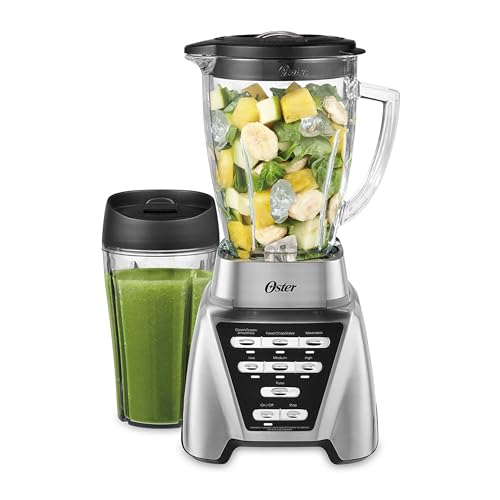
Oster Pro 1200 smoothie blender
publishes a "6-cup Boroclass glass jar" that is "built to handle thermal shock, durable for hot
and cold ingredients", alongside 1200 watts, 7 speeds and a 3.5-inch blade. That is the only
material specification in the category that speaks to hot liquid, and it is worth putting a
figure on.
Thermal stress in a constrained surface layer is the modulus times the expansion
coefficient times the temperature difference, divided by one minus Poisson's ratio.
Borosilicate expands at about 3.3 parts per million per kelvin with a modulus near 64
gigapascals, which gives 0.264 megapascals of stress per kelvin. Ordinary soda-lime glass
expands at about 9.0 parts per million with a modulus near 72, giving 0.810 megapascals per
kelvin.
The ratio is 3.07. So "built to handle thermal shock" is worth roughly three times the
survivable temperature step, and that factor is exact given the two material pairs. At a
practical tensile strength of 30 to 50 megapascals for a real jar with handling damage, that
is a step of 114 to 190 kelvin for the borosilicate and 37 to 62 kelvin for soda-lime.
Pouring 85 degree soup into a 20 degree jar is a 65 kelvin step. One glass clears it by a
factor of two or more. The other sits inside its own scatter band, which is the practical
difference between a jar you can pour hot soup into and a jar you have to warm first.
The same listing then undercuts itself in a different field. A 24-ounce to-go cup appears
in the product name and the record says to "confirm its inclusion and capacity", so the one
listing here with a glass specification is also the one that cannot account for its own box
contents.
The geometry that puts the pressure in your hand
A
nutribullet Pro personal
blender publishes 900 watts, a 32-ounce and a 24-ounce cup, a flip-top travel lid and a
method: "Screw the blade assembly onto the cup, then lock it onto the base." No vent is
published and no hot liquid capability is claimed, which is the correct combination, and the
reason is worth making explicit because personal blenders get used for soup anyway.
An inverted screw-on cup has no lid to lift. The pressure acts on the blade assembly, and
it acts through a threaded gasket whose whole design purpose is to keep liquid in. On a blade
base 70 millimeters across, 78.92 kilopascals is 304 newtons, so 68 pounds trying to unscrew
the one joint you assembled by hand. And the same record adds the detail that completes the
picture: "You do have to hold the cup in place during blending." Your hand is on the pressure
boundary for the duration.
A
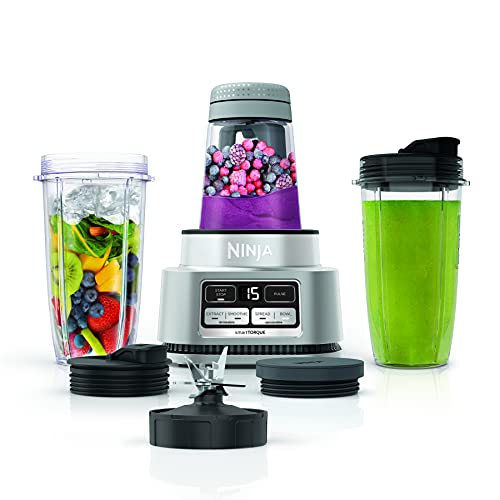
Ninja Foodi personal blender and
smoothie bowl maker is the same geometry at 1200 peak watts with a 14-ounce bowl, a
24-ounce cup, to-go lids and a built-in tamper, and it is honest about its intended use:
"Even blending of frozen foods with minimal liquid", which is the opposite end of the
temperature range and the right job for a sealed cup.
So the gap across the whole category is this. Three of nine blenders publish a hot liquid
capability. One of those three names a vent. Not one of the nine publishes a jar pressure
rating, a lid retention force, a maximum liquid temperature or a lid diameter, and the lid
diameter is the term every force on this page is most sensitive to.
The machine with no headspace at all
Which leaves the answer that removes the variable instead of managing it. A
Prasky 5-in-1 immersion
blender publishes 1200 watts, 20 speed settings plus a turbo boost, stainless blades and a
600 millilitre cup, whisk and frother, and its record names the actual benefit in passing:
"Blending soup directly in the saucepan saves transferring hot liquid to a jug."
That sentence is doing more work than it looks. A stick blender in an open pan has no
sealed headspace, so the saturation pressure has nowhere to accumulate and the entire 620
newtons is identically zero. Not reduced, not managed, zero. The only hazard left is the one
its own drawbacks name correctly: "Corded, and hot liquids need care against splashing", which
is momentum from the blade and is handled by the advice its performance text also gives, to
"start slow to avoid splashing and build up".
It is also honest about the wattage, which is relevant because of the heating argument
above: "The 1200W is a peak motor rating, a headline figure reflecting maximum capability
rather than constant draw." A peak rating puts less heat into the soup than a continuous one,
which in this one context is a small advantage. Our roundup of
immersion blenders for soups, sauces and more is the
place to compare them, and the roundup of
blenders for hot and cold use covers the jug side.
The honest limit, and the three things that matter
What is exact here is the pressure. Dry air at constant volume follows the ratio of
absolute temperatures. Water vapor above a liquid surface sits at its saturation pressure for
as long as liquid remains, and those saturation values are standard table entries. So 122.37
plus 57.87 equals 180.24, and 78.92 kilopascals gauge at 85 degrees, is arithmetic rather than
estimation. So is the result that the fill level drops out of it, and so is the 37 percent more
stored energy in the emptier jar.
What is representative is everything expressed in pounds. The lid diameter of 100
millimeters is not published by anything in this catalogue and the force depends on its square,
so the 139 pounds could be 89 or 200 on a real jar and the shape of the curve would be
identical. The 70 millimeter blade base, the 200 gram lid, the indoor humidity of 50 percent,
which is worth under a kilopascal either way, and the fractions of motor power reaching the
liquid are all assumptions. In the thermal shock comparison the ratio of 3.07 between the two
glasses is exact and the absolute kelvin figures carry the scatter of a strength assumption.
What this page deliberately does not do is tell you a safe temperature, and the reason is
that the number required does not exist in public. A safe margin needs a lid retention force or
a seal burst pressure, and no blender listing anywhere in this category publishes either, so
any threshold quoted here would be a guess wearing a decimal point. The arithmetic says which
direction to move and how much each kelvin is worth, and that is as far as published
information goes. Nor has it computed anything about the aerosol a hot blend produces, because
droplet size depends on blade geometry and surface tension and no listing publishes an edge
profile.
And the residue, which is short. Temperature is the only lever on the pressure, and it is a
strong one: below 60 degrees you have removed 58 percent of the force. A vent removes all of
it, and exactly one of the nine machines here publishes one. The fill level does nothing to the
pressure and makes the stored energy worse, so halve the fill for splash reasons and do not
count it as a safety margin. And if the soup is genuinely hot, the appliance with no sealed
volume is not a compromise. It is the only one of these designs where the arithmetic on this
page has nothing to say.
Why Hot Soup Pressurizes a Blender Jar at a glance
Households that want both a full-size pitcher and single-serve cups in one blender, especially for smoothies and soups.
Powerful 1200-watt motor Includes 64oz pitcher and two single-serve cups Three speeds, pulse, and Extract program Dishwasher-safe pitcher and cups Compact footprint BPA-free plastic
Blade requires hand washing 1-year limited warranty is short Single-serve cups share the same blade, requiring cleaning between uses Plastic may scratch over time
Individuals or small households who want a compact blender and food processor combo for daily smoothies and small prep tasks.
1-horsepower motor handles ice and frozen ingredients well Pre-programmed smoothie and ice crush functions for easy operation Includes a 3-cup food processor with slicer/shredder disc for versatility Two 16-ounce travel cups are included for on-the-go use BPA-free materials and a limited 3-year warranty for peace of mind Tight-seal lid with measuring cap allows adding ingredients while running
Food processor capacity is only 3 cups, limiting batch sizes Travel cups are not designed for blending directly, so you must pour Plastic jars may scratch or retain odors over time Die-cast base is heavy and takes up counter space
Home cooks who want a reliable, powerful blender for daily use and don't need preset programs.
Powerful blending performance Large 64-ounce capacity Includes tamper for thick blends Durable stainless-steel blades 5-year warranty Versatile for hot and cold recipes
No preset programs Manual speed control only No digital display Requires manual cleaning
Families and home cooks who want versatile, high-performance blending with automated convenience.
Powerful 2.2 HP motor handles tough ingredients Three automatic programs for consistent results Large 64-ounce low-profile container fits under cabinets Self-cleaning in 30-60 seconds 10 variable speeds and pulse for precise control BPA-free, dishwasher-safe container
Renewed product may show signs of prior use Noisy operation (typical of high-power blenders) Large footprint requires counter space Programs are limited to three presets
Large-batch frozen drinks and smoothies for families.
1400W motor is more powerful than the original BL610 Three Auto-iQ presets automate blending for consistent results 72-oz pitcher with 64-oz max liquid capacity suits family batches Stacked blade assembly crushes ice and frozen fruit effectively Modern design with clear markings on the pitcher Includes recipe guide and quick start instructions
Plastic pitcher may scratch and stain over time No tamper included for thick mixtures Motor is loud during operation Auto-iQ programs are limited to three presets, not customizable
Everyday smoothies, shakes, and ice crushing in a home kitchen.
1200 power watts for strong blending 900 watts of ice crushing power 7 speeds with 3 pre-programmed settings Pulse feature for manual control 50% larger blade system compared to previous models Dishwasher safe Boroclass glass jar that withstands thermal shock
To-go cup details are not provided in the specs Glass jar is heavier than plastic alternatives No specific blending time or capacity limits given May not handle very hard ingredients like whole nuts or grains without additional effort
Daily smoothies and shakes with frozen or fibrous ingredients.
900 watts of power for tough ingredients Simple twist-and-blend operation Includes two cup sizes (32 oz and 24 oz) Flip-top travel lid for on-the-go Compact footprint Easy to clean (cups and blades are dishwasher safe, though not stated, but typical)
Loud motor No preset programs or speed settings Plastic cups may scratch or stain over time Only two cups included, no additional accessories
Ninja Foodi Personal Blender & Smoothie Bowl Maker
Individuals who enjoy thick smoothie bowls and want a portable, powerful personal blender.
Powerful 1200-peak-watt motor with smartTORQUE technology prevents stalling Built-in tamper in the bowl maker helps achieve thick blends without excess liquid 4 preset Auto-iQ programs for one-touch convenience Includes 2 cups and 1 bowl with to-go lids for portability Manual speed and pulse options for custom control Compact design for easy storage
Bowl capacity is only 14-oz, which may be small for some users No specific details on cup materials or dishwasher safety Preset programs may not suit all recipes perfectly Not suitable for large batches or family-sized portions
A stick blender, not a full jug blender for ice or big batches
Why you can trust this guide
We compared these picks using verified manufacturer specifications, current retailer listings, and patterns in owner feedback, alongside editorial research. We focus on measurable differences such as performance, capacity, usability, and build quality. Pickpedia does not present editorial research as laboratory testing, and we do not claim hands-on testing unless it was actually performed.
Best for Households that want both a full-size pitcher and single-serve cups in one blender, especially for smoothies and soups.
8.8/ 10 Pickpedia editorial score
The Nutribullet Full-Size Blender Combo packs 1200 watts of power into a compact unit, offering three speeds, pulse, and an Extract program. It includes a 64oz pitcher, two single-serve cups, and a tamper, making it a flexible addition to any kitchen. The cyclonic action of the stainless steel blade ensures smooth results, while the dishwasher-safe parts simplify cleanup. However, the blade is not dishwasher safe, and the 1-year warranty is shorter than some competitors.
FeatureThree precision speeds, a pulse function and the Ext
Includes(1) 1200 Watt Motor Base, (1) 64 oz (1.8L) Blender P
The Easy-Twist Extractor B7.75 Lx 8.07 W x 16.97 H
FeatureHassle-free cleaning - simply place pitcher and cups
Pros
Powerful 1200-watt motor Includes 64oz pitcher and two single-serve cups Three speeds, pulse, and Extract program Dishwasher-safe pitcher and cups Compact footprint BPA-free plastic
Cons
Blade requires hand washing 1-year limited warranty is short Single-serve cups share the same blade, requiring cleaning between uses Plastic may scratch over time
Best for Individuals or small households who want a compact blender and food processor combo for daily smoothies and small prep tasks.
8.8/ 10 Pickpedia editorial score
The Cuisinart BFP-650P1 combines a 1-horsepower motor with a blender jar, a food processor attachment, and travel cups in one unit. It offers pre-programmed smoothie and ice crush functions, plus a slicer/shredder disc for added versatility. While it performs well on basic tasks, the 56-ounce jar and 3-cup processor may feel limited for larger batches. The included travel cups are a nice touch, but the overall design has some ergonomic quirks.
Superior PerformanceHigh-performance 1-horsepower motor with 3-in-1 blen
Must-have FeaturesPre-programmed smoothie and ice crush functions, tig
Included56-ounce BPA-free Tritan plastic jar, 3-cup food pro
Limited 3-year WarrantyRefer to user manual for troubleshooting steps and q
Pros
1-horsepower motor handles ice and frozen ingredients well Pre-programmed smoothie and ice crush functions for easy operation Includes a 3-cup food processor with slicer/shredder disc for versatility Two 16-ounce travel cups are included for on-the-go use BPA-free materials and a limited 3-year warranty for peace of mind Tight-seal lid with measuring cap allows adding ingredients while running
Cons
Food processor capacity is only 3 cups, limiting batch sizes Travel cups are not designed for blending directly, so you must pour Plastic jars may scratch or retain odors over time Die-cast base is heavy and takes up counter space
Best for Home cooks who want a reliable, powerful blender for daily use and don't need preset programs.
8.8/ 10 Pickpedia editorial score
The Vitamix VX1 is a professional-grade blender that delivers the iconic Vitamix performance with a 64-ounce container and stainless-steel blades. It is built to last with a 5-year warranty, making it a reliable choice for heavy daily use. However, it lacks preset programs and digital controls, so you'll need to manually adjust speed and time. It is ideal for those who want a straightforward, high-performance blender without extra features.
Classic 64 Oz. ContainerThe precisely engineered geometry of the container a
5-Year Limited WarrantyBuilt to last and backed by our industry-leading war
Pros
Powerful blending performance Large 64-ounce capacity Includes tamper for thick blends Durable stainless-steel blades 5-year warranty Versatile for hot and cold recipes
Cons
No preset programs Manual speed control only No digital display Requires manual cleaning
Best for Families and home cooks who want versatile, high-performance blending with automated convenience.
8.8/ 10 Pickpedia editorial score
The Vitamix Explorian with Programs is a high-performance blender that simplifies making smoothies, soups, and frozen desserts with its three automatic programs. It features a 2.2 HP motor and a large 64-ounce container, making it suitable for big batches. The self-cleaning function is convenient, but as a renewed product, buyers should verify its condition. Overall, it's a solid choice for those wanting reliable blending without manual adjustments.
IncludedExplorian with Programs Renewed Premium blender moto
Three Blending ProgramsThree automatic Blending Programs for Smoothies, Hot
2.2 Hp MotorEquipped with a high-performance motor, this counter
64-Ounce ContainerThe BPA-free, dishwasher-safe blending container is
Self-CleaningSimply add warm water, a drop of dish soap to the co
Pros
Powerful 2.2 HP motor handles tough ingredients Three automatic programs for consistent results Large 64-ounce low-profile container fits under cabinets Self-cleaning in 30-60 seconds 10 variable speeds and pulse for precise control BPA-free, dishwasher-safe container
Cons
Renewed product may show signs of prior use Noisy operation (typical of high-power blenders) Large footprint requires counter space Programs are limited to three presets
Best for Large-batch frozen drinks and smoothies for families.
8.8/ 10 Pickpedia editorial score
The Ninja Professional Plus Blender BN701 is a 1400-watt upgrade over the classic Ninja Professional, designed for large batches. It features three Auto-iQ preset programs that automate pulsing and blending for consistent results. The 72-ounce pitcher, with a 64-ounce max liquid capacity, suits family needs. It's a straightforward, capable blender for frozen drinks, smoothies, and more.
Increased Motor PowerThe Ninja Professional Plus features a new modern de
Intelligent Auto-iq PrograTake the guesswork out of drink making with 3 Auto-i
Family-size PitcherThe 72-oz. pitcher is great for making large batches
What's Included1400-Peak-Watt Motor Base, 72-oz. Total Crushing Pit
Pros
1400W motor is more powerful than the original BL610 Three Auto-iQ presets automate blending for consistent results 72-oz pitcher with 64-oz max liquid capacity suits family batches Stacked blade assembly crushes ice and frozen fruit effectively Modern design with clear markings on the pitcher Includes recipe guide and quick start instructions
Cons
Plastic pitcher may scratch and stain over time No tamper included for thick mixtures Motor is loud during operation Auto-iQ programs are limited to three presets, not customizable
Best for Everyday smoothies, shakes, and ice crushing in a home kitchen.
8.8/ 10 Pickpedia editorial score
The Oster Pro 1200 is a countertop blender that brings 1200 watts of power, a large 3.5-inch dual-direction blade system, and 7 speeds including 3 pre-programmed settings for convenience. Its 6-cup Boroclass glass jar is dishwasher safe and designed to withstand thermal shock. However, the 24-ounce to-go cup is mentioned in the name but not detailed in the specs, so confirm its inclusion and capacity. This blender is best for everyday blending tasks, but it may not suit heavy-duty crushing or single-serve needs without verification.
FeatureSmart settings technology and 7 speeds including 3 p
FeatureDual direction blade technology for extra blending p
Feature1200 power watts and 900 watts of ice crushing power
Feature6 cup dishwasher safe Boroclass glass jar withstands
FeaturePulse feature for added control and precision; Featu
Pros
1200 power watts for strong blending 900 watts of ice crushing power 7 speeds with 3 pre-programmed settings Pulse feature for manual control 50% larger blade system compared to previous models Dishwasher safe Boroclass glass jar that withstands thermal shock
Cons
To-go cup details are not provided in the specs Glass jar is heavier than plastic alternatives No specific blending time or capacity limits given May not handle very hard ingredients like whole nuts or grains without additional effort
Best for Daily smoothies and shakes with frozen or fibrous ingredients.
8.8/ 10 Pickpedia editorial score
The nutribullet Pro is a 900-watt personal blender designed for making smoothies, shakes, and food prep. It comes with two cups, a to-go lid, and a simple push-and-twist operation. While it lacks preset programs, its raw power makes it effective for frozen and fibrous ingredients. The main trade-off is noise and limited capacity.
FeatureWith 900 Watts of power, the nutribullet Pro is fast
Power Your Day900 watts of power in this compact powerhouse turns
Included(1) 900W Motor Base, (1) Extractor Blade, (1) 32 oz
Pros
900 watts of power for tough ingredients Simple twist-and-blend operation Includes two cup sizes (32 oz and 24 oz) Flip-top travel lid for on-the-go Compact footprint Easy to clean (cups and blades are dishwasher safe, though not stated, but typical)
Cons
Loud motor No preset programs or speed settings Plastic cups may scratch or stain over time Only two cups included, no additional accessories
Best for Individuals who enjoy thick smoothie bowls and want a portable, powerful personal blender.
8.8/ 10 Pickpedia editorial score
The Ninja Foodi Personal Blender & Smoothie Bowl Maker (SS101) is a compact yet powerful appliance designed for making thick smoothie bowls and smooth nutrient-packed drinks. It features a 1200-peak-watt smartTORQUE motor that handles frozen ingredients without stalling, and includes a 14-oz bowl with a built-in tamper for thick blends, plus a 24-oz cup for smoothies. With 6 functions including 4 Auto-iQ presets, it offers convenience for various recipes. Its portability and included to-go cups make it easy for on-the-go use.
Thick Smoothie Bowls14-oz. Smoothie Bowl Maker with built-in tamper blen
Smooth Nutrient Extraction24-oz. Cup with better breakdown delivers smoother e
Powerful Smarttorque Motor1200-peak-watt power-dense motor with smartTORQUE te
6 Versatile Functions4 preset Auto-iQ programs for one-touch smoothies, e
Easy Storage & Portability2 cups and 1 bowl are easy to take on the go or stor
Pros
Powerful 1200-peak-watt motor with smartTORQUE technology prevents stalling Built-in tamper in the bowl maker helps achieve thick blends without excess liquid 4 preset Auto-iQ programs for one-touch convenience Includes 2 cups and 1 bowl with to-go lids for portability Manual speed and pulse options for custom control Compact design for easy storage
Cons
Bowl capacity is only 14-oz, which may be small for some users No specific details on cup materials or dishwasher safety Preset programs may not suit all recipes perfectly Not suitable for large batches or family-sized portions
Best for Soups, sauces, smoothies, whisking and frothing
8.8/ 10 Pickpedia editorial score
A handheld immersion blender with a 1200W motor, 20 speed settings plus turbo boost, stainless steel blades and a 5-in-1 attachment set including a 600ml blending cup, whisk and frother, with a detachable, dishwasher-safe, ergonomic design.