PBy the Pickpedia Team·4 picks compared·Last verified October 2026
Affiliate disclosure: As an Amazon Associate, Pickpedia earns from qualifying purchases. Links on this page are paid links, and we may earn a commission at no extra cost to you. This never affects our picks or scores.
This page contains affiliate links. If you buy through one we may earn a
commission, at no cost to you.
On a magnetic bike, a watt on the console is not a measurement. There is no force
sensor anywhere in the machine. The number is a calculation from your cadence and an
assumed property of the brake, and because of how a magnetic brake works, the
calculation squares your cadence.
That has a consequence you can check on your own machine in thirty seconds. Leave
the knob exactly where it is and pedal twice as fast. The resistance you feel doubles,
and the power doubles twice, to four times what it was. Nothing on the bike moved.
What the knob actually sets
A magnetic brake is a magnet held near the rim of a spinning metal flywheel. The
metal moving through the field has a voltage induced in it, and that voltage is
proportional to how fast it is moving. The voltage drives currents in the flywheel,
proportional to the voltage. Those currents sit in the magnet's field and feel a
retarding force, proportional to the current.
Follow the chain and the braking torque comes out proportional to speed. Not
constant with speed, the way a friction pad is. Proportional to it.
Power is torque multiplied by speed. So if the torque is itself proportional to
speed, the power is proportional to speed squared. The thing the knob changes is the
constant in front, and that constant has units of newton metres per radian per second.
It is not a force. It is not a torque. It is not a power. It is a damping coefficient,
and there is no everyday word for it, which is exactly why the dial has numbers on it
instead of units.
Our own page on why a drill
clutch number is not a torque establishes the general version of this and this page
is a harder case of it. A clutch number at least maps onto one torque, even if the
maker will not tell you which. A magnetic resistance level maps onto a coefficient, and
the torque it produces depends on how fast you are going, so two riders on the same
level are not experiencing the same anything.
The ladder, at one fixed knob position
Anchor it somewhere readable. Suppose a given knob position gives 100 watts at 60
revolutions per minute, which fixes the coefficient at 2.533 newton metre seconds and
the brake torque at 15.92 newton metres. Now change nothing but your legs.
At 70 revolutions per minute the power is 136.1 watts. At 80 it is 177.8. At 90, 225.
At 100, 277.8. At 110, 336.1. At 120, exactly 400. The torque has doubled from 15.92 to
31.83 newton metres over that range and the power has quadrupled, because both the
torque and the speed went up together.
Run it backwards and it is more useful still. If you want to hold 100 watts, you
must hold 60 revolutions per minute, and a drift of 10 revolutions costs you 36 watts,
which is 36 percent. Cadence discipline on a magnetic machine is not a style
preference. It is the only thing holding the power steady.
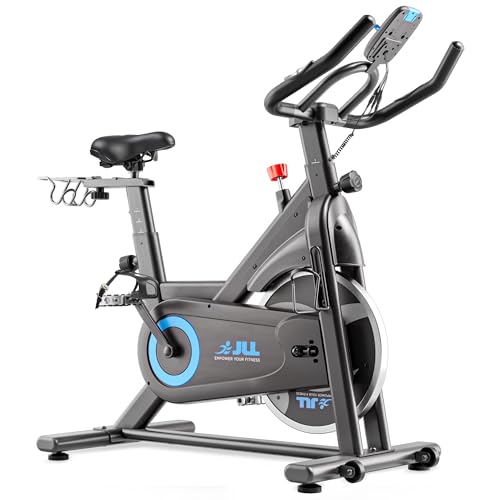
A
JLL magnetic indoor exercise
bike is the machine this question is really about, and its record contains the most
interesting thing on this page by not containing something. The console, it says, "shows
time, speed, distance, RPM, odometer and pulse (30 to 240)". Six metrics. Power is not
one of them.
That is correct, and the reason is in the next line of the same record: "Resistance
is stepless magnetic, controlled by a tension knob for instant intensity changes." A
stepless knob has no position number. With no position number there is nothing for a
console to look the brake coefficient up from, and without the coefficient there is no
power to display. So the bike measures the one thing it genuinely can measure, which is
revolutions per minute, and declines to multiply it by an assumption. Nothing in the
listing explains that this is what is happening, and it is the single most honest design
decision in the category.
Why the error doubles
The square law has a corollary worth having. If the power is proportional to the
square of the cadence, then a small proportional error in the cadence becomes twice
that proportional error in the power. Three percent out on cadence is six percent out on
watts. Five percent is ten.
And the brake coefficient is worse, because it is not measured at all. Whatever the
console's table assumes for a given level, any discrepancy between that assumption and
the actual magnet position, flywheel temperature, belt tension and age of the machine
passes straight into the displayed power at full strength.
Flywheel temperature is not a throwaway. An eddy current brake dissipates every watt
you produce as heat in the flywheel itself, and the electrical resistivity of the
flywheel metal rises with temperature. Higher resistivity means smaller induced
currents, which means less torque for the same speed, which means the coefficient
drifts downward as you warm the machine up. A console reading from a cold table will
therefore read high after twenty minutes, and the size of that drift is not something I
can put a number on, because no listing publishes the flywheel material, let alone its
temperature coefficient.
The square law and the error doubling are exact: power is torque times speed and an
eddy current brake's torque is proportional to speed, so the exponent is two and
nothing in any product can change it. The 100 watts at 60 revolutions per minute is an
anchor chosen to make the ladder readable rather than a published figure, and every
other power on the curve is that anchor times the square of the cadence ratio. The
sixteen bars are the one piece of modelling here: they assume a magnet gap running from
ten millimetres down to two in fifteen equal steps with field strength inversely
proportional to gap, both of which are representative rather than published, and no
listing we carry states a gap, a field or a brake constant. On a gentler field law the
range compresses from twentyfive to five and half of it sits above level eleven and a
half instead of fourteen and a half. The direction never changes, because the brake
constant goes as the square of the field whatever the field does.
Sixteen levels, and where the sixteen levels actually are
A
YCCHENG 16 level magnetic stair
stepper takes the other approach and numbers its dial. Its record says "Sixteen
levels of magnetic resistance let you dial intensity from a gentle warm-up to a hard
climb, and progress as you get fitter", which is a reasonable description and leaves
open the question everybody assumes the answer to: are the levels the same size?
They cannot be. The braking coefficient goes as the square of the magnetic field at
the flywheel, and the field falls steeply as the magnet is drawn away from it. So the
dial is converting a roughly linear mechanical movement into a strongly nonlinear
resistance, and then squaring the nonlinearity.
Put representative numbers on it, clearly labelled as representative because no
listing states any of them. Suppose the magnet gap runs from ten millimetres at level
one down to two millimetres at level sixteen, in fifteen equal steps, with the field
inversely proportional to the gap. Then the resistance at level sixteen is twenty five
times the resistance at level one. The step from level fifteen to level sixteen is 81.5
times the size of the step from level one to level two. Levels one through eight,
exactly half the dial, cover six percent of the machine's range. And half of the total
range lies above level fourteen and a half, which is the top nine percent of the
numbers printed on the knob.
Change the field law and the magnitudes change: if the field falls only as the square
root of the gap, the range compresses from twentyfive to five and half of it sits above
level eleven and a half instead. What does not change is the shape, because the squaring
is not an assumption. Whatever the gap does to the field, the coefficient does it twice.
The dial is compressed at the bottom and explosive at the top, and that is why every
machine of this type feels like nothing is happening for the first third of the dial and
then suddenly happens all at once.
The flywheel is a ripple number, not a resistance number
The bike publishes a 22 pound flywheel and makes a lot of it, and the flywheel mass
is the one figure in the whole machine that cannot affect average power at all.
Here is what it does do. Twenty two pounds is 9.979 kilograms. Treated as a ring at a
radius of 0.17 metres, the moment of inertia is 0.2884 kilogram metres squared. At a
representative belt ratio of four and a half to one and 80 revolutions per minute at the
cranks, the flywheel is turning 360 revolutions per minute, and the kinetic energy
stored in it is 204.9 joules.
Compare that with the energy in one pedal revolution. At 150 watts and 80 revolutions
per minute, each revolution takes 0.75 seconds and carries 112.5 joules. So the flywheel
is holding 1.82 pedal revolutions' worth of energy. That is the buffer, and the buffer is
what "smooth" means.
Work the ripple. Your legs deliver almost nothing through the top and bottom of the
stroke, call it 20 percent of each revolution, or 0.15 seconds, during which the brake
is still taking 150 watts and so withdraws 22.5 joules. Since energy goes as speed
squared, the flywheel slows by the square root of one minus 22.5 over 204.9, which is a
5.65 percent dip. Halve the flywheel to 11 pounds and the same dead spot costs 11.66
percent. So the flywheel mass roughly inversely sets the speed ripple, which you feel
directly, and leaves the average power exactly where it was.
One more figure makes the stored energy tangible. The record says "you press the knob
to stop the flywheel". From a hard 110 revolutions per minute at the cranks there are
387.4 joules in there, which is the same 9.979 kilograms dropped from 3.96 metres. That
is what the press has to absorb, and it is why these machines have a brake rather than
just a lower setting.
Three ratings, one of which means something
It helps to put the magnetic level next to the two other ways home equipment states
resistance, because the three are not the same kind of statement.
A
FIAMEARMOR twister arm
exerciser rated 22 to 440 pounds is the spring case. Its record quotes a "Wide 22
to 440 lb adjustable range" and, in its own drawbacks, concedes "No weight or dimensions
stated". A spring's force depends on how far you have bent it, so a pound figure without
a deflection is a number without a question attached to it, and a twentyfold range
multiplies the ambiguity rather than resolving it. Our page on
whether a 50 pound resistance
band is really 50 pounds works that case through properly and this page takes its
conclusion rather than repeating the arithmetic.
A pair of
ATIVAFIT adjustable dumbbells
dialling 5 to 25 pounds each is the honest case, and it is worth saying so because
it is easy to take for granted. Its record says it "Dials from 5 to 25 lb each" in
"Five clear steps for progression". Those steps are 5, 10, 15, 20 and 25, which are
exactly equal, exactly a force, independent of how fast you move, and directly
comparable with every other dumbbell ever made. Its drawbacks note "Dimensions not
published", which for a mass genuinely does not matter: a 15 pound dumbbell is a 15
pound dumbbell whatever shape it is.
That is the comparison the original question needs. Twenty five pounds transfers.
Level 12 does not transfer, between two machines or between two riders on the same
machine, and 180 watts transfers only if you also know the cadence it was produced at
and trust the table it was computed from.
What a console watt is and is not
Where a console does show watts, the number it is trying to show is mechanical power
delivered to the brake. There are two things it is not.
It is not your power at the pedals, because a belt and two sets of bearings sit in
between. At a typical belt efficiency the difference is a few percent, and it runs in
the direction of the console under-reading your effort, which is the pleasant direction
for once.
And it is not the energy you are spending. The chemical energy a person consumes to
deliver a mechanical watt is several times that watt, and the multiplier is a figure
about human physiology rather than a figure about this bike, so this page does not
compute it and does not turn it into anything else. Both of our machines' records carry
their own sensible notes about new exercisers and health conditions, and those stand.
The point here is narrower and purely mechanical: the watt is at the brake, and the
brake is the only place in the system where anything is known.
Our page on blender
horsepower versus watts makes the related point about appliances, which is that a
headline power figure describes an input rather than an outcome. On an exercise bike the
problem inverts: the figure describes an output, and the input, which is the coefficient
the knob sets, is the part nobody states.
The honest limit, and what to do with the dial
Three things on this page are exact and the rest are not. The square law is exact,
because power is torque times speed and eddy current torque is proportional to speed.
The error doubling is exact, because it follows from the exponent. And the dumbbell
steps are exact, because they are published.
Everything else is representative and stated as such. The 100 watts at 60 revolutions
per minute is an anchor to make the ladder readable, not a specification. The flywheel
radius of 0.17 metres, the four and a half to one belt ratio, the 20 percent dead spot
and the 150 watt working level are all assumptions, because the bike publishes a
flywheel mass and nothing else mechanical. The ten to two millimetre magnet gap and the
inverse field law behind the sixteen bars are the most assumed things here, and I have
given the result for a gentler law so you can see which part survives.
What survives is the ratio structure. Doubling cadence always quadruples power.
Halving the flywheel always roughly doubles the ripple and never changes the average.
The top of a magnetic dial always holds a disproportionate share of its range. And a
level is never comparable to a level on another machine, because the quantity it sets
has no unit anyone prints.
Which suggests the one practical change worth making, and it costs nothing. Stop
using the dial as the variable. Pick a knob position and leave it there, then use
cadence as your intensity control and record the cadence, because cadence is the one
number on a magnetic console that is genuinely measured. Two sessions at level 8 are not
comparable. Two sessions at level 8 and 85 revolutions per minute are, on that machine,
to within the drift of a warming flywheel. And if you ever want a figure that transfers
to a different machine or a different year, the honest answer is that a magnetic bike
cannot give you one, which is a limitation of the brake and not of the rider.
Why Exercise Bike Watts Go Up as Cadence Squared at a glance
ATIVAFIT Adjustable Dumbbell Set of 2, 5 to 25 LB Quick Dial
Beginners and toning workouts in small spaces
Dials from 5 to 25 lb each
Maximum is 25 lb per hand
Why you can trust this guide
We compared these picks using verified manufacturer specifications, current retailer listings, and patterns in owner feedback, alongside editorial research. We focus on measurable differences such as performance, capacity, usability, and build quality. Pickpedia does not present editorial research as laboratory testing, and we do not claim hands-on testing unless it was actually performed.
Best for Quiet, adjustable home cardio in apartments and shared spaces
9.0/ 10 Pickpedia editorial score
A quiet belt-driven indoor exercise bike with a 22-pound flywheel and stepless magnetic resistance, a 4-way adjustable seat (31.7 to 38.8 inches) and 2-way handlebars, an LCD console with pulse reading, Bluetooth SunnyFit app connectivity (no subscription) with guided workouts and routes, plus a device holder, bottle cage and dumbbell rack, supporting users up to 300 pounds in a compact footprint.
BrandJLL Fitness
TypeMagnetic indoor bike
Flywheel22 lb, belt drive
ResistanceStepless magnetic knob
Seat4-way adj, 31.7 to 38.8 in
ConsoleLCD + pulse; SunnyFit app
CapacityUp to 300 lb
FootprintAbout 37.8 x 21.3 in; 76.5 lb
Pros
Near-silent magnetic belt drive, ideal for apartments
Stepless magnetic resistance with instant changes
4-way adjustable seat and handlebars fit many riders
No-subscription SunnyFit app with guided rides and routes
Device holder, bottle cage and dumbbell rack included
Sturdy frame supporting up to 300 pounds
Cons
A home cardio bike, not a commercial spin machine
Requires assembly out of the box
Heavy at about 76 pounds, not casual to move
Pulse reading is training feedback, not medical-grade
Best for Effective home cardio and lower-body work in a small space
8.6/ 10 Pickpedia editorial score
A foldable magnetic stair stepper and vertical climber with 16 resistance levels, a full-body climbing motion, a reinforced steel frame rated to 350 pounds, quiet operation, app workout tracking, a cup holder and tool-free adjustment, for home cardio in a small space.
BrandYCCHENG
TypeMagnetic stair stepper / climber
Resistance16 magnetic levels
WorksLegs, hips, core, full body
FrameSteel, holds up to 350 lb
DesignFoldable, quiet
SmartApp workout tracking
ExtrasCup holder, tool-free T-knob, 1yr
Pros
16 magnetic resistance levels grow with you
Full-body climbing works legs, hips and core
Sturdy steel frame rated to 350 pounds
Foldable and quiet for apartments
App tracks workouts and progress
Cup holder, tool-free adjustment, 1-year warranty
Cons
A single compact machine, not a full gym
App needs a phone and quality varies
Low-impact framing is a design point, not medical
Check with a doctor first if new to exercise or with health conditions
Best for adjustable upper-body squeeze training at home
8.4/ 10 Pickpedia editorial score
The FIAMEARMOR twister arm exerciser adjusts from 22 to 440 lb with a turn of the knob, targeting chest, shoulders, arms, and more. A stable triangular frame and non-slip PU handles aim for a secure grip. The maker cites a patented enclosed hydraulic cylinder, double-layer steel pipes, and a controlled micro-rebound system for safer returns.
Best for Beginners and toning workouts in small spaces
8.4/ 10 Pickpedia editorial score
ATIVAFIT makes a set of two adjustable dumbbells that dial from 5 to 25 lb each in five steps. The quick dial swaps weight without disassembly, and an upgraded safety lock holds plates during exercises. A textured alloy steel handle improves grip. Aimed at beginners, toning, and small-space home training, it replaces several fixed dumbbells in one footprint.