1 HP or 1200 Watts: Which Blender Is Actually Stronger?
PBy the Pickpedia Team·3 picks compared·Last verified October 2026
Affiliate disclosure: As an Amazon Associate, Pickpedia earns from qualifying purchases. Links on this page are paid links, and we may earn a commission at no extra cost to you. This never affects our picks or scores.
This page contains affiliate links. If you buy through one we may earn a
commission, at no cost to you.
One horsepower is 746 watts, so a 1200 watt blender must be stronger than a
1 horsepower one. That conversion is arithmetically correct and the conclusion is
wrong, because the two numbers are not measured at the same place. One is taken at
the plug and the other at the shaft, and between them sits everything the motor
throws away as heat. Once you know that, the whole blender power ladder stops
being a ranking and becomes two ladders that nobody has told you are different.
Input and output are separated by the motor's losses
A horsepower rating on a motor is a statement about mechanical work delivered
at the output shaft. A wattage rating on a kitchen appliance is almost always a
statement about electrical power drawn from the socket. The difference between
them is efficiency, and for the small universal motors in countertop appliances
that is not a rounding error. As a rule of thumb from standard motor data rather
than anything we measured, machines in this class land somewhere around 50 to 65
percent efficient at their working point, with the rest leaving as heat in the
windings. It is why a blender base is warm after a long run.
Run the numbers in both directions. A motor drawing 1200 watts delivers
roughly 600 to 780 watts to the blades, which is about 0.8 to 1.05 horsepower. A
motor that genuinely delivers 1 horsepower, meaning 746 watts at the shaft, has to
draw somewhere around 1,150 to 1,490 watts to do it. Those two ranges overlap
almost completely.
Both scales are watts, so they look comparable. They are not, and the wedge is
the reason. A horsepower figure has already paid the toll that a wattage figure
has not.
So the honest comparison between a machine labelled 1200 watts and a machine
labelled 1 horsepower is that they are plausibly the same motor, described from
opposite ends, and the one with the smaller looking number is the one quoting the
figure that actually reaches the food. The dashed line on the chart is the mistake:
converting 1200 watts into 1.61 horsepower treats the motor as though it wasted
nothing.
Then there are three kinds of watt
It gets one layer worse, and the evidence is on the listings themselves rather
than anywhere we had to go looking.
A machine can quote the power it draws under its rated continuous load. It can
quote peak power, which occurs at or near stall, when current is highest and
useful work is lowest, so the number is at its largest exactly when the machine is
achieving the least. And it can quote a figure for a specific task, which is a
third convention again. When a single listing carries two different wattages for
one motor, that is not an error, it is two different measuring conditions, and
neither is labelled.
Which means a watt figure is only comparable to another watt figure from the
same maker using the same convention. Across brands you are comparing marketing
departments.
What our own blenders publish
An
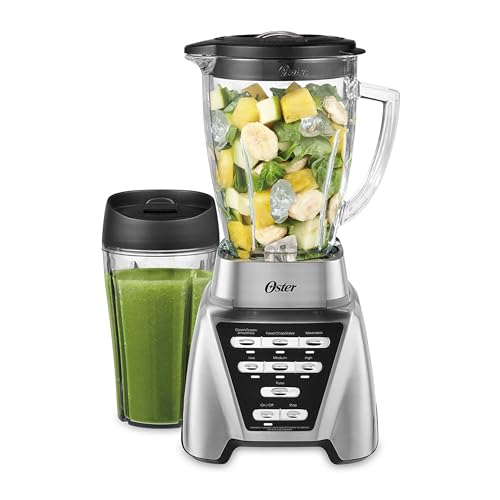
Oster Pro 1200 smoothie
blender is the clearest illustration because its record carries both figures
at once: 1200 power watts and 900 watts of ice crushing power. One motor, two
numbers, differing by a third, and the difference is the load condition rather
than the hardware. The rest of the record is more useful than either: seven speeds
including three pre-programmed settings, dual direction blade technology, a blade
system described as 50 percent larger than previous models, a pulse function, and
a six cup Boroclass glass jar rated to withstand thermal shock and go in the
dishwasher. The jar is arguably the real specification there, since glass resists
scratching and odour retention in a way plastic does not. Its published gaps are
that the to-go cup named in the title is not detailed in the specs, and that the
listing gives no blending time or capacity limits. Our
review of the Oster Pro 1200
goes through it.
A
Cuisinart Velocity Ultra
Trio 1-HP blender and food processor is the other side of the chart, and its
record quotes a 1 horsepower motor, which on the arithmetic above is the same
neighbourhood as the 1200 watt figure rather than 60 percent below it. What
distinguishes it is not power at all: it carries a 56 ounce Tritan jar, a three
cup food processor attachment with a feed tube, pusher and slicer and shredder
disc, two 16 ounce travel cups, pre-programmed smoothie and ice crush functions, a
tight seal lid with a two ounce measuring cap, and a limited three year warranty.
Its published limits are a three cup processor bowl that is small for real
batches, travel cups you pour into rather than blend in, and a heavy die-cast
base. Details in our
review
of the Cuisinart Velocity Ultra Trio.
A
Ninja Professional Plus
blender is the one that labels its own convention honestly, and it deserves
credit for it. The record describes a 1400 peak watt motor base, with the word
peak printed rather than implied. Read against the chart that is a number taken
where the motor is working hardest and achieving least, so it is not comparable
to a continuous figure from another brand, but at least you know which figure you
have been handed. The rest of the record is a 72 ounce Total Crushing pitcher with
a 64 ounce maximum liquid fill, a stacked blade assembly, and three Auto-iQ preset
programmes that run their own pulse and pause patterns. Published limits: a plastic
pitcher that scratches and stains, no tamper for thick mixtures, a loud motor, and
three presets that cannot be customised. See our
review of the Ninja Professional
Plus.
The honest limit
The specification that would settle any of this is sustained shaft power, or
better still torque at blending speed, and no consumer listing publishes either.
So the practical reading is narrower than it looks. Within one brand's own range,
a bigger watt figure does mean a bigger motor and that comparison holds. Between
brands, and especially between a watt figure and a horsepower figure, you are
comparing conventions and you should stop before you draw a conclusion.
And then the part that makes most of the argument moot. For everyday smoothies,
soups and sauces, the jar shape, the blade geometry and whether the vortex pulls
food back down decide the result more reliably than the last few hundred watts,
which is the case we made in
how much blender power do
you actually need. If your current machine leaves chunks, the cheapest fixes
are more liquid, a smaller batch and letting it run longer, in that order. Power
genuinely matters for nut butters, daily ice and dense frozen loads with no added
liquid, and if none of those are on your weekly list then the honest recommendation
is to buy the jar you like and ignore the number on the front entirely.
One last thing worth knowing, since it follows directly from the chart. Nearly
all of the power that does reach the blades ends up as heat in whatever you are
blending, because stirring a thick liquid hard is a very efficient way to warm it.
That is why long runs produce warm soup, and it is also why a machine that is
struggling is heating your ingredients rather than cutting them.
1 HP or 1200 Watts: Which Blender Is Actually Stronger? at a glance
Everyday smoothies, shakes, and ice crushing in a home kitchen.
1200 power watts for strong blending 900 watts of ice crushing power 7 speeds with 3 pre-programmed settings Pulse feature for manual control 50% larger blade system compared to previous models Dishwasher safe Boroclass glass jar that withstands thermal shock
To-go cup details are not provided in the specs Glass jar is heavier than plastic alternatives No specific blending time or capacity limits given May not handle very hard ingredients like whole nuts or grains without additional effort
Individuals or small households who want a compact blender and food processor combo for daily smoothies and small prep tasks.
1-horsepower motor handles ice and frozen ingredients well Pre-programmed smoothie and ice crush functions for easy operation Includes a 3-cup food processor with slicer/shredder disc for versatility Two 16-ounce travel cups are included for on-the-go use BPA-free materials and a limited 3-year warranty for peace of mind Tight-seal lid with measuring cap allows adding ingredients while running
Food processor capacity is only 3 cups, limiting batch sizes Travel cups are not designed for blending directly, so you must pour Plastic jars may scratch or retain odors over time Die-cast base is heavy and takes up counter space
Large-batch frozen drinks and smoothies for families.
1400W motor is more powerful than the original BL610 Three Auto-iQ presets automate blending for consistent results 72-oz pitcher with 64-oz max liquid capacity suits family batches Stacked blade assembly crushes ice and frozen fruit effectively Modern design with clear markings on the pitcher Includes recipe guide and quick start instructions
Plastic pitcher may scratch and stain over time No tamper included for thick mixtures Motor is loud during operation Auto-iQ programs are limited to three presets, not customizable
Why you can trust this guide
We compared these picks using verified manufacturer specifications, current retailer listings, and patterns in owner feedback, alongside editorial research. We focus on measurable differences such as performance, capacity, usability, and build quality. Pickpedia does not present editorial research as laboratory testing, and we do not claim hands-on testing unless it was actually performed.
Best for Everyday smoothies, shakes, and ice crushing in a home kitchen.
8.8/ 10 Pickpedia editorial score
The Oster Pro 1200 is a countertop blender that brings 1200 watts of power, a large 3.5-inch dual-direction blade system, and 7 speeds including 3 pre-programmed settings for convenience. Its 6-cup Boroclass glass jar is dishwasher safe and designed to withstand thermal shock. However, the 24-ounce to-go cup is mentioned in the name but not detailed in the specs, so confirm its inclusion and capacity. This blender is best for everyday blending tasks, but it may not suit heavy-duty crushing or single-serve needs without verification.
FeatureSmart settings technology and 7 speeds including 3 p
FeatureDual direction blade technology for extra blending p
Feature1200 power watts and 900 watts of ice crushing power
Feature6 cup dishwasher safe Boroclass glass jar withstands
FeaturePulse feature for added control and precision; Featu
Pros
1200 power watts for strong blending 900 watts of ice crushing power 7 speeds with 3 pre-programmed settings Pulse feature for manual control 50% larger blade system compared to previous models Dishwasher safe Boroclass glass jar that withstands thermal shock
Cons
To-go cup details are not provided in the specs Glass jar is heavier than plastic alternatives No specific blending time or capacity limits given May not handle very hard ingredients like whole nuts or grains without additional effort
Best for Individuals or small households who want a compact blender and food processor combo for daily smoothies and small prep tasks.
8.8/ 10 Pickpedia editorial score
The Cuisinart BFP-650P1 combines a 1-horsepower motor with a blender jar, a food processor attachment, and travel cups in one unit. It offers pre-programmed smoothie and ice crush functions, plus a slicer/shredder disc for added versatility. While it performs well on basic tasks, the 56-ounce jar and 3-cup processor may feel limited for larger batches. The included travel cups are a nice touch, but the overall design has some ergonomic quirks.
Superior PerformanceHigh-performance 1-horsepower motor with 3-in-1 blen
Must-have FeaturesPre-programmed smoothie and ice crush functions, tig
Included56-ounce BPA-free Tritan plastic jar, 3-cup food pro
Limited 3-year WarrantyRefer to user manual for troubleshooting steps and q
Pros
1-horsepower motor handles ice and frozen ingredients well Pre-programmed smoothie and ice crush functions for easy operation Includes a 3-cup food processor with slicer/shredder disc for versatility Two 16-ounce travel cups are included for on-the-go use BPA-free materials and a limited 3-year warranty for peace of mind Tight-seal lid with measuring cap allows adding ingredients while running
Cons
Food processor capacity is only 3 cups, limiting batch sizes Travel cups are not designed for blending directly, so you must pour Plastic jars may scratch or retain odors over time Die-cast base is heavy and takes up counter space
Best for Large-batch frozen drinks and smoothies for families.
8.8/ 10 Pickpedia editorial score
The Ninja Professional Plus Blender BN701 is a 1400-watt upgrade over the classic Ninja Professional, designed for large batches. It features three Auto-iQ preset programs that automate pulsing and blending for consistent results. The 72-ounce pitcher, with a 64-ounce max liquid capacity, suits family needs. It's a straightforward, capable blender for frozen drinks, smoothies, and more.
Increased Motor PowerThe Ninja Professional Plus features a new modern de
Intelligent Auto-iq PrograTake the guesswork out of drink making with 3 Auto-i
Family-size PitcherThe 72-oz. pitcher is great for making large batches
What's Included1400-Peak-Watt Motor Base, 72-oz. Total Crushing Pit
Pros
1400W motor is more powerful than the original BL610 Three Auto-iQ presets automate blending for consistent results 72-oz pitcher with 64-oz max liquid capacity suits family batches Stacked blade assembly crushes ice and frozen fruit effectively Modern design with clear markings on the pitcher Includes recipe guide and quick start instructions
Cons
Plastic pitcher may scratch and stain over time No tamper included for thick mixtures Motor is loud during operation Auto-iQ programs are limited to three presets, not customizable