Home ›
Tools & DIY › Why a Drill Clutch Number Is Not a Torque
Tools & DIY
Why a Drill Clutch Number Is Not a Torque
PBy the Pickpedia Team·6 picks compared·Last verified October 2026
Affiliate disclosure: As an Amazon Associate, Pickpedia earns from qualifying purchases. Links on this page are paid links, and we may earn a commission at no extra cost to you. This never affects our picks or scores.
This page contains affiliate links. If you buy through one we may earn a
commission, at no cost to you.
Useful, and not for the reason printed on the ring. The numbers are ordinal. They
index a spring preload, they have no units, and no maker publishes what any of them
means in newton metres. What a clutch does well is repeat the same depth on the same
joint, and what it cannot do is hit a figure.
There are two separate reasons, and both are arithmetic. The first is that a ladder of
settings spaced evenly across a range is nearly useless at the bottom of that range,
where almost all the work is. The second is that whether the clutch governs at all
depends on a property of the joint nobody can read off a tool, and on a small driver the
motor's own ceiling is often doing the limiting instead.
Seven settings is not seven useful settings
We do not carry drills, but we carry powered drivers that publish exactly what a drill
clutch does not: numbered levels with units on them. That makes the ladder arithmetic
checkable.
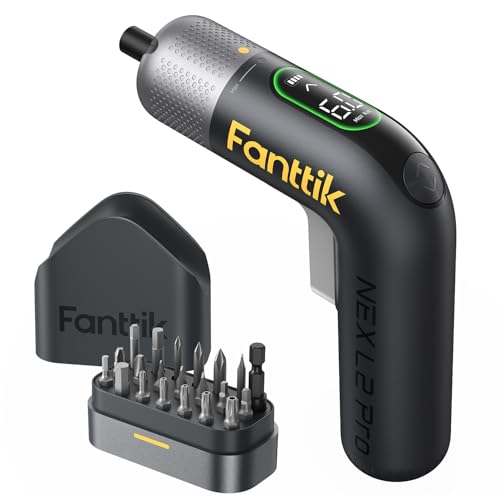
A Fanttik L2 Pro cordless
electric screwdriver set publishes "7 torque settings from 0.5 to 6 N.m". Space those
evenly, which is what a mechanical ring does, and the step is 0.9167 newton metres: 0.5,
1.417, 2.333, 3.250, 4.167, 5.083, 6.0.
Look at the two ends of that ladder. Clicking from the first setting to the second
multiplies the torque by 2.833. Clicking from the sixth to the seventh multiplies it by
1.180. The control is almost 2.5 times coarser, proportionally, at the bottom than at the
top, and the bottom is where a small screw lives.
Space the same seven settings geometrically instead, each 1.5131 times the last, and
you get 0.5, 0.757, 1.145, 1.733, 2.622, 3.967, 6.0. Every click is the same 51 percent
change, which is what a human expects from a dial. Nobody builds that, because the
mechanism is a spring and a ramp and its natural behaviour is linear in preload.
The consequence is specific. A small wood screw seating in softwood wants somewhere
in the region of one and a half to three newton metres. On the linear ladder, that entire
window sits between settings one and two. The control has one usable position in exactly
the range where you want three, and six positions above it that are all too much.
A Fittwt mini electric
screwdriver set is the best behaved tool in this catalogue for precisely this reason,
and not because it is more precise. It publishes "Six torque levels from 0.2 to 0.7
newton metres", which is a span of only 3.5 to 1. Evenly spaced that is a 0.1 newton
metre step, so its first click multiplies by 1.5 and its last by 1.167. A narrow range
makes an even ladder behave itself. A wide range does not, and the wide ranges are the
ones that get advertised.
The 0.5 to 6 newton metre span, the seven setting count, the 6 newton metre ceiling, the
250 and 320 revolutions a minute and the 10 to 70 inch pound range in half inch pound
steps are all figures our own listings publish. The even spacing of the seven settings is
an assumption, because no listing states the torque at each individual setting: the
endpoints and the count are all that is given. The 5 degrees of detent travel, the 0.2 and
3.0 newton metres per degree joint rates and the 20 and 40 newton metre drill ceilings are
representative engineering figures rather than product figures. The threshold expression
itself, the ceiling minus the setting divided by the travel, is exact, and the conclusion
that it scales with the tool's ceiling holds whatever numbers you put into it.
The part that decides whether the clutch matters at all
Now the dynamic half, which is the actual answer to the real world question.
A clutch is a ball or a cam sitting in a detent against a spring. To release, it has
to climb out of that detent, which takes a finite amount of output rotation: a few
degrees. During those few degrees the screw keeps turning and the joint keeps
tightening.
So the overshoot is the product of two things: how far the detent has to travel, and
how fast the torque is rising as it does. That second quantity is the joint rate, in
newton metres per degree, and it is a property of what you are screwing into rather than
of the tool.
A long screw pulling into timber is a soft joint. Call it 0.2 newton metres per degree.
Over 5 degrees of detent travel that adds 1.0 newton metre, so a setting of 2.333 delivers
3.33: an overshoot of 43 percent. Annoying, survivable, repeatable.
A machine screw bottoming on metal is a hard joint. Call it 3.0 newton metres per
degree. The same 5 degrees would add 15 newton metres, turning a 2.333 setting into 17.3:
an overshoot of 644 percent. The ratio of the two overshoots is 15, which is exactly the
ratio of the joint rates, because the detent travel is the same in both cases.
My first conclusion from that was wrong, and the ceiling is why
The obvious reading is that a clutch is dangerous on hard joints. Then I put the 15
newton metres back against the tool that was supposed to deliver it, and it cannot: the
Fanttik publishes a 6 newton metre ceiling and its own drawbacks say so plainly, "Torque
ceiling of 6 N.m limits heavy jobs".
Redo it. Starting at a 2.333 setting on a 3.0 newton metre per degree joint, the torque
reaches 6 newton metres after only (6 minus 2.333) divided by 3, which is 1.22 degrees.
That is less than a quarter of the detent travel. The motor stalls before the clutch
finishes releasing, so on that joint the clutch setting does nothing at all and the thing
limiting the torque is the tool running out of grunt.
Which gives a threshold, and it is the one genuinely useful expression on this page.
The joint rate at which the ceiling arrives before the clutch is the ceiling minus the
setting, divided by the detent travel. For this tool at this setting that is 0.73 newton
metres per degree. On anything softer than that, the clutch governs. On anything harder,
the motor does, and the ring is decoration.
And the scaling runs against intuition. Put the same setting on a drill with a 20
newton metre ceiling and the threshold becomes 3.53 newton metres per degree. On a 40
newton metre drill it becomes 7.53, ten times the small driver's. A more powerful tool
does not control torque better. It removes the stall that was accidentally doing the
controlling, so it has ten times more room to overshoot before anything stops it. The
clutch on a weak tool is backed up by the tool's weakness. The clutch on a strong tool is
on its own.
Why the mechanism has to exist, even though it is imprecise
A fair question is why not simply listen and stop. The rotation speeds our own listings
publish answer it.
The Fanttik and the Fittwt both publish 250 revolutions a minute, which is 1,500
degrees a second. A
SATA 32-piece cordless electric
screwdriver publishes 320 revolutions a minute and 1,920 degrees a second. An alert
human reaction is about 200 milliseconds, which at those speeds is 300 and 384 degrees of
output rotation. On a screw with a 1.25 mm thread pitch that is 1.04 and 1.33 millimetres
of extra travel after you decide to stop.
So on a powered tool there is no driving by ear. Something mechanical has to make the
decision, which is why the clutch is there and why our own guide to
driving
screws cleanly gives it the correct job description: "use the clutch setting to
control depth, so you do not overdrive". That is exactly right, and it is worth noticing
how carefully it is phrased. Depth, on a repeated joint. Not torque, and not a
number.
The spec that cannot be solved
Two of our powered tools publish a setting count and one endpoint, which is not enough
to reconstruct anything.
The SATA publishes "three torque settings" and "up to 5 N.m electric", with no bottom
of the range anywhere in prose. Three settings topping out at 5 could be 1, 3 and 5, in
which case the first click triples the torque. Or it could be 0.5, 2.75 and 5, in which
case the first click multiplies by 5.5. Both satisfy everything published. There is no
way to choose between them, and they imply completely different tools.
The same record also publishes "Up to 5 N.m electric plus 8 N.m manual torque", which
is worth reading twice. The tool's largest number belongs to its manual mode, and the
manual mode has no torque control of any kind: it is you turning a handle. So the headline
capability is the uncontrolled capability. An
iFu 42-in-1 cordless precision
electric screwdriver kit does the same thing in the other direction, publishing "0.2
N.m of electric torque for [delicate screws]" with a firmer manual mode above it, and its
own drawbacks are honest that the "Electric torque is a light 0.2 N.m, not for tough
fasteners". In both cases the controlled figure and the maximum figure are different
numbers for different modes, and only one of them is the one the clutch applies to.
Nobody publishes a tolerance on a powered setting. The hand tools do
This is the finding that puts the whole question in proportion. Across every powered
driver in this catalogue there is not one published accuracy figure for a torque setting.
Counts, spans and ceilings, but no tolerance.
Both manual torque tools publish one. A
YIYEIE 90-piece master torque
screwdriver set publishes "a 10 to 70 in-lb range in 0.5 in-lb steps" with "A click
[that] signals when you hit the preset value", and its own drawbacks add the right caveat:
"Accuracy depends on the tool's calibration". A
DSBYKJ 17-piece torque wrench
set publishes a "5 to 30 Nm range, plus or minus 3 percent accuracy, a stated
10,000-cycle test" and a 72-tooth ratchet, and is straight about its limits in its own
drawbacks: "Low 5 to 30 Nm range, not for car lug nuts".
Put the resolution side by side. The YIYEIE's 10 to 70 inch pounds is 1.130 to 7.909
newton metres, and its half inch pound increment is 0.0565 newton metres. That is 121
settings over a span that overlaps the Fanttik's 0.5 to 6 almost entirely. Its step is 5.0
percent of its lowest setting. The Fanttik's first step is 183 percent of its lowest
setting. Sixteen times finer, over the same ground, in a tool with no motor in it.
Which is not an argument for using a hand driver for everything. It is an argument
about what each tool is for. The powered clutch exists because a human cannot react inside
300 degrees of rotation. The hand tool exists because a figure that matters needs a
tolerance, and a tolerance needs a mechanism that moves slowly enough to have one. Our own
page on what
a torque wrench does and why the range matters covers the wrench side properly, and
our page on
why a lubricated bolt snaps at
the right torque works out what happens downstream of the number, which is a separate
mechanism again and not repeated here.
One more thing the catalogue does not reconcile
The torque tools on this site span 0.2 to 30 newton metres across six products, in two
unit systems, and not one listing converts. The YIYEIE is in inch pounds and everything
else is in newton metres, which means its 10 to 70 looks like a bigger number than the
Fanttik's 0.5 to 6 and is actually a near identical range, 1.13 to 7.91. A reader
comparing the two from the listings alone would conclude the hand tool is roughly ten
times stronger. It is not. It is the same strength with sixteen times the resolution and a
published tolerance.
The honest limit, and what to do with a clutch ring
Three of the inputs here are representative rather than published, and they are the
ones that set the absolute numbers. The 5 degrees of detent travel is typical for a ball
clutch and not stated by anyone. The 0.2 and 3.0 newton metres per degree joint rates are
engineering figures for soft and hard joints, not measurements of any particular screw.
And the even spacing of the seven settings is an assumption, because the listing gives
endpoints and a count and nothing between them.
The threshold expression is exact, and the conclusion that it scales with the tool's
ceiling survives any numbers you substitute. So does the ladder arithmetic, which depends
only on the endpoints and the count.
Which leaves one practical move, and it is the opposite of what the ring invites. Do
not look for the setting that corresponds to your screw. There is no such correspondence
published and the bottom of the ladder is too coarse to find it anyway. Drive one screw
into an offcut of the actual material at a low setting, click up until it seats flush, and
then leave it there for the whole batch. That uses the only thing a clutch is genuinely
good at, which is repeating itself, and it sidesteps both of the problems on this page: you
never need to know the newton metres, and you have calibrated against the real joint rate
rather than guessing it.
Why a Drill Clutch Number Is Not a Torque at a glance
Precise low-torque work on bikes, electronics and small parts
Precise click at your set torque
Low 5 to 30 Nm range, not for car lug nuts
Why you can trust this guide
We compared these picks using verified manufacturer specifications, current retailer listings, and patterns in owner feedback, alongside editorial research. We focus on measurable differences such as performance, capacity, usability, and build quality. Pickpedia does not present editorial research as laboratory testing, and we do not claim hands-on testing unless it was actually performed.
Best for DIY builds and furniture assembly with fine torque control
8.8/ 10 Pickpedia editorial score
The Fanttik L2 Pro is a cordless electric screwdriver aimed at DIY builds and furniture assembly. It offers 7 torque settings from 0.5 to 6 N.m and a 250 RPM MagnaStorm motor with variable-speed trigger. A color display shows torque, battery, and direction. Twenty S2 bits and an extension rod sit in a cottage-shaped base, and the 2000mAh battery charges via Type-C in about 80 minutes.
Torque settings7 (0.5 to 6 N.m)
Motor250 RPM MagnaStorm
Bits20 S2 steel
Extension rodFits 1/4-inch hex chuck
Battery2000mAh
ChargingType-C, 5V/2A
Full chargeAbout 80 minutes
DisplayColor screen for torque, battery, direction
Pros
Seven torque settings span fine to firm work
Color display shows torque, battery, and direction
Best for Electronics repair needing controlled low torque
8.6/ 10 Pickpedia editorial score
The Fittwt mini electric screwdriver set suits phone, laptop and PC repairs where control matters. Six torque levels from 0.2 to 0.7 newton metres help prevent stripped screws and cracked housings. A 500mAh Type-C battery drives up to 600 screws per charge at 250 RPM. The kit adds 60 S2 magnetic bits, 7 sockets, a bit holder, tweezers, a spudger and four LED lights.
Best for furniture assembly and light home repairs
8.6/ 10 Pickpedia editorial score
SATA's cordless electric screwdriver pairs a 3.7V motor with a 32-piece bit set for everyday repairs. It delivers up to 5 N.m of electric torque, 320 RPM, and three torque settings, plus a spindle lock for up to 8 N.m by hand. A 2000mAh USB-C battery, LED work light, and quick-change 1/4-inch chuck round out a light, home-focused kit.
Best for delicate electronics teardowns like phones, watches, and laptops
8.8/ 10 Pickpedia editorial score
The iFu 42-in-1 is a cordless precision screwdriver kit built for electronics repair. It runs a dual-mode setup: 0.2 N.m of electric torque for delicate screws and up to 3 N.m by hand for firmer work. A 360-degree ring of three LEDs lights dark chassis, and 37 magnetic S2 steel bits cover diverse jobs. USB-C recharges it in about an hour, and the maker states up to 300 screws per charge.
Pieces42-in-1 set
Bits37 magnetic S2 steel
Electric torque0.2 N.m
Manual torqueUp to 3 N.m
Motor speed200 RPM
BodyOne-piece aluminum alloy
Lighting360-degree 3-LED ring
ChargingUSB-C, about 1 hour
Pros
Dual torque modes protect delicate screws while allowing firmer manual force
360-degree LED ring lights dark chassis clearly
37 magnetic S2 hardened bits cover many devices
One-piece aluminum alloy body feels solid and controlled
USB-C recharges fully in about an hour
Clip case keeps the driver and every bit organized
Cons
Electric torque is a light 0.2 N.m, not for tough fasteners
Best for repeatable spec torque on scopes and bikes
8.8/ 10 Pickpedia editorial score
The YIYEIE set centers on a 1/4-inch torque screwdriver with a 10 to 70 in-lb range in 0.5 in-lb steps. A click signals when you hit the preset value, preventing overtorque. The 90-piece kit adds 84 S2 steel bits, an extension, adapter, T-bar ratchet, magnetic collector, and case. It suits gunsmithing, scope mounting, and bicycle repair.
Best for Precise low-torque work on bikes, electronics and small parts
9.0/ 10 Pickpedia editorial score
A 17 piece 1/4 inch drive click torque wrench set with a 5 to 30 Nm range, plus or minus 3 percent accuracy, a stated 10,000-cycle test, a 72-tooth reversible ratchet with clear haptic feedback, and a universal adapter plus hex bits, for precise low-torque work.
BrandDSBYKJ
TypeClick torque wrench set
Drive1/4 inch
Range5 to 30 Nm (45 to 265 in-lb)
AccuracyPlus or minus 3 percent
Ratchet72-tooth reversible
FeedbackClick and haptic
Pieces17, with adapter and hex bits
ColourSilver
Pros
Precise click at your set torque
Plus or minus 3 percent, 10,000-cycle tested
Fine 72-tooth reversible ratchet
Complete 17-piece kit with bits
Great for bikes, cameras and electronics
Compact and good value
Cons
Low 5 to 30 Nm range, not for car lug nuts
Must be stored wound down to protect calibration
Will need re-checking over time like any torque wrench