PBy the Pickpedia Team·5 picks compared·Last verified October 2026
Affiliate disclosure: As an Amazon Associate, Pickpedia earns from qualifying purchases. Links on this page are paid links, and we may earn a commission at no extra cost to you. This never affects our picks or scores.
This page contains affiliate links. If you buy through one we may earn a
commission, at no cost to you.
Nothing is broken, and the reason the symptom is so confusing is that the thing
you are adjusting is smaller than the thing you are standing inside. Every simple
thermostat switches on below the setpoint and off above it, on purpose, and the gap
between those two switching points is the deadband. The temperature then spends its
entire life travelling from one edge of that gap to the other and back. So the swing
you are complaining about is not an error around the setpoint. It is the deadband,
seen from inside. And if the band is two degrees wide, moving the setpoint by one
degree moves you from one part of the same swing to another part of the same swing,
which is exactly the experience of raising it and getting hot, then lowering it and
getting cold.
The useful part is that the band is almost always printed on the box, under a
different name. It is the accuracy figure.
Why a controller refuses to switch at the setpoint
Imagine a controller with no band at all, switching the instant the measured
temperature crosses the target. The moment it switches on, the temperature rises
through the threshold and it switches off. The moment it switches off, the
temperature falls back through and it switches on. Add any sensor noise at all and
this happens many times a second. The output is a relay buzzing and an element
flickering, and nothing in the system has a defined state.
So a band is added. Switch on at the setpoint minus some margin, switch off at the
setpoint plus some margin, and in between do nothing. That single change turns an
unstable oscillator into a predictable cycle, and it is the simplest possible
controller: one comparison, two thresholds, no arithmetic. It is called bang bang
control, and it is what is inside almost every temperature controller short of a laboratory
instrument.
Three things follow immediately, and the third is the one that matters.
The swing is the band. Not approximately. The temperature settles into a sawtooth
whose peak to peak amplitude is exactly the band width, and that amplitude does not
depend on the wattage, the tank or room size, the ambient temperature, the insulation
or the quality of the hardware. All of those change how long a cycle takes. None of
them changes how far it travels. A more powerful heater in a smaller tank does not
hold temperature more tightly; it arrives at the same two edges more often.
The duty cycle is set by the load, not the controller. The fraction of time the
element runs settles at the steady heat loss divided by the element's capacity, all
by itself, with no feedback loop needed. An oversized element runs briefly and often.
An undersized one runs almost continuously and eventually cannot reach the upper
edge at all, at which point the controller stops cycling and the system is simply at
whatever temperature the loss allows.
And the period depends on everything the amplitude does not. The time to cross the
band upward is the thermal capacity times the band, divided by the net heating power.
The time to fall back is the capacity times the band divided by the heat loss. Add
them and the whole period is the capacity times the band times the capacity over the
product of the loss and the surplus, which is shortest when the element runs exactly
half the time.
Worked from the published figures on our own listings: a plus or minus 1 degree
Fahrenheit accuracy, a 0.1 degree adjustment step, and the stated wattages and tank
ranges. Water taken at 4,186 joules per kilogram per kelvin. The duty cycle is drawn
at 50 percent, which is the condition that makes the period as short as it can be.
The correction: in water, the band is not protecting anything
The standard explanation for why the band exists, and the one I started this page
believing, is that it protects the machine. Rapid on and off cycling is genuinely hard
on a compressor, which has to start against a pressurised head, and hard on a relay,
whose contacts erode a little on every make and break. Give the controller a band and
the cycles get longer and fewer, and the equipment lasts.
That is correct, and it is correct about air. Put the numbers in water and it stops
being the explanation.
Take the smallest heater we carry: 50 watts, in a 5 gallon tank. Five US gallons
is 18.9 kilograms of water, and water takes 4,186 joules per kilogram per kelvin, so
the tank is 79,240 joules per kelvin. A plus or minus 1 degree Fahrenheit band is 2
degrees wide, which is 1.111 kelvin. The shortest period the controller can produce,
which happens at a 50 percent duty cycle, is four times the capacity times the band
divided by the power: four times 79,240 times 1.111, divided by 50, which is 7,043
seconds. One hour and 57 minutes.
Now the largest: 800 watts in a 150 gallon tank. That is 568 kilograms of water,
2.38 million joules per kelvin, and the same arithmetic gives 13,208 seconds, or 3.67
hours.
So the fastest an aquarium heater can possibly cycle, at either end of the range we
sell, is measured in hours. There is no compressor, there is no start load, and the
relay will make and break perhaps a dozen times a day. Short cycling is not a risk
that has been mitigated. It is not physically available.
The reason is one material property. Water holds about 4.19 megajoules per cubic
metre per kelvin and air holds about 1,160 joules, a ratio of roughly 3,600. So the
same two degree band that gives a six minute cycle in 300 square feet of air gives a
two hour cycle in 5 gallons of water. Everything intuitive about thermostats comes
from rooms, and water is a different regime.
Which leaves the question of what the band in a water heater is for, and the answer
is less flattering: it is the measurement limit, wearing a control limit's clothes. A
thermistor and a simple converter can resolve the water temperature to about a degree
Fahrenheit, so the controller cannot switch on a tighter threshold than that without
switching on noise. The band is the sensor. Which is exactly why the listings print it
as an accuracy figure rather than as a control band, and why the two are the same
number.
Two listings that publish the band as an accuracy
A
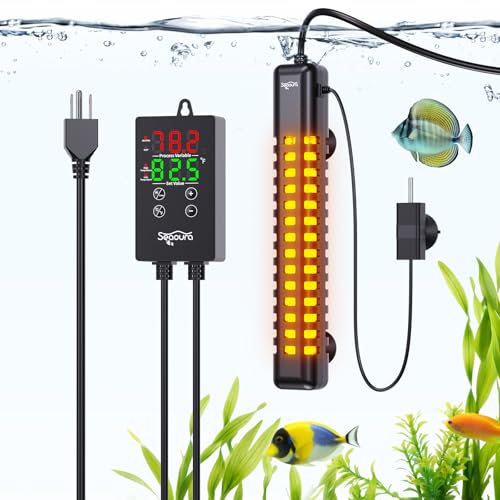
SEAOURA 50W small aquarium
heater with LED controller publishes, among its specifications, an accuracy of
plus or minus 1 degree Fahrenheit, for tanks from 5 to 15 gallons, with an external
LED controller, a switch between Celsius and Fahrenheit, and overheat and dry burn
protection. Its record carries the accuracy figure in its own list of advantages, as
accuracy stated at plus or minus 1 degree Fahrenheit, and is honest enough to add that
the accuracy and wattage are maker stated.
Read that figure as a band and you have the whole behaviour of the product: the
water will sit in a 2 degree Fahrenheit sawtooth, the element will run for about an
hour and rest for about an hour, and the display will read whatever the probe happens
to be seeing at that instant on the ramp. None of that is a defect. It is what the
published number means. See our
SEAOURA 50W
heater with LED controller review.
An
AZW 800W aquarium heater for
110 to 250 gallon tanks publishes the same stated accuracy of plus or minus 1
degree Fahrenheit at sixteen times the power, with a digital controller showing current
and set temperature, double quartz glass and three safety cut offs. That is the figure
that produces the 3.67 hour cycle above, and its record is appropriately careful,
listing as drawbacks that the wattage and range are maker stated, that the accuracy
claim is not independently verified, and that it needs full submersion and flow for
accuracy. That last drawback is the subject of the next section and it is the most
important sentence on the record. Details in our
AZW 800W heater
review.
Our own roundup of these is worth reading next to them, because it has the spread
in one place. Our
guide to aquarium heaters with a
guard publishes a thermostat accuracy of plus or minus 1 degree on one pick, within
plus or minus 2 degrees Fahrenheit on another, and plus or minus 1.8 degrees Fahrenheit
on a third. Those are three different swing widths, from 2 to 4 degrees peak to peak,
and the page presents them as three precision ratings rather than as three answers to
the question of how far the water will drift. They are the latter.
The number that cannot mean what it says
And then the inconsistency, which is the find of this page and which exists because
the same manufacturer splits the two halves of one specification across different
listings.
A
SEAOURA 50W small aquarium
heater for 5 to 10 gallon tanks publishes an adjustment of 0.1 degree steps, a
range of 63 to 94 Fahrenheit, an external dual LED controller and a memory function.
It publishes no accuracy figure at all. Its stablemate above publishes an accuracy of
plus or minus 1 degree and no adjustment step. Put the two together, which no single
listing lets you do, and the setting resolution is twenty times finer than the
interval the water actually occupies. Nineteen of the twenty available settings land
inside one swing of the sawtooth, where the instrument reading the water cannot tell
them apart.
To be clear about what is and is not wrong here. The 0.1 degree step is real: at 50
watts into 79,240 joules per kelvin, heating the water by 0.1 Fahrenheit takes 88
seconds, so the step is a physically achievable amount of heat. What it cannot be is a
distinguishable setpoint, because the control band is 20 times wider than the step and
the measurement that closes the loop is no better. A finer dial on a coarse
measurement does not produce finer control. It produces more numbers.
The record for this one is also the best in the group on the thing that matters,
listing as its main weakness that the probe must stay fully submerged to read
correctly and as a drawback that the probe must be fully submerged to detect
correctly. That is the right warning, and the next section is why. Full record in our
SEAOURA 50W
heater review.
The controller regulates at the sensor, and the sensor is in a gradient
A controller does not regulate the water. It regulates the one point where its
probe is, and it has no way of knowing whether that point represents the rest of the
tank. In a tank with a heater in it, it very often does not.
Work out how big the gradient is. Take the 300 watt heater, whose rod is 10.4
inches long. With the published cross section of about an inch by seven eighths, the
wetted surface is roughly 0.020 square metres. Natural convection from a hot vertical
surface into water runs somewhere between about 300 and 1,000 watts per square metre
per kelvin depending on the temperature difference and the geometry, and no listing
publishes it. Take the range at face value: 300 watts over 0.020 square metres needs a
surface to bulk temperature difference somewhere between 15 and 50 kelvin.
So the glass of a running heater is tens of degrees above the water it is sitting
in, and a plume of hot water is rising off it continuously. Against a control band of
1.111 kelvin, that gradient is between thirteen and forty five times the entire band.
Which means a probe placed in the plume is not slightly wrong. It is reading a
different system, and it will satisfy the controller and switch the element off while
the far corner of the tank is still cold.
This is why every one of these listings carries a probe warning and why
our own guide to aquarium
heater wattage already has it right. That guide says to position the heater near
good water movement so warmth spreads evenly, to keep the probe submerged and away
from the heating element, and that poor flow creates hot and cold pockets that stress
fish. All three of those are correct and this page is only adding the magnitude: the
pocket a probe can sit in is tens of degrees deep, so flow is not a refinement on a
good controller, it is the thing that makes the controller's reading mean anything at
all. A small circulation pump does more for temperature stability than any accuracy
figure on any box.
The two escapes, and both of them exist in our catalogue
There are exactly two ways out of a sawtooth and we carry one product for each,
which is lucky because almost nothing else on the site exposes either.
The first is to stop switching fully on and off. A
SEAOURA 300W aquarium heater
for 50 to 60 gallon tanks publishes something none of the others do: adjustable
power thermostat control that heats fast when the water is cold and then gently near
the target. That is proportional control, and it is a different kind of controller
rather than a better version of the same one. If the delivered power falls smoothly as
the error shrinks, the system can approach the setpoint and stay there instead of
crossing it, and the sawtooth collapses towards a line. It is the same idea as the
proportional, integral and derivative control that our
barbecue temperature controllers
guide describes on pellet grills, where a variable speed fan replaces an on and off
relay. The listing does not say how many power levels it has or over what error band
it tapers, which is the specification that would tell you how much of the swing it
removes, but the mechanism named is the right one. Record in our
SEAOURA
300W heater review.
The second is to be given the band itself, and exactly one product in our catalogue
does that. A
SEAOURA aquarium chiller fan
with timer and temperature control publishes fully customisable start and stop
thresholds across a 60 to 104 Fahrenheit range. Start and stop as two separate numbers
is the deadband, handed to the user as a setting, and it is the only place on this site
where the quantity this whole page is about is adjustable at all.
Which makes the trade visible, so it is worth stating. Narrow the gap between your
start and stop thresholds and the water holds closer to target, and the fan starts and
stops more often. Widen it and the fan runs in long calm stretches and the water drifts
further. For a fan that is an easy call and you should set it narrow, because a
brushless fan has no start load worth protecting and the only cost of frequent cycling
is the noise of it changing state. For a compressor it would be the opposite call. Our
SEAOURA
chiller fan review has the rest, and the separate reason that machine can only ever
move the water 3 to 7 degrees is worked out in
why an
evaporative cooler runs out of degrees in humid air.
Problems in our own records
Three worth reporting.
The first is the split specification above. Two listings from the same brand, both
50 watts, one publishing a 0.1 degree adjustment step with no accuracy and the other
publishing a plus or minus 1 degree accuracy with no step. Each number is harmless
alone and together they are a contradiction, and the catalogue is arranged so that a
buyer never sees them together.
The second is a sizing conflict between those same two 50 watt heaters. One is
rated for 5 to 10 gallon tanks and the other for 5 to 15, with the same 50 watts and
the same 63 to 94 Fahrenheit range. Wattage is what sets how much heat loss a heater
can replace, so the same element cannot correctly serve a tank range 50 percent wider.
One of the two ratings is optimistic and the listings give no way to tell which.
The third is a vocabulary problem across the whole site rather than a defect in any
record. The phrase "plus or minus" appears in 33 of our published pages, almost always
on a thermometer or a controller, and it is always introduced as accuracy. For an
instrument that only reads, accuracy is the right word. For an instrument that reads
and then switches, the same number is also the width of the interval the thing it
controls will occupy, and those are different claims about different quantities. We
have never drawn that distinction anywhere, and the result is 33 pages where a
specification is reported at half its actual significance.
The honest limit, and the free technique that beats the purchase
The specification that would settle this is the deadband itself, stated as a band
and separately from the sensor accuracy, and no product we carry publishes it that way.
Several publish the number and call it accuracy, two publish a setting resolution
instead, and one lets you set it without ever naming it. So you cannot shop for a
tighter band. You can only read an accuracy figure as a band, which is the single most
useful reading trick in this category, and it costs nothing.
Then two moves that beat buying a more accurate controller, and both follow from the
arithmetic rather than from preference.
Fix the measurement, not the controller. The band cannot be tighter than the sensor
can resolve, so a controller claiming a finer band than its probe can see is claiming
nothing. But a probe in moving water, away from the element, placed where the organism
or the food actually is, converts a reading from one corner of a gradient into a
reading of the system. That is a placement decision and it is free, and against a
gradient that can be tens of degrees deep it is worth more than any accuracy claim at
any size. A second, independent thermometer at the far end of the tank is the simplest
instrument you can add and the only way to find out whether the first one is telling
the truth.
And add thermal mass or reduce loss rather than adding power. The swing is the band
and the band does not move, so the only thing left to improve is how gently the system
travels across it. More thermal mass and less heat loss both lengthen the cycle, which
means fewer transitions and a gentler rate of change at every instant, which is what
actually matters to anything living in the water. Insulating the back and sides of a
tank, or keeping a lid on it, lowers the loss and therefore the duty cycle, and it does
so without touching a single published figure. The temperature still travels the same
two degrees. It just takes four hours to do it instead of two.
Why a Thermostat Lets the Temperature Swing at a glance
SEAOURA Aquarium Chiller Fan with Timer and Temperature Control
keepers fighting mild summer heat in home or office tanks
Digital control auto-cools between set temperatures
Cooling drop is limited to 3 to 7F
Why you can trust this guide
We compared these picks using verified manufacturer specifications, current retailer listings, and patterns in owner feedback, alongside editorial research. We focus on measurable differences such as performance, capacity, usability, and build quality. Pickpedia does not present editorial research as laboratory testing, and we do not claim hands-on testing unless it was actually performed.
SEAOURA makes a compact 50W aquarium heater for tanks from 5 to 15 gallons. It uses an explosion-proof quartz heating tube with a plastic protective cover. An external LED controller shows temperature to plus or minus 1 degree F and toggles between C and F. Overheat and dry-burn protection shut it off automatically. It fits freshwater and saltwater setups.
Best for Large 110 to 250 gallon aquariums and ponds
8.4/ 10 Pickpedia editorial score
AZW's 800W submersible aquarium heater targets large 110 to 250 gallon tanks. It pairs double explosion-proof quartz glass with an ABS outer shell to guard fish from scalding. A digital LED controller shows current and set temperatures with stated accuracy of plus or minus 1 degree F. Three safety layers cover off-water warning, over-temperature cutoff, and anti-boiling protection. Memory function keeps your setting after a power outage.
Best for small 5 to 10 gallon tanks needing controllable heat
8.6/ 10 Pickpedia editorial score
The SEAOURA 50W aquarium heater warms 5 to 10 gallon tanks and pairs with a separate temperature probe and external dual LED controller. It suits bettas, tropical fish, shrimp, and small turtles. The maker lists dual safety protection, adjustable over-temperature limits, 0.1 degree precision control, a memory function, and an explosion-proof quartz core in an ABS shell.
SEAOURA's 300W heater warms 50 to 60 gallon fish and turtle tanks. A connected temp probe reads several areas and doubles as a thermometer, while an external controller sets the target safely. Adjustable-power thermostat control heats fast when cold, then gently near target to save energy. Over-temperature protection with an alarm, 0.1 degree steps, a memory function and quartz-in-ABS build round it out.
Wattage300W
Tank range50 to 60 gallons
Rod length10.4 in
Temperature range63 to 94 F (17 to 34 C)
Power cord37.4 + 59 in
Sensor cord19.68 in
ElementPure nickel alloy
HousingThickened quartz + ABS
Pros
Adaptive power for fast then gentle heating
Wired probe reads several areas and shows temperature
Best for keepers fighting mild summer heat in home or office tanks
8.6/ 10 Pickpedia editorial score
SEAOURA's chiller fan cools aquarium water by evaporation, dropping it 3 to 7F. A high-sensitivity probe drives fully customizable start and stop thresholds from 60F to 104F, so the fan runs only when needed. Ten speeds, one to three fan heads, a 24-hour programmable timer, and a 720-degree gooseneck give flexible, largely hands-off cooling for many tank types.
Cooling methodEvaporative fan
Cooling drop3 to 7F
Temp control range60F to 104F
Speeds10 adjustable
Fan heads1 to 3
Timer24-hour programmable
Gooseneck5.4 in, 720-degree
Bracket fit0.2 to 1 in rims
Pros
Digital control auto-cools between set temperatures