Tools & DIY 9 BBQ Temperature Controllers for Steady Heat
P
By the Pickpedia Team
·9 picks compared
·Last verified October 2026
Affiliate disclosure: As an Amazon Associate, Pickpedia earns from qualifying purchases. Links on this page are paid links, and we may earn a commission at no extra cost to you. This never affects our picks or scores.
Quick answer
Pick a controller that matches your gear. Plug-and-play thermostats like the Inkbird ITC-308 or bayite BTC211 switch heating and cooling outlets on and off. Pellet owners want a board replacement, while fan-driven units like TempMaster Solo actively hold smoker temperature through variable airflow and probes.
9 BBQ Temperature Controllers for Steady Heat at a glance
Why you can trust this guide
We compared these picks using verified manufacturer specifications, available manuals and documentation, current retailer listings, and patterns in owner feedback, alongside editorial research. We focus on measurable differences such as performance, capacity, usability, and build quality. Pickpedia does not present editorial research as laboratory testing, and we do not claim hands-on testing unless it was actually performed.
How we chose: We compared nine controllers, weighing relay capacity, probe range, display clarity, and how each holds steady heat across real grill and smoker setups.
Steady heat separates good barbecue from guesswork. Some cooks only need a simple outlet thermostat to switch a heater or fridge on and off around a target. Others running smokers want active fan control that reacts to swings and probes that track meat as it cooks.
This roundup groups the two families so you buy the right tool. We read every specification, cross-checked owner reports, and noted honest limitations. Whether you want plug-and-play simplicity or competition-style fan automation, one of these should fit how you cook.
Our top picks
A dependable all-rounder built around a dual relay that powers both refrigeration and heating gear as conditions change. The dual display window shows measured and set temperature together, so you always know where things stand. Switching between Celsius and Fahrenheit is simple, and buzzer alarms warn on high, low, or sensor faults. A customizable compressor delay protects connected equipment from short cycling. Rated for an 1100 watt load at 110 volts, it suits typical home projects rather than heavy industrial loads. Owners praise its steady behavior, though the interface takes a short read of the manual before the parameter codes click.
RelayDual, heating and cooling
Max load1100 W at 110 V
DisplayDual window, °C/°F
AlertsHigh, low, sensor fault buzzer
Pros
- Dual relay handles heating and cooling gear
- Simultaneous measured and set readouts
- Compressor delay guards equipment
Cons
- Parameter menu takes learning
- Load ceiling limits heavy equipment
Check price on Amazon ›
A direct replacement board for many Traeger wood pellet grills, standing in for factory item BAC236. It brings auto start ignition, a high mode for maximum heat, plus smoke and temperature modes spanning 180 to 375 Fahrenheit. A large knob turns easily, letting you nudge settings without opening the lid for long. The LED display stays readable even in direct sunlight, showing the cook temperature inside the grill. Installation is embedded, sized roughly 140 by 70 millimeters on 120 volts. One clear limitation, it is not compatible with PTG models, so confirm your grill before ordering.
FitsTraeger models except PTG
ReplacesItem BAC236
Temp modes180 to 375 °F
Voltage120 V, embedded install
Pros
- Auto start ignition built in
- Sunlight-readable LED display
- Large knob for quick adjustments
Cons
- Not compatible with PTG models
- Verify fitment before buying
Check price on Amazon ›
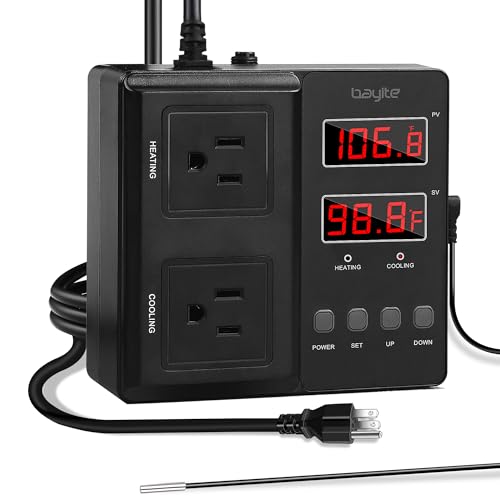
Stepping up the wattage ceiling, this plug-and-play unit handles up to 1650 watts at 110 volts through dual relay outputs for cooling and heating at once. Setup stays simple with Celsius or Fahrenheit display and a dual window showing live and target temperature. High and low alarms fire when readings overshoot, and compressor delay protection plus temperature calibration add safety and accuracy. A 9.8 foot waterproof probe reaches a range of -58 to 230 Fahrenheit, covering most home tasks. It ships with a one year warranty. The higher load headroom is the main reason to pick it over lighter thermostats.
Max load1650 W at 110 V
RelayDual output
Probe9.8 ft waterproof
Range-58 to 230 °F
Pros
- Higher wattage headroom than most
- Long waterproof probe included
- One year warranty
Cons
- Overshoot alarm, not proportional control
- Menu codes need a quick read
Check price on Amazon ›
With a wide -22 to 572 Fahrenheit span and a 30 amp relay, this regulator targets bigger loads like incubators, fermenters, and greenhouses. It works as a switch, so you connect a separate power supply for the load, then set a differential to turn it on and off. A 1 degree Fahrenheit accuracy claim keeps ranges tight, and delay start plus temperature correction fine-tune behavior. Settings save through power cycles, handy after outages or a vacation. Alarms flag limit breaches and sensor errors. Because it outputs no voltage directly, wiring in your own supply is required, which suits builders more than plug-and-play shoppers.
Range-22 to 572 °F
Relay30 A
Accuracy1 °F claimed
Sensor2 m NTC
Pros
- Large 30 A relay for big loads
- Wide temperature span
- Settings persist after power loss
Cons
- No direct voltage output, wiring needed
- Switch behavior, not proportional
Check price on Amazon ›
Designed for straightforward plug-and-play use, this unit uses a standard US outlet and drops the WiFi to keep operation simple. Insert the probe, set your on and off points, and it switches your device to hold the range you want. Heating and refrigeration modes swap depending on what you plug in. Rated at 10 amps and 1100 watts on 110 volts, it fits germination, home brewing, fermentation, rooting, sous vide, incubation, and aquarium tasks. The 9.8 foot probe reads -58 to 230 Fahrenheit with an enhanced waterproof tip. Its 10 amp ceiling is the tradeoff, so pair it with lighter appliances rather than demanding equipment.
Rated load10 A, 1100 W at 110 V
OutletStandard US, no WiFi
Probe9.8 ft waterproof
Range-58 to 230 °F
Pros
- Simple plug-and-play setup
- Standard US outlet fit
- Broad hobby applications
Cons
- 10 amp ceiling limits appliances
- On/off switching only
Check price on Amazon ›
Built heavy-duty for demanding spots, this box pairs plug-and-play wiring with a selectable 10, 15, or 20 amp circuit breaker for safety. You can order it with or without a waterproof cover for outdoor duty. Its range runs -22 to 572 Fahrenheit at 0.1 degree resolution, with heating or cooling function, two timer types, calibration, and a high or low buzzer alarm. Compressor delay protection reaches up to 10 minutes, and the 10 foot cable gives placement room on 100 to 120 volt supply. Choosing amp rating and cover options at purchase means reading the listing carefully so your selection matches your setup.
Breaker10, 15 or 20 A selectable
Range-22 to 572 °F
Resolution0.1 degree
Cable10 ft, 100 to 120 V
Pros
- Selectable breaker for safety
- Optional waterproof cover
- Fine 0.1 degree resolution
Cons
- Options must be chosen at checkout
- Bulkier than simple thermostats
Check price on Amazon ›
Not a controller but a fast handheld probe, this instant-read thermometer suits cooks who verify doneness by hand. An IPX6 waterproof rating lets you rinse it under running water, so cleanup stays quick. Large backlit numbers read easily indoors or out at any hour. A calibration function keeps accuracy dependable over time, and a foldable probe stores neatly in a drawer, with a magnetic back and hook for grabbing it fast. Reviewers value the one second reading claim for busy cooks. Since it does not automate heat, treat it as a companion to a controller rather than a replacement for one.
TypeInstant-read handheld probe
WaterproofIPX6 rating
DisplayLarge backlit numbers
StorageFoldable, magnetic, hook
Pros
- Fast one second reading claim
- Fully washable IPX6 body
- Compact foldable storage
Cons
- Does not automate heat
- Manual checking only
Check price on Amazon ›
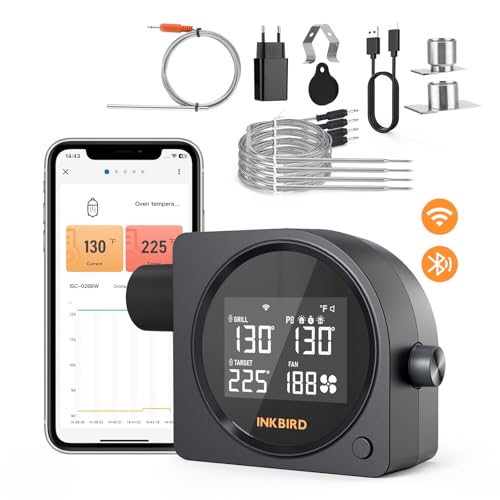
This connected fan controller adds 5G WiFi and Bluetooth 5.0, letting you watch the grill from a phone and even share monitoring across people. A built-in fan reaching 5 meters per second adjusts speed to hold your target, and a lid detector stops the fan when the lid opens to save power. The LCD screen, alarms, timer, and a temperature graph help avoid over or undercooking, with three days of offline data saved. USB power means a power bank runs it away from outlets. Five food-grade probes cover four meats and ambient, quoted at plus or minus 0.9 Fahrenheit. App reliance is the tradeoff for anyone who prefers pure hardware controls.
Connectivity5G WiFi, Bluetooth 5.0
Fan5 m/s, lid detection
Probes5, ±0.9 °F claimed
Power5 V USB, power bank ready
Pros
- App monitoring with temperature graph
- Automatic fan and lid detection
- Five probes cover meats and ambient
Cons
- Leans on the app for full use
- Needs USB power source
Check price on Amazon ›
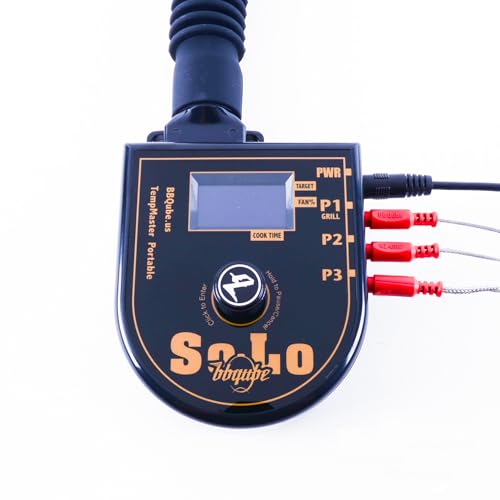
Compact yet capable, TempMaster Solo drives precise airflow with a variable speed fan run by an advanced chipset and fast-reading probes. One-dial operation replaces greasy push buttons, making menu navigation and temperature changes simple with messy hands. The maker points to stable, precise control that limits swings, aiming at competition-level results. Three fast-responding probes ship in the box, a small grill probe plus long and short meat probes, each with a practical wire wrap. A hardcase keeps rain out and stores everything, and one adapter for large-vent Kamado grills is included. Fit depends on your grill vent, so check adapter compatibility for your specific cooker.
FanVariable speed, chipset driven
ControlsOne-dial operation
Probes3, grill and two meat
ExtrasHardcase, Kamado adapter
Pros
- One-dial control with messy hands
- Three fast-responding probes included
- Hardcase and adapter in box
Cons
- Adapter fit varies by grill vent
- Single adapter covers one vent type
Check price on Amazon ›
What to look for
Match the controller to your cooker
Two families exist here. Outlet thermostats switch a plugged-in heater or cooler on and off around a target, ideal for brewing, fermentation, or an incubator. Fan controllers actively feed air to a smoker to hold temperature. Pick the family that matches how you cook before comparing features.
Check the load rating
Every switching controller lists a maximum load in amps and watts. Running a device beyond that ceiling risks tripping or damage. Lighter tasks pair fine with a 10 amp unit, while bigger equipment wants higher-rated relays. Read your appliance label and leave headroom rather than working at the limit.
Probes and range matter
A longer probe reaches into place easily, and waterproof tips survive washdowns. Confirm the measuring range covers your cooking or fermentation targets. Multiple probes let smoker cooks watch meat and ambient at once, while a single handheld reader suits quick doneness checks away from any controller.
Alarms, calibration, and delays
Useful safety extras include high and low alarms, sensor-fault warnings, and compressor delay that prevents rapid short cycling. Calibration lets you correct small reading errors against a trusted reference. For pellet or fan units, confirm model compatibility and adapter fit before ordering so the hardware works with your grill.
Frequently asked questions
Do these controllers work on any grill?
No. Outlet thermostats control whatever device you plug in, not the grill directly. Pellet boards replace specific factory units, and fan controllers need a compatible vent or adapter. Always confirm your model and connection type before buying.
What is the difference between a thermostat and a fan controller?
A thermostat switches power to a heater or cooler on and off around your setpoint. A fan controller pushes measured airflow into a smoker, adjusting speed to hold temperature. Smokers benefit most from the fan approach.
Can I use one outdoors?
Some units offer waterproof probes or optional weather covers, and a few run on USB so a power bank works away from outlets. Check the waterproof rating and ambient temperature limits, and shelter any non-rated electronics from rain.
How accurate are they?
Accuracy claims vary, from roughly 1 degree on switching thermostats to tighter figures on probe systems. Many offer calibration so you can correct against a trusted reference. Treat quoted figures as manufacturer specifications and verify against a known-good thermometer.
Do I need WiFi?
Not necessarily. Several models deliberately skip WiFi for simple hands-on operation. Connected units add phone monitoring, graphs, and alerts, which help during long cooks. Choose based on whether you want remote visibility or prefer pure hardware controls.
Will a controller stop temperature swings completely?
It reduces them but rarely eliminates them. Switching thermostats cycle around a band, while fan controllers react faster to hold a target. Cooker insulation, weather, and probe placement all affect how steady your heat stays.
What load can I safely connect?
Stay under the listed maximum amps and watts for your voltage. Options here range from 10 amp up to a 30 amp relay and selectable breaker boxes. Read your appliance label and leave headroom rather than running at the ceiling.
Can I use these for home brewing or fermentation?
Yes, the dual-relay outlet thermostats are popular for brewing, fermentation, and incubation because they switch both heating and cooling gear. Confirm the temperature range and probe suit your vessel, and use the compressor delay to protect any refrigeration.
The verdict
Inkbird ITC-308 Digital Temperature Contro...
9.2/10
For most cooks, the Inkbird ITC-308 earns Best Overall with dependable dual-relay switching and clear readouts. Need more headroom, the bayite BTC211 handles higher wattage, while KETOTEK KT8230 suits heavy equipment. Smoker fans should look at TempMaster Solo for steady airflow or the 5G WiFi unit for app monitoring. Traeger owners want the pellet replacement board, and the TempPro probe pairs well as a doneness checker. Pick by cooker and load, not by looks.
Check price on Amazon ›
Our top pick, secure checkout via Amazon
Note: Availability and specifications change often. Always confirm the current details on Amazon before buying.