Why an Evaporative Cooler Runs Out of Degrees in Humid Air
PBy the Pickpedia Team·3 picks compared·Last verified October 2026
Affiliate disclosure: As an Amazon Associate, Pickpedia earns from qualifying purchases. Links on this page are paid links, and we may earn a commission at no extra cost to you. This never affects our picks or scores.
This page contains affiliate links. If you buy through one we may earn a
commission, at no cost to you.
There is no such temperature, and that is the useful part of the answer. An
evaporative cooler does not stop at some number on a thermometer. It stops at a
humidity, and between those two extremes it does not fade gradually either: the
amount of cooling available is an exact subtraction you can look up, and at 90
degrees Fahrenheit it falls from about 32 degrees of available drop in desert air to
2.7 degrees at 90 percent humidity. Same machine, same outside temperature, same
everything. A factor of twelve, set entirely by how much water the air will still
accept.
Our own guide to
evaporative
coolers versus air conditioners already says the right thing in words: these work
well only in dry air, in humid conditions little water can evaporate so you get
almost no cooling, and cracking a window helps. All three are correct and this page
is not here to argue with any of them. It is here to put numbers on them, because the
numbers change what you do with the advice.
It does not remove heat, and that is a statement about the arithmetic
Start with what the machine does to a kilogram of air, because the usual
description is slightly too generous.
Air carries energy in two forms. Sensible heat is the part a thermometer reads,
and for dry air it takes about 1,005 joules to raise one kilogram by one kelvin.
Latent heat is the energy stored in water vapour, and it is enormous by comparison:
turning liquid water into vapour at room temperature takes about 2,442 kilojoules per
kilogram. The sum of the two is the enthalpy, and that is the number to watch.
An evaporative cooler evaporates water into the airstream. The energy to do that
comes out of the air's sensible heat, so the temperature falls. But the energy has not
gone anywhere: it is now sitting in the water vapour, in the same air, moving down the
same duct. The enthalpy is unchanged. The air leaves cooler and wetter and carrying
exactly as much energy as it arrived with.
So the machine is not a heat pump. It is an energy converter, and the correct way
to think about it is as a trade: you are spending the air's dryness to buy a lower
temperature. Which immediately tells you where the limit is. The process can continue
only while the air is still capable of accepting water, and it must stop the instant
the air is saturated.
The wet bulb, which is where it stops
That stopping point has a name. If you evaporate water into air at constant
enthalpy until the air is fully saturated, the temperature it arrives at is the wet
bulb temperature. It is called that because a thermometer with a wet wick on its bulb,
in moving air, reads exactly this: the wick evaporates, cools, and settles at the
temperature where its cooling balances the heat arriving from the air.
The difference between the ordinary dry bulb temperature and the wet bulb
temperature is the wet bulb depression, and it is the entire cooling budget. Not the
cooling you will get, which is less. The cooling that exists to be got. No
evaporative machine of any size or design can take air below its own wet bulb,
any more than a ball can roll uphill.
Here is the subtraction worked out for air at 90 degrees Fahrenheit, which is
32.2 Celsius. At 20 percent humidity the wet bulb is 62.5 degrees, so the depression
is 27.5. At 40 percent it is 71.0 degrees and the depression is 19.0. At 60 percent
the wet bulb has climbed to 78.2 and the depression is down to 11.8. At 90 percent
the wet bulb is 87.3 and the depression is 2.7. At 100 percent the wet bulb equals
the dry bulb, by definition, and the depression is zero.
Notice the shape, because it is the answer to the question. The budget does not
hold up and then collapse near the end. It is falling the whole way, and it is already
down by a third by the time you reach the humidity of an ordinary temperate summer
afternoon. Arizona and Florida are not two sides of a threshold. They are two points
on a curve that is sloping under your feet the entire time.
The curve is computed from the Magnus saturation vapour pressure relation and moist
air enthalpy at standard pressure, by solving for the adiabatic saturation
temperature. The table uses only figures our own listing publishes, except the ice
pack mass, which it does not state and which is taken as 200 grams each.
Then the pad takes its cut
A real machine does not reach the wet bulb either, and the reason is contact. The
air passes through a wet honeycomb pad in a fraction of a second, so only part of it
gets close enough to a wet surface to saturate. The fraction of the available
depression a machine actually delivers is the saturation effectiveness, and for a
properly deep rigid media pad it sits somewhere between 70 and 90 percent. For a thin
pad in a slim portable tower it will be lower, and no listing we carry publishes it.
At a generous 80 percent, the 19 degrees of budget on an ordinary dry day becomes 15.2
degrees of actual drop, and the 2.7 degrees of budget in humid air becomes 2.2.
Which is worth saying plainly: 2.2 degrees Fahrenheit at the outlet is not a
disappointing performance. It is the machine working correctly against a budget that
had almost nothing in it.
What one of our own machines can and cannot do, from its own figures
A
41 inch evaporative air
cooler tower fan publishes enough to work all of this out, which is more than
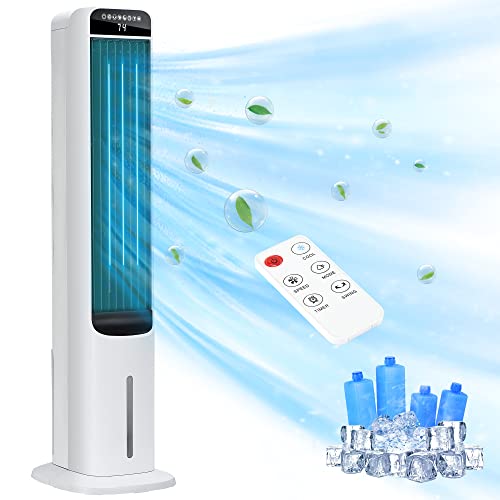
most. Its record gives a 4 litre tank, 80 watts, four reusable ice packs, honeycomb
pads, coverage up to about 300 square feet, a 12 hour timer, 120 degree oscillation
and under 35 decibels in sleep mode. It notably does not publish a temperature drop,
and after everything above, that is to its credit: a drop figure without a stated
humidity would be meaningless, and it has not printed one.
Start with the case the physics forbids. Take that 300 square feet at an eight
foot ceiling, which is 68 cubic metres, holding about 79 kilograms of dry air. At 90
degrees and 40 percent humidity that air carries 12.0 grams of water per kilogram,
and at its wet bulb, saturated, it would carry 16.3. The difference is 4.3 grams per
kilogram, so the whole room can accept 79 times 4.3, which is 335 grams of water.
That is 335 millilitres out of a 4 litre tank, which is 8.4 percent of it, and when
it is gone the air in that room is saturated and the cooling is over. Not reduced.
Over. In a sealed room the machine has roughly one tenth of one tankful of work
available to it, no matter how long the timer runs.
So ventilation is not a tip. It is the mechanism. The machine's actual job is to
pass outside air through a wet pad and push the saturated result out of the room
again, and the window is the second half of the appliance. Our existing guide says
cracking a window helps, which is right, and the correction worth making is to the
word helps. Without it there is no steady state at all.
Now the running figures. Stretch the 4 litre tank across the full 12 hour timer and
you are evaporating 0.093 grams per second, which at 2,442 kilojoules per kilogram is
226 watts of cooling. That is the machine's whole output, and it is a reasonable
number for a personal cooler. Against it, the 80 watt motor puts 80 watts of heat
straight back into the room, because every watt a fan draws ends up as warm air. So
the net is 146 watts, and only if the humid air is genuinely leaving. In a sealed
room the net is minus 80 watts, and over the full 12 hours that motor adds 3.5
megajoules to a room whose air the evaporation was only ever going to shuffle between
two forms.
The ice packs deserve the same treatment, because they are the headline feature
and the record says the water and ice chilled pads cool the air more than a fan. Four
packs at 200 grams each, which is an assumption because the mass is not published,
hold 800 grams of ice. Melting ice absorbs 334 kilojoules per kilogram, so the whole
set is worth 267 kilojoules. Spread over the 12 hour timer that is 6.2 watts, against
226 from evaporation. The ice packs are 2.7 percent of the cooling, they are a one
time contribution rather than a rate, and their real value is making the first few
minutes at the outlet feel colder than the average, which is a genuine comfort effect
and not a cooling capacity. Full record in our
41 inch evaporative air
cooler review.
One thing in that listing does not hold together, and it is the headline. It is
sold as a 3 in 1 fan, humidifier and evaporative cooler. A humidifier and an
evaporative cooler are the same machine. Both of them pass air over water and
evaporate some of it into the stream, and there is no setting at which one happens
without the other, because they are a single process described on two different axes:
the air gets wetter, which is the humidifier, and therefore it gets cooler, which is
the cooler. So it is a 2 in 1 at most, with the fan as the genuine second mode, and
the listing is selling the same function twice. To the record's credit, its own
drawbacks are the most honest part of it, saying flatly that this is an evaporative
cooler and not an air conditioner, that it works poorly in humid weather and adds
humidity, and that it is a spot cooler for small rooms.
The one listing on this site that publishes the ceiling
There is a product in our catalogue that is an evaporative cooler under another
name, and it is the only one anywhere on the site that prints the physical limit as a
number. A
SEAOURA aquarium chiller
fan with timer and temperature control blows air across the water surface of a
tank, which is exactly the same process with the water in a different place, and its
record states a cooling drop of 3 to 7 degrees Fahrenheit.
Check that against the arithmetic. Indoor air at 72 degrees and 50 percent humidity
has a wet bulb of 59.9 degrees, so the depression is 12.1 degrees. A fan blowing over
an open water surface has a far worse contact efficiency than a honeycomb pad, since
the air only touches the top of the water, so 3 to 7 degrees is 25 to 58 percent of
the available budget. That is entirely consistent, and the upper end is generous. The
number is real.
And the record does the honest thing twice over, listing as a drawback that the
cooling drop is limited to 3 to 7 degrees and naming that same figure as the main
weakness, rather than as the feature. It also names the cost nobody else does, that
evaporation lowers the water level faster, which is what the tank pays for the cooling. One
caution on reading it: the 60 to 104 degree control range is a thermostat range and
not a cooling range, and the two sit near each other on the page. Details in our
SEAOURA
chiller fan review.
The opposite machine, and why you cannot run both
If the air is already humid, the useful appliance is the one that takes water out.
A
CLEVAST compact
dehumidifier with drain hose publishes up to 23 ounces, or 700 millilitres, per
day, for rooms up to 500 square feet, with a real time humidity display and either a
tank with auto shut off or a continuous hose.
Put its figure on the same scale as the cooler's and the contrast does the
arguing. The cooler at full output evaporates 0.093 grams per second, which is 8.0
kilograms of water into the room per day. The dehumidifier removes 0.7 kilograms per
day. So the cooler adds moisture 11.4 times faster than the dehumidifier takes it
away, and running the two in one room is not a compromise, it is a rout. In energy
terms the dehumidifier is moving about 20 watts of latent heat and the cooler is
moving 226 the other way.
Its record is also unusually straight about the one thing that matters for a
thermoelectric unit, listing as drawbacks that the 700 millilitre capacity suits small
spaces only, that it is not for large rooms, serious damp or basements, and that it
works best in warmer conditions. That last one is the real constraint and it is
correctly stated: a semiconductor cooling element has a fixed temperature difference
to work with, so in a cold room the cold plate cannot get far enough below the dew
point to condense much. Full record in our
CLEVAST compact
dehumidifier review.
Problems in our own records
Three worth reporting.
The first is the 3 in 1 claim above, which sells one process as two features.
The second is an absence across the whole category. Not one evaporative product we
carry publishes an airflow in cubic feet per minute, a pad depth, or a saturation
effectiveness. Without an airflow figure you cannot convert a cooling power into a
temperature drop at the outlet, which is the only number a buyer actually wants, and
without an effectiveness figure you cannot tell how much of the available budget the
machine captures. Everything on this page about the tower had to be worked from its
tank and its timer instead, which is a roundabout route to an answer the listing could
have given directly.
The third is the ice pack mass, which is not published for a feature that is named
five times in one listing. Four packs could be 100 grams each or 400, which is the
difference between 3 watts and 12, and in neither case does it change the conclusion,
which is itself the point: the feature cannot be large enough to matter whatever the
mass turns out to be.
The honest limit, and the free technique that beats the purchase
The specification that would settle this is your own local wet bulb, and no product
can publish it because it is a property of where you live rather than of the machine.
What you can do before buying is get it for nothing. Weather services publish the dew
point alongside the temperature, and the wet bulb always lies between the two, nearer
the dry bulb than the dew point. If your dry bulb and your dew point are close
together on a hot afternoon, the budget is small and no machine will find more of it.
If they are 30 degrees apart, an evaporative cooler is the right appliance and will
feel like magic.
Then the technique that takes nothing and, for one person in a room, beats the
purchase outright. You are already an evaporative cooler. Sweat evaporating from skin
draws on the same latent heat and the same wet bulb depression, and it has an
unlimited water supply arriving from the inside. All a plain fan does is raise the
mass transfer coefficient at your skin so that more of it evaporates per second. The
reason that wins is the mass you have to act on: cooling 79 kilograms of room air by
5 kelvin takes about 400 kilojoules, whereas shifting an extra 50 watts of a person's
own output from sensible to latent takes 50 watts and no tank. A fan draws less power
than the cooler's 80 watts, adds no humidity to the room, and needs no window
open.
So the honest ranking is narrower than the category suggests. If the air is dry and
you want to cool a room, an evaporative cooler is genuinely the efficient answer, and
the window has to be open. If the air is humid and you want to cool a room, nothing
evaporative will do it and the appliance that helps is the dehumidifier. And if you
want to cool a person rather than a room, which is what most of these are actually
bought for, a fan and a glass of water spend the same wet bulb depression on a target
one four hundredth the size.
Why an Evaporative Cooler Runs Out of Degrees in Humid Air at a glance
Everyday damp in a small bedroom, bathroom or closet
Quiet semiconductor removal, no compressor
Modest 700ml/day capacity, small spaces only
Why you can trust this guide
We compared these picks using verified manufacturer specifications, current retailer listings, and patterns in owner feedback, alongside editorial research. We focus on measurable differences such as performance, capacity, usability, and build quality. Pickpedia does not present editorial research as laboratory testing, and we do not claim hands-on testing unless it was actually performed.
Best for Low-cost portable spot cooling in small rooms in dry conditions
8.4/ 10 Pickpedia editorial score
A 41-inch tower evaporative air cooler combining a fan, humidifier and swamp cooler, with 3 speeds, 4 modes, 120 degree oscillation, 4 reusable ice packs, honeycomb pads, a 4-litre tank, remote and LED panel with a 12-hour timer, an 80-watt draw and ETL listing, for spaces up to about 300 square feet in dry conditions.
Best for keepers fighting mild summer heat in home or office tanks
8.6/ 10 Pickpedia editorial score
SEAOURA's chiller fan cools aquarium water by evaporation, dropping it 3 to 7F. A high-sensitivity probe drives fully customizable start and stop thresholds from 60F to 104F, so the fan runs only when needed. Ten speeds, one to three fan heads, a 24-hour programmable timer, and a 720-degree gooseneck give flexible, largely hands-off cooling for many tank types.
Cooling methodEvaporative fan
Cooling drop3 to 7F
Temp control range60F to 104F
Speeds10 adjustable
Fan heads1 to 3
Timer24-hour programmable
Gooseneck5.4 in, 720-degree
Bracket fit0.2 to 1 in rims
Pros
Digital control auto-cools between set temperatures
Best for Everyday damp in a small bedroom, bathroom or closet
8.4/ 10 Pickpedia editorial score
A compact, quiet semiconductor dehumidifier that removes up to 23 oz (700ml) of moisture per day for small rooms up to 500 square feet, with a real-time humidity display, tank drainage with auto shut-off or a continuous drain hose, a quiet brushless motor with sleep mode and timer, and a slim design.
BrandCLEVAST
TypeSemiconductor dehumidifier
RemovalUp to 23 oz (700ml) per day
CoverageUp to 500 sq ft (small rooms)
DrainageTank with auto shut-off, or drain hose
DisplayReal-time humidity
MotorQuiet brushless DC, sleep mode, timer
Size8.8 by 4.9 by 13.5 inches
ColourWhite
Pros
Quiet semiconductor removal, no compressor
Two drainage options: tank or continuous hose
Real-time humidity display
Quiet enough for a bedroom, with sleep mode and timer