PBy the Pickpedia Team·6 picks compared·Last verified October 2026
Affiliate disclosure: As an Amazon Associate, Pickpedia earns from qualifying purchases. Links on this page are paid links, and we may earn a commission at no extra cost to you. This never affects our picks or scores.
This page contains affiliate links. If you buy through one we may earn a
commission, at no cost to you.
Probably yes, and the reason is that Low has never been a temperature. It is a
wattage. A slow cooker has no thermostat on Low at all: a band element runs at a fixed
power and the food settles wherever the heat going in equals the heat leaking out. That
makes the temperature a consequence of two numbers, one of which the maker chooses and
neither of which is printed anywhere.
And the sensitivity is brutal. On a six quart crock, thirty watts is about eighteen
degrees. Thirty watts is nothing, it is less than a phone charger, and it is the entire
distance between a gentle braise and a rolling boil. So two cookers whose dials say the
same word can be doing completely different things, and a maker who quietly moved the
element up by a fifth has moved your Low from a simmer to a boil without changing a
single word on the box.
The equation, which has only three terms
Heat leaves a slow cooker in proportion to how much hotter the food is than the
kitchen. Call that constant the loss coefficient. Then the steady temperature is the
room temperature plus the element power divided by the loss coefficient, and that is the
whole model.
Put representative numbers in, clearly labelled as representative because nothing in
this category publishes them. Take a six quart crock, which is 5.678 litres, as a
cylinder 220 millimetres across filled 149 millimetres deep, inside a shell 260
millimetres across and 200 tall with a glass lid 230 across. That gives an effective
losing area of 0.231 square metres, and at an overall loss coefficient of 7 watts per
square metre per kelvin the constant comes out at 1.62 watts per kelvin.
Invert it and you have the number that matters: 0.617 kelvin per watt. Now read the
ladder off it, against a 22 degree kitchen.
At 100 watts the food settles at 83.7 degrees. At 110 watts, 89.9. At 120 watts, 96.1.
At 126.4 watts it reaches 100 and stops, because at 100 degrees the water starts boiling
and a boiling liquid cannot be made hotter while any of it is still liquid. Above 126
watts the extra power does not raise the temperature at all. It makes steam.
That is the answer to the question as asked. Nothing is running hotter than 100
degrees, because nothing can. What changed is which side of 126 watts the element sits
on, and how much of the eight hours is spent on the boiling side of it.
The cooker that cannot be checked, and it is the only dedicated one we carry
A
Hamilton Beach 6 quart slow
cooker is the traditional machine the question is about, and its record is the
clearest possible demonstration of the problem, because it contains every figure except
the one that decides. It publishes six quarts, a stoneware crock that holds a six pound
chicken or a four pound roast or barbecue for twenty five sliders, three settings reading
Low, High and Keep Warm, and a single dial with no timer. Then its own performance text
says the quiet part out loud: "Heating runs even, though specific temperature ranges are
not listed."
No wattage. No temperature. Three words on a dial, and the arithmetic above says that
those three words are standing in for a number that decides everything, with an
eighteen degree swing hiding inside every thirty watts of it. Our
slow cooker roundup carries the same gap across the
group, and our
review of this cooker has the
rest of its feature list.
The companion question in the same forum, about a seventies cooker with two separate
High settings, now answers itself. Two Highs is not a redundancy. It is a maker who
understood that the dial sets power and gave you two of them, which is more honest than
a single word.
Above the threshold the surplus becomes water, and you can count it
Once the pot is at 100 degrees, the energy balance changes character. The loss through
the walls is fixed at 126 watts, because the temperature difference is fixed. Everything
above that goes into turning liquid water into steam, and water absorbs 2,257 joules for
every gram it evaporates.
So divide. At 140 watts the surplus is 13.6 watts, which is 21.7 grams an hour. At 160
watts, 53.6 grams an hour. At 200 watts, 117.4. At 250 watts, 197.1, which is nearly two
hundred grams of liquid leaving your dinner every hour.
Now the part that ties the four questions in that forum into one answer, because the
other three are all about food drying out. The loss rate is absolute. It does not care
how much is in the pot. But the fraction lost does.
The straight line and the clamp are exact: a fixed power source reaches equilibrium where
power equals loss, loss is proportional to the temperature difference, and water boiling
at atmospheric pressure cannot be pushed past 100 C while any of it remains liquid. The
1200 watts, the 700 watts, the six quarts and the three quarts are published by our own
listings. Everything geometric is representative and stated as such, because no slow
cooker or pressure cooker we carry publishes a dimension: the 0.22 metre crock, the 8
millimetre stoneware wall, the 0.10 metre band and the overall loss coefficient of 7
watts per square metre per kelvin are all assumptions. On a leakier shell at 10 watts per
square metre per kelvin the boiling threshold moves from 126 to 181 watts and the slope
falls from 0.617 to 0.432 kelvin per watt, so thirty watts becomes 13.0 kelvin instead of
18.5. The direction never changes, because the slope is one over the loss coefficient and
nothing in any product makes that number large.
Fill is the control, and it is three times stronger than the dial
Work the eight hours properly. A full crock holds 5.678 kilograms of stew at about
3.8 kilojoules per kilogram per kelvin, and the stoneware itself adds about 2.21, for a
total heat capacity of 23.8 kilojoules per kelvin. Half full, that falls to 13.0, because
the stoneware does not shrink.
From 5 degrees out of the fridge to the clamp at 100 is 95 kelvin. At 200 watts, net of
a mean loss of 49 watts during the climb, the full crock takes 4.17 hours to get there and
the half filled one takes 2.28. Both then boil for the rest of the cook.
Full crock: 3.83 hours of boiling at 117.4 grams an hour is 450 grams gone, which is
7.92 percent of the charge. Half filled crock: 5.72 hours of boiling is 672 grams gone,
out of a charge half the size, which is 23.66 percent. The ratio is 2.99.
Halving the fill triples the proportion of liquid you lose, with the dial untouched
and the element unchanged. That is a bigger effect than anything the controls can do, and
it is why the same cooker on the same setting produces a perfect pot roast one week and a
dry one the next. The variable was never the setting.
Which also gives the fix, and it is free. Fill the crock. Two thirds to three quarters
full is not a capacity recommendation, it is a thermal one: it keeps the ramp long, the
boiling window short and the absolute loss a small fraction of what is in the pot. A big
cooker running a small meal is the worst case in the whole category, and our guide to
slow cookers sized for large
families is worth reading in the other direction, as a warning about buying ahead of
your usual batch size.
The multi cooker problem, with the number our own record leaves out
An
Instant Pot Pro 6 quart 10 in
1 is the machine that makes this concrete, because it is the one in the group that
publishes a wattage: 1200 watts, in six quarts, which its record uses to explain that it
"preheat 20% faster and cook up to 70% faster than slow cooking methods". For pressure
cooking that is exactly the right way round. For slow cooking it is the problem.
To average the 126 watts that holds a six quart pot at the edge of boiling, a 1200
watt element has to be on for 10.5 percent of the time and off for the rest. And it is a
flat plate under the pot rather than a band around the side. Spread 200 watts over the
0.0738 square metres of a wrap-around band and the flux is 2.71 kilowatts per square
metre, continuously. Put 1200 watts through the 0.038 square metres of a pot base and the
flux is 31.6 kilowatts per square metre while it is on.
That is 11.7 times the local heat flux, arriving in pulses, through the one surface
your food is resting on. An
Instant Pot Duo 6 quart 7 in
1 states the consequence in its own drawbacks without the mechanism, saying the
"Slow cook function may not be as precise as dedicated slow cookers", and its performance
text adds that slow cooking "may not hit the low temperatures of dedicated slow cookers".
Both are right, and 11.7 is the size of it. A band element is a genuinely different
machine from a plate element running a program, and the difference is geometric rather
than a question of control sophistication.
Our
roundup reaches the same conclusion from owner reports
rather than arithmetic, noting of the Duo that "used purely as a slow cooker, reviewers
note its results can differ from a dedicated stoneware pot". That sentence is correct and
this is the quantity under it.
One of our own records has the inference backwards
An
Instant Pot Duo 7 in 1 Mini
publishes the other wattage in the group, and our record draws the wrong conclusion from
it twice. Its performance text says "At 700 watts, it may take a bit longer to reach
pressure than higher-wattage models", and its drawbacks repeat it as "700-watt power may
heat slower than higher-watt models".
Check it. The Mini is 700 watts in three quarts, which is 2.839 litres, so 246.6 watts
per litre. The Pro is 1200 watts in six quarts, which is 211.3 watts per litre. The small
machine carries 16.7 percent more power for every litre it has to heat, so for the same
job scaled to its own capacity it should reach pressure sooner, not later. Comparing raw
wattages between two different capacities is the same error as comparing two cars by fuel
tank size, and our own record makes it in two separate fields.
The record is right about one thing in passing, almost by accident: "yet it suits the
smaller capacity" is exactly the correct framing, and it sits one sentence after the
claim it contradicts.
Two more claims in the group that do not line up
A
Ninja HyperHeat 9 in 1 says it
cooks "up to 2 times faster than traditional slow cooking", and publishes a usefully
concrete capacity, 6.5 quarts fitting a four pound chicken or a five pound roast and
serving eight to ten. Both Instant Pots in the same group say "up to 70% faster than slow
cooking". Read as a reduction in time, seventy percent faster means the job takes 0.30 of
the time, which is a speed-up of 3.33. Two times is two times. The same comparison
against the same baseline is being quoted with a factor of 1.67 between the two
answers, and at least one of them is loose.
A
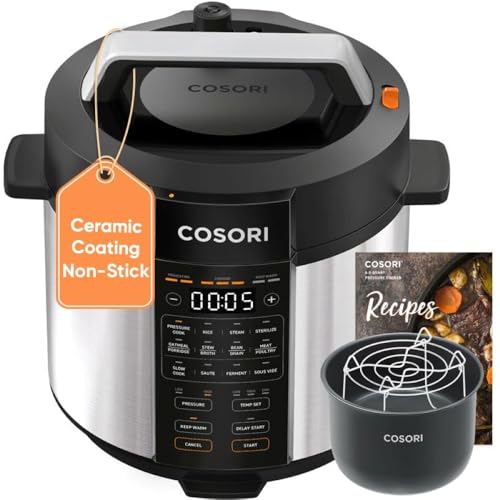
Cosori 6 quart pressure cooker
closes the category gap honestly by naming it. Its drawbacks say there is "No explicit
mention of pressure levels or wattage; check listing for details", which is the single
most useful sentence in the whole group, because wattage is the only input to the
equation at the top of this page. Of the six multi cookers and the one slow cooker we
carry, two publish a wattage, one admits it does not, and the rest leave it out without
comment.
The missing dimensions are the same story and our page on
why a pressure cooker is
tall and its pot is not already established that gap across this exact category, so
this page takes that finding rather than repeating the audit.
Why the ceiling is a ceiling, which another page already proves
The clamp at 100 degrees is the one part of this page that needs no assumptions, and
our page on
how a rice cooker knows when
the rice is done works it through in full: while free water is boiling, heat goes in
and the temperature does not move, because the energy is spent breaking the liquid apart
rather than speeding its molecules up. That page uses the plateau as a clock, to detect
the end of cooking. This page uses the same plateau as a ceiling, to explain why a dial
cannot make a stew hotter than a boil however far you turn it.
It is also why the comparison people reach for, that a slow cooker is a low
temperature oven, is the wrong picture. An oven is a thermostat: it holds a temperature
and varies its power. A slow cooker is the opposite: it holds a power and lets the
temperature land. Our page on
whether kettle wattage really matters
handles the third case, an appliance where the power is capped by the socket rather than
chosen by the maker, and the three together cover most of what a wattage on a kitchen
label can mean.
The honest limit, and the one measurement worth taking
What is exact here is the structure. A fixed power source settles where power equals
loss. Loss is proportional to temperature difference. Water clamps at its boiling point.
The slope of temperature against power is one over the loss coefficient, and the surplus
above the clamp is divided by 2,257 joules a gram. None of that depends on a product.
What is representative is everything geometric, and it matters more here than usual
because the loss coefficient appears in the denominator of the headline result. The 220
millimetre crock, the 8 millimetre stoneware wall, the 0.10 metre band, the 3.8 kilojoule
specific heat of stew and the overall coefficient of 7 watts per square metre per kelvin
are all assumptions. Run it again at 10 instead of 7, which is a plausible leakier shell,
and the boiling threshold moves from 126 watts to 181 and the slope falls from 0.617 to
0.432 kelvin per watt, so thirty watts buys 13.0 degrees instead of 18.5. The threshold
moved, the sensitivity stayed large, and the fill result did not change at all, because
it is a ratio of thermal masses.
The one thing this page deliberately does not do is put a number on the element power
of any specific cooker, because not one of them publishes it and guessing would be the
whole answer dressed up as a finding. Which leaves a genuinely useful measurement you can
take yourself in two minutes, needing nothing but a lid and a clock.
Fill the crock to your usual level, set it to Low, and come back in an hour to look at
the lid. If it is clear, or has a thin even film, you are below the clamp and the pot is
braising. If it is streaming with condensate and the rim is spitting, you are above it and
the pot is boiling. That observation is worth more than any specification in this
category, because it measures the one quantity that decides the result and that nobody
prints. And if it is boiling when you wanted a braise, the lever to pull is not the dial.
It is a fuller pot.
Why a Slow Cooker Low Setting Is a Wattage at a glance
Large families, potlucks, and meal prepping in bulk.
Large 6-quart capacity serves 7+ people Dishwasher-safe crock and lid for easy cleanup Space-saving folding handles for storage Three heat settings including Keep Warm Holds up to a 6 lb. chicken or 4 lb. roast Backed by a 1-year limited warranty
No timer or auto-shift to warm Limited to basic heat settings No temperature probe or advanced controls May be too large for small households
Instant Pot Pro 6 Qt 10-in-1 Electric Pressure Cooker
Families and meal preppers who want a versatile, fast cooking appliance.
10 cooking functions in one device 28 one-touch smart programs Cooks up to 70% faster than slow methods 6-quart capacity for up to 6 servings 1200 watts for quick preheating UL and ULC listed for safety
Bulky and heavy, requires ample storage Many programs can be confusing initially Some functions (sterilize, yogurt) may be rarely used Not ideal for small households or singles
Instant Pot Duo 6 Qt 7-in-1 Electric Pressure Cooker
Families and meal preppers who want a versatile, reliable multi-cooker.
7-in-1 functionality replaces multiple appliances Cooks up to 70% faster than slow cooking Stainless steel pot with tri-ply bottom for even heating and searing 6-quart capacity fits up to 6 servings 13 one-touch smart programs for convenience Easy to clean and maintain
Manual pressure release requires attention Interface is basic compared to newer models No Wi-Fi or app connectivity Slow cook function may not be as precise as dedicated slow cookers
Instant Pot Duo 7-in-1 Mini Electric Pressure Cooker
Singles, couples, and small households
Seven cooking functions in one compact unit 11 one-touch smart programs for easy operation Cooks up to 70% faster than slow cooking Stainless steel inner pot with tri-ply bottom for even heating Includes free app with over 1900 recipes UL and ULC listed for safety
3-quart capacity is small for larger meals 700-watt power may heat slower than higher-watt models Slow cooker function is limited by small size No advanced features like Wi-Fi or Bluetooth
Busy families who want quick, versatile meals without multiple appliances.
9-in-1 versatility replaces multiple appliances HyperHeat cooks up to 2x faster than traditional slow cooking 6.5-qt capacity fits a 4-lb chicken or 5-lb roast PFAS-free ceramic nonstick pot for easy cleanup Fast rice and grains: white rice in 8 minutes, quinoa in 5 minutes Space-saving design for everyday meals
Nonstick coating may wear over time Rice and grain times exclude pressure build/release No stainless steel pot option Some functions may require trial and error
Small to medium households wanting a versatile, safe, and easy-to-clean multi-cooker.
13 cooking functions in one appliance Safety-focused design with angled steam release and 12 safety features Ceramic-coated inner pot is non-stick and dishwasher-safe Fingerprint-resistant stainless steel housing Widened pot gap for easier cleaning Includes sous vide and ferment modes, which are uncommon at this level
Ceramic coating is less durable than stainless steel 6-quart capacity may be small for large households No explicit mention of pressure levels or wattage; check listing for details Dishwasher-safe parts may still require hand washing to preserve ceramic coating
Why you can trust this guide
We compared these picks using verified manufacturer specifications, current retailer listings, and patterns in owner feedback, alongside editorial research. We focus on measurable differences such as performance, capacity, usability, and build quality. Pickpedia does not present editorial research as laboratory testing, and we do not claim hands-on testing unless it was actually performed.
Best for Large families, potlucks, and meal prepping in bulk.
8.8/ 10 Pickpedia editorial score
The Hamilton Beach 6 Quart Slow Cooker is a large-capacity appliance designed for feeding crowds, with a 6-quart stoneware crock that holds a 6 lb. chicken or a 4 lb. roast. It features three simple heat settings (Low, High, Keep Warm) and dishwasher-safe parts for easy cleanup. Its space-saving folding handles are a unique convenience, but the lack of a timer or programmable features may not suit everyone.
Feed A CrowdMake enough for friends and family with a large 6 qu
Dial In The HeatWith 3 heat settings on this large slow cooker, you
Almost Cleans ItselfThe removable stoneware crock and durable glass lid
Looks As Good As It CooksThis slow cooker is made with quality materials for
Pros
Large 6-quart capacity serves 7+ people Dishwasher-safe crock and lid for easy cleanup Space-saving folding handles for storage Three heat settings including Keep Warm Holds up to a 6 lb. chicken or 4 lb. roast Backed by a 1-year limited warranty
Cons
No timer or auto-shift to warm Limited to basic heat settings No temperature probe or advanced controls May be too large for small households
Best for Families and meal preppers who want a versatile, fast cooking appliance.
8.8/ 10 Pickpedia editorial score
The Instant Pot Pro 6 Qt is a multi-functional electric pressure cooker with 10 cooking functions and 28 smart programs, making it a strong contender for family meals. It promises faster preheating and cooking compared to slow methods, and its 6-quart capacity suits up to six servings. While it excels in versatility, its size and feature set may be overkill for small households or beginners.
10 Cooking FunctionsPressure cook, slow cook, sous vide, sauté, steriliz
Customizable Smart ProgramTackle every recipe with 28 one-touch options coveri
Good Food Done FasterPreheat 20% faster and cook up to 70% faster compare
Family-Sized CapacityThe 6-quart capacity is perfect for up to 6 servings
Power Packed Performance1200 watts, 120 V 60 Hz, UL & ULC Listed
Pros
10 cooking functions in one device 28 one-touch smart programs Cooks up to 70% faster than slow methods 6-quart capacity for up to 6 servings 1200 watts for quick preheating UL and ULC listed for safety
Cons
Bulky and heavy, requires ample storage Many programs can be confusing initially Some functions (sterilize, yogurt) may be rarely used Not ideal for small households or singles
Best for Families and meal preppers who want a versatile, reliable multi-cooker.
8.8/ 10 Pickpedia editorial score
The Instant Pot Duo 6 Qt is a popular multi-cooker that combines seven cooking functions into one appliance. It offers 13 smart programs for one-touch cooking, and its stainless steel pot is durable and good for searing. The 6-quart size suits families or meal preppers. However, it lacks some advanced features like Wi-Fi or a sous-vide mode, and its interface may feel basic to some.
7 Cooking FunctionsPressure cook, slow cook, sauté, steam, make rice, y
Customizable Smart ProgramTackle every recipe with 13 one-touch options, from
Good Food Done FasterCook up to 70% faster compared to slow cooking metho
Pro-Grade Cooking PotCrafted from stainless steel (18/8) with a tri-ply b
Family-Sized CapacityThe 6-quart capacity is perfect for up to 6 servings
Pros
7-in-1 functionality replaces multiple appliances Cooks up to 70% faster than slow cooking Stainless steel pot with tri-ply bottom for even heating and searing 6-quart capacity fits up to 6 servings 13 one-touch smart programs for convenience Easy to clean and maintain
Cons
Manual pressure release requires attention Interface is basic compared to newer models No Wi-Fi or app connectivity Slow cook function may not be as precise as dedicated slow cookers
The Instant Pot Duo 7-in-1 Mini is a 3-quart electric pressure cooker that combines seven cooking functions in one appliance. It features 11 one-touch smart programs and a stainless steel inner pot, making it versatile for small households. While it cooks up to 70% faster than slow cooking, its small capacity limits batch cooking. It includes a free app with over 1900 recipes to help you get started.
7 Cooking FunctionsPressure cook, slow cook, sauté, steam, make rice, y
Compact Yet CapableA 3-quart capacity makes it perfect for small househ
Good Food Done FasterCook up to 70% faster compared to slow cooking metho
Pro-Grade Cooking PotCrafted from stainless steel (18/8) with a tri-ply b
Power-Packed Performance700 watts, 120 V 60 Hz, UL & ULC Listed.
Pros
Seven cooking functions in one compact unit 11 one-touch smart programs for easy operation Cooks up to 70% faster than slow cooking Stainless steel inner pot with tri-ply bottom for even heating Includes free app with over 1900 recipes UL and ULC listed for safety
Cons
3-quart capacity is small for larger meals 700-watt power may heat slower than higher-watt models Slow cooker function is limited by small size No advanced features like Wi-Fi or Bluetooth
Best for Busy families who want quick, versatile meals without multiple appliances.
8.8/ 10 Pickpedia editorial score
The Ninja HyperHeat 9-in-1 Pressure Cooker combines multiple cooking functions in one appliance, promising faster cooking times with its HyperHeat technology. It has a 6.5-quart capacity, a PFAS-free ceramic nonstick pot, and can handle everything from pressure cooking to sous vide. While it excels at speed and versatility, its nonstick surface may be a concern for those who prefer stainless steel. It's a solid choice for families needing quick, everyday meals.
All-in-one Electric PressuReplace multiple appliances with one 9-in-1 multi co
Cook Up To 2x Faster*HyperHeat technology builds pressure quickly to spee
Family-sized 6.5 Qt CapaciCook for a crowd with a large-capacity pot that fits
Fast Rice And GrainsMake white rice in as little as 8 minutes or quinoa
Easy Cleanup, Pfas-free NoThe removable ceramic nonstick pot is made 100% PFAS
Pros
9-in-1 versatility replaces multiple appliances HyperHeat cooks up to 2x faster than traditional slow cooking 6.5-qt capacity fits a 4-lb chicken or 5-lb roast PFAS-free ceramic nonstick pot for easy cleanup Fast rice and grains: white rice in 8 minutes, quinoa in 5 minutes Space-saving design for everyday meals
Cons
Nonstick coating may wear over time Rice and grain times exclude pressure build/release No stainless steel pot option Some functions may require trial and error
Best for Small to medium households wanting a versatile, safe, and easy-to-clean multi-cooker.
8.8/ 10 Pickpedia editorial score
The Cosori Pressure Cooker 6QT offers a wide range of cooking functions, from pressure cooking to sous vide, in a single appliance. Its ceramic-coated inner pot and dishwasher-safe parts make cleanup easier, while the angled steam release and 12 safety features aim to reduce risk. However, the 6-quart capacity may not suit larger families, and the ceramic coating requires gentle handling to avoid chipping.
𝗦𝗮𝗳𝗲𝗿 𝗩𝗲𝗻𝘁𝗶𝗻𝗴 𝗗𝗲𝘀𝗶𝗴𝗻The Seal/Vent button away from the steam release val
𝗘𝗮𝘀𝘆 𝗧𝗼 𝗖𝗹𝗲𝗮𝗻Stainless steel, fingerprint-resistant housing, the
𝟭𝟮 𝗦𝗮𝗳𝗲𝘁𝘆 𝗙𝗲𝗮𝘁𝘂𝗿𝗲𝘀The pressure cooker is designed with a double-layer
Pros
13 cooking functions in one appliance Safety-focused design with angled steam release and 12 safety features Ceramic-coated inner pot is non-stick and dishwasher-safe Fingerprint-resistant stainless steel housing Widened pot gap for easier cleaning Includes sous vide and ferment modes, which are uncommon at this level
Cons
Ceramic coating is less durable than stainless steel 6-quart capacity may be small for large households No explicit mention of pressure levels or wattage; check listing for details Dishwasher-safe parts may still require hand washing to preserve ceramic coating