PBy the Pickpedia Team·3 picks compared·Last verified October 2026
Affiliate disclosure: As an Amazon Associate, Pickpedia earns from qualifying purchases. Links on this page are paid links, and we may earn a commission at no extra cost to you. This never affects our picks or scores.
This page contains affiliate links. If you buy through one we may earn a
commission, at no cost to you.
Because a rice cooker is not a pot with a timer. It is a pot with an edge detector,
and the edge is one of the sharpest signals in any kitchen appliance: the moment the
last free water boils away, the temperature at the bottom of the pan goes from a slope
of exactly zero to a slope of between six and twenty three kelvin a minute, in about a
second. Everything a rice cooker does is built on waiting for that corner.
Which also tells you what the machine is not doing, and our own pages get this
wrong. A rice cooker does not sense moisture. It senses temperature. Temperature
happens to be a flawless proxy for whether free water remains, for exactly as long as
free water remains, and useless afterwards, and that is the trick.
The plateau carries no information, and that is the point
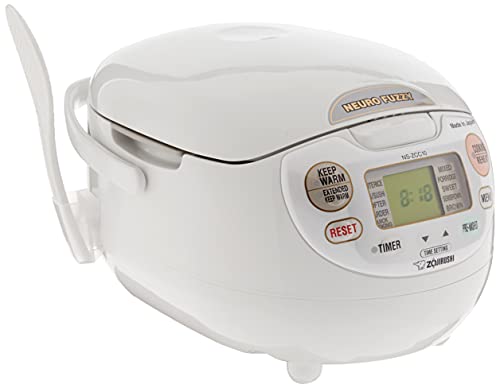
Take the load our own
Zojirushi NS-ZCC10 Neuro Fuzzy
rice cooker is sized for. Its record publishes two useful figures, 680 watts and
5.5 cups, and the cup is the Japanese 180 millilitre measure, so that is about 825 grams
of dry rice with roughly 1,188 grams of water.
Getting all of that from 20 degrees to 100 takes 539 kilojoules of ordinary sensible
heat, which at 680 watts is 13.2 minutes, and during those 13.2 minutes a thermometer
tells you precisely where you are. Then the useful part starts and the thermometer stops
working.
White rice takes up about 1.3 times its dry mass of water, so 1,073 grams goes into
the grain and 115 grams stays free, sitting in the bottom of the pan and boiling. Water
boiling at 100 degrees absorbs 2,257 joules for every gram that leaves as steam, and it
absorbs it without getting any hotter, because the energy goes into breaking the liquid
apart rather than into motion. So 115 grams of free water is 260 kilojoules of heat that
the pan can take without the temperature moving at all, and at 680 watts that is 382
seconds, or 6.4 minutes.
Six and a half minutes of dead flat 100 degrees, with a quarter of a megajoule going
in. No thermometer of any precision whatsoever could tell you how far through that you
are, because the reading is identical at the start and the finish. If you wanted to know
the progress you would have to weigh the pan.
Computed from the 680 W our Zojirushi listing publishes and the 1000 W quick-rice
figure our Cosori listing publishes, with a 180 mL rice cup, 150 g of dry rice per cup,
1.2 parts water by volume, an absorption of 1.3 times dry mass, 2,257 joules per gram
of latent heat at 100 C, and heat capacities of 4.186 for water, 1.6 for dry rice, 3.2
for cooked rice and 0.9 for the aluminium pan, all in kilojoules per kilogram per
kelvin. The 103 C release point is the classic ferrite thermostat figure and no listing
we carry publishes a trip temperature of any kind.
And then the corner, which a magnet can find
The instant the last free water goes, there is nothing left to take the latent heat,
and the same 680 watts is now heating 1,898 grams of cooked rice plus a pan, about 6.52
kilojoules per kelvin. That gives 0.104 kelvin per second, which is 6.3 kelvin a
minute. On a smaller load at the 1,000 watt quick-rice setting a
Cosori 10 cup rice cooker
publishes, it is 0.376 kelvin a second, or 22.6 a minute.
So the signal is not a subtle change. It is a step from zero to somewhere between six
and twenty three degrees a minute, and anything capable of noticing three degrees will
notice it within half a minute.
Which is exactly what the original mechanical rice cooker did, and it remains one of
the most elegant pieces of engineering in any kitchen. The thermostat is a small block
of ferrite held against a permanent magnet by a spring, with the switch contacts
arranged so that the magnet holds them closed. Ferrite is ferromagnetic only below its
Curie temperature, and the one chosen loses its magnetism at about 103 degrees. So the
pan heats, the plateau happens, the corner arrives, the pan goes through 103, the ferrite
stops being magnetic, the magnet lets go and the spring opens the switch. Three kelvin
above boiling at 0.104 kelvin a second is 29 seconds, and on the small fast load it is
8.
No clock. No electronics. No sensor in the modern sense. A material property chosen
to sit three degrees above the boiling point of water, finding the end of cooking to
within half a minute, in a device with one moving part. That is the answer to why you
would buy one.
What our own pages say, and the one word that is wrong
Our rice cooker roundup and our
Japanese rice cooker roundup both describe
the machine this way: "Fuzzy logic senses moisture and adjusts heat for consistent
grains." The conclusion is right and the mechanism is not. There is no moisture sensor
in a rice cooker, in any of them, at any level of sophistication. Measuring the water
content of a boiling mass of starch directly would be a genuinely difficult instrument
problem and nobody has had to solve it, because the phase change does the measurement
for free.
The same claim has propagated into a product record. The Cosori's performance text
says "Fuzzy logic is a proven way to adjust cooking time and temperature to the rice's
moisture and heat". What fuzzy logic actually adds over the magnet is not sensing, it is
scheduling: a soak stage held below boiling so water reaches the centre of the grain
before the outside gelatinises, a controlled approach to the boil, and a steam stage held
after the corner rather than switching straight to warm. Every one of those is a decision
about what to do with the same temperature trace, and all of them are timed from the
corner. Our
Zojirushi NS-ZCC10
review and Cosori 10 cup review have
the feature lists.
Why the measuring cup is a specification and not a nicety
Here is the consequence that makes the mechanism worth understanding, because it
explains the single commonest complaint about rice cookers.
The detector fires when the free water is gone. The free water is the water you added
minus the water the rice absorbed. So the moment of detection is set entirely by your
water measurement, and the machine has no way of distinguishing between "the grain has
taken up what it needs" and "there is no water left". Those two happen at the same
instant only if the ratio was right.
Put a number on the sensitivity. One percent of that 1,188 grams is 11.9 grams of
water, which is 26.8 kilojoules of latent heat, which at 680 watts is 39 seconds. So
every one percent of excess water buys 39 more seconds of the rice sitting in boiling
water after it is already cooked. Ten percent is six and a half minutes of it, and that
is the difference between separate grains and porridge.
Now the error everyone makes. A rice cooker cup is 180 millilitres. A US cup is 237,
which is 31.7 percent larger. Fill one US cup with rice, about 198 grams, and then fill
the pot to the line marked for one cup, which supplies about 216 grams of water. That
rice wants 1.3 times 198, which is 257 grams. It is 41 grams short. The free water runs
out before the grain is hydrated, the corner arrives early, the magnet lets go and the
machine confidently announces that hard rice is finished.
So the Zojirushi record's apparently fussy insistence is a real specification, and it
states it plainly: "Using only the included measuring cup matters for accurate
water-to-rice ratios, which shape final texture." That is not brand protection. The
water lines moulded into the pan are calibrated to that cup, and mixing the two
measurement systems is the one input error the detector cannot see.
The simple machine is the honest one about this
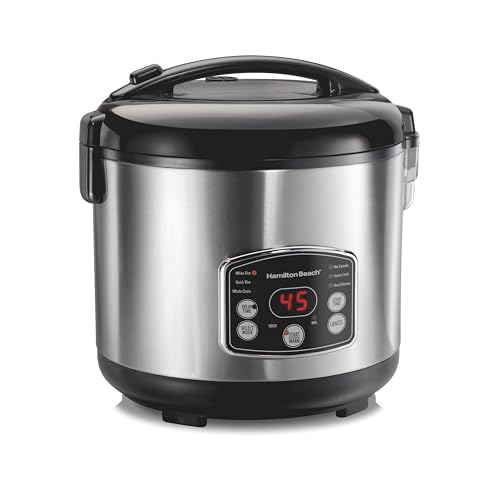
A Hamilton Beach digital
programmable rice cooker and steamer is the plain version, at 2 to 14 cups cooked,
with a steam basket that doubles as a rice rinser and a delay start up to 11 hours. Our
record is appropriately careful about what is inside it: "It likely runs a simple
thermostat rather than fuzzy logic, so some experimenting with water ratios may follow
across grains", and its drawbacks say it "May require manual water ratio adjustments".
Read that against the arithmetic and it is the most informative sentence in the whole
group. A simple thermostat detects exactly one thing, the corner, which means the ratio
is the only control you have. Across different grains the absorption multiple changes,
so the ratio changes with it, and a machine that detects only the corner cannot
compensate. That is a precise and honest statement of the limitation of the mechanism
rather than a complaint about the product. The rinsing basket is also doing more than it
looks: rinsing removes loose surface starch, and surface starch is what makes the free
water foam and boil over, which is a separate consequence of the same plateau. Our
Hamilton Beach rice
cooker review has the delay timer detail.
Worth flagging a records problem while we are here. All three of these rice cooker
records store their pros and cons as one unbroken run of text with no line breaks, so
the lists render as a single sentence running several unrelated claims together. All three
have ids between 3500 and 3900, which is the import cohort earlier work on this site
identified as damaged, and this is the same signature. The usable figures on this page,
the 680 watts, the 1,000 watts, the 5.5 cups and the 14 cups, all came out of the summary
and performance prose instead.
The honest limit, and the free technique that does the same job
The limit is that not one listing in this category publishes the thing the whole
mechanism depends on. No thermostat type, no trip temperature, no water ratio, no
absorption figure, and in the Hamilton Beach's case no wattage at all. The 103 degrees
in the drawing is the classic ferrite figure rather than a number read off a record, and
whether any given modern machine still uses a magnet or a thermistor is not stated
anywhere. What is not an assumption is the plateau, because latent heat is latent heat,
and the corner exists in every pot on earth whether anything is watching it or not.
Which is the free technique, and it is a complete substitute. The corner is in your
own saucepan too. You cannot see it, so you replace the detector with two things you can
control: the ratio and a rest.
Measure by ratio rather than by eye, bring it to the boil uncovered, then cover, drop
to the lowest heat for about ten minutes, and here is the part that matters, take it off
the heat entirely and leave it covered for ten more. The rest is the detector's
replacement. With no heat going in, the plateau argument no longer applies, because
nothing is driving the temperature past boiling and there is no corner to miss. Run the
cooling: 6.52 kilojoules per kelvin losing perhaps 50 watts under a lid falls 0.0077
kelvin a second, which is 4.6 kelvin in ten minutes. The pot sits within five degrees of
boiling for the entire rest, using no energy at all, while the remaining moisture
redistributes from the surface into the centre of the grains.
That is why a pot of rice made by the absorption method and rested is indistinguishable
from a rice cooker's output, and why the honest answer to the question is that you are
buying repeatability and attention rather than a result. The machine's real advantages are
that it does the rest stage for you, that it will not boil dry if you walk away, and that
its keep-warm stage holds the batch for hours. Those are genuine, and none of them is a
cooking advantage.
One cross-reference worth making, because the same constant turns up in a different
guise. Our page on
where a countertop dishwasher's
energy goes uses 2,330 joules per gram for the drying stage and this page uses 2,257
at 100 degrees, and both are correct for their temperature. Our page on
why an evaporative
cooler runs out of degrees puts the same latent heat to work in the opposite
direction, to make air colder. It is the single largest number in domestic thermal physics, and in a
rice cooker it is being used not as a heat load but as a clock.
Why a Rice Cooker Knows When the Rice Is Done at a glance
Zojirushi Ns ZCC10 Neuro Fuzzy Rice Cooker and Warmer
Small to medium households that cook rice regularly and appreciate automated cooking adjustments.
Neuro Fuzzy logic for automatic adjustments Multiple keep-warm and reheat cycles Wall-mountable for space saving Includes measuring cups and nonstick spoon Compact footprint 1-year limited warranty
Only 5.5-cup capacity No specific menu details listed Requires using included measuring cup only Wall mounting may require extra installation
Families or individuals who cook rice often and want a multi-functional cooker for grains, oats, and soups.
18 functions for versatile cooking Fuzzy logic for consistent rice results Ceramic-coated inner pot 24-hour keep warm and delay timer Quick rice feature at 1000W Covers white rice, brown rice, grains, oats, vegetables, soups, and sauté
Large capacity may be too big for small households Many functions may be overwhelming for some users Exact dimensions and weight not specified Ceramic coating durability may vary
Hamilton Beach Digital Programmable Rice Cooker & Food
Families or individuals who cook rice and grains in large batches and want a simple, convenient appliance.
Large 14-cup cooked capacity Steam basket doubles as a rice rinser Delay start up to 11 hours Automatic warm mode Stainless steel exterior Versatile for grains, cereals, and steaming
No specific settings for different rice types Cooking times not specified Exact dimensions not provided May require manual water ratio adjustments
Why you can trust this guide
We compared these picks using verified manufacturer specifications, current retailer listings, and patterns in owner feedback, alongside editorial research. We focus on measurable differences such as performance, capacity, usability, and build quality. Pickpedia does not present editorial research as laboratory testing, and we do not claim hands-on testing unless it was actually performed.
Best for Small to medium households that cook rice regularly and appreciate automated cooking adjustments.
8.8/ 10 Pickpedia editorial score
The Zojirushi NS-ZCC10 Neuro Fuzzy Rice Cooker is a 5.5-cup capacity model that uses advanced fuzzy logic technology to adjust cooking parameters automatically. It offers multiple menu selections, keep-warm, extended keep-warm, and reheat functions. With a compact footprint and useful accessories, it's a reliable choice for everyday rice cooking.
Feature5-1/2-cup computerized rice cooker and warmer with a
Measures Approximately 1410-1/8 x 13 x 8-1/8 inches
Includes 2 Measuring CupsPlease ensure to measure rice in the cup that comes
Pros
Neuro Fuzzy logic for automatic adjustments Multiple keep-warm and reheat cycles Wall-mountable for space saving Includes measuring cups and nonstick spoon Compact footprint 1-year limited warranty
Cons
Only 5.5-cup capacity No specific menu details listed Requires using included measuring cup only Wall mounting may require extra installation
Best for Families or individuals who cook rice often and want a multi-functional cooker for grains, oats, and soups.
8.8/ 10 Pickpedia editorial score
The Cosori Rice Cooker 10 Cup is a multi-functional appliance that goes beyond basic rice cooking. With 18 functions, fuzzy logic technology, and a ceramic-coated inner pot, it aims to deliver consistent results for various grains and dishes. It offers convenient features like 24-hour keep warm and delay timer, plus a quick cook option for busy days. However, its size and feature set may not suit everyone, and some details require confirmation.
𝟭𝟴 𝗙𝘂𝗻𝗰𝘁𝗶𝗼𝗻𝘀 𝗥𝗶𝗰𝗲 𝗠𝗮𝗸𝗲𝗿Choose from different types of white and brown rice
𝗣𝗲𝗿𝗳𝗲𝗰𝘁 𝗥𝗶𝗰𝗲 𝘄𝗶𝘁𝗵 𝗙𝘂𝘇𝘇𝘆 𝗟𝗼Whether you're a cooking novice or an experienced ho
𝗘𝗳𝗳𝗼𝗿𝘁𝗹𝗲𝘀𝘀 𝗖𝗼𝗼𝗸𝗶𝗻𝗴You can enjoy warm and fresh rice anytime with the a
𝗤𝘂𝗶𝗰𝗸 𝗖𝗼𝗼𝗸𝗶𝗻𝗴The perfect rice is worth the wait, and our 'Quick R
Pros
18 functions for versatile cooking Fuzzy logic for consistent rice results Ceramic-coated inner pot 24-hour keep warm and delay timer Quick rice feature at 1000W Covers white rice, brown rice, grains, oats, vegetables, soups, and sauté
Cons
Large capacity may be too big for small households Many functions may be overwhelming for some users Exact dimensions and weight not specified Ceramic coating durability may vary
Best for Families or individuals who cook rice and grains in large batches and want a simple, convenient appliance.
8.8/ 10 Pickpedia editorial score
The Hamilton Beach 37548 is a digital rice cooker and food steamer that can prepare 2 to 14 cups of cooked rice, grains, hot cereals, and steamed vegetables. Its standout feature is a steam basket that doubles as a rice rinser, simplifying prep. With a delay start timer up to 11 hours and automatic warm mode, it supports convenient meal planning. However, it lacks advanced features like fuzzy logic or specific settings for different rice types.
2-in-1 Rice Rinser/steam BRice cooker includes steam basket that doubles as a
Versatile CapacityThe rice/hot cereal cooker makes 2, 14 cups of cooke
Make Meal Planning EasierThe Delay Start feature on rice cooker lets you prog
Pros
Large 14-cup cooked capacity Steam basket doubles as a rice rinser Delay start up to 11 hours Automatic warm mode Stainless steel exterior Versatile for grains, cereals, and steaming
Cons
No specific settings for different rice types Cooking times not specified Exact dimensions not provided May require manual water ratio adjustments