Home ›
Home & Kitchen › Why a Seed's Soak Time Goes as the Square of Its Size
Home & Kitchen
Why a Seed's Soak Time Goes as the Square of Its Size
PBy the Pickpedia Team·5 picks compared·Last verified October 2026
Affiliate disclosure: As an Amazon Associate, Pickpedia earns from qualifying purchases. Links on this page are paid links, and we may earn a commission at no extra cost to you. This never affects our picks or scores.
This page contains affiliate links. If you buy through one we may earn a
commission, at no cost to you.
No, and for a reason that is worth more than the answer: a saturated sponge is already a
soak. The seed begins taking up water the moment it goes in, so a pre-soak buys you only
the hours before planting, and the number of hours it buys is set almost entirely by how big the
seed is.
Water uptake is a diffusion problem, which means it goes as the square of the
seed. At a representative coat-limited diffusivity, a mountain mint seed is done in
1.9 minutes and a runner bean takes 12.7 hours. A twenty-fold
step in size, a four hundred fold step in time. For anything sown into a wet plug the soak is
therefore pointless at the small end and genuinely useful at the large end, and the dividing line
is a seed diameter rather than a species.
And then the part that actually matters, because the failure mode runs the other way.
One millimetre of standing water around a seed carries the same oxygen resistance as ten
metres of still air. The risk is on the wet side.
Why the time is a square
A dry seed takes up water by diffusion through its coat and into the cotyledons, and for a
sphere of radius a the time to reach ninety percent of equilibrium uptake is 0.183 times the
radius squared, divided by an effective diffusivity. The 0.183 is exact for a sphere. The
diffusivity is representative: a coat-limited value of one times ten to the minus ten square
metres a second is the right order of magnitude for an intact seed, and it varies between species
by more than tenfold, which is why the minutes below are soft and the ratios between them are
not.
Put numbers in it and the spread is startling:
Mountain mint at a quarter millimetre radius, 1.9 minutes. Basil at three
quarters of a millimetre, 17 minutes. Chives and flat parsley at a millimetre,
30 minutes each. A coriander schizocarp at 1.75 millimetres, 1.6
hours. A pea at three and a half, 6.2 hours. A runner bean at five,
12.7 hours.
So the overnight soak that gets applied to everything is between fifteen and three hundred times
longer than a small seed needs, and about right for a bean. It is not that the advice is wrong. It
is that it was written for the seeds where it matters and then repeated for the ones where it does
not.
The sponge was the soak, so what does the plug change
A
Patigrow 120-cell self-watering seed
starter kit with a grow light publishes 120 cells across two separate 60-cell trays, a footprint
of 16.6 by 11 inches at 7.28 high, 1.5 millimetre BPA-free PET for the dome and base tray, domes
4.07 inches tall with two adjustable vents each, capillary mats between tray and base,
enlarged drainage holes in the cell trays, 56 LED beads per tray on an adjustable timer and plant
stands to set the tray height.
Two of those features point in opposite directions and the record does not say how they balance.
A capillary mat holds the base of the medium at effectively zero suction, which keeps the plug wet.
Enlarged drainage holes let water leave, which keeps the plug drained. Both are sold as
benefits and only one of them can be winning at any moment, and which one it is decides
whether the seed in that cell is soaking or breathing. Full record in our
review of the
Patigrow kit.
The useful consequence is that the question changes shape. Once the plug is saturated the seed
cannot soak any faster or any slower than the arithmetic above allows. What a pre-soak does is move
those minutes or hours to a time when you are watching, which for a bean is half a day of progress
you can see and for mint is no progress at all.
Water uptake is diffusive, so soak time goes as the
square of the seed: 1.9 minutes for mountain mint and 12.7 hours for a runner bean. The risk is on
the wet side, because one millimetre of standing water carries the same oxygen resistance as ten
metres of air.
One kit, five seed packs, a forty nine fold spread
This is where the square law stops being an abstraction. A
HOME GROWN 5 herb indoor garden starter
kit publishes five named seed packs, five soil pellets, reusable pots with trays, wooden
markers, a nutrition pack and a grow guide, with the seeds stated as USA grown, non-GMO heirloom
Genovese basil, chives, cilantro, mountain mint and Italian giant parsley, in hermetically sealed
envelopes rated to stay fresh for up to two years.
Those five names are five different radii. Mountain mint at about a quarter millimetre is the
smallest, the coriander that cilantro is grown from at about 1.75 millimetres the largest.
Seven times the size, so forty nine times the imbibition time: 1.9 minutes against 1.6
hours, inside one box with one instruction sheet.
The soil pellets are the other half of the same physics pointed at a different object. A
compressed pellet has to be hydrated before it will accept a seed at all, and a pellet is both
larger than any of these seeds and much more porous, so it wets in a minute or two rather than in
hours. That is the one thing in the kit for which the instruction "soak first" is unambiguous, and
it is the one thing in the kit that is not a seed. More in our
review of the HOME GROWN 5 herb
kit, whose own drawbacks are properly cautious: "Germination results vary by home conditions"
and "Pot and pellet sizes are not listed".
The real answer, and it is four orders of magnitude
An imbibed seed is metabolically awake and it needs oxygen. Oxygen reaches it by diffusion, and
the two media it might diffuse through are not remotely comparable.
Oxygen's diffusivity in air is about two times ten to the minus five square metres a second. In
water it is about two times ten to the minus nine. A ratio of ten thousand.
The diffusive resistance of a layer is its thickness divided by its diffusivity, so a one
millimetre film of water presents five hundred thousand seconds per metre, and the thickness of
still air carrying the same resistance is ten metres.
That is the whole of it. A merely damp plug has continuous air channels running through
it and a saturated plug has none, and the step between those two states is not a matter of
degree, it is four orders of magnitude in the one supply the seed cannot do without. Which is why
over-soaking kills, why a plug standing in water kills, and why the advice that sounds fussiest,
bottom water and let it drain, is the advice doing the real work.
And it reframes a feature on another tray. A
Burpee SuperSeed 36-cell reusable seed
starting tray publishes food-grade silicone pop-out cells, a tray of 11.5 by 10 and three
eighths by 2 and a quarter inches, moulded corner slots in every cell for drainage and soil
aeration, deep channels in the watering tray to draw excess away from the cell bases, a
raised perimeter edge, alphanumeric rows with a planting diagram, side handles and dishwasher
safety.
Its own record uses exactly the right pair of words, drainage and aeration, and it is worth
saying that the second one is not a bonus. The slots are an oxygen feature wearing a water
name. Water leaving is the mechanism; air arriving is the point. Our
review of the Burpee
SuperSeed tray has the rest, and notes the real limit on a single tray: 36 cells is one
sowing's worth.
Cell count is not the variable. Depth is.
Compare the two trays on geometry rather than on features and something useful falls out.
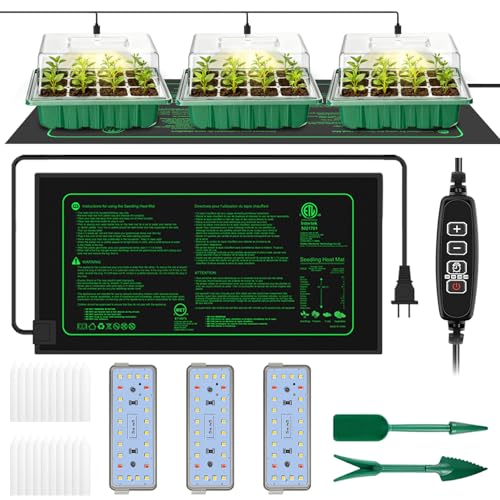
A
Kokopro seed starter kit with grow lights
and a heat mat publishes cells divided into equal 1.96 inch squares at 1.85 inches
deep, a far-infrared heat mat holding 70 to 85 degrees Fahrenheit with
double insulation and an IP67 rating, three grow lights on an intelligent controller with four
timing settings, heightened humidity domes, and drainage holes sized to let water through while the
bottom tray retains overflow.
That cell is 116 cubic centimetres with a top area of 24.8 square centimetres. The Patigrow's
120 cells in a 41 percent larger footprint work out at about 37 cubic centimetres each with a top
area of 9.8.
A volume ratio of 3.11 and a drying time ratio of only 1.23, because the
evaporating area shrinks along with the volume and the only term that survives the division is the
depth. So the headline difference between a 36-cell kit and a 120-cell kit is not how fast the
cells dry out. It is how long a seedling can stay in one before it is pot bound, which the Kokopro
record identifies correctly: "a shallow cell forces an early transplant or a check in
growth."
That listing also carries an ambiguity its own record flags and declines to settle, which is the
right call: the title says 36 extra large cells and describes a three pack, and nothing says
whether 36 is per tray or across all three. We are not resolving it either. See our
review of the Kokopro
kit.
What the heat mat is worth on this particular clock
Our page on
whether heat mats make seeds germinate
faster owns the temperature argument properly, including the part most guides miss: "in lettuce,
spinach and several brassicas warmth past the high 70s does not merely slow germination, it
suppresses it." It also makes the point that decides the whole question: "the correct temperature is
a property of the seed and not of the kit." Both are right and neither is about water uptake, so
here is the missing half.
Diffusivity rises with absolute temperature and falls with viscosity. Across the mat's own
published band, 70 to 85 Fahrenheit, which is 21.1 to 29.4 Celsius, water's viscosity falls by a
factor of 1.200 while absolute temperature rises by 1.028. So the diffusivity rises by 1.234 and
imbibition time falls by 19 percent.
Nineteen percent, from the entire range of the mat. Against four hundred fold from the choice of
seed. The mat is a strong lever on the enzymes of germination and a weak one on the water
getting in, which is a clean way to keep the two clocks separate: the mat is for after the
seed is wet, not for getting it wet. The lighting side of these same kits, which is a third clock
again, is worked through in
why a grow light's coverage area needs a
height.
The instrument that reads the wrong half
A
3-in-1 houseplant health meter reading
moisture, light and pH publishes a dual-sensor probe with a three-position toggle and no
batteries, and its own drawbacks are unusually useful here: "Best results only in loose, aerated
soil", "Dense or compacted mixes can skew results", and "No listed probe length or
dimensions".
Read those three together and the meter is telling you something about itself. It
measures water in a medium whose air is the question, and it works best precisely where
the air problem is least. A reading of "moist" is consistent with a plug that is perfectly aerated
and with one that is sealed, because the quantity that separates them is the air-filled fraction
and no consumer probe reads it. More in our
review of the
houseplant health meter.
Which leaves the practical test as the one that needs no equipment at all. Lift the tray. A plug
heavy enough to feel saturated and a plug that has drained differ by a few grams of water and four
orders of magnitude in oxygen supply, and your hand can tell the difference even though the probe
cannot.
The honest limit, and what it leaves alone
What is exact here is the structure. Imbibition goes as the square of the radius, so the twenty
fold size step giving four hundred fold in time, and the seven fold step inside one kit giving
forty nine fold, are exact whatever diffusivity you assume. The 0.183 coefficient is the exact
sphere solution at ninety percent uptake. The ten thousand between oxygen in air and oxygen in
water, and the ten metre equivalence that follows, are exact to the precision of two textbook
diffusivities. The 3.11 volume ratio against the 1.23 drying ratio follows from published
dimensions. The nineteen percent follows from the mat's own published band and water's viscosity
table.
What is representative rather than published is the list that sets every absolute number. The
coat-limited diffusivity of one times ten to the minus ten square metres a second is an order of
magnitude, not a measurement, and it varies between species by more than tenfold, so every minute
and every hour above should be read as the right size rather than the right value. The seven seed
radii are typical for their species and the seeds themselves are not spheres, which the sphere
solution handles only approximately. The Patigrow cell depth of an inch and a half is derived from
a published kit height minus a published dome height rather than stated. And the one millimetre
water film is an illustration: the real geometry inside a wet plug is a network, not a shell.
Three things this page deliberately does not compute. It does not give a soak time for any named
species, because the diffusivity that would make that honest is not published for any of them and
the spread between species is larger than the effect being recommended. It does not touch
germination percentage, viability or dormancy, which are different gates entirely and which the
heat mat page handles properly, including stratification and scarification. And it does not compute
the time a saturated plug takes to suffocate a seed, which would need an oxygen consumption rate
for a germinating seed, and that is the real limit on the central practical advice here: the
arithmetic establishes that saturation is catastrophic for oxygen supply by four orders of
magnitude, and it cannot tell you how many hours of it a particular seed survives.
Three numbers to carry. Soak time goes as the square of the seed, so mint is two minutes and a
bean is half a day, and anything under about a millimetre of radius is not worth soaking at all.
One millimetre of standing water is ten metres of air to a seed's oxygen, so the fatal error is wet
rather than dry. And a heat mat's whole published range is worth nineteen percent on getting water
in, which means it is on the tray for a different reason and should be judged on that one.
Why a Seed's Soak Time Goes as the Square of Its Size at a glance
Houseplant Health Meter, 3-in-1 Moisture, Light and pH Tester
beginners wanting to time watering and feeding
Combines moisture, light, and pH in one tool
Readings show trends, not exact lab values
Why you can trust this guide
We compared these picks using verified manufacturer specifications, current retailer listings, and patterns in owner feedback, alongside editorial research. We focus on measurable differences such as performance, capacity, usability, and build quality. Pickpedia does not present editorial research as laboratory testing, and we do not claim hands-on testing unless it was actually performed.
Best for Starting a full season of seedlings indoors with no windowsill light to rely on
9.0/ 10 Pickpedia editorial score
A two tray seed starting kit totalling 120 cells, with capillary self-watering, 56 LED beads per tray on an adjustable timer, 4.07 inch humidity domes with adjustable vents, and 1.5mm BPA-free PET construction.
BrandPatigrow
ModelSWSST-L60
Total cells120
Tray configuration2 x 60-cell trays
Lighting4 LED strips, 56 beads per tray
Light controlAdjustable brightness and timer
WateringSelf-watering with capillary mats
Dome height4.07 in
Vents2 per dome, 4 total, adjustable
MaterialHigh-density BPA-free PET
Dome and base thickness1.5 mm
DrainageEnlarged holes in the cell trays
Dimensions16.6 x 11 x 7.28 in
Weight3.8 lb
ColourBlack
Pros
120 cells across two separate 60-cell trays
Capillary self-watering, one fill from germination to transplanting
Four LED strips with 56 beads per tray, adjustable brightness and timer
1.5mm BPA-free PET dome and base tray
Two adjustable vents per dome, four in total
Enlarged drainage holes in the cell trays
Plant stands included to set tray height under the lights
20 plant labels and two gardening tools supplied
Cons
No heat mat, so cold rooms need bottom heat separately
Two trays is more kit than a small sowing needs
Light controller needs a mains outlet near the trays
Best for beginners and gift-givers starting a kitchen herb garden
8.6/ 10 Pickpedia editorial score
HOME GROWN's herb starter kit gives beginners everything to grow five herbs indoors or out. It includes five seed packs, five soil pellets, reusable pots with trays, wooden markers, a nutrition pack, and a grow guide. Seeds are USA grown, non-GMO heirloom basil, chives, cilantro, mountain mint, and Italian giant parsley, sealed to stay fresh for up to two years.
Best for Indoor seed starting where transplant shock has been the problem
9.2/ 10 Pickpedia editorial score
A 36 cell seed starting tray with food-grade silicone pop-out cells, drainage slots in every cell, a channelled watering tray and alphanumeric row labelling, dishwasher safe and reusable.
BrandBurpee
Model96512
Cells36, flexible pop-out
Cell materialFood-grade silicone
Tray dimensions11.5 x 10-3/8 x 2-1/4 in
DrainageMoulded corner slots in each cell
Watering trayDeep channels with raised perimeter edge
LabellingAlphanumeric rows, Plant-o-Gram diagram included
HandlesMoulded side handles
CleaningTop shelf dishwasher safe
ReuseDesigned to clean and store between seasons
ColourBlue
Pros
Food-grade silicone cells flex so plugs pop out root ball intact
Moulded corner slots in every cell for drainage and soil aeration
Deep channels in the watering tray draw excess water off the cells
Raised perimeter edge keeps water in the tray, not on the sill
Alphanumeric row labelling with a Plant-o-Gram diagram included
Side handles for lifting and pouring off excess
Top shelf dishwasher safe and genuinely reusable
Cons
Thirty six cells is a single tray's capacity
No grow light or heat mat included
Silicone cells need a firm surface under them when moving a wet tray
Best for Peppers, chillies and anything else that needs bottom heat to germinate
8.8/ 10 Pickpedia editorial score
A three tray seed starting kit with a far-infrared heat mat holding 70 to 85F, extra large 1.96 inch cells at 1.85 inch depth, three grow lights, an intelligent controller with four timing settings and heightened humidity domes.
Best for beginners wanting to time watering and feeding
8.2/ 10 Pickpedia editorial score
This 3-in-1 meter reads soil moisture, sunlight, and pH for houseplants using a single probe and a simple toggle. A dual-sensor design tells you when to water and when to fertilize, helping prevent root rot and leaf burn. It needs no batteries, works indoors or outdoors, and suits fiddle leaf figs, monsteras, pothos, and other potted plants.