PBy the Pickpedia Team·5 picks compared·Last verified October 2026
Affiliate disclosure: As an Amazon Associate, Pickpedia earns from qualifying purchases. Links on this page are paid links, and we may earn a commission at no extra cost to you. This never affects our picks or scores.
This page contains affiliate links. If you buy through one we may earn a
commission, at no cost to you.
Far less often than the inverse square law makes you think, and the reason is that the
inverse square law is the wrong law. A panel is not a point source at the heights people hang
it, and the difference between the two is a factor of 2.7 on the question you are
asking.
Here is the shape of the real answer. Raising a 1 by 2 foot panel from 6 inches to 18
inches above the canopy removes 70 percent of the light. An inverse square law predicts 89
percent. And a published coverage area of 2 by 3 feet, which is the only coverage figure in
our catalogue, corresponds to a mounting height of anywhere between 3.46 and 10.39 inches
depending on a beam angle no grow light here publishes. A coverage area with no height on it
is half a specification.
From a watt to something a plant answers
A
MetryGrow 100W smart LED grow
light is the right product to start on because it is unusually straight about the one
figure it gives. Its record makes the point explicitly: "Grow lights are notorious for
exaggerated wattage claims. MetryGrow makes a point that this is a genuine 100 watt LED, not
an inflated figure." It publishes a stated 2 by 3 foot coverage, full spectrum output, app
control, aluminium honeycomb cooling and daisy-chain support, and it is upfront that no stand
or mounting kit comes with it.
An honest wattage is better than a dishonest one and it is still only the first link in a
chain of three. Watts go in. Photons come out at some efficacy. Those photons land on some
area. And the plant responds to a number of photons per square meter per second, accumulated
over a photoperiod.
Take a modern white horticultural LED at a representative 2.2 micromoles of photosynthetic
photons per joule. One hundred watts is then 220 micromoles a second of photon flux. Spread
over the published 2 by 3 feet, which is 6 square feet or 0.5574 square meters, that is 394.7
micromoles per square meter per second.
Run it for 16 hours and the daily total is 394.7 times 57,600 seconds, which is 22.73
moles per square meter per day. The conventional bands are 12 to 17 for seedlings and leafy
greens and 20 to 30 for fruiting crops, so over its stated footprint this light genuinely
reaches the fruiting band. At a 12 hour photoperiod the same fixture delivers 17.05 moles,
because the photoperiod multiplies the whole chain directly.
That is a good light. It is also a result that depends completely on the footprint, and
the footprint depends completely on the height.
The law that is not inverse square
A point source radiates into a solid angle and its intensity falls as one over the
distance squared. Our page on
whether more lumens mean a light
shines further works that chain out properly for a beam, and this page takes it rather
than repeating it.
A panel is different, and the difference is geometric rather than subtle. The lit area
under a rectangular panel of width W and length L at a standoff d, with a beam half angle of
theta, is W plus twice d times the tangent of theta, multiplied by L plus the same quantity.
Both terms are linear in d. So the area grows as the product of two linear terms, and the
flux density goes as one over that product.
When d is small compared with W and L, the added terms barely matter and the intensity is
nearly flat with height. When d is large compared with the panel, the panel's own dimensions
drop out and the expression collapses to one over four d squared tangent squared theta, which
is the inverse square law. The familiar law is the asymptote, not the rule.
Put the numbers on it. For a 1 by 2 foot panel at a 45 degree half angle:
At 6 inches the footprint is 0.6096 by 0.9144 meters, which is 0.5574 square meters, and
the flux density is 394.7.
At 12 inches it is 0.9144 by 1.2192, which is 1.1146 square meters, and the density is
197.4. Exactly half, for doubling the height.
At 18 inches it is 1.2192 by 1.5240, which is 1.8581 square meters, and the density is
118.4, so 30.0 percent of what you started with.
An inverse square law from 6 to 18 inches would have left 394.7 divided by 9, which is
43.9. The real figure is 118.4. The law everyone reaches for understates what survives by a
factor of 2.70, and it does so in the direction of making people too nervous about
height.
And the asymptote arrives nowhere useful. For the inverse square approximation to be
within 20 percent on this panel you need a standoff of about five feet, which is ten times
the height the light is designed for.
Three of the relations here are exact and one conversion is not. Exact: the footprint of a
panel is its own width plus twice the standoff times the tangent of the beam half angle, in
each direction, so the area grows as the product of two linear terms and the inverse square
law is only its asymptote. For a 1 by 2 foot panel at 45 degrees that asymptote is within 20
percent at about five feet, which is ten times the height anyone uses. Also exact: photon flux
density is total flux divided by area, so two chained lights over twice the area hold it
constant while one light raised over twice the area halves it. And the daily light integral is
just the flux density times the seconds of photoperiod. The published inputs are the 100 watt
rating, the 2 by 3 foot coverage, the 56 beads per tray, the 4.07 inch dome, the 1.96 inch
cells and 10.2 by 8.07 inch tray, the 70 to 85 Fahrenheit mat range, and the CRI 93, PAR 89,
2142 lumens, 10000 K and 22 watts on the aquarium fixture. Representative rather than
published, and this is the load-bearing one: the efficacy of 2.2 micromoles per joule, because
not one grow light in this catalogue publishes a micromoles per joule, a photon flux or a flux
density with a distance attached. At 1.8 the whole first panel scales to 323 and 18.6 moles; at
2.8 it scales to 502 and 28.9. Every ratio on the page is untouched by that choice. Also
representative: the 1 by 2 foot panel geometry, the 0.2 to 0.5 watts per strip bead, the 300
lumens per radiometric watt used to turn 2142 lumens into photons, and the 12 to 17 and 20 to
30 mole benchmark bands, which are conventional horticultural figures rather than anything a
product states.
The height hidden inside a coverage area
Now run that backwards, because it answers the question the listing leaves open.
For a footprint to come out as 2 by 3 feet, the growth has to be the same in both
directions, which means the panel itself is one foot longer than it is wide. So twice the
height times the tangent of the half angle equals one foot, which is 0.3048 meters.
At a 30 degree half angle that gives a height of 0.2640 meters, which is 10.39 inches. At
45 degrees it gives 0.1524 meters, which is 6.00 inches. At 60 degrees it gives 0.0880
meters, which is 3.46 inches.
A factor of three in the single number the buyer has to set with their own hands, decided
by a beam angle that no grow light in this catalogue publishes. The record knows this matters
and says so twice: "You must arrange your own way to hang or mount it at the right height
above the plants", and "Getting that height and the daily light schedule right for each plant
type matters for good growth." Both sentences are correct. Neither is actionable without a
number.
This is the same gap, in the same shape, as the one our page on
why blender rpm needs a blade diameter
describes: a figure that looks like a specification and cannot be compared with anything
because the other half of the pair is missing. There, an rpm with no diameter. Here, a
coverage area with no height, and a wattage with no efficacy.
Our own guide to
growing
plants indoors with grow lights gets the direction exactly right, and it deserves the
credit for being blunt about the wattage problem before anyone else: "grow-light wattage is
often wildly exaggerated", and "Too close can stress or scorch plants; too far and the
intensity drops off." The arithmetic above is what those two sentences are worth in
micromoles.
What the daisy chain is actually for
The same listing publishes "seamless daisy-chaining" and treats it as a convenience
feature about plugs. It is not. It is the only way to add light without giving any up.
Flux density is total photon flux divided by lit area. So two lights side by side at 6
inches cover 2 by 6 feet and still deliver 394.7, because the flux doubled and so did the
area. One light raised until it covers that same 12 square feet delivers 220 divided by
1.1148, which is 197.3. Exactly half.
Chaining holds the density constant as the garden grows. Raising divides it. That is a
factor of two for the same footprint, it is exact, and it appears on the listing as a tidiness
feature. Our roundup of
plant grow lights for thriving indoor plants is the
place to compare fixtures, and this is the question to carry into it: how many does the shelf
need, rather than how high does one go.
A bead count is not a photon flux
A
Patigrow 120-cell self-watering
seed starter kit publishes a great deal and publishes it carefully: 120 cells across two
separate 60-cell trays, capillary self-watering, four LED strips with 56 beads per tray,
adjustable brightness with timer functions, domes 4.07 inches tall with two adjustable vents
each, 1.5 mm BPA-free PET, a kit 16.6 by 11 by 7.28 inches weighing 3.8 pounds, and plant
stands "to set the trays at the right distance from the lights".
Everything in that list is a figure except the one that matters for light. A bead count is
not a flux, and the gap it leaves is enormous.
Strip LEDs of this kind draw somewhere between 0.2 and 0.5 watts each. Fifty six of them is
therefore 11.2 to 28 watts, which is already a factor of 2.5. Push that through an efficacy
band of 1.0 to 2.2 micromoles per joule, because small 5 volt beads sit well below the 2.2 a
dedicated panel manages, and the photon flux is 11.2 to 61.6 micromoles a second. A factor of
5.5.
One 60-cell tray in that kit is roughly 8.3 by 11 inches, so 0.0589 square meters. At the
bottom of the band that is 190 micromoles per square meter per second, which at 16 hours is
10.9 moles a day, just under the seedling floor. At the top it is 1,046, which is 60.3 moles a
day and ample for anything. The published number cannot tell those two situations apart, and
the kit publishes no wattage at all.
What the kit does get right is the mechanism for adjustment, and it is the better one.
Instead of a hanging height you have to keep changing, it includes plant stands to raise the
tray toward the light. That is thermodynamically identical and mechanically far easier,
because a tray with a handle moves and a light screwed to a shelf does not. It is the correct
answer to the question at the top of this page and it arrives without any arithmetic
attached.
The dome that takes two thirds of your height
There is one more number in that kit worth pulling out, because it constrains the thing the
whole page is about. The humidity domes stand 4.07 inches tall. That is 103.4 millimeters of
mandatory standoff between the light and the seed for as long as the dome is on.
Against the 152.4 millimeters the coverage arithmetic implied at a 45 degree half angle,
the dome is 67.8 percent of the entire recommended height. The grower has about 49 millimeters
of discretion and the lid has the rest.
Which reframes the vents, correctly, as a lighting feature as much as a humidity one. The
record is sharp about when they matter: the domes "trap warmth and moisture for germination,
and the two adjustable vents per dome let you reduce that as seedlings emerge, which is when
trapped humidity turns from help to hazard". Taking the dome off at that point does not only
drop the humidity. It returns two thirds of your height budget, and on the arithmetic above
that is worth roughly a doubling of flux density at the leaf.
A
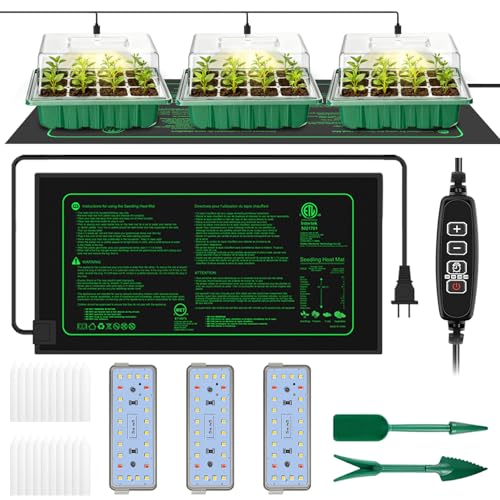
Kokopro seed starter kit with grow
lights and heat mat publishes "heightened humidity domes" with no figure, so the same
fraction cannot be formed for it, and heightened is the direction that makes it worse rather
than better.
An ambiguity in our own record that its own numbers settle
That Kokopro kit publishes a far-infrared heat mat holding 70 to 85 Fahrenheit with double
insulation layers and an IP67 rating, three trays, three grow lights, an intelligent
controller with four timing settings, cells in "equal 1.96 inch squares at 1.85 inch depth",
and a kit measuring 10.2 by 8.07 by 6.69 inches.
Its own record then flags something it could not resolve: "The title states 36 extra large
cells and describes a three pack, and the bullets do not clarify whether 36 is the count per
tray or the total across all three. We have reported both readings rather than pick one."
Both readings cannot stand, and the listing's own dimensions settle it. A cell 1.96 inches
square is 3.8416 square inches. Thirty six of them is 138.3 square inches. The published tray
footprint is 10.2 by 8.07 inches, which is 82.31 square inches. Thirty six cells per tray
would need 1.68 times the whole tray, walls and rim included, which is impossible.
So 36 is the total, which is 12 cells per tray. Twelve cells at 3.8416 is 46.1 square
inches, which is 56.0 percent of the footprint and leaves a sensible allowance for dividing
walls and a lip. The open question in our own record has an answer sitting in two other fields
of the same record.
Twelve cells per tray also changes what the kit is for, which is why it was worth doing.
Thirty six large cells across three trays is a modest sowing with generous root room, exactly
matched to the crops the mat exists for, and the record is right about why those crops need it:
"Soil temperature, not air temperature, is what triggers them." That sentence is correct and it
is the best thing on the listing.
What cannot be checked is the trade between the kit's two heat paths, because only one of
them has a figure. Essentially the entire electrical input of an LED fixture ends up as heat,
the photons included once they are absorbed, so a 100 watt grow light is also a 100 watt
heater, delivered from above into the air and the leaves. The mat delivers its heat from below
into the medium, where the record correctly says the trigger is. No mat wattage is published,
so the only honest statement is that the kit contains two heaters pointing in opposite
directions and publishes a temperature range for one of them. Our roundup of
seedling heat mats for faster germination is the place
to compare the mats on their own terms.
The only published photon figure, and the unit problem beside it
A
SEAOURA WRGB aquarium LED light
is the one product in this catalogue that publishes anything resembling a photon measurement,
and it publishes it in a crowd: "CRI 93, PAR 89, 2142 lumens, 10000K, and 22W, with enhanced
455nm blue and 660nm red for photosynthesis", on 90 chips in a four-channel layout for 18 to
24 inch tanks.
Start with the honest part, because the record flags it itself: "PAR and lumen figures are
maker-stated" and "Growth varies with tank depth". Both true, and the second one is the key to
the first.
A bare "PAR 89" has no unit and no distance. If it is a flux density in micromoles per
square meter per second, the question is where, and tank depth is exactly the variable the
record names. Work it from the lumen figure instead. At a luminous efficacy of radiation near
300 lumens per radiometric watt for a cool white source, 2142 lumens is about 7.14 watts of
radiant power, and a mole of 550 nanometer photons carries 217.7 kilojoules, so that is 32.8
micromoles a second. On the published 22 watts that is 1.49 micromoles per joule, which is
modest for horticulture and reasonable for a fixture spending part of its budget on colour
channels.
Spread 32.8 micromoles a second over a 20 by 10 inch tank surface, which is 0.1290 square
meters, and you get 254 micromoles per square meter per second at the water line, against a
published PAR of 89. A factor of 2.9. The two figures are not inconsistent. They describe the
light in two different places, and the listing names neither of them. Our guide to
lighting a planted aquarium
says that demanding plants "need high PAR and penetration", which is right, and the figure that
would make it usable is a flux density with a depth attached.
Why a lumen is the wrong unit, with the factor
And then there is the deeper problem with publishing a lumen figure on a fixture sold for
photosynthesis, which is that the two quantities disagree about which photons count.
A lumen is radiant power weighted by the human eye's photopic response, which peaks in the
green at 555 nanometers. That response is about 0.04 at 455 nanometers and about 0.061 at 660,
against 1.00 at the peak. A photon flux density counts every photon between 400 and 700
nanometers equally.
So a 455 nanometer blue photon contributes roughly a twenty-fifth as much to a lumen total
as a green one, and a 660 nanometer red photon roughly a sixteenth, while all three are worth
the same to a plant. Which means that the fixture's own headline feature, "enhanced 455nm blue
and 660nm red for photosynthesis", pushes its lumen number down. Every photon moved out of the
green and into the bands plants use most is a photon that nearly vanishes from the lumen
count.
That is why no amount of care with a lumen figure makes it a horticultural number, and it
is the arithmetic behind the standing advice never to shop for a grow light on lumens. It also
explains a question people keep asking about 20,000 kelvin bulbs and the like: a colour
temperature describes the shape of a white spectrum as the eye sees it, and two sources with
the same figure can differ substantially in how many photons they put in the red.
One tension inside that same product's numbers, worth noting rather than overstating. CRI 93
measures how faithfully a source renders colours against a blackbody reference, and strongly
peaked red and blue spectra usually score poorly on it. A four-channel fixture with a dominant
white channel can honestly do both, but then the enhancement of the two narrow bands has to be
modest. Either the boost is small or the CRI was measured with the channels set differently
from a growth setting, and the listing does not say which.
What a windowsill is, numerically
A
HOME GROWN indoor herb garden starter
kit is worth including precisely because it has no light in it, and its own drawbacks are
honest about the consequence: "Grows from seed, needs light and patience", and "Results vary
with light and care". Both sentences are correct and both are doing a lot of quiet work.
Here is roughly what they mean. A bright south-facing sill in winter at middle latitudes
receives something like 1 to 4 moles per square meter per day, once the glass, the window's
restricted view of the sky and the short day are accounted for. The seedling floor is around 12.
So a windowsill in January is somewhere between three and twelve times short, which is not a
deficit that patience fixes.
The 100 watt panel at the top of this page, over its own footprint at 16 hours, delivers
22.73 moles. That is roughly six to twenty times a winter sill. Which is the honest version of
the sentence every grow light listing opens with, and the reason the kits that include a light
are a different proposition from the ones that do not. Our roundup of
grow light stands for healthy indoor seedlings covers
the mounting problem that the panel's own record declines to solve.
The honest limit, and the answer to the question
Three things on this page are exact. The footprint of a panel grows as the product of two
linear terms, so the inverse square law is its asymptote and not its rule, and the 2.70
discrepancy at 18 inches follows from geometry alone. Flux density is total flux over area, so
the daisy chain's factor of two is arithmetic. And the daily light integral is a flux density
times a number of seconds. The 56 percent of the Kokopro tray and the impossibility of 36 cells
per tray are also exact, being two published dimensions multiplied together.
One input is load-bearing and representative, and it is the efficacy. Not one grow light in
this catalogue publishes a micromoles per joule, a photon flux, or a flux density with a
distance attached, so the 2.2 is a reasonable figure for a modern white horticultural LED and
nothing more. At 1.8 the first panel reads 323 micromoles per square meter per second and 18.6
moles a day. At 2.8 it reads 502 and 28.9. Every ratio and every percentage on this page is
untouched by that choice, and every absolute figure scales with it.
Also representative: the 1 by 2 foot panel geometry, which was deduced from the published
aspect of the coverage rather than stated; the 0.2 to 0.5 watts per strip bead; the 300 lumens
per radiometric watt used to turn a lumen figure into photons; the windowsill estimate, which
no product could publish; and the 12 to 17 and 20 to 30 mole benchmark bands, which are
conventional horticultural numbers rather than anything a listing says.
What this page deliberately does not compute is a plant outcome. Turning a daily light
integral into a growth rate needs a species, a temperature, a carbon dioxide concentration and
a light response curve that saturates, and nothing in this catalogue publishes any of them. Nor
has it computed a spectrum effect beyond the lumen weighting, because that would need a
channel-by-channel photon distribution and the only fixture that publishes a wavelength
publishes two of them with no proportions.
And the answer to the question, which was whether adjusting the height is worth the hassle.
On the arithmetic: between 6 and 12 inches you are trading a factor of two in intensity for a
factor of two in area, which is a real decision and not a small one. Above about a foot the
curve has already given away 70 percent and keeps going. Below the dome you have no choice at
all until the dome comes off, and taking it off at the right moment is worth about as much as
any height adjustment you will ever make. If the fixture can be chained, chain it instead of
raising it, because that is the one move with no cost in intensity. And if you are going to
adjust anything weekly, adjust the tray rather than the light, which is what the one kit here
that thought about it already does.
Why a Grow Light's Coverage Area Needs a Height at a glance
Beginners growing fresh herbs at home, and gifting
All-in-one, nothing else to buy
Grows from seed, needs light and patience
Why you can trust this guide
We compared these picks using verified manufacturer specifications, current retailer listings, and patterns in owner feedback, alongside editorial research. We focus on measurable differences such as performance, capacity, usability, and build quality. Pickpedia does not present editorial research as laboratory testing, and we do not claim hands-on testing unless it was actually performed.
Best for Serious indoor growing of seedlings, herbs and houseplants
8.6/ 10 Pickpedia editorial score
A genuine 100W full-spectrum LED grow light with app control via the MetryGrow app, a stated 2 by 3 foot coverage, aluminium honeycomb heat dissipation and daisy-chain support, for indoor growing. Note this version does not include a stand or mounting kit.
Best for Starting a full season of seedlings indoors with no windowsill light to rely on
9.0/ 10 Pickpedia editorial score
A two tray seed starting kit totalling 120 cells, with capillary self-watering, 56 LED beads per tray on an adjustable timer, 4.07 inch humidity domes with adjustable vents, and 1.5mm BPA-free PET construction.
BrandPatigrow
ModelSWSST-L60
Total cells120
Tray configuration2 x 60-cell trays
Lighting4 LED strips, 56 beads per tray
Light controlAdjustable brightness and timer
WateringSelf-watering with capillary mats
Dome height4.07 in
Vents2 per dome, 4 total, adjustable
MaterialHigh-density BPA-free PET
Dome and base thickness1.5 mm
DrainageEnlarged holes in the cell trays
Dimensions16.6 x 11 x 7.28 in
Weight3.8 lb
ColourBlack
Pros
120 cells across two separate 60-cell trays
Capillary self-watering, one fill from germination to transplanting
Four LED strips with 56 beads per tray, adjustable brightness and timer
1.5mm BPA-free PET dome and base tray
Two adjustable vents per dome, four in total
Enlarged drainage holes in the cell trays
Plant stands included to set tray height under the lights
20 plant labels and two gardening tools supplied
Cons
No heat mat, so cold rooms need bottom heat separately
Two trays is more kit than a small sowing needs
Light controller needs a mains outlet near the trays
Best for Peppers, chillies and anything else that needs bottom heat to germinate
8.8/ 10 Pickpedia editorial score
A three tray seed starting kit with a far-infrared heat mat holding 70 to 85F, extra large 1.96 inch cells at 1.85 inch depth, three grow lights, an intelligent controller with four timing settings and heightened humidity domes.
Best for Medium planted and aquascape tanks needing control
8.6/ 10 Pickpedia editorial score
SEAOURA's WRGB DIY light targets 18 to 24 inch planted tanks of 10 to 20 gallons. Ninety 5054 and 2835 chips deliver a full spectrum the maker rates at CRI 93, PAR 89, and 2142 lumens at 22W. Four-channel WRGB control offers 9 preset colors and 20 brightness levels. Three timer modes include natural sunrise-to-moonlight staging, while a waterproof probe reads temperature on the LCD and sounds a high-low alarm.
Tank fit18-24 inches (10-20 gal)
ChannelsWRGB four-channel DIY
Chips90 premium 5054 and 2835
Rated PAR / CRIPAR 89 / CRI 93
Lumens / power2142 lumens / 22W
Color temperature10000K
Timer modes3 (day-night, natural, 8-stage custom)
Temperature probeWaterproof, LCD readout with alarm
Best for Beginners growing fresh herbs at home, and gifting
8.6/ 10 Pickpedia editorial score
An all-in-one indoor herb garden starter kit with premium durable materials, pre-measured soil and clear step-by-step instructions, designed for beginners to grow fresh herbs at home and packaged ready as a gift.
BrandHOME GROWN
TypeIndoor herb garden starter kit
ContentsAll-in-one, everything to start growing
SoilPre-measured included
GuidanceStep-by-step instructions
MaterialsPremium, durable
PackagingGift-ready
LevelBeginner friendly
Pros
All-in-one, nothing else to buy
Pre-measured soil and clear instructions
Beginner friendly and hard to get wrong
Durable, premium materials
Calming, rewarding hobby
Gift-ready packaging
Cons
Grows from seed, needs light and patience
Soil and seeds are consumable, replant to continue