Home ›
Seed Starting › Do Heat Mats Make Seeds Germinate Faster? Only If Temperature Is What Is Stopping Them
Seed Starting
Do Heat Mats Make Seeds Germinate Faster? Only If Temperature Is What Is Stopping Them
PBy the Pickpedia Team·2 picks compared·Last verified October 2026
Affiliate disclosure: As an Amazon Associate, Pickpedia earns from qualifying purchases. Links on this page are paid links, and we may earn a commission at no extra cost to you. This never affects our picks or scores.
This page contains affiliate links. If you buy through one we may earn a
commission, at no cost to you.
A heat mat speeds germination when temperature is the thing holding it back,
and does nothing whatsoever when something else is. Three weeks of nothing from a
tray of conifer seed is the second case, and no amount of warmth will fix it,
because warmth is not the signal those seeds are waiting for. The grow light is
doing even less, since a seed under soil is in the dark by definition.
What a heat mat actually changes
Germination is run by enzymes, and enzyme reactions speed up with temperature
within a band. So within that band, warmer soil genuinely does mean faster
germination, and the effect is not small.
The part worth understanding is that the mat changes soil temperature rather
than air temperature, and those two are not the same number. A freshly watered
tray is losing heat from its surface as that water evaporates, so the growing
medium in a 65 degree room commonly sits below 65 degrees. Conduction from a mat
underneath pushes the root zone up rather than heating the room, which means the
mat is often doing more than the thermometer on the wall would suggest. That is
the honest case for one.
But above the optimum the direction reverses
Here is the bit that makes "does a heat mat help" an unanswerable question
until you say what you sowed.
One mat, one stated range, two opposite verdicts. This is why "does a heat mat
help" has no answer until you say what you sowed.
Read the two curves. The warm season crops want the high 70s and low 80s, and
peppers and chillies in a cool room are the classic case where a mat transforms a
sowing from sulking to sprouting. The cool season crops peak lower and then fall
off a cliff, and in lettuce, spinach and several brassicas warmth past the high
70s does not merely slow germination, it suppresses it, a behaviour growers call
thermal inhibition. Those seeds will sit there in warm compost and refuse.
Now read the shaded band, which is the range one of the mats in our catalogue
states that it holds. It sits right on the peak of one curve and right on the
collapsing shoulder of the other. Same equipment, same setting, opposite result.
This is also why thermostats are worth having on a mat: not for precision for its
own sake, but because the correct temperature is a property of the seed and not of
the kit.
Warmth is not a dormancy breaking cue
This is the part that answers the spruce directly, and it is a different
mechanism entirely.
A lot of tree and conifer seed is not simply waiting for conditions to be
pleasant. It is dormant, which means there is an internal block that has to be
lifted before the seed will respond to good conditions at all. For many temperate
species, including a great deal of conifer seed, the block is lifted by a cold
moist period, weeks of it, which growers call stratification. Evolutionarily that
is the seed making sure it does not germinate in autumn and die in the first
frost.
Put a seed in that state on a heat mat at 80 degrees and you have not
accelerated anything. You have offered summer to something that is still waiting
for winter to finish. It will sit, and three weeks of nothing is the expected
result rather than a sign the equipment failed. Other seeds have other gates: a
hard coat needing scarification, a light requirement that means they must be sown
on the surface rather than buried, or nothing more exotic than age, since
viability falls over time and old seed germinates poorly whatever you do to
it.
So the order of operations is diagnosis first. Find out which gate is closed
for the species in front of you, and only reach for the mat if the answer is
temperature.
And the light does nothing until the seedlings are up
The grow light has the opposite problem. Before emergence it is illuminating
compost, which does nothing useful for a buried seed and does mildly harm by
warming and drying the surface. After emergence it is the single most important
thing in the setup.
The mat also switches sides at that moment. Keep bottom heat running on
emerged seedlings that do not have enough light and you get etiolation: long pale
stems, wide spacing between leaves, and plants that fall over, because warmth is
telling the seedling to grow fast while the light is not there to support it. The
leggy seedling problem is nearly always too little light, and running a heat mat
underneath makes it worse rather than better. A warm, wet, still surface also
favours the fungal complex that causes damping off, where seedlings collapse at
soil level having looked fine the day before.
Practical version: mat on from sowing to emergence, then off. Lights on from
emergence, close to the plants, and leave the air moving.
What the kits publish
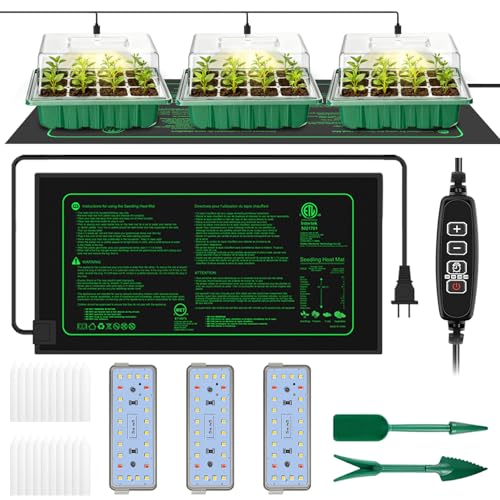
A
seed starter tray set
with grow lights and a heat mat is the one with the stated band in the diagram
above. Its record lists 3 trays, 36 extra large cells stated at 1.96 inches square
and 1.85 inches deep, an included heat mat holding 70 to 85F, far infrared heating
film with double insulation layers, multiple layers of waterproof PVC, an IP67
rating stated to exceed MET standards, 3 grow lights with an intelligent
controller and 4 timing settings, heightened humidity domes, sized drainage holes
with overflow retention in the bottom tray, and indoor only use.
Two things in that list matter more than the rest. The 70 to 85F figure is what
lets you check the mat against your sowing instead of guessing. And the timer on
the lights is the feature that handles the handover described above, because the
job after emergence is a long consistent photoperiod rather than more heat. Its
own record is admirably blunt about the limits: best for peppers, chillies and
anything else needing bottom heat, not for warm rooms where a heat mat adds
nothing, and the listing does not make clear whether 36 cells is per tray or
across all three. More in our
review
of the Kokopro kit, and the wider comparison is in
best seedling heat mats.
If temperature is not your problem, the tray is still worth getting right. A
36 cell reusable seed
starting tray with flexible silicone cells lists food grade silicone cells
that flex to pop a seedling out with the root ball intact, a tray measuring 11.5
by 10 and three eighths by 2 and a quarter inches, moulded corner drainage slots
in every cell, deep watering channels with a raised perimeter edge, alphanumeric
rows with a planting diagram included, moulded side handles, top shelf dishwasher
safe cleaning, and a design intended to be reused between seasons rather than
binned.
The watering channels are the relevant part here. Watering from underneath lets
the medium draw moisture up by capillary action while the surface stays
comparatively dry, which is the single most useful thing you can do against
damping off, and it does not disturb seed the way a watering can does. The record
is explicit that it includes no heated propagator and no grow light, and that 36
cells is one tray's worth. See our
review of
the Burpee SuperSeed tray.
The honest limit
If your room is already sitting in the band for what you sowed, a mat buys you
days and nothing else, which is exactly what the Kokopro's own record concedes
when it says it is not for warm rooms. Days are worth something at the start of a
season and worth nothing in the middle of one.
And the limit that no purchase addresses. Nothing you plug in substitutes for
stratification, for scarification, or for seed that is still alive. For the spruce
in the original question the honest answer is that the equipment was never the
problem, the dormancy was, and leaving the tray outside through a real winter is
both the cheaper and the more likely to work option. For most indoor sowing the
highest value upgrade is not heat at all, it is more light at emergence and some
air movement, which costs very little and fixes the failure most people actually
have. If you are starting from scratch on the windowsill,
how to start an indoor
herb garden from seed is the gentler place to begin.
Do Heat Mats Make Seeds Germinate Faster? Only If Temperature Is What Is Stopping Them at a glance
Indoor seed starting where transplant shock has been the problem
Food-grade silicone cells flex so plugs pop out root ball intact
Thirty six cells is a single tray's capacity
Why you can trust this guide
We compared these picks using verified manufacturer specifications, current retailer listings, and patterns in owner feedback, alongside editorial research. We focus on measurable differences such as performance, capacity, usability, and build quality. Pickpedia does not present editorial research as laboratory testing, and we do not claim hands-on testing unless it was actually performed.
Best for Peppers, chillies and anything else that needs bottom heat to germinate
8.8/ 10 Pickpedia editorial score
A three tray seed starting kit with a far-infrared heat mat holding 70 to 85F, extra large 1.96 inch cells at 1.85 inch depth, three grow lights, an intelligent controller with four timing settings and heightened humidity domes.
Best for Indoor seed starting where transplant shock has been the problem
9.2/ 10 Pickpedia editorial score
A 36 cell seed starting tray with food-grade silicone pop-out cells, drainage slots in every cell, a channelled watering tray and alphanumeric row labelling, dishwasher safe and reusable.
BrandBurpee
Model96512
Cells36, flexible pop-out
Cell materialFood-grade silicone
Tray dimensions11.5 x 10-3/8 x 2-1/4 in
DrainageMoulded corner slots in each cell
Watering trayDeep channels with raised perimeter edge
LabellingAlphanumeric rows, Plant-o-Gram diagram included
HandlesMoulded side handles
CleaningTop shelf dishwasher safe
ReuseDesigned to clean and store between seasons
ColourBlue
Pros
Food-grade silicone cells flex so plugs pop out root ball intact
Moulded corner slots in every cell for drainage and soil aeration
Deep channels in the watering tray draw excess water off the cells
Raised perimeter edge keeps water in the tray, not on the sill
Alphanumeric row labelling with a Plant-o-Gram diagram included
Side handles for lifting and pouring off excess
Top shelf dishwasher safe and genuinely reusable
Cons
Thirty six cells is a single tray's capacity
No grow light or heat mat included
Silicone cells need a firm surface under them when moving a wet tray