PBy the Pickpedia Team·4 picks compared·Last verified October 2026
Affiliate disclosure: As an Amazon Associate, Pickpedia earns from qualifying purchases. Links on this page are paid links, and we may earn a commission at no extra cost to you. This never affects our picks or scores.
This page contains affiliate links. If you buy through one we may earn a
commission, at no cost to you.
Water is not really what is being compared. Heating the water is almost the whole
energy bill of a dishwasher, so the water figure is a proxy for the electricity
figure, and once you see that the comparison stops being a matter of opinion and
becomes arithmetic you can do in your head.
Three of the countertop machines we carry publish the one number that makes this
possible: a built in tank of 5 litres, which they also state as 1.32 gallons. In
tank mode that is not an estimate of water use. It is a ceiling. The machine
physically cannot use more than it holds, and from that single figure the whole
energy sum follows.
The arithmetic, from one published figure
Water takes 4,186 joules per kilogram to raise by one degree Celsius, and a litre
weighs a kilogram. That is the only constant you need.
A
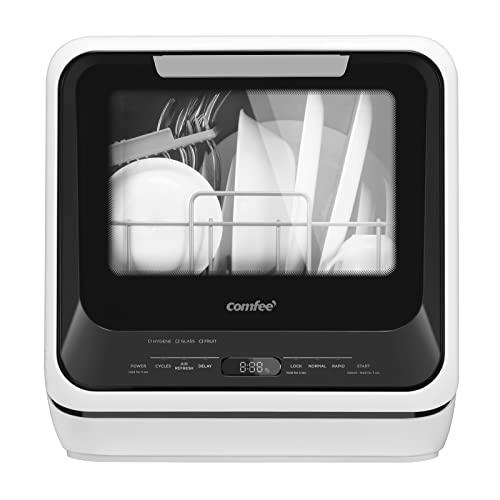
COMFEE portable mini
countertop dishwasher publishes a 1.32 gallon built in tank and a hygiene cycle
that heats water to 162 Fahrenheit, which is 72.2 Celsius. Take a cold supply at 15
degrees, which is ordinary. The rise is 57.2 degrees, so the heat required is 5
times 4,186 times 57.2, which is 1,198 kilojoules, and dividing by the 3.6 million
joules in a kilowatt hour gives 0.333 kilowatt hours. A normal cycle at perhaps 50
degrees is a 35 degree rise, which is 733 kilojoules, or 0.203 kilowatt hours. A
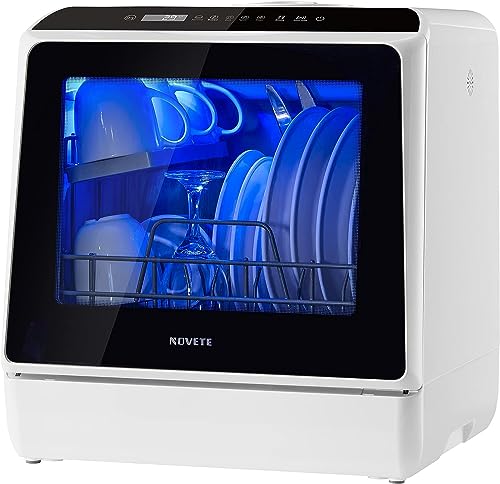
NOVETE portable countertop
dishwasher publishes a 5 litre tank and a Baby Care mode at 167 Fahrenheit, 75
Celsius, which is a 60 degree rise and 0.349 kilowatt hours.
So the whole thermal cost of running one of these machines, from the one figure
they publish, is between a fifth and a third of a kilowatt hour. That is the number,
and nothing else in the machine comes close to it: the circulation pump on a unit
this size draws tens of watts for an hour, which is a few hundredths of a kilowatt
hour, and the electronics are negligible.
The one real addition is drying, and it is a latent heat rather than a sensible
one. To dry a load you have to evaporate the film of water left on it, and
evaporation near these temperatures costs about 2,330 joules per gram. A hundred
grams of residual water, which is a reasonable amount on a small load, is therefore
233 kilojoules, or 0.065 kilowatt hours. Drying is roughly a fifth of a hygiene
cycle, which is a larger share than most people would guess and still a minority of
the total.
Five ways to wash the same load, compared on the one term that dominates. The
countertop machine wins against a running tap by a factor of four and loses to a
filled basin.
Why the tank is the specification that matters
The reason a tank cap is so much more useful than a water use estimate is that it
is a physical limit rather than a test result. A plumbed machine draws fresh water
for each fill, and a cycle has several: a prewash, a main wash, and one or more
rinses. Each fill is new water that has to be heated from cold. That is where the
gallons in a full size machine go, and it is why the per cycle figure for a plumbed
machine depends entirely on how many fills its programme uses, which nobody
publishes either.
A tank machine in tank mode recirculates. It heats one tank of water and pumps it
round the cycle. So the cap is also, near enough, the energy cap.
And this is where the listings become unhelpful in a specific and avoidable way,
because the same machines offer a second mode. A
EUHOMY countertop portable
dishwasher publishes a 5 litre, 1.32 gallon tank and a faucet connection, and
so do both of the others. In faucet mode there is no tank and therefore no cap, and
not one of the four listings we carry states how many fills a cycle takes or how
much water it draws when plumbed in. The identical machine has a known water figure
in one mode and a completely unpublished one in the other, and no listing separates
them. If you are buying one of these for the water saving, the tank mode is the mode
the saving exists in.
Worth checking one conversion while we are here, because it is the only one in
this group that holds up. Five litres divided by 3.78541 litres per US gallon is
1.3209 gallons, so the 5 L and 1.32 gal printed together are genuinely the same
quantity. Three separate listings get it right.
The comparison the question is really asking, and the free technique that wins
Against a running tap, the machine wins by a wide margin, and the figure that
settles it is a regulation rather than a measurement. United States federal law has
capped kitchen faucet flow at 2.2 gallons per minute since 1994. Six minutes of
washing up with the tap running is therefore 13.2 gallons, which is 50 litres.
Raising 50 litres from 15 degrees to a hand-tolerable 40 degrees takes 50 times
4,186 times 25, which is 5.23 megajoules, or 1.45 kilowatt hours. That is 4.4 times
the energy of the hygiene cycle and 10 times the water, for one load of dishes.
Which identifies the real variable, and it is not the machine. It is whether the
tap is running. Turn it off and fill a basin instead: 8 litres at 40 degrees is 0.233
kilowatt hours, which beats the hygiene cycle and is close to the normal cycle. A
filled basin is a better machine than the machine, on energy, and it costs
nothing.
So the honest answer to whether a dishwasher uses less water is: less than a
running tap, yes, by about ten times, and that is a comparison against a habit
rather than against a method. Less than a basin, no. The dishwasher's genuine
advantages over a basin are elsewhere and are real: it reaches 162 or 167
Fahrenheit, which a hand cannot, and the only thing a basin cannot substitute for
is temperature. Our own records are careful to describe those as hygiene and baby
care cycles rather than as sterilisation, which is the right level of claim.
The feature on this page that best understands all of the above is one that uses
no energy at all. That EUHOMY listing publishes 60 minutes of hot air drying
followed by up to 73 hours of automatic ventilation. The ventilation is a fan moving
room air, so it evaporates the same water using the room's heat rather than a
heating element. It substitutes time for energy, which is exactly the right trade in
a machine whose whole budget is heat, and it means the 0.065 kilowatt hours of
drying in the drawing above is avoidable on that model if you are willing to wait.
Our record calls it a convenience feature. It is better than that. Details in our
EUHOMY countertop dishwasher
review, and in the
COMFEE portable mini
review and
NOVETE countertop
review.
Small machine, big machine, and the per dish question
Our existing comparison of a
countertop dishwasher
against a portable dishwasher gets to the right conclusion without a number. It
says portables "use more water and energy per cycle since they clean a bigger
load", and that "one full portable cycle can replace two or three countertop
cycles, so per-dish the gap narrows for a busy household". Both halves are correct,
and the arithmetic above lets you see why and where the line falls.
Energy per cycle is proportional to water, and water on a tank machine is capped
at 5 litres. So if a countertop machine does four to six place settings on 5
litres, that is roughly a litre per place setting. A full size machine using, say,
12 litres on twelve place settings is the same litre per setting. The two are a
wash per dish, and whichever one you fill properly wins. Run a countertop machine
half empty and your litres per dish doubles; run a full size machine half empty and
it doubles too, from a bigger starting figure. That is the whole of the per dish
argument and it is a loading argument rather than a machine argument.
Which leaves one specification in our set that asserts the conclusion without
the figure. A
COMFEE countertop
dishwasher publishes six place settings, eight cycles including a 45 minute
speed cycle, a heavy programme with twelve nozzles, and the claim "Energy Star
certified with low water usage". Energy Star certification is a real standard with
real published thresholds, and it is the only efficiency credential anywhere in this
group, so that is a meaningful thing to carry. What the listing does not do is state
the gallons per cycle or the kilowatt hours per year that the certification is
based on, which are exactly the two numbers the programme requires a manufacturer to
measure. The credential is published and the measurement behind it is not. Our
record repeats the claim, as it should, and cannot improve on it. See our
COMFEE countertop dishwasher
review.
Problems in our own records, found while doing this
Four things turned up that are worth stating plainly.
First, the specification tables on all four of these product records are
unusable. The labels are not specification names, they are truncated Amazon bullet
headings: one reads "Please Make Sure The Dista", another "6 Place Setting- A
Perfect". The values are cut off mid word, as in "Adding water manually with the
water filling guide i". One record's labels are rendered in bold mathematical
Unicode characters rather than plain text. The features arrays carry the same
damage. Every usable figure on this page came out of the summary and pros fields
instead, which is why the hygiene temperatures and the tank size are cited and
nothing else is.
Second, one of those four records has its pros stored as a single run-on
paragraph rather than one claim per line as every other product on the site does,
so the list renders as a sentence that reads oddly and runs several unrelated claims
together.
Third, and this is the serious one: our roundup of the best countertop
dishwashers has nine picks and not one of them is a countertop dishwasher. They are
detergent pacs, a drain board, an XL electric griddle, a bamboo laundry countertop,
a cutlery holder, a drying rack, a silicone mat, dish cloths and a sponge holder.
Its own comparison line also says eight items were compared when nine are listed.
Our roundup of the best dishwasher that cleans the best has seven picks, all of
them detergents, rinse aid or cleaner, plus a replacement dishwasher door panel. And
our portable dishwashers roundup has six picks of which three are descaling tablets
and one is a collapsible plastic basin. No argument on this page rests on any of
those, deliberately, and I have not linked them.
Fourth, a correction to our own planning note for this article. We had kilowatt
hours down as absent from the site. It is not: the term appears in the roundup data
of three posts, covering smart plugs with energy monitoring, beverage refrigerators
and mini fridges. None of them is a dishwasher, so the gap this post fills is real,
but the count was wrong.
The honest limit
Every figure above is heating only, and it is my arithmetic on their published
tank size and their published cycle temperatures rather than a measurement of
anything. Not one of the four listings publishes a heating element wattage, a
gallons per cycle figure, a kilowatt hours per year figure, a number of fills, a
cold inlet temperature or a water use in faucet mode. The 15 degree tap and the 100
grams of residual water are both reasonable assumptions of mine, and both move the
answer: a 10 degree tap adds about 15 percent to every bar in the drawing, and a 20
degree tap takes about 15 percent off.
Which makes the free moves the ones worth doing, and they are all about the terms
the arithmetic says are large. Fill the machine before you run it, because the
energy is per cycle and almost independent of how many dishes are inside. Use the
normal cycle rather than the hygiene cycle unless you have a reason, because the
difference is 0.13 kilowatt hours, which is 64 percent of the normal cycle's entire
heat. Let it air dry, by cracking the door or using a ventilation setting if it has
one, which removes the drying term completely. And above all, if you wash anything
by hand alongside it, fill a basin rather than running the tap, because that single
habit is worth more than every other decision on this page put together: 50 litres
and 1.45 kilowatt hours against 8 litres and 0.233.
Where a Countertop Dishwasher Energy Really Goes at a glance
Apartments, RVs, and small households with limited counter space
No permanent installation needed, built-in water tank for portability Compact design fits small spaces, washes up to 30+ items Six programs including high-temperature hygiene cycle Can connect directly to faucet with included adapter and hose Air refresh drying mode for extra convenience Ideal for RVs, boats, and campers
Manual water filling may be inconvenient for daily use Limited capacity for larger households Clearance requirement may not suit all kitchens Detergent restrictions (no liquid dish soap)
Small apartments, dorms, RVs, and boat owners needing a compact, no-install dishwasher.
Compact size fits small spaces No installation required with two water supply modes Baby Care mode with 167°F for sanitizing 3-in-1 function: dishwasher, dryer, and storage cabinet Holds up to 4 place settings and 12-inch dishes Automatic water level indicator for easy filling
Small capacity may require multiple cycles Manual water tank filling if not using faucet mode Drying performance may vary Residual water after quality tests may require initial run
Apartments, dorms, RVs, and small kitchens needing a portable, no-install dishwasher.
No installation required, tank or faucet options Quiet 40 dB operation Six programs including Quick and Baby Care/Heavy Holds 30+ items with cutlery holder and fruit basket 73-hour ventilation to keep dishes dry Compact size fits most countertops
Faucet adapter not included Needs sufficient countertop space and vertical clearance 5L tank may require frequent refills for large loads Not suitable for large households
Small households, dorm rooms, RVs, and apartments with limited counter space.
Compact and portable design fits on countertops Eight washing cycles including Speed and Baby-Care Heavy program with 12 nozzles and 360-degree spray Energy Star certified with low water usage Rapid 45-minute Speed cycle Extra-drying function for better drying results
Small capacity limits number of dishes per load Requires counter space and manual connection to faucet Drying performance may vary for plastic items Not suitable for large or oddly shaped cookware
Why you can trust this guide
We compared these picks using verified manufacturer specifications, current retailer listings, and patterns in owner feedback, alongside editorial research. We focus on measurable differences such as performance, capacity, usability, and build quality. Pickpedia does not present editorial research as laboratory testing, and we do not claim hands-on testing unless it was actually performed.
Best for Apartments, RVs, and small households with limited counter space
8.8/ 10 Pickpedia editorial score
The COMFEE' Portable Mini Dishwasher is a space-saving appliance designed for apartments, dorms, and RVs. It features a 1.32-gallon built-in water tank, allowing manual water filling or direct faucet connection. With six programs including a high-temperature hygiene cycle, it handles daily dishwashing needs without permanent installation. Its compact footprint holds up to 30+ items, but you must verify clearance above 19.6 inches from countertop to cupboard.
Please Make Sure The DistaAdding water manually with the water filling guide i
Ultra-compact DesignThe ultra-compact design allows the dishwasher to wa
6 Program OptionsNORMAL, RAPID, HYGIENE, FRUIT, GLASS washing program
High-Temp HygieneThe Hygiene cycle heats the water up to 162℉, making
Pros
No permanent installation needed, built-in water tank for portability Compact design fits small spaces, washes up to 30+ items Six programs including high-temperature hygiene cycle Can connect directly to faucet with included adapter and hose Air refresh drying mode for extra convenience Ideal for RVs, boats, and campers
Cons
Manual water filling may be inconvenient for daily use Limited capacity for larger households Clearance requirement may not suit all kitchens Detergent restrictions (no liquid dish soap)
Best for Small apartments, dorms, RVs, and boat owners needing a compact, no-install dishwasher.
8.8/ 10 Pickpedia editorial score
The NOVETE Portable Countertop Dishwasher is designed for small living spaces, measuring just 16.9 x 16.8 x 18.1 inches yet holding up to four place settings. It offers flexible water supply via a built-in 5L tank or faucet connection, eliminating the need for installation. With five wash cycles including a high-temperature Baby Care mode and a 3-in-1 function that dries and stores dishes, it aims to be a versatile kitchen companion. However, its small capacity and manual water filling may not suit larger households or heavy daily use.
Feature(SMALL SIZE, LARGE CAPACITY)This portable dishwasher
Feature(NO INSTALLATION NEEDED)This countertop dishwasher s
Feature(BABY CARE MODE)This compact dishwasher offers 5 was
Feature(3-IN-1 FUNCTION)Featuring a Dry mode, this machine
Feature(QUALITY CONTROL NOTE) NOVETE dishwasher undergoes m
Pros
Compact size fits small spaces No installation required with two water supply modes Baby Care mode with 167°F for sanitizing 3-in-1 function: dishwasher, dryer, and storage cabinet Holds up to 4 place settings and 12-inch dishes Automatic water level indicator for easy filling
Cons
Small capacity may require multiple cycles Manual water tank filling if not using faucet mode Drying performance may vary Residual water after quality tests may require initial run
Best for Apartments, dorms, RVs, and small kitchens needing a portable, no-install dishwasher.
8.8/ 10 Pickpedia editorial score
The EUHOMY Countertop Dishwasher offers a no-install solution for small kitchens, with a 5L tank or faucet hookup, six programs, and a quiet 40 dB operation. It holds 30+ items and includes a 73-hour ventilation feature. However, it requires ample countertop space and may need a separate faucet adapter. Ideal for apartments, dorms, or RVs, but not for large families or permanent installations.
𝐍𝐨 𝐈𝐧𝐬𝐭𝐚𝐥𝐥𝐚𝐭𝐢𝐨𝐧 , 𝐓𝐚𝐧𝐤 𝐨𝐫No permanent setup required. Use the built-in 5L (1.
𝟒𝟎 𝐝𝐁 𝐐𝐮𝐢𝐞𝐭 , 𝐌𝐚𝐝𝐞 𝐟𝐨𝐫 𝐑𝐞𝐚Built for apartments and open kitchens, this counter
𝐖𝐚𝐬𝐡, 𝐃𝐫𝐲, 𝐒𝐭𝐚𝐲 𝐅𝐫𝐞𝐬𝐡 , 𝐔𝐩After washing, enjoy 60 minutes of hot air drying, t
𝐋𝐚𝐫𝐠𝐞 𝐂𝐚𝐩𝐚𝐜𝐢𝐭𝐲-𝐅𝐢𝐭𝐬 𝟑𝟎+ 𝐈𝐭Sized at 16.83 x 16.73 x 18.03 in, this portable dis
No installation required, tank or faucet options Quiet 40 dB operation Six programs including Quick and Baby Care/Heavy Holds 30+ items with cutlery holder and fruit basket 73-hour ventilation to keep dishes dry Compact size fits most countertops
Cons
Faucet adapter not included Needs sufficient countertop space and vertical clearance 5L tank may require frequent refills for large loads Not suitable for large households
Best for Small households, dorm rooms, RVs, and apartments with limited counter space.
8.8/ 10 Pickpedia editorial score
The COMFEE' Countertop Dishwasher is a compact, Energy Star certified dishwasher designed for 2-3 people, fitting easily on a countertop in dorms, RVs, or apartments. It offers eight washing cycles, including a heavy-duty option with multiple spray nozzles and high-temperature washing, plus a rapid cycle that finishes in 45 minutes. While it saves water and energy, its small capacity and countertop design may not suit larger families or those with permanent kitchen setups. Overall, it's a convenient, effective solution for small-space living.
6 Place Setting- A PerfectCOMFEE dishwashers are rigorously factory tested bef
Feature8 Washing Cycles- Most of the cleaning cycles, inclu
FeaturePowerful Wash Performance- This counter dishwasher p
Pros
Compact and portable design fits on countertops Eight washing cycles including Speed and Baby-Care Heavy program with 12 nozzles and 360-degree spray Energy Star certified with low water usage Rapid 45-minute Speed cycle Extra-drying function for better drying results
Cons
Small capacity limits number of dishes per load Requires counter space and manual connection to faucet Drying performance may vary for plastic items Not suitable for large or oddly shaped cookware