Home ›
Kettles › Why Boiling Milk Breaks an Electric Kettle
Kettles
Why Boiling Milk Breaks an Electric Kettle
PBy the Pickpedia Team·4 picks compared·Last verified October 2026
Affiliate disclosure: As an Amazon Associate, Pickpedia earns from qualifying purchases. Links on this page are paid links, and we may earn a commission at no extra cost to you. This never affects our picks or scores.
This page contains affiliate links. If you buy through one we may earn a
commission, at no cost to you.
Because a kettle does not know what is in it. It is not a pan with a heater
underneath, and the thing most people picture happening, sugars caramelising onto the
metal, is a consequence rather than a cause. Two separate failures stack, and they
are independent enough that fixing one does nothing for the other.
The first is that the switch which turns the kettle off is a steam detector, not a
thermometer. The second is that a film of baked milk on the element is a layer of
insulation, and 0.154 mm of it is enough to make the kettle's own safety device open
while the kettle is still full.
The switch is listening, not measuring
Open any ordinary cordless kettle and the control sits in the base of the handle.
A vent under the lid feeds a narrow channel that runs down inside the handle to a
small bimetal disc. When the water boils, steam travels that channel, warms the disc,
the disc snaps, and the contacts open. That is the whole mechanism, and it is why a
kettle switches off a second or two after the boil rather than at the instant the
water reaches 100 degrees.
So the control has exactly one input: is a clean column of vapour coming out of
the top. Milk does not provide one. Milk's surface is loaded with proteins that
stabilise foam, so instead of an open liquid surface venting steam, you get a rising
head of bubbles that climbs into the headspace, plugs the vent, and wets the channel
below it. The disc receives either nothing or a late and soggy version of the signal,
and the kettle keeps heating.
One of our own listings describes this part in a way that is worth correcting,
because the correction is the whole point of this section. An
Amazon Basics 1 litre
cordless kettle lists among its features that "a Strix thermostat helps regulate
temperature accurately". A Strix type control does not regulate temperature and has
no setpoint to regulate it to. It is a one shot boil detector plus a dry boil cutout,
and the proof is in the same record four lines later, where the drawbacks say
plainly: "No temperature control options". Both statements cannot be true. The second
one is.
That matters here rather than being pedantry, because if you believe the kettle
has a thermostat you will also believe it will stop milk from overheating. It has no
means of doing so. The only kettles that can are the ones with a real sensor instead
of a steam channel. A
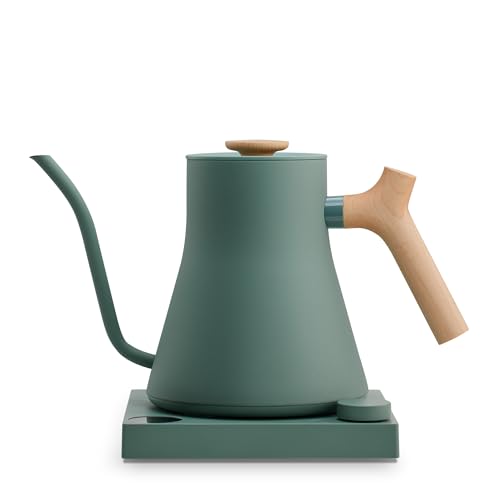
Fellow Stagg EKG Pro
gooseneck kettle publishes to the degree temperature control and a 0.9 litre
capacity, and that is a genuinely different machine: it reads the water and holds a
number, so it can stop at 70 degrees and never produce steam at all. It solves the
first failure completely. Hold that thought, because it does nothing at all about the
second one, and the second one is the one that kills kettles.
The deposit is insulation, and the arithmetic is brutal
A Zulay 1.7 litre glass
kettle publishes a 1500 watt element, which is the standard figure in a 120 volt
market and, as our own page on
whether kettle wattage really
matters sets out correctly, the ceiling rather than an achievement: 1500 watts is
12.5 amps of a 15 amp circuit and there is no headroom above it. That page is about
how fast the water heats. This one is about what those 1500 watts are doing to the
2 cm of metal they pass through on the way.
A concealed element in a kettle of that size spreads its heat over a base plate of
roughly 140 mm diameter, which is 0.01539 square metres. Divide 1500 watts by that
and the flux through the surface is 97,466 watts per square metre, call it 97.5
kilowatts per square metre. That is a large number for a domestic appliance and it is
why a kettle boils 1.7 litres in minutes.
Now put a layer of baked milk on top of it. Heat crossing a layer needs a
temperature difference, and that difference is the flux times the thickness divided
by the conductivity. Dried dairy soil runs around 0.5 watts per metre kelvin. So
every tenth of a millimetre of deposit adds 19.5 kelvin of temperature rise across
it, and the element plate must sit that much hotter than the liquid to push the same
1500 watts through.
With boiling liquid above it, a tenth of a millimetre puts the plate at 120
degrees. Two tenths puts it at 139. Half a millimetre, which is still a film you
would describe as a stain rather than a crust, puts the plate at 198 degrees with
liquid sitting on it.
Heat flux is the element wattage divided by the plate area, and the temperature rise
across a deposit is the flux times its thickness over its conductivity. The wattages
are the ones our own four kettle listings publish. The 140 mm plate is an assumption,
because no kettle listing we carry states an element diameter or a heating surface
area anywhere, and the 0.5 W per metre kelvin for baked dairy soil comes from dairy
process engineering rather than from any product record. The ratios between the bars
are therefore sounder than their absolute heights. The dry boil cutout threshold is
drawn at a plate temperature of 130 C, which is the low end of the range such devices
are built for.
Which is where the kettle's own protection turns on it
Every kettle in our catalogue publishes boil dry protection, and all of them are
right to. It is a bimetal disc bonded to the element plate, and it opens when the
plate gets hot. Its threshold was chosen for a specific scenario: an element switched
on with no water at all, which reaches a few hundred degrees within seconds because
there is nothing to carry the heat away. Something in the region of 130 degrees of
plate temperature is the low end of what such a device is set for.
Read that against the figures above. A plate temperature of 130 degrees with
boiling liquid in the kettle is a rise of 30 kelvin, and 30 kelvin arrives at a
deposit thickness of 30 times 0.5 divided by 97,466, which is 0.154 mm. Two sheets of
paper. At that point the dry boil cutout opens on a kettle that is not dry, and it
will keep opening, because the deposit does not come off by itself and the flux has
not changed.
That is the failure people describe as the kettle breaking. On designs where the
backup is a resettable disc you get a kettle that trips early and never completes a
boil. On designs where it is a one shot thermal fuse, which is the common second line
of defence, it goes once and the kettle is finished. Nothing was overloaded, nothing
was abused, and the element is intact underneath. The protective device did exactly
what it was built to do, against a condition it was never told about.
It is also self accelerating, which is the part that turns one episode into a dead
kettle. Milk proteins start unfolding above roughly 70 degrees and aggregate onto the
hottest surface they can find. Raise that surface from 110 to 139 degrees and you
have raised the deposition rate on the very layer that raised the temperature.
Calcium phosphate makes it worse, because it is one of the few salts whose solubility
falls as water gets hotter, so it also comes out of solution preferentially on the
hot plate.
The one place a slower kettle wins
Since the flux is the wattage divided by the plate, the same deposit is less
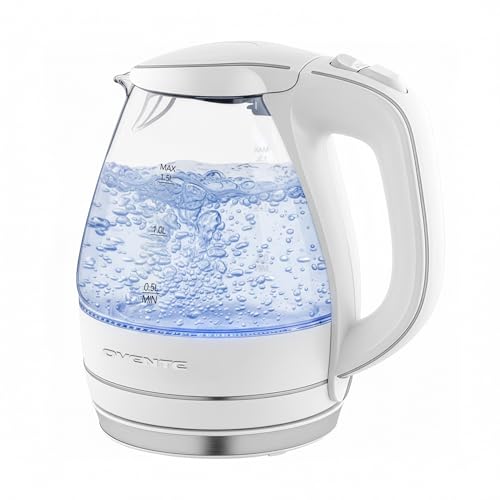
dangerous on a less powerful kettle. An
OVENTE 1.5 litre glass
kettle publishes 1100 watts, which on the same plate is 71.5 kilowatts per square
metre, and the 30 kelvin margin then survives to 0.210 mm of deposit. A 1000 watt
kettle reaches 65.0 kilowatts per square metre and 0.231 mm. That is half as much
again as the 1500 watt machine tolerates.
It is worth being clear about how small a consolation that is. It is a 50 percent
improvement in the thickness of a film you cannot see, on an appliance you were not
supposed to put milk in. The useful part is the direction of the result, because it
tells you the mechanism is the surface flux rather than anything about the milk
itself, and that points at the fix.
Why descaling does not clean it, and our own page already explains that
The usual advice for a kettle with something stuck to the bottom is to descale it.
That advice is correct for limescale and useless here, and the reason is a chemistry
our own page on
why one cleaner
cannot cut grease and dissolve limescale already sets out properly: the two soils
need reagents of opposite sign, and a reagent for one does nothing for the other.
Credit where it belongs, and this page will not repeat the argument.
What is worth adding is that milk puts both soils on the same disc of metal at the
same time. The protein and fat fraction is organic and wants an alkali to break it
up. The calcium phosphate fraction is a mineral and wants an acid. A kettle descaler,
whether citric acid sachets or household vinegar, is an acid. It will take the
mineral half away and leave the protein half sitting exactly where it was, which is
why a descaled kettle that was used for milk still trips.
This is not an exotic problem. Dairy plants clean heat exchangers in two stages for
precisely this reason, caustic first to lift the protein and then acid to take the
mineral, with a rinse between. At home the version of that is a hot alkaline soak,
then a rinse, then the descaler you already own, then another rinse. Our
electric kettle
buying guide is right that glass shows every mark and wants regular descaling,
and the glass bodies on two of the kettles above are a real advantage for exactly
this job, since you can see whether the plate came clean instead of guessing.
Two things our listings do not publish
The first is the element plate. Not one kettle listing we carry states an element
diameter, a heating surface area, or even whether the element is a concealed disc or a
coil, and that single number is what converts a wattage into a surface temperature.
Every flux on this page is anchored to an assumed 140 mm disc. The ratios between
1500, 1100 and 1000 watts hold regardless, but the absolute plate temperatures would
move if the real plate were 120 mm, which would raise the flux by 36 percent and
bring the cutout threshold down to 0.113 mm of deposit.
The second is the headspace. Every kettle publishes a capacity, which is the
maximum fill line, and none publishes the internal volume above it. That figure is
the entire overflow margin, and for a foaming liquid it is the number that decides
whether you get foam at the vent or foam in the base contacts. A kettle filled to its
marked capacity has only that unpublished gap between a boil and a flood.
The honest limit, and the technique that needs no hardware
The limit is that the deposit growth rate cannot be computed from anything here.
Dairy fouling depends on protein denaturation kinetics, on calcium content, on
surface finish and on flow, and milk varies between cartons. The arithmetic above
tells you what a given thickness does once it is there. It cannot tell you whether
one episode gets you to 0.05 mm or to 0.3 mm, and anyone who gives you that number
without knowing your milk and your element is guessing.
So the answer worth having is the one that removes the flux instead of managing
it, and it needs no appliance at all. Boil water in the kettle, pour it into a jug or
a bowl, and stand the milk in it in a second container. Heat still flows into the
milk, but now the hottest surface it can touch is water at 100 degrees rather than
metal at 139, which is below the temperature at which the problem starts and
structurally incapable of rising above it.
The energy is there for it. Half a litre of just boiled water carries 0.5 times
4,186 times 100 degrees above freezing, and a quarter litre of refrigerated milk at
5 degrees needs 0.2575 kilograms times 3,930 joules per kilogram kelvin to warm up.
Let them equilibrate and the pair settles at 214,360 divided by 3,105, which is 69
degrees. One kettle of water, no stirring, nothing to scrub, and a final temperature
in the right range for drinking rather than scalding.
And if the milk must be hot rather than warm, use a pan, where the hot surface is
one you can see, reach and stir, and where the vessel is designed to be scrubbed with
an alkali afterwards. The kettle's problem was never the milk. It was that the one
place milk should never sit is a 97.5 kilowatt per square metre surface behind a
switch that cannot see it.
Why Boiling Milk Breaks an Electric Kettle at a glance
Individuals or small households needing a quick, safe kettle for hot beverages.
Quick boiling with 1500W power Auto shut-off and boil dry protection for safety Cordless design with 360-degree swivel base for easy serving BPA-free materials for health safety Compact size fits small kitchens Strix thermostat for reliable temperature regulation
1-liter capacity may be small for multiple users No temperature control options Cord storage is basic Black and stainless steel exterior may show fingerprints
Fellow Stagg EKG Pro Electric Gooseneck Kettle - Pour-Over
Pour-over coffee and tea enthusiasts who value precise temperature control and brewing customization.
To-the-degree temperature control Precision gooseneck spout for controlled pours Built-in brew timer and Guide Mode presets Scheduling and customizable settings (hold mode, altitude, chime) Intuitive full-color display Ergonomic handle and stylish design
Small capacity (0.9 liters) No built-in thermometer (but digital display shows temp) Wood handle may require extra care Higher-end feature set may be overkill for casual users
Everyday hot water needs like tea, coffee, and instant meals.
Boils water in 7 minutes or less Auto shut-off and boil-dry protection Stylish borosilicate glass with blue LED 360-degree rotary base with cord storage 50% more efficient than stovetop kettles 2-year warranty and US-based support
No temperature control 1100W may be slower than higher wattage kettles Glass body may be fragile if dropped Cord length not specified
Why you can trust this guide
We compared these picks using verified manufacturer specifications, current retailer listings, and patterns in owner feedback, alongside editorial research. We focus on measurable differences such as performance, capacity, usability, and build quality. Pickpedia does not present editorial research as laboratory testing, and we do not claim hands-on testing unless it was actually performed.
Best for Individuals or small households needing a quick, safe kettle for hot beverages.
8.8/ 10 Pickpedia editorial score
The Amazon Basics Electric Kettle is a compact 1-liter model with a 1500W heating element that boils water quickly. It features a cordless design with a 360-degree swivel base for easy pouring and serving. Safety features include auto shut-off and boil dry protection, backed by a Strix thermostat. It is made with a BPA-free, black and stainless steel exterior, making it a practical choice for everyday hot beverages.
Feature1.0 liter electric kettle for heating water for coff
Feature1500W/120V quick-boiling, fast-heating design for ev
FeatureCordless tea kettle can be removed from base for eas
Pros
Quick boiling with 1500W power Auto shut-off and boil dry protection for safety Cordless design with 360-degree swivel base for easy serving BPA-free materials for health safety Compact size fits small kitchens Strix thermostat for reliable temperature regulation
Cons
1-liter capacity may be small for multiple users No temperature control options Cord storage is basic Black and stainless steel exterior may show fingerprints
Best for Pour-over coffee and tea enthusiasts who value precise temperature control and brewing customization.
8.8/ 10 Pickpedia editorial score
The Fellow Stagg EKG Pro is a 0.9-liter electric gooseneck kettle designed for pour-over coffee and tea. It offers to-the-degree temperature control, a high-res LCD, scheduling, and a built-in brew timer. Its precision spout and ergonomic handle aim to improve your pour technique. While it lacks a built-in thermometer (not needed due to digital control) and has a modest capacity, it excels in customization and precision.
1) The Ultimate Pour-overDesigned for pour-over perfection, the precision spo
2) Tailored To Your RoutinThe full-color display offers an intuitive interface
3) Pour Like A ProA precision gooseneck spout ensures a slow, controll
4) Effortless PrecisionWith to-the-degree temperature control and a quick h
5) Brew With ConfidenceGuide Mode lets you select a preset temperature for
Pros
To-the-degree temperature control Precision gooseneck spout for controlled pours Built-in brew timer and Guide Mode presets Scheduling and customizable settings (hold mode, altitude, chime) Intuitive full-color display Ergonomic handle and stylish design
Cons
Small capacity (0.9 liters) No built-in thermometer (but digital display shows temp) Wood handle may require extra care Higher-end feature set may be overkill for casual users
Best for Fast, everyday boiling for tea, coffee and instant meals
9.0/ 10 Pickpedia editorial score
A 1.7 litre, 1500W electric kettle with a borosilicate glass body and stainless steel components, auto shut-off and boil-dry protection, a cool-touch handle, a 360-degree cordless base and a spout scale filter, backed by a lifetime guarantee.
Best for Everyday hot water needs like tea, coffee, and instant meals.
8.8/ 10 Pickpedia editorial score
The OVENTE 1.5L Glass Electric Kettle combines a sleek borosilicate glass body with practical features like auto shut-off and boil-dry protection. It boils water quickly, thanks to its 1100W power, and its 360-degree base adds convenience. While it lacks temperature controls, it's a solid choice for basic hot water needs.
FeatureA BLEND OF STYLE & DURABILITY , The OVENTE KG83 Kett
FeatureENJOY HOT WATER ANYTIME , This attractive glass elec
FeatureCONVENIENCE AT ITS FINEST , Enjoy peace of mind with
FeatureUS-BASED CUSTOMER SERVICE LETS YOU BUY WITH CONFIDEN
Pros
Boils water in 7 minutes or less Auto shut-off and boil-dry protection Stylish borosilicate glass with blue LED 360-degree rotary base with cord storage 50% more efficient than stovetop kettles 2-year warranty and US-based support
Cons
No temperature control 1100W may be slower than higher wattage kettles Glass body may be fragile if dropped Cord length not specified