Home ›
Tools & DIY › Why a Longer Hose Loses Pressure and a Thinner One Loses Far More
Tools & DIY
Why a Longer Hose Loses Pressure and a Thinner One Loses Far More
PBy the Pickpedia Team·3 picks compared·Last verified October 2026
Affiliate disclosure: As an Amazon Associate, Pickpedia earns from qualifying purchases. Links on this page are paid links, and we may earn a commission at no extra cost to you. This never affects our picks or scores.
This page contains affiliate links. If you buy through one we may earn a
commission, at no cost to you.
Yes and no, and the split is the useful part. With the nozzle shut, a hose loses
no pressure at all, and it would lose none if it were a mile long: the water is
standing still, nothing is rubbing against anything, and the gauge at the far end
reads exactly what the tap reads. The moment you open the nozzle, the hose starts
taking a share. So the honest answer is that length takes nothing from you when you are
not using it and something when you are, which is why the question feels like it has
two answers.
The part worth knowing is that length is the mild term. Bore is the severe
one, by a factor of about thirteen, and almost nobody chooses a hose that way.
What the hose takes grows as the square of how fast you make the water go
Friction in a pipe follows one equation that has been settled for a century and a
half. The pressure you lose is a friction factor, times the length divided by the
diameter, times the kinetic energy density of the moving water. Two of those three
terms are obvious: twice the length rubs twice as much, and a narrower pipe has more
wall per unit of water. The third is where the surprise lives. Kinetic energy density
goes as velocity squared, so making the water go twice as fast does not take twice as
much pressure, it takes roughly four times as much.
Roughly, because the friction factor is not constant either. First, is the flow
smooth or churning? Take the Wurzberge hose below at its published 5/8 inch bore. Run
10 gallons per minute through it and the water moves at 3.19 metres per second, which
puts the Reynolds number at about 50,400. Smooth, orderly, laminar flow in that bore
would need the water below 0.145 metres per second, which is 0.46 gallons per minute,
slower than a dripping tap. So garden hose flow is never laminar. It is firmly
turbulent at any flow you would call watering, and that is exactly why the loss goes
as velocity squared instead of linearly: laminar flow is the regime where loss is
proportional to velocity, and no hose is ever in it.
In the turbulent regime the friction factor itself drifts downward as the flow
rises, as about the minus one quarter power of the Reynolds number, which pulls the
exponent on velocity back from 2.0 to about 1.75. That refinement is small but it is
the difference between two real predictions, so here it is checked: at 5 gallons per
minute, 50 feet of that 5/8 inch bore loses 4.43 PSI, and at 10 gallons per minute it
loses 14.89 PSI. The ratio is 3.36, which is two raised to the 1.75, and not 4.
Diameter enters five times over
Now hold the flow rate fixed and change the bore, which is the comparison a buyer
actually makes. Diameter appears in that equation once, in the length over diameter
term. But it also appears in the velocity, because a narrower pipe has to push the
same gallons per minute through less area, and area goes as diameter squared. Feed
that back in and the loss scales as diameter to the minus 4.75.
Minus 4.75 is a brutal exponent. Halve the bore and the loss goes up by two to the
4.75, which is 26.9 times. Double the length and it goes up by 2. So one halving of
diameter is worth 13.5 doublings of length, and since nobody sells a 6,400 foot
garden hose, the practical conclusion is that if your water is weak, the bore is
almost certainly the reason and the length almost certainly is not.
The step buyers actually face is smaller than a halving and still decisive. Going
from 5/8 inch to 1/2 inch is a ratio of 0.8, and 0.8 to the minus 4.75 is 2.89. A
half inch hose loses nearly three times what a 5/8 inch hose loses over the same run
at the same flow. Going up to 3/4 inch multiplies the loss by 0.42, cutting it to
well under half.
What that does to a real tap, with the flow allowed to settle
Here is the trap in doing this arithmetic, and it is worth naming because it is
easy to overstate the case. You cannot simply subtract the loss at a fixed flow rate,
because the flow rate is not fixed. A nozzle is a restriction, the hose is a
restriction, and they are in series. Fit a thinner hose and the flow falls, which
reduces the loss. The system settles wherever the two losses add up to the supply
pressure. So the figures below are solved for that operating point rather than
assumed.
Our own hose nozzle comparison already publishes the supply figure this needs:
A typical home supply arrives at roughly 40 to 60 PSI, and a good nozzle
concentrates that into a stream that feels much stronger, yet the underlying pressure
is still your tap's. That page is right, and it is right about the thing most
pages get wrong, which is where the energy comes from. Take 50 PSI from the middle of
its range, hold one nozzle fixed across every case, and solve.
On 50 feet of 5/8 inch bore, the system settles at 10.0 gallons per minute, the
hose eats 14.9 PSI, and 35.1 PSI arrives at the nozzle. Swap in a 1/2 inch hose of
the same length and the same nozzle, and the flow drops to 7.9 gallons per minute and
the nozzle inlet falls to 21.7 PSI. One bore size has taken 21 percent of your
water and 38 percent of your pressure, on an identical run with identical fittings.
Go the other way, to 75 feet of 5/8 inch, and you get 9.3 gallons per minute at 30.3
PSI. Fifty percent more length took 13 percent of the pressure. One bore size took
38 percent. That is the whole post in two sentences.
Worked from the 5/8 inch bore and the 50 and 75 foot lengths our own two hose
listings publish, and from the 40 to 60 PSI domestic supply figure already published
on our hose nozzle comparison. Friction from Darcy and Weisbach with the Blasius
smooth bore factor, water at 20 C. The nozzle is held fixed across all four bars and
sized so that it passes 10.0 gallons per minute at 35 PSI, so the flow in each bar is
the operating point the whole system settles at, not an assumption. No nozzle we
carry publishes a flow or a pressure, so the nozzle is a model and the hose figures
are not.
The correction: our own hose guide names the right numbers and the wrong reason
Our guide to choosing a garden hose gets the two numbers that matter exactly right
and then explains one of them in a way that will lose a reader real water pressure.
It says: Bore is the other number: a wider bore carries more water. 5/8 inch is
the standard all-round size, balancing flow and weight. 1/2 inch runs lighter for
small gardens, and 3/4 inch handles high flow over long runs.
Every clause there is true and the framing is wrong. It presents bore as a comfort
trade, lighter against heavier, with flow as a mild consequence. The arithmetic above
says bore is the single most powerful variable in the system, nearly three times the
loss for one step down, and that it dominates length so completely that the guide's
own advice to measure your reach and add slack is the less important of its two
recommendations. A reader who takes that paragraph at face value buys a 1/2 inch hose
because their garden is small, and then wonders why the nozzle dribbles.
The same page also treats length purely as an ergonomic question: Too short
leaves you unable to reach. Too long is heavy and awkward to manage and store.
Both true, and both about your arms. The hydraulic reason to avoid surplus length
never appears, which is a smaller error than the bore one, because as shown above
length really is the mild term. Full page:
choosing
a garden hose, materials, length, fittings and what makes one last.
What the listings do and do not publish
A
Wurzberge 50ft hybrid rubber
garden hose publishes the two figures this argument needs and one more that is
quietly interesting. Its record gives a 50 foot length and a 5/8 inch bore, which is
what every number above is computed from, and it also publishes a 650 PSI burst
pressure against what the record calls the optimal 150 PSI working pressure. Set that
against the 50 PSI standing at your tap and the burst rating carries a factor of
thirteen in hand. That is a reassuring number and it is answering a question nobody
asked: a hose almost never fails by bursting at mains pressure, and the figure tells
you nothing about the loss, which is the thing you will actually notice. Our
Wurzberge hybrid rubber
hose review has the rest of the record.
A
PHLEX PRO 75ft retractable
garden hose reel publishes 75 feet of the same 5/8 inch bore with a 3/4 inch brass
fitting, and it is the one product here where the mechanism has a genuine design
consequence. On a loose hose you uncoil what you need, so a 75 foot hose used across
20 feet of lawn behaves like a 20 foot hose. On a retractable reel the water enters at
the drum and leaves at the tip, so it travels the entire stored 75 feet whether you
pulled it out or not. The 19.7 PSI in the drawing is therefore not a worst case, it is
the only case: the reel's length is not optional. That is a real penalty and it is the
honest trade for never coiling a hose again, which is a convenience worth having.
It is worth being precise about one thing I expected to matter here and which does
not. A coiled hose is also a long curve, and curvature does add friction. At 10
gallons per minute on a drum of roughly a foot across, the Dean number is about
11,500, which lifts the friction factor on the coiled portion by some tens of percent.
Tens of percent on part of the run is a real effect and a small one. The length is the
story, not the bends. Our
PHLEX PRO retractable
hose reel review covers the mounting, which matters more.
And then an
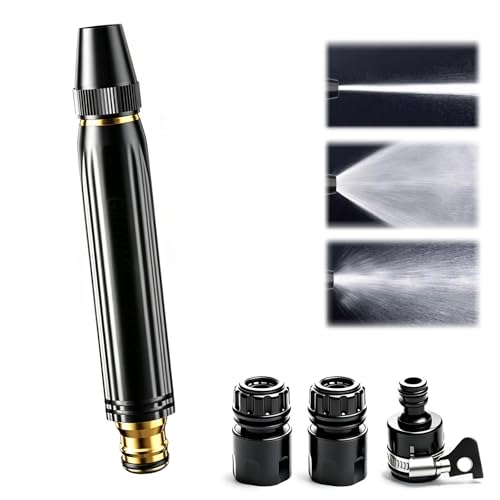
AD ADASTONE high pressure
hose nozzle, which is the product whose name this page is about. I went looking
for what its high pressure claim is measured against, across every prose field on its
record. The answer is nothing. There is no pressure figure, no flow figure, no
orifice size, and no comparison to anything. What there is, to the record's credit, is
a cons field that gives the game away honestly: it says plainly that force is limited
to your home water pressure and that this is a hose nozzle, not a powered pressure
washer, and the performance text says the same thing at length. So the listing's own
honest half contradicts its own name, and the honest half is right. Our
AD ADASTONE
hose nozzle review leads with that limit rather than the name.
This is the general defect in the category and it is worth stating as a defect. A
nozzle quoted at a pressure, if one ever were, would be quoting a condition nobody
can reproduce, because the pressure at a nozzle depends on the hose in front of it,
the flow through it and the tap behind it. The only pressure a hose assembly has that
is a property of the assembly is the standing pressure with the nozzle shut, which is
the top bar of the drawing and is the one condition in which the nozzle is doing
nothing.
The honest limit, and the free technique that beats the purchase
The limit first. Not one hose or nozzle listing in our catalogue publishes a flow
rate, which is the variable the loss is most sensitive to. The nozzle in the drawing
is therefore a model, chosen to pass 10 gallons per minute at 35 PSI, and the shape
of the comparison between the bars is reliable while the absolute numbers inherit
that choice. The hose figures do not: those come from the published bore and length.
If you want the real numbers for your own garden you cannot get them from any
specification sheet, and you do not need to, because you can measure them.
So, the free technique, and it takes a bucket and a watch. Fill a container of
known volume straight from the tap with nothing attached and time it. That is your
supply. Now fill the same container at the end of your hose with the nozzle fully
open and time it again. The drop between those two numbers is your actual loss,
measured on your actual plumbing, and it costs nothing. If the second figure is close
to the first, your hose is not your problem and a nozzle will not help. If it has
collapsed, you have found your answer, and the bore is the first thing to look at.
And then the counterintuitive one, which is free and works and is the exact
opposite of buying a high pressure nozzle. If what you want is force at the tip
rather than volume, use a smaller opening, not a bigger hose. The jet's force comes
from pressure, and the hose's appetite comes from flow, so throttling the flow starves
the hose of the thing it feeds on. On that same 50 foot 5/8 inch run, halving the
nozzle's open area takes the flow from 10.0 down to 5.6 gallons per minute, which
collapses the hose loss from 14.9 PSI to 5.5 PSI, and the pressure arriving at the tip
rises from 35.1 to 44.5 PSI. You get a harder jet out of a narrower hole on the same
hose from the same tap, and the thing you give up is gallons, which for washing a car
you did not want anyway. Any multi mode nozzle already has this setting on it. It is
the jet mode, and most people reach for it because it looks powerful without knowing
that it genuinely is, for this reason.
One thing elevation will not fix, since it comes up: water head is worth about
2.31 feet per PSI, so lifting a hose onto a first floor windowsill takes around 4
PSI and hanging it from a tree takes a similar amount. That is real but small next to a
bore change. If you want the same argument about why a headline pressure figure on a
pump describes a condition that never coexists with useful flow, our piece on
why a 180 PSI inflator stops
before 60 PSI works the compressor version of it.
Why a Longer Hose Loses Pressure and a Thinner One Loses Far More at a glance
AD ADASTONE High Pressure Hose Nozzle (3 Spray Modes)
Boosting a garden hose for car washing and cleaning
Gives a garden hose real cleaning force
A hose nozzle, not a powered pressure washer
Why you can trust this guide
We compared these picks using verified manufacturer specifications, current retailer listings, and patterns in owner feedback, alongside editorial research. We focus on measurable differences such as performance, capacity, usability, and build quality. Pickpedia does not present editorial research as laboratory testing, and we do not claim hands-on testing unless it was actually performed.
Best for Durable, kink-resistant everyday watering in any climate
8.8/ 10 Pickpedia editorial score
A 50ft, 5/8 inch hybrid rubber garden hose with a reinforced three-ply construction, solid brass fittings and a 650PSI burst pressure, that stays flexible from roughly minus 40F to 150F and coils easily, for durable everyday watering.
Best for Tidy, kink-free watering from a fixed outdoor tap
8.6/ 10 Pickpedia editorial score
A wall-mounted retractable garden hose reel with 75 feet of kink-resistant 5/8 inch hose, a durable 3/4 inch brass fitting, a pull-and-lock feed with smooth automatic retraction, and an included ten-pattern spray nozzle.
Best for Boosting a garden hose for car washing and cleaning
8.6/ 10 Pickpedia editorial score
A high-pressure garden hose nozzle that concentrates your water into a forceful stream, with three spray modes (jet, fan and shower), three included connectors for standard hoses, a sturdy alloy tip and an ergonomic non-slip handle, for car washing, cleaning and watering.