Home ›
Tools & DIY › Why a 180 PSI Inflator Stops Before 60 PSI
Tools & DIY
Why a 180 PSI Inflator Stops Before 60 PSI
PBy the Pickpedia Team·3 picks compared·Last verified October 2026
Affiliate disclosure: As an Amazon Associate, Pickpedia earns from qualifying purchases. Links on this page are paid links, and we may earn a commission at no extra cost to you. This never affects our picks or scores.
This page contains affiliate links. If you buy through one we may earn a
commission, at no cost to you.
Almost certainly not a bigger compressor. A pump's published maximum pressure is
measured with the outlet shut, which is to say at the one operating point where it
delivers no air at all, so a 180 PSI label tells you nothing about whether the
machine can hold 60 PSI while actually moving air. And the reason a small cordless
unit quits part way up is usually not that it has run out of pressure. It is that it
has run out of ability to get rid of heat, and heat is set by how much air you are
moving, not by the number on the gauge.
Why the headline number is the wrong end of the curve
A small inflator is a positive displacement pump: a piston sweeps a fixed volume
each stroke and pushes it past a one way valve. How much actually arrives at the
tyre is the swept volume minus whatever leaks back past the piston rings and the
valves, and that leakage grows as the pressure downstream rises. Keep raising the
back pressure and you reach the point where leakage equals the swept volume. Nothing
comes out. That pressure is the maximum, and it is defined by delivery falling to
zero.
So the figure on the box is not a capability with margin in hand. It is the
x intercept of the flow curve.
The headline figure sits where the two lines are least useful together: maximum
cost per litre, zero litres. Everything you will actually do happens in the shaded
band on the left.
Meanwhile the energy cost of each litre goes the other way, and this part is
exact arithmetic you can check. The isothermal work to push a litre of atmospheric
air up to a higher pressure is atmospheric pressure in pascals times the natural
logarithm of the absolute pressure ratio. A car tyre at 35 PSI gauge is 49.7 PSI
absolute, so the ratio is 3.38, the logarithm is 1.218, and the cost is 101,325
times 0.001218 cubic metres worth, which works out to about 123 joules for every
litre of free air you deliver. At 100 PSI gauge the ratio is 7.80, the logarithm is
2.055 and the cost is 208 joules a litre. At the 180 PSI on the box it is 262 joules
a litre, of which you receive none.
Put those two together and the shape of the problem is clear. Near the headline
pressure the pump is spending its most expensive joules to move its smallest volume,
and every joule it spends that does not leave in compressed air leaves as heat in
your hand.
The quantity that actually decides the job is volume
Here is the arithmetic nobody puts on a box, worked from the code on your
sidewall so you can redo it for your own car.
Take a 205/55R16. The section is 205 mm wide and the sidewall is 55 percent of
that, so 112.75 mm tall. A 16 inch rim is 406.4 mm across, so 203.2 mm in radius,
and the outside of the air chamber sits at 203.2 plus 112.75, which is 315.95 mm.
Treat the chamber as a torus whose cross section is an ellipse 205 mm wide and
112.75 mm tall, and its centroid runs at 203.2 plus half of 112.75, which is 259.6
mm. The cross sectional area is pi times 102.5 times 56.4, about 18,160 square
millimetres, and the volume is two pi times 259.6 times that, which comes out at
about 29.6 litres. Round it to 30. A real tyre is not a perfect torus and its
published figures land in the same neighbourhood, so treat 30 litres as the order of
magnitude rather than a specification.
Now the air. At 35 PSI gauge the tyre is at 3.38 atmospheres absolute, so it
holds 30 times 3.38, which is 101 litres of free air. A flat tyre already contains
30 litres of free air at one atmosphere, so filling it from flat means pushing in
about 71 litres. A monthly top up from 28 to 35 PSI is a very different job: the
difference between 2.905 and 3.381 atmospheres over 30 litres is about 14 litres of
free air, and all four tyres together come to about 57 litres, which is less than a
single flat one.
Compare a road bicycle tyre, because the comparison is the point. A 700 by 25C
tyre wraps a 622 mm rim with a 25 mm section, so the chamber is a torus of roughly
323.5 mm centroid radius and 491 square millimetres of cross section: about one
litre. At 100 PSI gauge that is 7.80 atmospheres, so from flat it needs about 6.8
litres of free air. The car tyre needs about ten and a half times as much air at
roughly a third of the pressure, which is exactly backwards from the way people
reason about it.
Multiply each by its cost per litre and the energy follows. The car tyre from
flat is 71.4 litres at 123 joules each, about 8.8 kilojoules of gas work. The bicycle
tyre is 6.8 litres at 208 joules each, about 1.4 kilojoules. The high pressure job
is the cheap one, by a factor of six, because volume dominates and the logarithm
flattens.
Where those 8.8 kilojoules go
Into a cylinder of air, a motor, and a plastic body about the size of a drinks
can, and most of it stays there.
A small single cylinder pump driven by a brushed or small brushless motor does
not convert electricity into compression work efficiently. Assume 35 percent overall,
which is generous, and that is an assumption rather than a measured figure for any
product here: the 8.8 kilojoules of gas work then needs about 25 kilojoules of
electrical energy, and roughly 16 kilojoules of that becomes heat inside the
housing. Give the housing a mass of 400 grams of mixed aluminium, copper and plastic
with an average specific heat around 700 joules per kilogram per kelvin, and its
heat capacity is about 280 joules per kelvin. Sixteen thousand joules divided by 280
is a temperature rise of about 57 degrees Celsius if none of it escapes. On a
20 degree day that puts the body somewhere near 77, and that is precisely the region
where motor insulation, lithium cells and the thermal cutouts that protect both
start to object.
It gets worse on the air side, which is where the heat starts. Compressing air
adiabatically from one atmosphere to 3.38 raises its temperature by the pressure
ratio to the power of 0.2857: about 1.42 times, so 20 degree air comes out of the
cylinder near 142 degrees before it has mixed with anything. For the bicycle tyre at
7.80 atmospheres the factor is about 1.80 and the discharge air is near 254 degrees.
That is why a hand pump's barrel gets hot and why the hose on a cheap inflator is
too hot to hold: you are not heating it from outside, you are making the heat in the
cylinder and the metal is simply where it ends up.
None of this can leave quickly. A sealed cordless body has no fan drawing air
across the motor, no finned head, and a plastic shell that is a poor conductor by
design. So these machines are not rated for continuous running. They are rated for a
few minutes on and many minutes off, and that ratio is what duty cycle means. It is
the single most useful number for deciding whether a pump can do your job, and it is
almost never printed.
What our own inflators publish, and what they do not
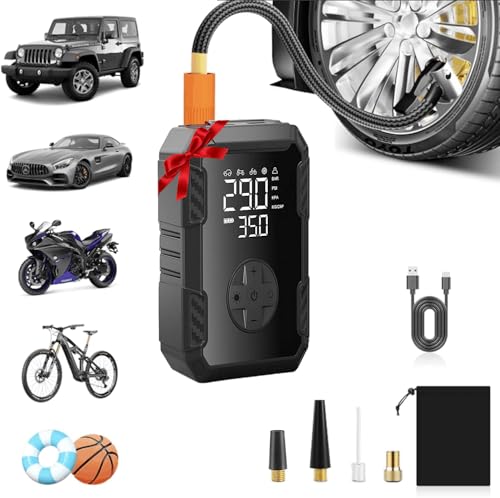
Our
Rnful TJ09 cordless
inflator leads on 180 PSI, which by the argument above is the pressure at which
it delivers nothing. The listing also has a feature bullet headed heat management,
and it is worth reading closely, because it names two things that work in opposite
directions: a vented backplate, which genuinely helps by giving the hot parts a path
to the air, and a silicone sleeve, which is an insulator. Wrapping a body that is
struggling to dump 16 kilojoules in a layer of silicone raises its thermal
resistance to the surroundings. A sleeve is a sensible thing to fit for grip and for
not burning your hand, and it is the opposite of cooling, and both claims sit under
the same heading. Our own record is blunt about the gaps: battery capacity is not
stated, fill times and runtime are maker unspecified, and the performance figures are
maker stated rather than measured. Which means the three numbers that would answer
the question in the title, flow at 35 PSI, minutes on and minutes off, are all
absent while the one number that cannot matter is on the front. Full record in the
Rnful TJ09
review.
Our
Lazyshine cordless
inflator is the more honest listing of the two, because the limits are stated
rather than implied: it is described as a top up tool, slow to fill large tyres from
flat, and our record says in as many words that the battery warms up and gives
limited inflations per charge. That is the duty cycle, named without being explained,
and the arithmetic above is the explanation. It also has the four presets and the
auto shut off that make a monthly check genuinely quick, and on the numbers it
deserves that: 14 litres of free air per tyre is a small job. Our
tyre
pressure guide calls it a two minute job on the driveway and that holds up for a
top up, which is what it is describing. Record in the
Lazyshine
inflator review, and the field is in
how to choose a
portable tyre inflator.
Now the contrast that makes the volume argument concrete, because it is the same
two words doing a completely different job. A
Lanryn drop stitch camping
sleeping pad ships with an air pump. The listing publishes a 700 kg load rating,
a 5.6 lb weight, a firmness adjustment between 80 and 95 percent, and a stated 100
hours of air retention, and it publishes no pressure and no dimensions at all. You
can still bound the pressure from its own number. A pad spread over a double
footprint of roughly 1.9 by 1.3 metres covers 2.47 square metres, and 700 kg of load
is 6,870 newtons, so the average pressure it has to support is 2,780 pascals, about
0.4 PSI. Concentrate the load on a smaller contact area and the local figure rises,
so call the working pressure somewhere around one PSI rather than thirty five. At one
PSI gauge the logarithm of the pressure ratio is 0.066, so each litre costs about 7
joules instead of 123. A pad holds well over a hundred litres and still represents
under a kilojoule of gas work, which is a tenth of the flat car tyre.
So the included blower moves more air than a tyre inflator and does a fraction of
the work, and a tyre inflator pointed at a pad would take all afternoon because its
cylinder is small. Same phrase, opposite machines: one is high volume and low
pressure, the other is low volume and high pressure, and neither will do the other's
job. Record in the
Lanryn
sleeping pad review.
What we got wrong in our own guide
Our guide to
choosing a portable tyre inflator opens its first section like this: "check the
max pressure printed on your tire sidewall. Choose a unit rated comfortably above it
so the pump is not working flat out. Higher ratings also help with truck or trailer
tires."
Two problems. The smaller one is that the sidewall maximum is a pressure you
should never inflate to, as our own
tyre
pressure guide correctly insists, so the advice sizes the tool against a figure
you will never ask it for. Pick the tool against the door jamb number you actually
use.
The bigger one is the phrase "not working flat out". A higher published maximum
does not mean a pump is loafing at 35 PSI. The maximum is a no flow figure, and two
pumps that both print 180 PSI can differ by a factor of two in litres per minute at
35 PSI and by just as much in how many minutes they will run before a thermal cutout
trips. The thing that keeps a pump from working flat out is a bigger cylinder, a
path for heat to leave, and a published on and off rating. None of those is the
number on the front.
The honest limit
Not one inflator listing on this site publishes a duty cycle, a flow rate, or a
flow rate at a stated pressure, and our own records say so. So this post cannot end
with a better product, because the specification that would let you choose one is not
printed and asking a seller for it usually fails. If a listing does state something
like three minutes on and seven minutes off, that single line is worth more than
every other figure on the page, and you should weight it that way.
In the meantime, the fixes are free and they all follow from the arithmetic.
Do it in stages and let it cool. The 57 degree rise above ambient calculated
earlier is for one flat tyre done in one run. Split it into two runs with five
minutes between them and the peak is roughly halved, because the housing is shedding
heat the whole time it is off. The pump is not weaker in stages, it is simply never
reaching the temperature at which it protects itself.
Start with the easiest tyre last. Pressure rises as you fill, so the final PSI are
the slowest and the most expensive, and the pump is hottest exactly when it is
working hardest. If you are doing all four, do the top ups first while the machine is
cold.
And for the specific case in the question, two spares to 60 PSI: the reason it
stopped at 45 is far more likely to be a tripped thermal cutout or a sagging battery
under load than a pressure ceiling, and both of those clear by waiting. A larger
machine is the right answer only if you are filling truck or trailer tyres routinely,
and what makes it the right answer is not a bigger number on the label but a motor
with a fan, a finned head, and a continuous duty rating. For everything else the
limit is thermal, the cure is patience, and patience is free.
Why a 180 PSI Inflator Stops Before 60 PSI at a glance
Lanryn Drop-Stitch Camping Sleeping Pad with Air Pump
campers wanting firm, packable drop-stitch support
Firm drop-stitch support that stays level
Load rating and air retention are maker stated
Why you can trust this guide
We compared these picks using verified manufacturer specifications, current retailer listings, and patterns in owner feedback, alongside editorial research. We focus on measurable differences such as performance, capacity, usability, and build quality. Pickpedia does not present editorial research as laboratory testing, and we do not claim hands-on testing unless it was actually performed.
The Rnful TJ09 is a cordless tire inflator for quick top-ups on cars, motorcycles, and bikes. Owners set a target pressure, press once, and the pump stops automatically. A large screen shows preset and live readings together, with stated accuracy within 1 PSI. USB-C charging, a USB-A output, an LED light, and a storage bag round out a compact kit.
TypeCordless portable inflator
Stated accuracyWithin 1 PSI
DisplayLarge screen, dual values
Input portUSB-C
Output portUSB-A power bank
LightBuilt-in LED
Shut-offPreset auto stop
IncludedStorage bag and gift box
Pros
One-button preset with automatic shut-off
Dual on-screen preset and live readings
Stated accuracy within 1 PSI
USB-C charging plus USB-A power-bank output
Built-in LED for low-light work
Compact kit with storage bag included
Cons
Battery capacity is not stated in the listing
Fill times and runtime are maker-unspecified
Best for top-ups, not large flat tires
Performance figures are maker-stated, not lab-tested
Best for Quick, accurate tire top-ups and roadside emergencies
8.8/ 10 Pickpedia editorial score
A cordless, rechargeable portable tire inflator with four preset modes for car, motorcycle, bike and ball, a digital gauge and auto shut-off that stops at your set pressure, plus a built-in LED work and emergency light.
BrandLazyshine
TypeCordless portable air inflator
PowerBuilt-in rechargeable battery
Modes4 presets: car, motorcycle, bike, ball
ControlDigital gauge, auto shut-off at target
LightBuilt-in LED, 3 modes
PortabilityLightweight, glovebox size
ColourDark black
Pros
Fully cordless and rechargeable
Smart presets with auto shut-off at target
Clear digital pressure gauge
Built-in LED light for roadside use
Handles car, bike, motorcycle and balls
Compact glovebox size
Cons
A top-up tool, slow to fill large tires from flat
Battery warms up and gives limited inflations per charge
Best for campers wanting firm, packable drop-stitch support
8.8/ 10 Pickpedia editorial score
The Lanryn camping sleeping pad uses high elastic drop-stitch construction with thousands of internal threads for firm, even support. It is rated to hold up to 700 kg, weighs 5.6 lbs, and packs down small. A dual-action valve tunes firmness between 80 and 95 percent, and the maker states air holds for up to 100 hours. It ships with an air pump and carry bag.