Home ›
Hiking Headlamps › Do More Lumens Mean a Light Shines Further? What the Number Leaves Out
Hiking Headlamps
Do More Lumens Mean a Light Shines Further? What the Number Leaves Out
PBy the Pickpedia Team·3 picks compared·Last verified October 2026
Affiliate disclosure: As an Amazon Associate, Pickpedia earns from qualifying purchases. Links on this page are paid links, and we may earn a commission at no extra cost to you. This never affects our picks or scores.
This page contains affiliate links. If you buy through one we may earn a
commission, at no cost to you.
No. Lumens say nothing about distance, and that is not a quibble about units,
it is the reason a 1000 lumen headlamp can show you less at thirty metres than a
100 lumen one. A lumen count is a total, summed over every direction the light
goes. Reach depends on how tightly that total is packed into the direction you
are facing, and the lumen figure has that information removed by construction.
Two divisions recover it, and they change what is worth buying.
Lumens are a total, and a total has no direction
Think of lumens as a budget rather than a strength. A source emitting 1000
lumens is emitting 1000 lumens whether it sprays them over a whole room or
concentrates them into a pencil. Both are 1000 lumens. One is a work light and the
other is a searchlight.
The unit that has direction in it is the candela, which is lumens per
steradian, a steradian being the unit of solid angle. And the quantity that
describes what actually lands on a surface is lux, which is candela divided by the
square of the distance. So the chain is lumens, then divide by the solid angle to
get candela, then divide by distance squared to get what you can see by. The
listing gives you the first number and almost never either of the other two.
Do the division on a real published figure
One of the headlamps in our catalogue publishes both halves, which makes this
concrete. It states 1000 lumens and a 230 degree beam spread.
A cone of 230 degrees covers about 8.94 steradians. Put the whole 1000 lumens
in it and you get roughly 112 candela. Now compare that with a narrow spot, say
10 degrees across, carrying only 100 lumens. Ten degrees is about 0.024
steradians, so that gives about 4,180 candela, which is nearly forty times the
intensity from a tenth of the light.
Both columns start from the same unit. The only thing that changed is how tightly
the light was packed, and that is the variable no listing puts on the front.
Run both down the distance column and you get the answer to the question. At
arm's length the flood delivers around 448 lux, which is more than a well lit
office desk, so it is genuinely generous for anything your hands are doing. At
thirty metres the same flood delivers about 0.12 lux, which is dimmer than full
moonlight. The 100 lumen spot delivers about 4.6 lux at the same distance,
roughly 37 times more.
So the lumen figure predicted the wrong winner, and not by a little. The spot
has one tenth the lumens and nearly forty times the reach, because reach was never
what lumens measured.
Why you cannot just focus the flood
The obvious next question is why a headlamp does not simply let you narrow the
wide beam when you want distance. The answer is a real optical limit rather than a
cost saving, and it is why these lamps carry two separate emitters.
How tightly a reflector or lens can collimate light depends on the size of the
source compared with the size of the optic. As a rule of thumb, the spread you end
up with is roughly the width of the emitting surface divided by the diameter of
the optic in front of it. A single small LED die about a millimetre across,
sitting in a twenty millimetre reflector, can be squeezed to a few degrees. A COB
strip is a deliberately large emitting area, tens of millimetres of glowing
surface, which is exactly what makes it a good flood: it throws light everywhere
without hot spots. Put that same strip behind a twenty millimetre reflector and
there is nothing to collimate, because the source is as big as the optic.
This is why both headlamp records state that flood and spot cannot run at the
same time, and why there are two light sources rather than one adjustable one. It
is not a compromise the makers chose. A single emitter cannot be both.
Three lights, three solid angles, and the lumen number is useless across them
A
COSOOS rechargeable
motion-sensor headlamp is where the figures above come from. Its record states
1000 lumens and a 230 degree COB floodlight plus a separate focused spotlight,
2.4 ounces, a 1200mAh lithium battery, USB-C charging, a removable washable
silicone band fitting a 20 to 28 inch head, wave-to-toggle motion detection and an
SOS strobe. Its published limitations matter here: it cannot run flood and spot
together, the lumen and battery figures are maker-stated, and output typically
fades as the battery drains, which is the record's own wording. Read against the
arithmetic, this is a close-work light with a reach option, and the 1000 is about
the flood. Our
review of
the COSOOS headlamp has the detail, and
how to choose a
comfortable hands-free headlamp covers the fit and comfort side that decides
whether you wear it at all.
A
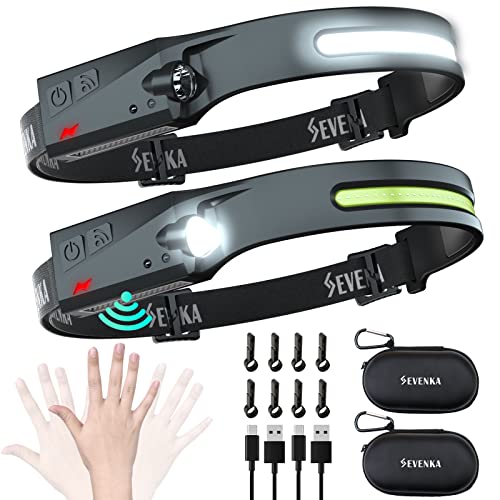
SEVENKA rechargeable COB
headlamp two-pack publishes the same 230 degree spread, a COB flood and a
separate spot, five modes cycling COB high, COB low, spot high, spot low and off,
70 grams each, a 20 to 28 inch fit, motion sensor control, and two cases, two
cables and hardhat clips in the box. What it does not publish is a lumen figure at
all, and on everything above that is a smaller loss than it sounds. The lumen
number would not have told you the reach anyway. What its record does flag as
genuine gaps are no runtime figures, maker-stated specs, and a USB-A to USB-C
cable requirement. See our
review of
the SEVENKA two-pack and
how to
choose a rechargeable headlamp.
And then the case that looks absurd next to 1000 lumens until you do the
division. A
BRIMMEL outdoor solar
lantern publishes three modes at 35, 140 and 330 lumens, a 3000mAh battery,
solar or USB-C charging, a maker-stated 30 plus hours in its lowest mode, 3000K
warm light, IP54 splash resistance and an iron frame over handwoven rattan. A
lantern radiates in roughly every direction, which is about 12.6 steradians, so
its brightest 330 lumen mode is only around 26 candela, giving something like 12
lux on faces a metre and a half away. Its 35 lumen mode is around 1.2 lux at the
same distance.
Those are tiny numbers and they are the correct numbers, because the job is not
to illuminate anything. It is to be a visible warm object on a table while leaving
people's night vision intact, and 1000 lumens pointed at a dinner would be a
fault rather than a feature. Its published limits are that the lumen and runtime
figures are maker-stated, IP54 is splash rather than submersion, and the listing
gives no size or weight. Details in our
review
of the BRIMMEL lantern.
The honest limit
The specification that would answer the reach question is candela, or the beam
distance figure derived from it under the ANSI FL1 convention, and none of these
listings publishes either. That is the state of the category rather than a failing
of any one product, and it means the arithmetic on this page is a worked
illustration from published beam spreads, not a measurement of these lamps. The 10
degree spot in the chart is an example, because no spot beam angle is published
for either headlamp.
Which leaves one practical rule and one honest recommendation. The rule: for
close work, stop reading the lumen figure. At arm's length a wide beam is already
delivering more light than an office, and extra lumens there buy you shorter
runtime, more heat and more glare bouncing back off your own hands. For reach, no
amount of lumens in a wide beam substitutes for a narrow one, so what you need is
a different beam, not a bigger number.
And the recommendation that is not a purchase. If you already own a headlamp
and cannot see far enough, try the thing that costs nothing first. Take it off your
head and hold it at waist height or set it on the ground pointing along your path.
Light arriving at a low angle throws long shadows off every rut and root, which is
how you read uneven ground, while light arriving from beside your eyes flattens
everything into one even tone with no shadows to read. On a dark trail that change
in position does more for what you can actually see than a step up in output, and
it is the one thing no specification on any box will tell you.
Do More Lumens Mean a Light Shines Further? What the Number Leaves Out at a glance
BRIMMEL Outdoor Solar Lantern, Rechargeable Rattan Table Lamp, IP54
cordless patio and campsite ambient lighting
Iron frame protects the woven rattan
IP54 is splash-rated, not submersible
Why you can trust this guide
We compared these picks using verified manufacturer specifications, current retailer listings, and patterns in owner feedback, alongside editorial research. We focus on measurable differences such as performance, capacity, usability, and build quality. Pickpedia does not present editorial research as laboratory testing, and we do not claim hands-on testing unless it was actually performed.
Best for campers and DIYers wanting hands-free motion-sensor light
8.6/ 10 Pickpedia editorial score
COSOOS builds a rechargeable headlamp around a 230 degree wide COB floodlight and a focused spotlight, with a stated 1000 lumens. Weighing 2.4 ounces with a 1200mAh battery, it uses a removable, washable silicone headband that fits a 20 to 28 inch head. Motion detection lets you switch the light by waving a hand, and a long press triggers an SOS strobe. It charges over USB-C.
Max output1000 lumens
Beam spread230 degrees
Weight2.4 oz (70g)
Battery1200mAh lithium
ChargingUSB-C
Head fit20 to 28 inch
HeadbandRemovable, washable silicone
Extra modeMotion sensor and SOS strobe
Pros
230 degree wide beam lights surroundings without head turning
Spotlight mode adds reach for distant objects
Motion sensor turns the light on or off with a wave
Light 2.4 ounce weight is comfortable for all-day wear
Best for buyers who want two rechargeable backup headlamps
8.4/ 10 Pickpedia editorial score
SEVENKA sells a two-pack of rechargeable COB headlamps built for hands-free light at home, in the car, or outdoors. Each unit blends a 230 degree wide beam with a focused spot, adds motion-sensor on/off for gloved hands, and weighs just 70 grams. USB-C charging, a carrying case, and hardhat clips are included with every headlamp.
Best for cordless patio and campsite ambient lighting
8.6/ 10 Pickpedia editorial score
This is a cordless outdoor lantern wrapping handwoven rattan in an iron frame, made for patio dinners, camping, and backyard gatherings. It charges by solar or USB-C and runs 30 plus hours in Moonlight mode per the maker. Three one-touch modes span 35, 140, and 330 lumens, and an IP54 rating handles rain and splash.
Battery3000mAh lithium
ChargingSolar panel or USB-C
Runtime30 plus hours Moonlight mode
ModesMoonlight 35LM, Reading 140LM, Entertainment 330LM