Home ›
Tools & DIY › Why a Clip That Stays Shut Loses Its Grip First
Tools & DIY
Why a Clip That Stays Shut Loses Its Grip First
PBy the Pickpedia Team·5 picks compared·Last verified October 2026
Affiliate disclosure: As an Amazon Associate, Pickpedia earns from qualifying purchases. Links on this page are paid links, and we may earn a commission at no extra cost to you. This never affects our picks or scores.
This page contains affiliate links. If you buy through one we may earn a
commission, at no cost to you.
They do, and not by getting weaker. That is the part worth getting straight,
because it changes what you do about it. A clip that has lost its grip is exactly as
strong as the day it was made and would still break at the same load. What has
changed is how hard it pushes back at a deflection it is already holding, and that is
a different property with a different name. The property is stress relaxation, the
clock that drives it is hours spent clamped rather than the age of the clip, and the
single biggest variable is a material that almost no listing names.
A clip is a spring, and the force is the deflection times the stiffness
A spring clip holds by being bent. You open the jaws, which stores elastic energy
in the arms, and the arms try to return. Whatever is between the jaws feels that
attempt as a clamping force, and for a spring behaving linearly the force is simply
the deflection multiplied by the stiffness.
Which gives you the whole mechanism in one observation. Once the clip is on
something, the deflection is fixed by the thing it is gripping: the jaws are held
apart by the thickness of the tank wall or the stem or the hair, and they cannot move.
So if the force drops, and the deflection cannot have changed, the stiffness must have
changed. That is what stress relaxation is: at constant strain, the stress decays. The
force decays in exact proportion to the material's relaxation modulus, with no other
term in the expression.
And stress relaxation is the right name for it, not creep. They are the same
underlying physics seen under two different experiments. Creep is constant stress with
the strain growing, which is a shelf bracket sagging under a fixed load. Stress
relaxation is constant strain with the stress falling, which is a clip. A clip is a
relaxation problem, and it is the less familiar of the two, which is probably why the
grip failure feels mysterious when the sagging shelf does not.
Three materials, three different failure modes
Here is where the usual account, including my own first draft of this page, goes
wrong. "Plastic and thin metal both stop wanting to return" is not one fact about
springy things. It is three different behaviours, and the diagnosis you would reach
from the general version is wrong for two of the three.
Spring steel at room temperature barely relaxes at all. Stress relaxation in steel
is a thermally activated process and it does not become significant until you are
somewhere above 100 to 150 Celsius, which is why steel is used for springs that must
hold a load for decades. A steel clip left clamped for ten years loses a fraction of a
percent. Steel springs do fail, but they fail the other way: by fatigue, from being
cycled open and shut thousands of times, and by corrosion. So a steel clip's enemy is
use and a polymer clip's enemy is rest, which is an exactly inverted relationship and
worth knowing before you decide which of your clips to distrust.
Semicrystalline polymers relax fast. Polypropylene and polyethylene, which are what
most inexpensive moulded clips are made of, consist of crystalline regions tied
together by amorphous chains, and the glass transition of that amorphous fraction is
well below room temperature, around minus 10 Celsius for polypropylene and minus 110
for polyethylene. So at room temperature the amorphous phase is rubbery and its chains
can slide past each other continuously. The relaxation modulus of such a material
commonly falls 10 to 15 percent of its remaining value per decade of time under
moderate sustained stress.
Glassy polymers relax slowly and break instead. Acrylic has a glass transition
around 105 Celsius and polycarbonate around 147, so at room temperature both are well
below it and their chains are effectively frozen. They lose only a few percent per
decade. Their failure modes are different: one over-opening past the elastic limit
takes a permanent set, and sustained tensile stress can produce crazing, a network of
fine cracks that appears long before the material's nominal yield stress, especially
in contact with solvents such as alcohols or cleaning sprays.
Relaxation rates are per decade of time at moderate sustained stress, taken as 4
percent for a glassy thermoplastic and 12 percent for a semicrystalline one, with the
temperature shift at a factor of two per 9 kelvin. No clip listing we carry publishes
a polymer grade, an arm geometry or a clamping force, so these are worked curves for
the material classes rather than measurements of any particular clip.
The arithmetic over a year, and the year you can lose in one second
Put decades on the x axis, because a logarithmic relaxation rate makes the time
scales easy to compare. One hour to one year is a factor of 8,760, which is 3.94
decades. One hour to eleven years is five decades.
A glassy polymer at 4 percent of remaining force per decade retains 0.96 raised to
3.94, which is 0.851. So about 15 percent lost over the first year, and only another
2 percent by year eleven, because each further decade takes ten times as long to
arrive as the last one.
A semicrystalline polymer at 12 percent per decade retains 0.88 raised to 3.94,
which is 0.604. So 40 percent lost in the first year and 47 percent by year eleven.
Against the glassy polymer's 15 percent, that is a factor of 2.6 at one year, from the
choice of material alone, on two clips that look and feel identical in the shop.
Now temperature, which the worklist is right about and which has a tidy
quantification. Polymer relaxation is thermally activated, and as a rough engineering
rule the rate roughly doubles for every 8 to 10 kelvin. Going from a 20 degree room to
a 60 degree radiator top or parked car is 40 kelvin, so about 16 times faster, which
is 1.2 extra decades of accumulated damage. In time terms: 365 days divided by 16 is
23 days. Three weeks on a radiator does what a year on a shelf does. That is the whole
of the hot car story and it is not folklore.
And then the failure that beats all of it. Open a clip past its elastic limit once
and it takes a permanent set, which means its rest gap is now wider. If a clip was
working at 12.5 millimetres of deflection and the rest gap opens by 2 millimetres, the
remaining working deflection is 10.5 millimetres, so the force is 10.5 over 12.5, or
84 percent. That is 16 percent gone, instantly, permanently, from one careless
opening, and it is the same loss as a whole year of being left clamped. Both arrows
are drawn the same length in the figure above for exactly that reason.
One clip in our catalogue publishes enough to work it out
A
DIY aquarium hood mesh lid
kit with net clips is the only clip listing on this site that names its polymer.
Its record states PC clips, which is polycarbonate, with a clip wall limit of under
0.98 inches, ten clips including two spares, a quarter inch mesh at 2.15 by 1.73 feet,
and mounting inside or outside the tank wall.
Take that wall limit seriously, because it is the most informative number in the
category and it is not what it looks like. To clamp a 25 millimetre wall, each arm has
to deflect about 12.5 millimetres. Polycarbonate has a stiffness near 2.3 gigapascals
and yields in tension somewhere near 65 megapascals, and the peak surface stress in a
bent cantilever arm is three times the stiffness times the deflection times the
thickness, divided by twice the square of the arm length. Put a 2 millimetre thick arm
30 millimetres long into that and you get 96 megapascals, well past yield, and the
clip takes a permanent set the first time you fit it. To keep the stress at half of
yield, which is a reasonable ceiling for a glassy polymer that has to hold stress for
years, a 2 millimetre arm needs to be about 52 millimetres long, or a 1 millimetre arm
about 36.
So the published wall limit is not a convenience note about what fits. It is the
elastic limit of the arms, expressed as a fitting dimension, and it is the one piece
of mechanical specification the category gives you. Exceed it and the clip does not
fail to fit. It fits, and then it is 16 percent weaker forever.
Work the force out for the compliant version, a 1 millimetre arm 36 millimetres
long, 10 millimetres wide, at 12.5 millimetres of deflection: the force comes out at
about 1.5 newtons, which is 150 grams. Eight clips give you about 1.2 kilograms, which
is ample for holding a net down against a fish trying to jump through it and nothing
like enough to hold a weight. That matches what the product is for, and it also
explains why the record says sturdy PC clips resist breaking in use while shipping two
spare clips out of ten against transit damage. Both things are true at once, which is
what a glassy polymer is like: it holds its force well and then it cracks rather than
sagging.
The polycarbonate choice is also the right one for where these live, which is
clamped permanently to a tank wall in warm, humid air above standing water. By the
curves above that is the worst possible duty for a semicrystalline clip and a mild one
for a glassy clip. Full record in our
DIY aquarium hood mesh
lid kit review.
Three listings where the missing word is the whole specification
A set of
reusable plant support garden
clips for vines and stems is sold on precisely the property this page is about.
Its record says sturdy plastic holds shape across seasons, and lists reusability
across multiple growing seasons as an advantage. Holding shape across seasons while
clamped to a stem in summer sun is a stress relaxation specification and nothing
else.
And the material is given as "sturdy plastic". If that is polypropylene, which is
what garden clips usually are, the curves say roughly 40 percent of the grip is gone
by the end of the first year, and a clip on a south facing trellis runs well above air
temperature in the sun, which moves it onto the 60 degree curve for part of every day.
If it is polycarbonate it loses 15 percent. The listing's own drawbacks are honest
about the gaps, recording that clip dimensions are not stated, that pack quantity is
not specified, and that no weight or load capacity is given. Add the polymer grade to
that list and you have the four numbers that would let anyone answer the question the
product is sold on. See our
plant support
garden clips review.
A two pack of
sparkling crystal braided
hair clips does name its material, acrylic and rhinestone, with a double layer
design. Acrylic is the glassy case, so the slow curve applies and the 15 percent per
year figure is the right one. But acrylic brings the other failure mode with it, and
the record half knows: it lists as a drawback that a rhinestone accessory needs gentle
handling. The mechanical reading of that is sharper than the cosmetic one. Acrylic
under sustained tensile stress is prone to crazing, a fine network of surface cracks
that can appear well below the nominal yield stress and is accelerated by contact with
alcohols and solvents, which is the family most hair products belong to. So the two
real risks for this clip are opening it too far once, and leaving it clamped while wet
with product. Neither is age. Record in our
sparkling crystal braided
hair clips review.
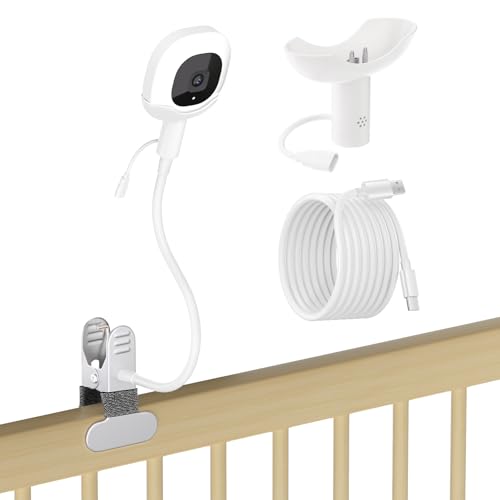
And then the product whose existence is the argument. A
tihii baby monitor clip mount
for Nanit Pro, Plus and Original is sold explicitly as a replacement for mounts
that stopped holding: its record says the upgraded mount holds the cameras more
securely, addressing loose or detaching original mounts, and lists a firmer hold that
fixes loose or detaching cameras as its first advantage.
That is a whole product category created by stress relaxation. A camera mount is the
purest possible version of the bad case: clamped once, left clamped for years, never
released, often on a crib rail in a warm room, and holding something whose falling is
the only thing anyone cares about. Neither the original nor the replacement publishes a
polymer or a load rating, so there is no way to tell whether the new one is a different
material or simply a new one of the same thing, which is the question a buyer most
wants answered. Details in our
tihii baby
monitor clip mount review.
The clip that solves it, and the clip this does not apply to
An
AORAEM helping hands magnifier
with dual alligator clips uses metal torsion springs, and by the top line of the
graph that means the problem is gone: at room temperature those clips will hold the
same force in a decade that they hold today. Its record notes that the clip pads may
mark delicate surfaces, which is the honest trade, and it is the trade you would expect,
because a spring that does not relax is a spring that keeps pressing. Metal does bring
its own failure mode, fatigue from repeated opening, which for a workbench tool opened
a few times a day is a non-issue, and corrosion, which is why a plated or stainless
spring outlasts a bare one. Record in our
AORAEM helping
hands magnifier review.
And the exception worth naming plainly, because it was the first product I expected
to use on this page and it turned out not to belong. Our ten pack of magnetic cable
clips has no spring in it at all. The record describes a magnetic clamp on a 90 degree
shaft with a residue free removable adhesive, and the grip comes from a magnet and a
pad. Neither relaxes in the sense used here: a neodymium magnet loses a fraction of a
percent of its remanence per decade at room temperature, although it can suffer real
irreversible loss if taken above its rated operating temperature, which a parked car
can do. And the adhesive's failure mode is peel, which is a geometry problem rather
than a stiffness one and which we take apart separately in
why a 25 pound adhesive
hook drops a 5 pound coat. Mentioning it here only to be clear that "clips lose
grip" is not a universal law about things called clips. It is a law about springs.
Why the one left shut goes first
Which brings the argument to the practical asymmetry, and it has a clean
explanation.
Relaxation at constant strain has a recoverable component. Part of the chain
rearrangement that lowered the stress is anelastic, meaning it reverses on a similar
logarithmic timescale once the load comes off. So the quantity that accumulates is not
the clip's age. It is the time it has spent deflected, and the recovery between uses
resets a good share of what the last clamping cost.
Run the two cases. A clip left permanently shut for a year has accumulated 8,760
hours under load, which is 3.94 decades, and by the semicrystalline curve it has lost
40 percent. A clip used for ten minutes, three times a day, for a year has accumulated
about 182 hours under load, which is 2.26 decades, and has lost 25 percent, with the
recovery between uses pushing the real figure lower still. The permanently shut clip
has been loaded 48 times longer in the only units that matter.
So the clip that fails is not the oldest one in the drawer. It is the one holding
the tank lid that has not been off in three years, the one on the trellis since spring,
the one on the crib rail since the baby was born. The chip clip you open twice a day
spends 99 percent of its life at zero deflection, where nothing accumulates at all.
Problems in our own records
Two worth reporting.
The first is the near total absence of mechanical specification in this category.
Across 22 clip, hanger and hook products we publish, exactly one names a polymer, and
it does so as the two letters PC in a specification row. Not one publishes a clamping
force, an arm length, an arm thickness, a working deflection, a load rating, or an
operating temperature range. Four of them are sold on an explicit durability claim,
holds shape across seasons, resists breaking in use, firmer hold, multi season reuse,
and in every case the specification that would substantiate the claim is the one that
is missing. Everything quantitative on this page had to be computed for a material
class rather than measured from a product.
The second is smaller and is about the sizing of the plant clips. The record lists
as drawbacks that the clip dimensions are not stated, the pack quantity is not
specified, and no load capacity is given. Three unstated figures on one listing is
unusual even by this category's standards, and for a product sold by the handful the
pack count is not a detail.
The honest limit, and the free technique that beats the purchase
The specification that would settle this is the polymer grade, and after that the
arm geometry, and the category publishes neither. So you cannot shop for a clip that
holds its force. What you can do is read two proxies that are usually available. A
clip with long, slim arms is running a lower stress for the same jaw force than a clip
with short stubby ones, because the stress goes as the thickness over the square of the
length while the force goes as the cube of the thickness over the cube of the length.
And a clip that feels springy over a long travel is a lower stress design than one that
goes from loose to immovable in two millimetres.
Then three habits that each beat buying a better clip, in order of how much they
buy.
Do not open it past where it wants to go. This is the single biggest one, because
one over-opening is worth a year and it happens in a second. If a clip will not reach
around something, it is the wrong clip, and forcing it converts a reversible loss into
a permanent one.
Release it when it is not working. The clock is hours under deflection, so a clip
stored open, or stored clamped to nothing, is not ageing in the only sense that
matters. For anything you want to last, this is free and it is substantial: the
difference between the two curves in the last section was 40 percent and 25 percent
over the same calendar year.
And keep it out of the heat. Sixteen times faster at 60 degrees is the whole of the
third curve, which means the top of a radiator, a window sill in summer sun and a
parked car dashboard are doing a year of damage every three weeks. Moving a clip out of
one of those changes its life more than any material upgrade available to you, and it
is the one intervention here that requires nothing but noticing.
One honest caveat about all of it. Everything above treats the clip as a linear
spring in its elastic range, and polymers stop being linear once the stress passes
roughly a third of yield, at which point relaxation accelerates and the percentages per
decade get worse rather than holding steady. So the figures here are the optimistic
reading for any clip that was already working hard, which is most of the ones that
fail.
Why a Clip That Stays Shut Loses Its Grip First at a glance
AORAEM Helping Hands Magnifier with Dual Alligator Clips
hobbyists soldering and inspecting small detailed parts
Heavy cast iron base keeps work steady
Built for medium to small items only
Why you can trust this guide
We compared these picks using verified manufacturer specifications, current retailer listings, and patterns in owner feedback, alongside editorial research. We focus on measurable differences such as performance, capacity, usability, and build quality. Pickpedia does not present editorial research as laboratory testing, and we do not claim hands-on testing unless it was actually performed.
Best for Keepers of jumpy fish wanting a breathable custom lid
8.2/ 10 Pickpedia editorial score
This DIY Aquarium Hood kit pairs a 2.15 by 1.73 foot mesh lid with clips to keep fish from jumping out. The soft quarter-inch mesh passes light and air while blocking escapes. Sturdy PC clips grip walls up to 0.98 inch, inside or out. You cut the net to fit your tank. It suits keepers of jumpy species wanting a custom, breathable cover.
Best for supporting vining vegetables and climbing flowers
8.0/ 10 Pickpedia editorial score
These reusable plant support clips help climbing plants and flowers grow upright on trellises, wires, and stakes. Sturdy plastic holds shape across seasons, indoors or outdoors. A quick-release design installs and removes fast without harming vines. The hollow build promotes air circulation around stems, and the clips suit tomatoes, peppers, watermelons, and other delicate young plants.
Best for Adding a sparkly, secure accent to everyday styles
8.8/ 10 Pickpedia editorial score
A two pack of sparkling crystal braided hair clips made from durable acrylic and rhinestone, with a double-layer design that holds thin or thick hair and comes in a choice of colours.
tihii's upgraded mount holds Nanit Pro, Plus, and Original baby cameras more securely, addressing loose or detaching original mounts. It adds a Type-C charging port connector and a built-in temperature and humidity display. Tool-free, damage-free setup snaps the camera in and out for travel. A 10-foot power cord and flex-tripod design make it a replacement for the original Nanit Flex Multi-Stand. Camera not included.
TypeClip charger mount accessory
CompatibilityNanit Pro, Plus, Original
ChargingType-C port connector
SensorTemperature and humidity display
Cord10ft / 3m power cord
SetupTool-free, damage-free
DesignFlex tripod mount
CameraNot included
Pros
Firmer hold fixes loose or detaching Nanit cameras
Fits Nanit Pro, Plus, and Original models
Type-C charging port powers the camera through the mount
Built-in temperature and humidity display adds awareness
Tool-free, damage-free snap-in setup for travel
Long 10-foot cord gives flexible placement
Cons
Camera is not included with the mount
Compatible only with three Nanit models
Sensor readings are for guidance, not calibrated use
Facts reflect the listing, not independent lab testing
Best for hobbyists soldering and inspecting small detailed parts
8.4/ 10 Pickpedia editorial score
The AORAEM Helping Hands is a soldering and hobby station with a heavy cast iron base, a 2.5x glass magnifier, and two alligator clips on 4-way swivels. The 63mm chromed lens rotates a full 360 degrees for close up inspection, while the clips and arms adjust to many angles. Its sturdy base holds circuit boards, jewelry, and small crafts steady for soldering, gluing, and detailed assembly.