Home ›
Home & Kitchen › Why a 25 Pound Adhesive Hook Drops a 5 Pound Coat
Home & Kitchen
Why a 25 Pound Adhesive Hook Drops a 5 Pound Coat
PBy the Pickpedia Team·5 picks compared·Last verified October 2026
Affiliate disclosure: As an Amazon Associate, Pickpedia earns from qualifying purchases. Links on this page are paid links, and we may earn a commission at no extra cost to you. This never affects our picks or scores.
This page contains affiliate links. If you buy through one we may earn a
commission, at no cost to you.
The question has a hidden assumption in it, and the assumption is the reason
these things come off the wall. A published figure in pounds sounds like a scale
reading: under it good, over it bad. It is not. It is a weight pulling in one
particular direction, and the moment you hang something on a hook that sticks
out, you stop loading it in that direction.
So the answer to can you go over the limit is that people go over it at half
the stated weight every day, by accident, and the arithmetic that shows why
needs two numbers off the box and one division.
Two completely different jobs, one number
An adhesive pad is good at being slid and bad at being lifted at an edge. Those
are not two versions of the same strength, they are different mechanisms.
Slide it, and every square millimetre of the pad resists at once. A pad 6 cm
square is 3,600 square millimetres of material all taking a share. Lift one edge
and the whole load goes onto the front line of the bond, a strip maybe a
millimetre deep along a 60 mm edge, which is sixty times less material carrying
the same force. Worse, once that line gives way the next line is exposed on the
same terms, so the failure runs. That is why a hook that has held for a year can
drop in half a second: there is no gradual sagging in a peel failure, it zips.
Which is also why the published number is a sliding number. It is the only
figure you can measure that does not depend on the shape of whatever the customer
hangs on it.
The arithmetic, with a hook that publishes both numbers
Most listings make this impossible to check because they give a weight and no
dimensions. One of ours gives dimensions and no weight, which turns out to be more
useful. A set of
no-drill self-adhesive
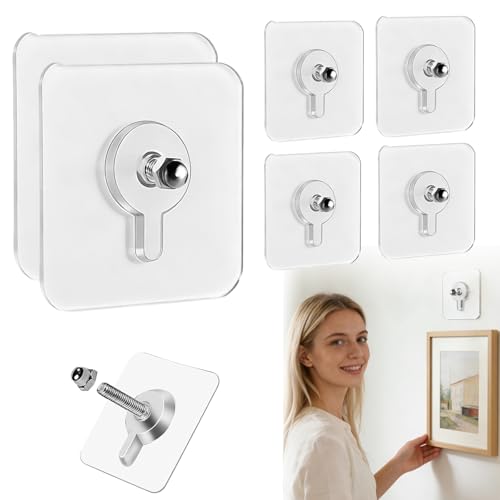
transparent wall hooks publishes a 6 by 6 cm body, which is 2.36 inches, and a
hook length of 14 mm, which is 0.55 inches. Its own record is upfront that no
maximum weight is stated at all.
Hang a weight on that hook and it tries to rotate the pad off the wall about
the pad's bottom edge. The pad fights back by pulling at the top and pushing at
the bottom, which gives it a lever of roughly half its height, about 1.18 inches.
So the pull at the top edge is the hanging weight multiplied by 0.55 divided by
1.18, which is about 0.47. Hang two pounds of keys and the top edge of that pad is
being peeled away from the wall with about one pound of force while the pad as a
whole is being slid down with two.
Now change one thing. A coat hook has to project far enough to get a shoulder
over it, so call it 2 inches. Same pad, same adhesive, same wall. Two divided by
1.18 is about 1.7, so the top edge is now being pulled off the wall with more
force than the coat actually weighs. You have not exceeded any published limit.
You have just moved the load into the direction nobody measured. What is and is not published on that set is in our
review
of the no-drill transparent wall hooks.
The published rating is a sliding load. A hook that sticks out converts part of
the weight into the one load an adhesive is worst at, and the conversion rate is
just the reach divided by half the pad height.
The listing that makes the point best is the one with the biggest number
A set of
Paoli heavy-duty adhesive
coat hooks in a 4-pack publishes up to 25 pounds per hook, tool-free peel and
press mounting on a clean smooth surface, a compact profile, and a choice of
colours and shapes, aimed squarely at entryways and mudrooms for coats, bags and
hats. Twenty five pounds is a genuinely large claim for an adhesive pad and it may
well be a fair sliding figure.
The figure it does not publish is the one the arithmetic above needs: the pad
dimensions and the hook reach. Without those two numbers you cannot work out what
fraction of a coat's weight arrives as peel, which means the 25 pounds cannot be
converted into an answer for the thing it is sold for. The record is at least
honest about the rest of it, listing that the hold depends on surface quality,
that adhesion can weaken in humid rooms, that repositioning costs you sticking
power, and that the load rating is maker-stated rather than independently
verified. Our
review of the Paoli
adhesive coat hooks sets out what is and is not published. The practical read:
treat a big number on a deep hook as a sliding figure and derate it hard in your
head, because a wet winter coat with someone tugging a sleeve out of it is the
worst case for exactly the mechanism nobody tested.
The same comparison makes the quiet, modest listing look much better than it
first does. A set of
adhesive wall and ceiling
decor hooks with a 360 degree swivel publishes only 3 pounds each, and it also
publishes a 20 second press, a full 48 hours to reach strength, and bonding to
painted wall, glass, tile, wood, metal and concrete ceilings. Three pounds reads
as feeble next to twenty five, until you notice the ceiling use case. A hook on a
ceiling is loaded in straight tension through the middle of the pad with no reach
and no prying at all, which is the one geometry where the published figure is
describing the actual load. The low-profile white disc is doing the same work:
less stand-off, less moment. Its own record is clear that 3 pounds is modest, that
grip depends on a clean smooth surface, and that the 48 hour cure is required
before full strength. Details in our
review of
the 360 swivel decor hooks.
Suction is a different trick with a hard ceiling on it
A suction cup has no glue in it. It works by having less air inside than
outside, so the thing holding your towel up is the atmosphere pressing on the back
of the cup, and the atmosphere only has about 14.7 pounds per square inch to press
with at sea level. That is the whole budget, and it is why cup area is the only
number that matters.
Run it on something that publishes its size. A pair of
PZTO stainless steel
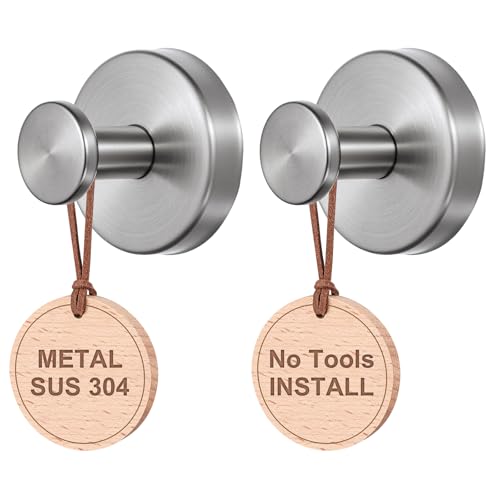
suction cup hooks for glass and tile publishes 11 pounds of capacity, a
2.63 inch width and 1.89 inch height, a corrosion-resistant stainless shell for
bathroom damp, press-and-rotate locking, and the useful note that a slipping cup
can be rinsed and dried to restore grip. Eleven pounds divided by 14.7 pounds per
square inch is 0.75 square inches, which is a circle just under an inch across,
and a perfect vacuum at that. No cup pulls a perfect vacuum, so call it an inch
and a quarter of sealed diameter in practice. Inside a 2.63 inch footprint that is
comfortable. The claim is physically honest, which is worth saying plainly after
the paragraphs above.
What it also means is that the failure mode is not weight. The number cannot
drift, because 14.7 does not drift, so when a cup lets go it is because the
differential collapsed: the rubber relaxed and crept a fraction of a millimetre,
air got back in, and the capacity fell while the towel stayed exactly as heavy as
it was. Its own record names the conditions that do it, listing failure on
frosted, textured or porous surfaces and ruling out painted walls, marble and
wood. More in our
review
of the PZTO suction hooks.
Which is how to read a second set of
waterproof no-drill
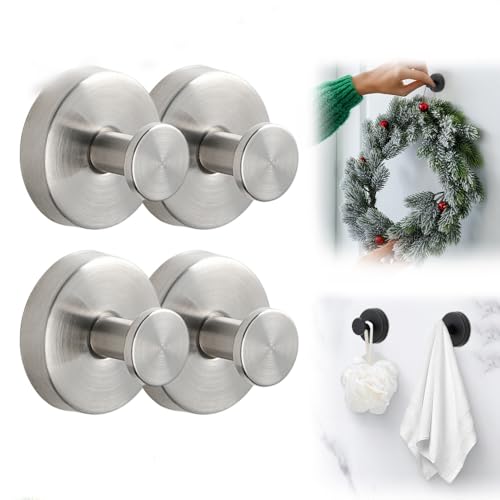
suction cup hooks for towels and wreaths. These publish the same 11 pounds, the
same stainless build, the same press-and-twist fitting and the same glass, tile
and mirror surfaces, and their record adds that suction can loosen and need
reseating. What they do not publish is a cup diameter. On the arithmetic above
that is the only figure that could justify the 11 pounds, so it is the gap worth
noticing rather than the pounds. See our
review
of the waterproof suction hooks, and for the fitting technique, which we are
deliberately not re-arguing here, our existing
guide to making suction
cup hooks stick and stay.
The honest limit
The free fix is not better prep, it is less reach. The prying force is the
reach divided by half the pad height, so every millimetre you take off the
stand-off comes straight off the load at the weak edge, in direct proportion. Choosing
the shallowest hook that will actually hold the item is worth more than any
upgrade in adhesive, and it costs nothing.
Two more that cost nothing. Let the load touch the wall. A towel folded over a
hook so the cloth lies against the plaster has most of its weight carried as a
slide, and a coat on a wire hanger stood off two inches has almost none of it.
Then hang the heavy thing low. The moment is the same but the consequences of a
failure are not, and a hook at shoulder height with a loaded bag on it is a
different proposition from the same hook at hip height.
And the honest ceiling on all of it: there is no adhesive answer to a shelf, a
mirror, or anything you would mind landing on a floor. Both the peel mechanism and
the suction mechanism fail suddenly and without warning, which is the part the
pounds figure cannot tell you. If the consequence of a drop is more than
inconvenience, that is a job for a screw into something solid, and the cost of
being wrong is the only number in this whole article that is not published
anywhere.
Why a 25 Pound Adhesive Hook Drops a 5 Pound Coat at a glance
Waterproof No-Drill Suction Cup Hooks for Towels and Wreaths
renters who cannot drill walls
Installs with no drill, screws, or tools
Only grips smooth, non-porous surfaces
Why you can trust this guide
We compared these picks using verified manufacturer specifications, current retailer listings, and patterns in owner feedback, alongside editorial research. We focus on measurable differences such as performance, capacity, usability, and build quality. Pickpedia does not present editorial research as laboratory testing, and we do not claim hands-on testing unless it was actually performed.
These no-drill adhesive wall hooks measure 6 by 6 cm with a 14 mm hook, using a high-toughness adhesive backing for tool-free hanging. They suit renters and homeowners who want to hang towels, keys, and small items without screws. The transparent design blends into walls, and the maker states removal leaves no residue. Details reflect the listing.
Paoli Adhesive Coat Hooks are self-stick wall hooks for entryways, mudrooms, and bedrooms. Each holds up to 25 lbs, per the listing, and installs without tools. Peel the backing, press onto a clean smooth surface, and hang coats, hats, or bags. A compact classic look suits renters and anyone avoiding drilling holes.
Best for renters hanging lightweight decor that they want to reposition
8.2/ 10 Pickpedia editorial score
This four-pack of adhesive decor hooks holds up to 3 lbs each and rotates a full 360 degrees, so you can angle plants, art, or lights without re-mounting. Peel-and-stick installation needs no drilling and sticks to painted walls, glass, tile, wood, metal, and concrete ceilings. A low-profile white disc keeps the look discreet. Renters and dorm dwellers get flexible hanging without wall damage.
PZTO sells a 2-pack of stainless steel suction cup hooks for smooth, non-porous surfaces like glass, tile, and mirrors. Each hook measures 2.63 inches wide and 1.89 inches tall, with a corrosion-resistant shell built for bathroom moisture. Vacuum attachment technology gives an 11 lb capacity for wet towels, robes, and clothing. Installation is toolless, and the reusable cups reseat with water and a hairdryer.
These no-drill suction cup hooks mount on smooth surfaces like glass, tile, or mirror by pressing and twisting to lock. Built from stainless steel, each hook supports up to 11 lbs, so they hold towels, robes, wreaths, or kitchen utensils. Waterproof and removable, they suit showers and bathroom doors, and can be repositioned for changing storage or seasonal decor. A renter-friendly pick with minimalist styling.