Home ›
Pets › Why a Chiller's First Job Is Your Light and Pump
Pets
Why a Chiller's First Job Is Your Light and Pump
PBy the Pickpedia Team·6 picks compared·Last verified October 2026
Affiliate disclosure: As an Amazon Associate, Pickpedia earns from qualifying purchases. Links on this page are paid links, and we may earn a commission at no extra cost to you. This never affects our picks or scores.
This page contains affiliate links. If you buy through one we may earn a
commission, at no cost to you.
Not the room, at least not entirely. At the shallow end of a chiller's own published range,
about two fifths of what it removes is heat that the tank's own light and pump put in, and that
fraction is the only part of the problem you chose.
There are exactly three terms in the budget. Heat leaking in through the glass and the water
surface, which depends on how far below the room you are holding the water. Heat from the
equipment, which does not depend on ambient at all. And, if the box is standing in the same room,
heat the chiller itself rejects, which raises the room and comes back around. Only the first one
gets sized for.
The three terms, and the one that does not move
A
1/3 HP aquarium water chiller for tanks
up to 79 gallons publishes a usefully specific claim: it cools fresh or salt water 5 to 15
degrees Fahrenheit below ambient, it ships with a pump and hose so the loop is complete, it runs
at a stated 30 to 40 decibels, and it has an LED touch screen. Its own drawbacks are honest about
the gap: "The listing omits exact dimensions, port sizes, and power draw."
That missing power draw matters, so hold onto it. First the tank.
Our page on
why a 5 gallon and a
15 gallon tank take the same 50 watt heater establishes the two coefficients this whole
category runs on, and this page uses them deliberately so the two agree: glass to still room air
at about 7 watts per square metre per kelvin, and the open water surface at about 100 watts per
square metre at a few kelvin of lift, which works out near 16.9 watts per square metre per
kelvin. Four walls, as that page counts them.
Take a standard 75 gallon tank at 48 by 18 by 21 inches, which is the class this chiller is
rated for. Its four walls are 2,772 square inches, or 1.7884 square metres, giving 12.52 watts
per kelvin. Its water surface is 864 square inches, or 0.5574 square metres, giving 9.42. Total
21.94 watts per kelvin.
An
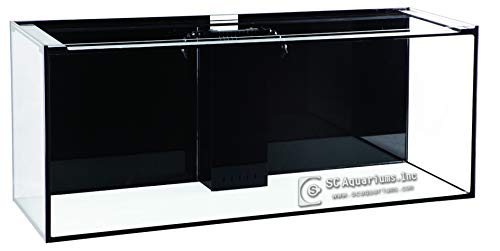
Empire USA Starfire Glass 150 gallon
aquarium is the one tank in this catalogue that publishes real dimensions, 60 by 24 by 24
inches, along with 12 millimetre low iron glass, a Eurobraced top and a built in overflow box for
a sump. Run the same two coefficients and it comes to 18.21 plus 15.70, which is
33.91 watts per kelvin. Note that the volume doubled against the 75 and the loss
rose by 55 percent, which is the same area against volume point that page makes.
Now the term that nobody counts.
Your pump and your light are a space heater you installed on purpose
An
AQQA 581GPH canister filter with 3-stage
filtration publishes a 35 watt motor, up to 581 gallons an hour, quartz balls and filter
cotton, a flow control valve, a four buckle seal with silicone rings and a copper motor. Its
record is correct and careful that "real turnover depends on head height and plumbing, so treat
581 GPH as a maximum."
Work out where the 35 watts goes. At 581 gallons an hour, which is 2,199 litres an hour,
lifting against a representative 1.2 metre head, the hydraulic power is density times gravity
times flow times head, which is 7.19 watts. Against a 35 watt input that is 20.5 percent
wire to water, which is entirely normal for a small canister. The other 27.8 watts is
heat in the motor and the bearings.
And then the 7.19 watts of hydraulic power does not escape either. It goes into moving water
around a closed tank, where it is dissipated by friction and turbulence and ends up as heat in
exactly the same water. There is nowhere else for it to go. Taking a representative 80 percent of
the electrical input as reaching the water through the wet path, the filter is a
28 watt heater.
A
Lominie 80W COB LED planted aquarium
light with a dimmer publishes an unusually complete set: 80 watts, up to 4325 lumens, a 90
degree secondary lens, a body 4.4 inches across and 3.86 long, suitability for tanks up to 24
inches, an aluminium fin heatsink with a fan below 28 decibels, a 0 to 100 percent dimmer, and a
stated operating temperature of 30 degrees Celsius.
Two of those numbers together give you the third. 4325 lumens from 80 watts is 54.1 lumens per
watt at the wall. White light has a luminous efficacy of radiation near 300 lumens per watt, so
the radiant efficiency is 54.1 divided by 300, which is 18.0 percent. In watts:
14.42 leaves the fixture as light and 65.6 watts is heat before any of it has
been near the water. That is what the aluminium heatsink and the fan are for, and it is why the
record publishes a 30 degree operating temperature.
Of the 14.42 watts that does leave as light, most is absorbed by water, substrate and plants
rather than escaping through the glass. Take a representative 85 percent and the light contributes
12.3 watts to the water.
So a tank running both is receiving 40.3 watts of equipment heat, around the
clock for the pump and for as long as the light is on, and that figure does not care what the
weather is doing.
The loss coefficients are taken deliberately from our own aquarium heater page so that the two
agree: 7 watts per square metre per kelvin on four glass walls and about 16.9 on the open water
surface, which is that page's 100 watts per square metre of evaporative loss at a few kelvin of
lift. Everything built on them is arithmetic. The radiant efficiency of the light follows from
two published figures and one reference constant, the luminous efficacy of radiation for white
light. The wet bulb temperatures come from the Magnus relation and the standard psychrometric
equation at 101.325 kilopascals. The published inputs are 1/3 horsepower, up to 79 gallons, 5 to
15 degrees Fahrenheit below ambient and 30 to 40 decibels on the chiller; 60 by 24 by 24 inches,
150 gallons and 12 millimetre glass on the tank; 35 watts and up to 581 gallons an hour on the
canister; 80 watts, up to 4325 lumens, a 90 degree lens, tanks to 24 inches and a 30 degree
Celsius operating temperature on the light; 3 to 7 degrees Fahrenheit, a 60 to 104 Fahrenheit
threshold range, ten speeds and one to three heads on the fan; and 28 watts, up to 1,700 litres
an hour and a 180 gallon drain in 30 minutes on the vacuum. Representative rather than
published: the coefficient of performance near 3, the 1.2 metre pump head, the 300 lumens per
watt luminous efficacy of radiation, the 80 and 85 percent heat and absorption fractions, the
standard 48 by 18 by 21 inch and 24 by 12 by 16 inch tank footprints, the 26 degree room at 60
and 80 percent humidity, the 150 watts per kelvin room, and the 6 kelvin tap water offset. No
equipment in this category publishes a heat output, and the chiller publishes no power draw at
all, which its own drawbacks admit.
What 40.3 watts is worth, which depends entirely on the setpoint
Here is the result that reframes the whole question. The chiller claims 5 to 15 Fahrenheit
below ambient. Those two ends of its own range are not the same job.
At 15 Fahrenheit, which is 8.33 kelvin, the glass and surface leak 21.94 times
8.33, which is 182.8 watts inward. Add the equipment and the load is 223.1 watts, of which the
equipment is 18.1 percent.
At 5 Fahrenheit, which is 2.78 kelvin, the leak falls to 61.0 watts. The
equipment term does not fall at all. The load is 101.3 watts and the equipment is
39.8 percent of it.
Two fifths. Set a chiller to hold a tank a modest 5 degrees under the room and you have bought
a refrigeration machine whose main job is undoing the pump and the light that are sitting in the
same tank. Dim the light to 50 percent, which this one can do, and roughly 6 watts of the load
goes away, which is 6 percent of the total at that setpoint and 2.7 percent at the deep one.
And the capacity check, because it is good news. One third of a horsepower is 248.7 watts of
input power. A small water chiller working at this kind of lift runs at a coefficient of
performance somewhere near 3, so about 746 watts of cooling. Against 223.1 watts that is a
29.9 percent duty cycle at the deep setpoint and 13.6 percent at the shallow one.
The rating and the published claim are consistent, with real margin. That is worth saying as
plainly as the criticisms, because a claim that survives arithmetic is rarer than one that does
not.
What is missing is the number a buyer actually lives through. Taking 79 gallons, which is 299.1
kilograms of water, down 8.33 kelvin takes 299.1 times 4,186 times 8.33, which is 10.43
megajoules. During the ramp the net cooling averages the 746 watts minus the equipment and minus
the growing leak, around 614 watts, so the pull down is 4.72 hours. Nothing
publishes it, and it is the difference between a machine you switch on before a heatwave and one
you switch on during it.
Where the removed heat goes, and why the room matters
A chiller does not destroy heat. It moves it, and it adds its own input power to the pile on
the way. Removing 223.1 watts while drawing 248.7 means rejecting 471.8 watts
into the air around the unit.
If that air is the same room the tank is in, the loop closes. Take a representative room losing
150 watts per kelvin to the rest of the house and outdoors: 471.8 watts raises it 3.15 kelvin.
Which raises the tank's leak by 21.94 times 3.15, or 69.1 watts. Which is
31.0 percent more load than the chiller started with, created by nothing except
where the box is standing.
Our guide to
choosing an aquarium chiller for your
tank gets close to this and stops one step short. It says to "site the unit with airflow
around its heat vents so it cools efficiently and stays quiet", which is right about the unit and
silent about the room. The stronger version is that the 471.8 watts should leave the room, through
a doorway, a vent or a different cupboard, and that a sealed cabinet under the tank is the worst
available location for precisely the reason the sentence hints at.
The same guide opens with "Match capacity to tank volume. Chillers are rated by gallons and
horsepower. Pick a unit that comfortably covers your tank size." Volume is the wrong variable, for
the exact reason our heater page lays out: the leak is an area and the gallons only enter because
bigger tanks happen to carry more glass. A 75 gallon tank and a 90 gallon tank sharing the same
48 by 18 inch footprint differ by 20 percent in volume and about 8 percent in loss. And the
sentence has no term at all for the equipment, which at a 5 degree setpoint is two fifths of the
answer.
Its advice to "Confirm a pump and hose are included or on hand" is correct and carries the same
unstated bill. This chiller does include a pump, which is genuinely convenient, and that pump's
electrical power is added to the heat the chiller must then remove. Its wattage is not published,
so the figure cannot be put in. If it draws 20 watts, it is 8.8 percent of the load at the deep
setpoint and 19.7 percent at the shallow one, all of it self inflicted.
The fan is a different machine with a hard ceiling
A
SEAOURA aquarium chiller fan with a timer
and temperature control publishes a drop of 3 to 7 Fahrenheit, a probe with thresholds
settable anywhere from 60 to 104 Fahrenheit, ten speeds, one to three fan heads, a 5.4 inch
gooseneck that rotates 720 degrees, a bracket for rimless glass from 0.2 to 1 inch, and a 24 hour
timer. Its drawbacks are the right ones: "Cooling drop is limited to 3 to 7F" and "Evaporation
also lowers water level, meaning you top up more often during heavy use."
Evaporative cooling has a floor it cannot pass, which is the wet bulb temperature of the room
air. Our page on
why an evaporative cooler
runs out of degrees in humid air works that argument through for a room, and the same ceiling
applies here with the water surface as the wet surface.
At 26 degrees Celsius and 60 percent relative humidity the wet bulb sits at 20.38, a depression
of 5.62 kelvin, which is 10.1 Fahrenheit. So the fan's published 7 degree figure
is 69 percent of the thermodynamic ceiling, which is an honest and achievable claim.
At the same 26 degrees and 80 percent relative humidity, which is an ordinary summer afternoon
in a lot of places, the wet bulb rises to 23.34 and the depression collapses to 2.66 kelvin, which
is 4.79 Fahrenheit. The fan's own upper figure is now impossible, and its lower
figure of 3 degrees is 63 percent of what remains. The 3 to 7 range is not a range of fan speeds.
It is a range of weather, and the listing does not say which end belongs to which.
Then there is the price in water, which is where the number gets surprising. Holding the 75
gallon tank 3.89 kelvin below ambient means removing 21.94 times 3.89 of leak plus 40.3 of
equipment, which is 125.6 watts, entirely by evaporation. At 2.44 megajoules per kilogram that is
4.45 litres a day.
On 299 litres that is 1.49 percent a day, so 10.4 percent of the tank leaves as vapour
every week and every dissolved solid in it stays behind. On a marine tank held at 35
parts per thousand, a week of that without topping off arrives at 39.1. On fresh water it is a
steady climb in hardness and in everything else that does not evaporate. The record's note that
you top up more often is correct, and 4.45 litres a day is what more often means.
And the comparison that makes the two machines genuinely different rather than two grades of
the same thing. The compressor removes the identical 125.6 watts for 125.6 divided by 3, which is
41.9 watts of electricity, and no water at all. Same heat, 41.9 watts against 4.45 litres a day,
and one of them has a ceiling at the wet bulb while the other does not.
The cleaning tool moves more degrees than either of them
An
electric aquarium vacuum 5-in-1 gravel
cleaner publishes a 28 watt pump, up to 1,700 litres an hour, a handle extending from 12.4 to
33.6 inches, a 2 metre hose, a reusable sponge filter cup, suitability for roughly 10 to 100
gallon tanks, and the claim that it can drain a 180 gallon tank in about 30 minutes.
That last pair is checkable. 180 US gallons is 681.4 litres, and in 30 minutes that is 1,362.8
litres an hour against a rated 1,700, which is 80.2 percent of the maximum. The
19.8 percent shortfall is exactly the head loss the canister filter's record warns about, applied
honestly to its own figure. Another claim that survives.
What no listing mentions is that a water change is a thermal event larger than anything the
temperature gear does. Replace 25 percent of 299 litres with tap water 6 kelvin cooler and the
mixed temperature falls by a quarter of 6, which is 1.5 kelvin, or 2.7
Fahrenheit. That is 54 percent of the chiller's entire 5 degree lower claim, delivered
in half an hour by a cleaning tool, and it goes the other way if the tap runs warm.
Which is a useful thing to know in both directions. If you are fighting heat, time the water
change for the warm part of the day and let it do the work. If you are holding a temperature, that
2.7 degree step is the disturbance your heater or chiller then has to recover from, and on the 75
gallon tank recovering 1.5 kelvin takes 299.1 times 4,186 times 1.5, which is 1.88 megajoules, so
about 51 minutes at the chiller's net rate.
What this category refuses to publish
No equipment in this aisle publishes a heat output, and heat output is the one property every
single item has. The filter publishes watts, which is nearly the same thing and is the most useful
figure here. The light publishes watts and lumens, which between them give the split. The vacuum
publishes watts. The fan publishes neither a wattage nor an airflow, which are the two numbers
that would turn 3 to 7 Fahrenheit into a prediction instead of a range. And the chiller, the one
machine whose entire function is thermal, publishes no power draw at all and says so in its own
drawbacks.
One third of a horsepower is not a cooling capacity and it is not an input power. It is a
convention from compressor sizing, and the two figures it stands in for, watts in and watts of
cooling at a stated temperature, are both absent. The 5 to 15 Fahrenheit claim is the closest
thing to a capacity on the page, and it only becomes one once you supply a tank area, which the
tank listings mostly do not publish either. The 150 gallon display is the exception and it is the
one tank nobody would put a 1/3 HP chiller on.
The honest limit, and the three numbers to carry
What is exact here is every balance. A steady state offset is heat in divided by loss
coefficient. The equipment term is published wattage times a path fraction. The radiant efficiency
of the light follows from its own two published numbers and one reference constant. The wet bulb
temperatures come from the Magnus relation and the standard psychrometric equation. The
evaporative water loss is a power divided by a latent heat. The pull down is a mass times a
specific heat times a temperature divided by a net rate. None of those is an estimate.
What is representative is the surrounding furniture of the calculation, and it is worth listing
because several of these are load bearing. The coefficient of performance near 3 sets the duty
cycle and the 41.9 watt figure for the fan comparison; at 2.5 both rise by 20 percent and at 3.5
they fall by 14. The 1.2 metre pump head sets the 20.5 percent wire to water figure but not the 28
watts, which comes from the published input. The 300 lumens per watt luminous efficacy of
radiation sets the 18.0 percent split; a warmer white spectrum runs nearer 260 and would make the
light's radiant share 20.8 percent instead. The 80 and 85 percent path fractions, the standard
tank footprints, the 26 degree room, the 150 watts per kelvin room and the 6 kelvin tap offset are
all in the same category. Every percentage that compares the equipment term with the leak term is
far more robust than any absolute watt figure, because both sides scale together.
What this page deliberately does not compute is three things. It does not give a temperature
any species should be held at, because that is an animal question rather than a heat transfer one
and no listing here carries a defensible figure. It does not compute the chiller's capacity in
watts, because that needs a compressor curve at a stated evaporating and condensing temperature
and the listing publishes no power draw at all; the 746 watts is the published horsepower times a
representative coefficient of performance and should be read as an order rather than a
specification. And it does not compute how fast the fan drops the water when it switches on,
because that needs the fan's airflow and the wetted area under it, and the listing publishes
neither; all that can be said is where the floor is.
Three numbers to carry. Equipment heat does not depend on your setpoint, so the shallower the
offset you want, the larger the share of a chiller's work that is undoing your own gear, reaching
two fifths at the 5 degree end of this one's range. A chiller rejects its removed heat plus its own
input into the room, which on the figures here is 471.8 watts and about 31 percent extra load if
the room is closed. And evaporative cooling stops at the wet bulb and is paid for in water, at
4.45 litres a day for 3.89 kelvin on a 75 gallon tank, which is 10 percent of the tank a week with
the salts left in.
Why a Chiller's First Job Is Your Light and Pump at a glance
Electric Aquarium Vacuum 5-in-1 Gravel Cleaner, 28W
keepers wanting one tool for water changes and gravel cleaning
Handles five cleaning jobs from one device
Pump must stay fully submerged to run
Why you can trust this guide
We compared these picks using verified manufacturer specifications, current retailer listings, and patterns in owner feedback, alongside editorial research. We focus on measurable differences such as performance, capacity, usability, and build quality. Pickpedia does not present editorial research as laboratory testing, and we do not claim hands-on testing unless it was actually performed.
This 1/3 HP aquarium chiller cools freshwater and saltwater tanks up to 79 gallons, dropping temperatures 5 to 15 degrees F below ambient. An energy-efficient compressor holds stable readings for species like axolotls and jellyfish. It ships with a pump and hose, runs at roughly 30 to 40 dB, and adds an upgraded LED touch screen. It suits keepers fighting warm-room heat.
Compressor1/3 HP energy-efficient
Tank capacityUp to 79 gallons
Cooling range5 to 15 degrees F below ambient
Water typesFreshwater and saltwater
Noise levelAbout 30 to 40 dB
DisplayUpgraded LED touch screen
IncludedWater pump and hose
Pros
Cools tanks 5 to 15 degrees F below ambient
Efficient 1/3 HP compressor holds steady temperatures
Best for serious hobbyists building a large sump-based display
8.8/ 10 Pickpedia editorial score
Empire USA's 150 gallon aquarium measures 60 by 24 by 24 inches and uses high-clarity Starfire low-iron glass for a crystal view. A built-in overflow box routes water to a sump for professional filtration. The 12mm Eurobraced construction adds strength for a large system. It suits both freshwater and saltwater displays with room for rockwork and coral.
Capacity150 gallon (151 listed)
Dimensions60 x 24 x 24 inches
GlassStarfire low-iron
Thickness12mm
ConstructionEurobraced
OverflowBuilt-in box
FiltrationSump-ready
Water typeFreshwater and saltwater
Pros
Starfire low-iron glass gives a crystal-clear view
Colors appear more vibrant through the low-iron panes
Large 150 gallon size makes a striking centerpiece
Built-in overflow supports professional sump filtration
12mm Eurobraced build reinforces a big system
Deep footprint suits rockwork and coral aquascaping
Cons
Very heavy once filled and hard to relocate
Requires a rated stand and planned plumbing
Sump and equipment are extra investments
Specs are maker-stated, not independently verified
Best for Freshwater keepers wanting strong, adjustable filtration
8.6/ 10 Pickpedia editorial score
The AQQA Canister Filter moves up to 581 GPH on a 35W motor for freshwater tanks. Three media stages with quartz balls and filter cotton clear particles and impurities. A flow-control valve lets you dial output to tank size, and a four-buckle seal with silicone rings guards against leaks. A copper motor keeps it quiet. It suits freshwater keepers wanting strong, adjustable, low-noise filtration.
Best for demanding planted tanks needing strong dimmable light
8.6/ 10 Pickpedia editorial score
The Lominie 80W planted aquarium light uses a COB LED with a 90 degree secondary lens for strong penetration and up to 4325lm output. It suits freshwater and planted tanks up to 24 inches long. A dimmer remote sets 0 to 100 percent brightness. An aluminum heatsink and silent fan handle cooling, and a Smart Controller is sold separately.
Best for keepers fighting mild summer heat in home or office tanks
8.6/ 10 Pickpedia editorial score
SEAOURA's chiller fan cools aquarium water by evaporation, dropping it 3 to 7F. A high-sensitivity probe drives fully customizable start and stop thresholds from 60F to 104F, so the fan runs only when needed. Ten speeds, one to three fan heads, a 24-hour programmable timer, and a 720-degree gooseneck give flexible, largely hands-off cooling for many tank types.
Cooling methodEvaporative fan
Cooling drop3 to 7F
Temp control range60F to 104F
Speeds10 adjustable
Fan heads1 to 3
Timer24-hour programmable
Gooseneck5.4 in, 720-degree
Bracket fit0.2 to 1 in rims
Pros
Digital control auto-cools between set temperatures
Best for keepers wanting one tool for water changes and gravel cleaning
8.4/ 10 Pickpedia editorial score
This 5-in-1 electric aquarium vacuum handles water changes, sand washing, debris cleaning, filtration, and water cycling from one 28W pump. The maker rates flow up to 1700 liters per hour and an extendable handle that reaches from 12.4 to 33.6 inches. A reusable sponge filter cup returns clean water to the tank. It suits freshwater and saltwater setups plus turtle tanks, roughly 10 to 100 gallons.
Functions5-in-1 clean, filter, cycle
Motor110V 28W pump
Max flow1700 liters per hour
Handle reach12.4 to 33.6 inches
Hose length2 meters
Tank range10 to 100 gallons
Water typesFreshwater and saltwater
FilterReusable sponge cup
Pros
Handles five cleaning jobs from one device
Rated 1700 liters per hour for strong suction
Extendable handle adapts to many tank depths
Reusable sponge filter returns clean water
Works in freshwater, saltwater, and turtle tanks
Complete accessory set covers most tasks
Cons
Pump must stay fully submerged to run
Handle and switch are not waterproof
Drain times are maker stated under ideal conditions