Home ›
Pets › Why a 5 Gallon and a 15 Gallon Tank Take the Same 50 Watt Heater
Pets
Why a 5 Gallon and a 15 Gallon Tank Take the Same 50 Watt Heater
PBy the Pickpedia Team·5 picks compared·Last verified October 2026
Affiliate disclosure: As an Amazon Associate, Pickpedia earns from qualifying purchases. Links on this page are paid links, and we may earn a commission at no extra cost to you. This never affects our picks or scores.
This page contains affiliate links. If you buy through one we may earn a
commission, at no cost to you.
Both halves of the question have the same answer and it is not the expected one. A
heater that runs most of the time is not in danger, it is correctly sized, and a heater
that barely runs is oversized. There is no mechanism by which running costs an immersion
heater anything: it is a resistance wire in water, there is nothing to wear, and the water
it sits in cannot let it get hot. Running a lot is what a well matched heater does.
And the sizing question is harder than gallons, because gallons is not what the heater
is fighting. Two of the heaters in our own catalogue are both 50 watts, both from the same
maker, and one is sold for 5 to 10 gallon tanks while the other is sold for 5 to 15. At
most one of those can be right, and working out which exposes what a wattage rating is
actually a statement about.
Heat leaves through the walls, and a wall is an area
A heater's job at equilibrium is to replace exactly what the tank loses, and the tank
loses through the glass to the room air and through the water surface to the room air.
Both of those are areas. Volume appears nowhere in the loss, and it only appears in the
problem at all because a bigger tank happens to come with more glass.
That distinction is not pedantic, because area and volume grow at different rates. Take
the real dimensions of standard glass tanks rather than an idealisation. A 5 gallon tank is
about 16 by 8 by 10 inches, which gives 0.310 square metres of glass facing the room. A 15
gallon is about 24 by 12 by 12 inches, which gives 0.557. The volume tripled and the area
went up by a factor of 1.80.
Work out what that does to the loss. Glass to still room air behaves at an overall
coefficient of roughly 7 watts per square metre per kelvin, almost all of which is the
air-side convection rather than the glass. Add the water surface, which loses heat by
evaporation at roughly 100 watts per square metre at a few degrees of lift. The 5 gallon
tank comes to 3.57 watts per kelvin and the 15 gallon to 7.05.
So the same 50 watt heater can hold 50 divided by 3.57, which is 14.0 kelvin or 25.2
degrees Fahrenheit, above the room in the 5 gallon tank, and 50 divided by 7.05, which is
7.1 kelvin or 12.8 Fahrenheit, in the 15. Roughly half. Which answers the original
question: a heater's rating is a statement about a temperature difference it can sustain,
not about a quantity of water it can serve.
The cleanest proof that volume is the wrong variable
There is a pair of standard tanks that settles this with no arithmetic at all. A 15
gallon and a 20 gallon high tank share the same 24 by 12 inch footprint; the 20 is simply
taller. So they have exactly the same water surface, and the taller one has more glass on
its four sides.
Volume between them differs by a third. Loss differs by 18 percent, from 7.05 to 8.35
watts per kelvin. A rule in watts per gallon says the 20 needs a third more heater. The
physics says it needs 18 percent more, and no rule expressed in gallons can produce that,
because the answer depends on which direction the extra gallons were added.
Areas computed from the real dimensions of standard US glass tanks, 16 by 8 by 10 inches
for 5 gallons through 48 by 13 by 21 for 55. Glass to still air taken at an overall 7
watts per square metre per kelvin, which is dominated by natural convection on the air
side. Evaporation from the open surface taken at about 100 watts per square metre at a few
kelvin of lift, from 0.15 kilograms per square metre per hour against a latent heat of
2.44 megajoules per kilogram. The 50 W, the gallon ranges and the 63 to 94 F setting range
are the figures our own listings publish. Tank dimensions are standard glass sizes, not
products we carry, because no heater listing publishes a tank dimension.
The correction: five of our own pages size heaters by the wrong variable
This site has five pages on aquarium heater wattage and every one of them reasons from
gallons. Two of them publish numbers that cannot both be right, and the pair is worth
laying side by side.
Our page on
how to choose the right
aquarium heater wattage says: A rough guide is a few watts per gallon, adjusted for
room temperature. Small tanks need modest output, and a 50W unit often suits 5 to 10 gallon
setups. Our page on
how to choose an aquarium
heater for a small tank says: A rough guide is about 3 to 5 watts per gallon. A 50W
unit like this small aquarium heater suits tanks from 5 to 15 gallons.
Those are the two ends of a 50 percent disagreement about the same wattage, published on
the same site, each taken from a different maker's listing. And the second one contradicts
its own rule in its own sentence: at 3 to 5 watts per gallon, 15 gallons wants 45 to 75
watts, so 50 watts is at the bottom of its own stated band, while at 5 gallons the same 50
watts is 10 watts per gallon, which is twice the top of it. The rule and the example in one
paragraph differ by a factor of three.
The deeper problem is that the rule is not what the makers used. Across every heater we
carry, the watts per gallon implied at the small end of each stated range is 10.0, 10.0,
10.0, 6.0 and 7.3, and at the large end it is 5.0, 3.3, 5.0, 5.0 and 3.2. The 3 to 5 figure
describes only the top of each range. Anyone sizing a heater for the small end of a range
using 3 to 5 watts per gallon will buy something half the size the maker intended.
Two of the five are right about things this page does not cover and deserve the credit.
How to heat a large aquarium
or turtle tank evenly is correct that the heater belongs in flow and that the probe
belongs at the far end reading the coolest zone, and the reason is exactly the one this page
implies: without circulation the heater warms a local parcel of water rather than the tank,
and a probe next to the element reads the heater rather than the fish. And
the second wattage page is
the only one of the five that names the real variable, when it says a cold room forces the
heater to work harder and that the bigger the gap between room and target temperature the
more reserve you want. That is the correct instinct. It is the lift, and the page then sizes
by gallons anyway.
One claim does need flatly correcting. Our page on
how to choose an aquarium
heater for a large tank says: Bigger water volumes lose heat slowly but need more
power to recover after a change. The first half is true in the sense that the
temperature moves slowly, because the thermal mass is large, and that is a real and useful
property. But it is stated as though it reduces the heating requirement, and it does the
opposite: a bigger tank loses heat faster in watts, because it has more area, and its slow
response is about how long it takes to notice, not how much it needs. Volume buys you
stability and costs you power. The page has those two consequences the wrong way round.
The listings, and the contradiction in our own records
A
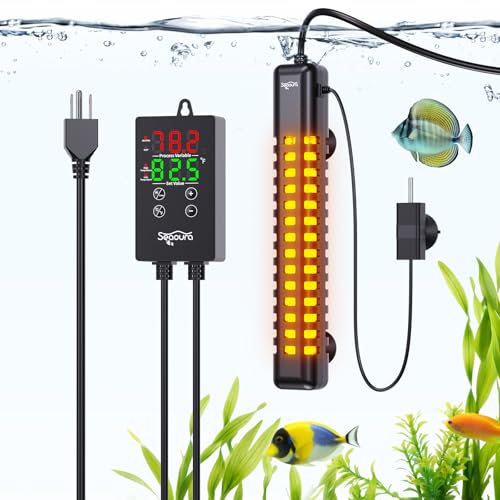
SEAOURA 50W small aquarium heater
with LED controller is published for 5 to 15 gallon tanks, with a quartz tube, an
external LED controller reading to plus or minus 1 degree Fahrenheit, overheat and dry-burn
shutoff, and an HH warning above 99 Fahrenheit. Its own honest note is that larger tanks
beyond 15 gallons need a higher wattage model.
A
SEAOURA 50W small aquarium heater
for 5 to 10 gallon tanks is the same maker and the same 50 watts, published for 5 to 10
gallons, with a separate probe, a dual LED controller, 0.1 degree adjustment steps and a
published setting range of 63 to 94 Fahrenheit. And here is the part worth pausing on: its
own drawbacks field lists, as a limitation, Rated only up to 10 gallon tanks.
So our catalogue contains one product apologising for a 10 gallon ceiling and another,
identical in wattage and from the same maker, claiming 15. The arithmetic above says the
first one is closer to honest. At the ordinary tropical requirement, 78 Fahrenheit water in
a 67 Fahrenheit room, a 15 gallon tank needs 42.3 of the available 50 watts, which is an 85
percent duty cycle with almost nothing in reserve for a cold night. The 10 gallon tank needs
32.6 watts, a 65 percent duty. The 5 gallon needs 21.4, a 43 percent duty. Fifteen gallons is
not impossible; it is the point at which the heater has stopped having a margin. Our
SEAOURA 50W heater
with LED controller review and our
SEAOURA 50W 5 to
10 gallon heater review carry both records as published.
The published setting range makes it sharper still, and this is the finding I did not
expect. That 63 to 94 Fahrenheit range is a range of settings the controller will accept.
Reaching 94 Fahrenheit in a 67 Fahrenheit room is a 27 degree lift, and 27 degrees needs
53.5 watts in the 5 gallon tank, 81.6 in the 10 and 105.8 in the 15. The heater has 50. So
the top of its own published setting range is unreachable in every tank it is sold for,
including the smallest. The number is real as a limit on what you may type in. It is not a
statement about what the water will do.
For the separate question of how precisely that controller then holds whatever it can
reach, batch eight worked it out properly in
why a thermostat lets the
temperature swing, including the finding that these same listings split one specification
across two products, publishing a 0.1 degree adjustment step on some and a plus or minus 1
degree accuracy on others, so that a buyer never sees the step and the band together.
The rest of the range, which is more consistent than the small end
A
SEAOURA 200W aquarium heater for 20
to 40 gallon tanks repeats the pattern exactly: 10 watts per gallon at the small end of
its range and 5 at the large end. That is the same ratio as the 5 to 10 gallon product, which
suggests the maker is working to a consistent internal rule even though it is not the rule our
pages publish. Read as lift rather than volume it makes sense: 200 watts against a 40 gallon
breeder's 14.9 watts per kelvin holds 13.4 kelvin, or 24 Fahrenheit, which is a generous
margin, and against a 20 gallon high tank's 8.35 it holds 43 Fahrenheit, which is more than
anyone needs and is the real meaning of the small end of a range. Our
SEAOURA 200W heater
review has the record.
A
SEAOURA 300W aquarium heater for 50
to 60 gallon fish and turtle tanks is the one that breaks the pattern, at 6.0 watts per
gallon at the small end rather than 10, and the narrow 50 to 60 gallon range is the reason: a
range that spans a fifth rather than a double cannot contain much variation in lift. It is the
most honestly bounded rating in the group. Our
SEAOURA 300W
heater review covers the adjustable power feature.
An
AZW 800W aquarium heater for 110 to
250 gallon tanks is the extreme, spanning more than a doubling of volume on one wattage,
from 7.3 watts per gallon down to 3.2. On a tank that large the loss is dominated by a very
big water surface, and the honest reading of a range like that is that the low end is for a
cold room and the high end is for a warm one. Its own record is appropriately careful, listing
as drawbacks that the wattage and range are maker stated and that the accuracy claim is not
independently verified. Our
AZW 800W aquarium heater
review keeps those caveats.
The honest limit, and the free technique that beats every upgrade here
The limit is structural and no maker can fix it. The quantity that decides whether a heater
is adequate is the loss in watts per kelvin, and that depends on the tank's dimensions, the
room's temperature, whether there is a lid, and whether the tank sits against an outside wall.
A heater maker knows none of those. So a gallon range is a guess about your room dressed as a
specification, and no heater listing in our catalogue publishes a tank dimension, a watts per
kelvin figure, or an ambient temperature the rating assumes. Every tank dimension in this
article is a standard glass size, not a product we carry.
Which makes the free technique unusually powerful here, because it attacks the loss rather
than the supply. Put a lid on the tank.
Evaporation from the open water surface is 39 percent of the total loss on the 5 gallon tank
and 45 percent on the 15, and it is a latent heat term, meaning every gram of water that leaves
as vapour takes about 2,440 joules with it. Covering the surface largely removes that term. The
lift a 50 watt heater can hold in the 15 gallon tank goes from 12.8 Fahrenheit to 23.1, which
is a bigger improvement than you could buy by moving from 50 watts to 90. Nothing else in this
subject comes close, and most tanks have a lid already, sitting beside the tank because it is in
the way of the light.
Three more that cost nothing. Move the tank off the outside wall and away from the window,
because the loss is driven by the air on the other side of the glass and that air is colder
there. Raise the room by a degree rather than the water, since the loss depends only on the
difference and a degree of room is a degree of lift you no longer have to supply. And if the
heater is running flat out and still short, add a second small heater rather than replacing it
with a large one: two 50 watt heaters in a 15 gallon tank hold the same lift as one 100 watt
heater, and they fail separately, which in a subject where a stuck heater is the serious failure
mode is worth more than the tidiness of one unit.
And to close the original question: a heater that runs 85 percent of the time is not failing
and will not burn out. It is telling you, accurately, that it has 15 percent left. That is the
most useful reading available in this whole category and it requires no instrument at all,
because the controllers on these products show a heating light. Watch how much of the time it is
on, and you have measured your own tank's loss without knowing a single one of the numbers
above.
Why a 5 Gallon and a 15 Gallon Tank Take the Same 50 Watt Heater at a glance
We compared these picks using verified manufacturer specifications, current retailer listings, and patterns in owner feedback, alongside editorial research. We focus on measurable differences such as performance, capacity, usability, and build quality. Pickpedia does not present editorial research as laboratory testing, and we do not claim hands-on testing unless it was actually performed.
SEAOURA makes a compact 50W aquarium heater for tanks from 5 to 15 gallons. It uses an explosion-proof quartz heating tube with a plastic protective cover. An external LED controller shows temperature to plus or minus 1 degree F and toggles between C and F. Overheat and dry-burn protection shut it off automatically. It fits freshwater and saltwater setups.
Best for small 5 to 10 gallon tanks needing controllable heat
8.6/ 10 Pickpedia editorial score
The SEAOURA 50W aquarium heater warms 5 to 10 gallon tanks and pairs with a separate temperature probe and external dual LED controller. It suits bettas, tropical fish, shrimp, and small turtles. The maker lists dual safety protection, adjustable over-temperature limits, 0.1 degree precision control, a memory function, and an explosion-proof quartz core in an ABS shell.
Best for small to mid tanks needing visible external control
8.6/ 10 Pickpedia editorial score
SEAOURA's 200W aquarium heater warms 20 to 40 gallon tanks and suits betta, tropical fish, shrimp and turtles. An external dual LED controller shows real water temperature beside your target, and short presses tune settings in 0.1 degree steps. Dry-run shutoff, an alarm and adjustable over-temperature limits guard against overheating. A memory chip restores the last setting after a power cut.
Wattage200W
Tank range20 to 40 gallons
Rod dimensions9.5 x 1 x 0.87 in
Temperature range63 to 94 F (17 to 34 C)
Power cord3.3 ft + 5.25 ft
Sensor cord19.7 in
Adjust step0.1 degree short press
HousingExplosion-proof quartz + ABS
Pros
External dual display reads water and target at once
SEAOURA's 300W heater warms 50 to 60 gallon fish and turtle tanks. A connected temp probe reads several areas and doubles as a thermometer, while an external controller sets the target safely. Adjustable-power thermostat control heats fast when cold, then gently near target to save energy. Over-temperature protection with an alarm, 0.1 degree steps, a memory function and quartz-in-ABS build round it out.
Wattage300W
Tank range50 to 60 gallons
Rod length10.4 in
Temperature range63 to 94 F (17 to 34 C)
Power cord37.4 + 59 in
Sensor cord19.68 in
ElementPure nickel alloy
HousingThickened quartz + ABS
Pros
Adaptive power for fast then gentle heating
Wired probe reads several areas and shows temperature
Best for Large 110 to 250 gallon aquariums and ponds
8.4/ 10 Pickpedia editorial score
AZW's 800W submersible aquarium heater targets large 110 to 250 gallon tanks. It pairs double explosion-proof quartz glass with an ABS outer shell to guard fish from scalding. A digital LED controller shows current and set temperatures with stated accuracy of plus or minus 1 degree F. Three safety layers cover off-water warning, over-temperature cutoff, and anti-boiling protection. Memory function keeps your setting after a power outage.