Home ›
Electronics › Why a Bag Is the Filter and a Cyclone Is Not
Electronics
Why a Bag Is the Filter and a Cyclone Is Not
PBy the Pickpedia Team·4 picks compared·Last verified October 2026
Affiliate disclosure: As an Amazon Associate, Pickpedia earns from qualifying purchases. Links on this page are paid links, and we may earn a commission at no extra cost to you. This never affects our picks or scores.
This page contains affiliate links. If you buy through one we may earn a
commission, at no cost to you.
Not for the reason it sounds like. The complaint reads as being about emptying a bin
over a kitchen caddy, and that is a real annoyance, but it is not the mechanism. The
mechanism is that a bag is not a container with a filter attached. The bag is the filter,
and it has about five times the media area of the pleated cartridge that replaces it.
Take the bag out and three things happen in order. The fine dust that used to land on
0.19 square metres of paper now lands on 0.04 square metres of pleat. The cyclone put in
front of it to help cuts off at somewhere between 0.6 and 2 micrometres, which is above the
particle size that same filter is specified at. And the dust cup, which is sold as the
convenience, decides how much of that fine dust accumulates before anybody intervenes.
A cyclone has a size below which it does nothing
Start with the separator, because it is the part people assume is doing the work. A
cyclone does not filter. It spins the air and lets inertia throw the heavy things outward,
so whether a given particle gets caught depends on whether its momentum can carry it
across the streamlines before the air leaves.
That gives a cut diameter, the size at which it catches half of what arrives. The
standard expression puts it at the square root of nine times the air viscosity times the
inlet width, divided by two pi times the number of effective turns times the inlet
velocity times the particle density.
Run it on three plausible geometries, with air viscosity at 1.81 times ten to the minus
five, household dust at 2,000 kilograms a cubic metre and five turns. A handheld with an 8
millimetre inlet at 20 metres a second cuts at 1.02 micrometres. A full size upright with a
25 millimetre inlet at 15 metres a second cuts at 2.08. A small multi-cyclone cone of 4
millimetres at 25 metres a second cuts at 0.644.
Now the number that matters. A
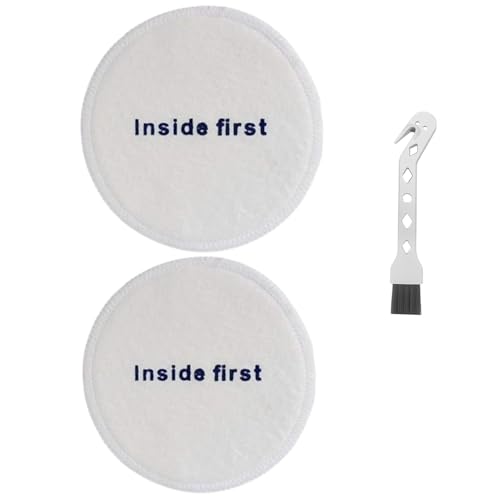
Eureka PowerSpeed H13 vacuum filter
set publishes exactly the figure the comparison needs, stating that "H13 media captures
99.97 percent of particles as small as 0.3 microns". Three tenths of a micrometre. Every
cut diameter above sits between 2.1 and 6.9 times higher than that.
Which settles what the cyclone is for. It is not reducing the filter's hardest duty. It
is removing the bulk that would otherwise bury the filter, which is genuinely valuable and
is a completely different job. At the one size the filter is specified at, the cyclone is
transparent.
There is also a direction in that expression worth noticing, because it is the opposite
of the intuition. The cut diameter rises with the square root of the inlet width, so a
bigger cyclone is worse at fine dust, not better. That is why machines in this category
use arrays of many small cones rather than one large one, and why our roundup of
cyclone dust collectors is full of multi-cone
arrangements rather than single large drums.
The cut diameter expression is the standard inertial result for a cyclone and the ratios
between the three points are exact, because only the inlet width and velocity differ. The
0.3 micrometre line, the 100 millilitre cup, the 680 millilitre cup and the 99.97 percent
figure are all published by our own listings. What is representative rather than published
is everything geometric: no vacuum we carry publishes a filter area, an airflow, an inlet
width, an impeller diameter or a clean filter pressure drop, so the 8, 25 and 4 millimetre
inlets, the 15 to 25 metres a second, the five effective turns, the 0.19 and 0.04 square
metres of media, the 0.02 cubic metres a second of airflow, the 200 kilogram bulk density
and the 2 percent fines fraction are all assumptions. Change the fines fraction and the
third panel scales as a block without the 6.8 ratio moving, because that ratio is two
published volumes over one shared area. Halve the assumed turns and every cut diameter
rises by 1.41 times together, which pushes all three further above the 0.3 line rather
than toward it. The one conclusion that no choice of input can reverse is the direction:
the cut diameter cannot fall below the filter's rating without an inlet narrower than any
cyclone is built with.
The area ratio, which is the actual answer
A four litre paper bag measuring roughly 300 by 200 by 70 millimetres presents about
0.19 square metres of filtering surface, and every square centimetre of it is working,
because the bag is the filter. A handheld pleated cartridge 60 millimetres across and 60
tall, with thirty pleats ten millimetres deep, presents about 0.04 square metres.
A ratio of 4.75. At a representative airflow of 0.02 cubic metres a second, the face
velocity through the bag is 0.105 metres a second and through the cartridge 0.50.
Both halves of that hurt, and they compound. Cake accumulates in proportion to the dust
arriving per unit of area, so nearly five times faster. And pressure drop through a cake
rises with the velocity you are pushing through it, so each layer of cake that does form
costs more. A bagged machine spreads the same dust over five times the paper at a fifth of
the speed, and then throws the whole thing away rather than asking anybody to rinse
it.
Our guide to
choosing the right
replacement vacuum filter is the page a buyer lands on at this point, and it is about
fit and type, as it should be. The quantity nobody publishes is the area. The Eureka
record is honest enough to name the gap in its own drawbacks: "No dimensions given for the
filter pieces". On a product that is nothing but filter, the area is the specification, and
it is absent.
The dust cup sets the clock, and bigger is worse
Here is where two published figures in this catalogue produce a result neither listing
mentions.
A
Runful handheld car vacuum
publishes a 100 millilitre dust cup and sells it as roomy: its record notes the cup "holds
100ml, which the maker notes is larger than many competitors". A
VACDRIVE DW688 handheld cordless car
vacuum publishes 680 millilitres and sells it harder, as "up to three times larger
than typical mini handhelds", with the reasoning spelled out: "On a car interior full of
sand and crumbs, cup size decides whether you finish the job or stop halfway to empty
it."
That is true and it is only half the consequence. At a bulk density of 200 kilograms a
cubic metre those cups hold 20 grams and 136 grams of debris. If two percent of the
collected mass is finer than the cyclone's cut diameter, then 0.40 grams and 2.72 grams
reach the filter between emptyings. Divided by the same 0.04 square metres of media that
is 10 grams a square metre against 68.
A ratio of 6.8, which is exactly the ratio of the cups, because the filter area did not
grow with the cup. The bigger cup does not reduce the filter's work. It postpones the
intervention that would have cleaned it, and it collects 6.8 times as much fine dust before
that happens.
Which reframes a detail on the VACDRIVE listing. It ships two washable filters, and its
record gives the stated reason: "you rotate them, so while one dries the other is in use.
That is a small design decision with a real consequence, because the usual failure pattern
with washable filters is putting a damp one back in and losing suction." That reasoning is
sound. The arithmetic adds the part the listing does not say, which is that a 680
millilitre cup needs two filters more than a 100 millilitre one does, and shipping the
second is the right answer to a problem the cup created.
One of our records publishes a speed that cannot make its own pressure
The Runful record contains the clearest arithmetic error we have found in this
catalogue, and it is in a single sentence of its design text: "A 24 volt maximum power
battery paired with a 1000rpm motor reaches a stated 25000 pascals of suction."
A centrifugal fan's pressure rise is set by the square of its impeller tip speed, times
the air density, times a coefficient of order one. Invert it. To make 25,000 pascals in air
at 1.2 kilograms a cubic metre, the tip speed has to be the square root of 25,000 over 1.2,
which is 144.34 metres a second. On a 50 millimetre impeller that is 5,773 radians a
second, which is 55,129 revolutions a minute.
At 1,000 revolutions a minute the tip speed is 2.618 metres a second and the pressure
rise is 8.22 pascals. Twenty five thousand divided by 8.22 is 3,041. The published speed is
short of the published pressure by a factor of three thousand in pressure, or fifty five
times in speed.
And the cross-check is on the shelf next to it. The VACDRIVE publishes "an 80,000 RPM
brushless motor". Eighty thousand revolutions a minute on the same 50 millimetre impeller
gives a tip speed of 209.44 metres a second and an ideal rise of 52,638 pascals, which
lands on 25,000 at a perfectly ordinary pressure coefficient of 0.475. So 80,000 is the
right order of magnitude for a 25 kilopascal handheld and 1,000 is not, by a factor of
eighty.
The two figures on the Runful cannot both be right, and the speed is the one that
fails. Everything else on that record is consistent and useful: 24 volts, 4000mAh, about 32
minutes, a 100 millilitre cup, a washable filter, a two year warranty, and an unusually
candid note that "Powerful car vacuums tend to be noisy" and that it is not built "for very
long continuous sessions". Which is itself a clue, because noise in a handheld comes from
tip speed. A machine that is genuinely loud is a machine whose impeller is turning fast,
and the record says it is loud two paragraphs after saying it turns at 1,000 revolutions a
minute.
The gap is symmetrical, and it is the whole category
The VACDRIVE's failing is the mirror image, and its own record states it better than we
could: "What the listing never tells you is how strong that suction actually is. There is
no figure in pascals or kilopascals anywhere, only words like relentless and hurricane.
That is the central gap in an otherwise well-documented product, and it means you cannot
compare this directly against a rival that does publish a number."
That is exactly right, and the record repeats it in the drawbacks as "No suction figure
published in pascals or any other unit". It is the most useful thing on the listing.
So one machine publishes a pressure and a speed that contradict each other, and the
other publishes a speed and no pressure. Neither can be compared with the other, and
there is a third figure missing from both and from every vacuum in this catalogue: the
airflow.
That matters more than the missing suction, because pressure and flow are the two ends
of one curve and a vacuum works somewhere in the middle of it. A sealed suction figure is
measured with the hose blocked, at zero flow, which is the one operating point at which
the machine is doing no cleaning whatsoever. Our page on
what kPa means on a vacuum sealer
establishes the conversion that makes the scale readable, that a suction figure is a
fraction of one fixed atmosphere of about 101 kilopascals, so the Runful's 25,000 pascals
is 24.7 percent of everything available. What it cannot tell you, and what this page
cannot compute either, is where on the curve the machine sits when air is actually moving,
because that needs the flow and nobody states it.
Which is the honest answer to how a loaded filter hurts. A filter's pressure drop is a
flowing quantity and a sealed suction figure is a zero-flow quantity, so they cannot
simply be subtracted. What can be said is the direction and the shape: every pascal the
filter takes is a pascal the nozzle does not get, the filter's share rises as the cake
builds, and the cake builds 4.75 times faster per unit area on a cartridge than on a bag.
The size of the penalty needs two numbers that no listing in this category publishes.
The honest product in the group is about a different problem
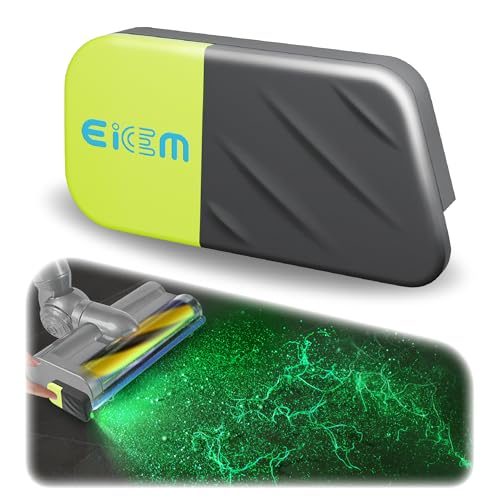
Worth naming the record that gets its own scope exactly right. An
EICEM green vacuum dust detection
light attachment clips to a vacuum head and rakes a low green beam across the floor so
fine debris casts a shadow. Its first drawback is four words long: "Adds visibility, not
suction."
That is the correct disclaimer and it points at a genuinely different failure. What a
raking light reveals is dust the nozzle did not pick up, which is an agitation and
sealing problem at the floor rather than a filtration problem inside the machine. A
bagless vacuum and a bagged one with the same head will leave the same debris behind, and
no amount of cyclone or filter changes that. Its record also notes that "Effectiveness also
drops in bright rooms where the beam contrast fades", which is the right caveat for a
device that works by shadow.
Two different complaints get tangled together in threads about bagless machines. One is
that it does not pick up, which is the head. One is that suction fades over a few weeks,
which is the filter area. The light diagnoses the first and this page is about the
second.
How to read the one figure the filter does publish
The 99.97 percent at 0.3 micrometres deserves a note, because it is a strong claim
stated in a format that invites misreading, and our own record already flags the right
caution: "performance claims such as the 99.97 percent capture figure are maker-stated, not
independently measured here."
The deeper point is about what the number is a statement of. Our page on
why two 5 micron filters are
not the same filter works through the general problem properly, that a single micron
number can describe a nominal average or an absolute ceiling and the two differ by an order
of magnitude in what gets through. It is written about water and the argument is identical
in air: a rating is a pair of numbers, an efficiency and a size, and quoting one without the
other is not a specification.
The Eureka figure does quote both, which puts it ahead of most, and 0.3 micrometres is
chosen because it is close to the hardest size for a fibrous filter to catch, so efficiency
at 0.3 is a genuine worst case rather than a flattering one. What the record still does not
give is the area it applies over, which is where this page started.
The honest limit, and the thing that actually decides it
What is exact here is the structure of the cut diameter expression and every ratio
inside it. The cut diameter goes as the square root of the inlet width and inversely as the
square root of the velocity and the turns, so the three points in the first panel are
exactly ordered whatever the inputs are, and a bigger cyclone is exactly and always worse
at fine dust. The 6.8 ratio in the third panel is also exact, because it is two published
cup volumes divided by one shared filter area.
What is representative is nearly everything geometric, and the list is long because the
category publishes so little. No vacuum we carry publishes a filter area, an airflow, an
inlet width, an impeller diameter or a clean filter pressure drop. So the 8, 25 and 4
millimetre inlets, the 15 to 25 metres a second, the five effective turns, the 0.19 and
0.04 square metres of media, the 0.02 cubic metres a second of airflow, the 200 kilogram
bulk density and the 2 percent fines fraction are all assumptions.
They move the answer in a convenient direction, which is worth saying. Halve the assumed
turns and every cut diameter rises by 1.41 times together, pushing all three further above
the filter's 0.3 micrometre rating rather than toward it. Change the fines fraction and the
third panel scales as a block without the 6.8 moving. Narrow the inlet to one millimetre,
which no cyclone is actually built with, and the handheld's cut still only falls to 0.36
micrometres, which is still above 0.3. There is no plausible set of inputs on which a
cyclone reaches down to the size its filter is specified at, and that is the one conclusion
this page would defend against any objection.
What it deliberately does not compute is how much suction any specific machine loses as
its filter loads, and the refusal is the finding rather than a gap in the method. That
calculation needs a filter area and an airflow, two numbers absent from every listing in
the category, and a fan curve, which is absent from every listing in every category. Our
roundups of
cordless vacuums and
dust extractors run into the same silence from the
other direction.
Which leaves the practical version, and it follows straight from the area ratio rather
than from any product. The reason bagless machines draw complaints is that they hand the
owner a maintenance job the bagged design did away with, and the job is on a fifth of the
area so it comes due five times as often. If you own one, the useful habit is not emptying
the cup more often, which only changes how much dust is in the cup. It is washing the
filter on the cup's schedule rather than when the suction has already gone, and owning the
second filter so the first one can dry properly. One of the two handhelds here ships that
second filter. The other tells you to dry the only one you have, which is the same advice
with a gap in the middle of it.
Why a Bag Is the Filter and a Cyclone Is Not at a glance
EICEM Green Vacuum Dust Detection Light Attachment
spotting hidden dust and pet hair while vacuuming
Reveals hidden dust and pet hair
Adds visibility, not suction
Why you can trust this guide
We compared these picks using verified manufacturer specifications, current retailer listings, and patterns in owner feedback, alongside editorial research. We focus on measurable differences such as performance, capacity, usability, and build quality. Pickpedia does not present editorial research as laboratory testing, and we do not claim hands-on testing unless it was actually performed.
Best for Eureka PowerSpeed owners restoring lost suction
8.6/ 10 Pickpedia editorial score
This replacement kit fits Eureka PowerSpeed uprights and swaps out part E0202. The set brings two foam filters, two felt filters and a cleaning brush. H13 media is stated to capture 99.97 percent of particles down to 0.3 microns, while an activated carbon layer targets odors. Foam and felt pieces rinse under clean water and air dry for repeated use. Installation needs no tools.
Filtration gradeH13
Particle capture99.97% at 0.3 microns (stated)
Odor controlActivated carbon layer
Foam filters2
Felt filters2
Cleaning brush1
Replaces partE0202
ReusableWashable foam and felt
Pros
Fits a wide range of Eureka PowerSpeed NEU models
Washable foam and felt allow repeated reuse
H13 media targets fine dust and pollen
Activated carbon layer helps cut odors
Bundled brush makes cleaning simple
Installs in seconds with no tools
Cons
Filtration figures are maker-stated, not lab-checked
Best for Powerful spot cleaning of car interiors and small spaces
8.6/ 10 Pickpedia editorial score
A powerful cordless handheld car vacuum rated at 25000 pascals of suction from a 24 volt motor, strong enough to lift embedded dust, crumbs, sand and pet hair from seats, mats and crevices. It runs about 32 minutes on a removable 4000mAh battery that charges in around 2 hours by USB, uses a washable, reusable filter and a larger 100ml dust cup, and adds a two-in-one blowing function for clearing tight corners. A strong, low-maintenance handheld for cars and small spaces, understood as a spot-cleaning tool rather than a whole-home vacuum, with the maker noting real power means real noise.
BrandRunful
Suction25000 Pa (stated)
Motor24V max, 1000rpm
Battery4000mAh, removable
RuntimeAbout 32 minutes
ChargingAbout 2h by USB (cable only)
Dust cup100 ml, washable filter
Function2-in-1 suction and blow
Pros
Strong stated 25000Pa suction lifts embedded dust and pet hair
Removable 4000mAh battery gives about 32 minutes, swap for a spare
Washable, reusable filter saves money and hassle
Larger 100ml dust cup means fewer stops to empty
Two-in-one blow function clears tight vents and corners
Compact, cordless and backed by a stated two-year warranty
Cons
Genuine power means it is noisy, and built for short bursts not long use
Handheld runtime and 100ml cup suit cars, not whole-home cleaning
Package includes the USB cable but not a wall charging plug
Washable filter must be dried fully before refitting
Best for Car interiors and pet hair, where a long warranty matters more than a spec sheet
8.6/ 10 Pickpedia editorial score
A cordless handheld car vacuum with an 80,000 RPM brushless motor, a 7800mAh battery quoted at up to 30 minutes in Eco mode, a 680ml dust cup, two washable filters, an LED headlight and a 5 year warranty.
BrandVACDRIVE
ModelDW688
MotorBrushless, 80,000 RPM
Battery7800mAh
ChargingUSB-C
RuntimeUp to 30 minutes in Eco mode
ModesEco and Max
Dust cup680ml
Filters2 washable
LightBuilt-in LED headlight
Attachments2-in-1 nozzle brush, wide brush nozzle
Weight2 lb
Dimensions16.14 x 4.32 x 4.25 in
ColourWhite and black
Suction ratingNot published
Warranty5 years
Pros
5 year warranty, longer than this category usually offers
80,000 RPM brushless motor, so suction should not fade with age
680ml dust cup, up to three times larger than typical mini handhelds
Two washable filters so one can dry while the other is used
Gravity flap for emptying without reaching inside
Built-in LED headlight for dark footwells and under seats
2-in-1 nozzle brush plus a wide brush nozzle included
USB-C charging with no base station needed
Cons
No suction figure published in pascals or any other unit
Max mode runtime is not stated, only Eco mode
At 16.14 inches with the nozzle fitted it is not a glovebox tool
Sized for interiors and crevices, not whole-house cleaning
Best for spotting hidden dust and pet hair while vacuuming
8.0/ 10 Pickpedia editorial score
This is the EICEM vacuum dust detection light, a universal green attachment that highlights hidden dust and pet hair as you clean. The maker states it mounts on the right side of your vacuum head with two included bases for easy switching. It fits upright, stick, and canister vacuums from brands like Dyson, Shark, Bissell, Tineco, Eureka, and more.