Home ›
Home & Kitchen › Why Two 5 Micron Filters Are Not the Same Filter
Home & Kitchen
Why Two 5 Micron Filters Are Not the Same Filter
PBy the Pickpedia Team·4 picks compared·Last verified October 2026
Affiliate disclosure: As an Amazon Associate, Pickpedia earns from qualifying purchases. Links on this page are paid links, and we may earn a commission at no extra cost to you. This never affects our picks or scores.
This page contains affiliate links. If you buy through one we may earn a
commission, at no cost to you.
Before the number, the convention. A micron rating on its own is not a
specification, because there are two standard ways of arriving at one and they can
differ by a factor of four on the same piece of media. A nominal rating names the
size at which the filter catches most of what arrives, where most is often defined
somewhere between 60 and 85 percent and is frequently not defined at all. An
absolute rating names the size at which it catches essentially everything. The same
cartridge can therefore be sold as a 5 micron filter or as a 20 micron filter, both
honestly, and the label is not obliged to say which convention produced the
number.
One note before going further. This page is about ratings, flow and pressure drop.
It makes no claim about what any filter removes from water, about any contaminant, or
about health, and nothing here should be read as one.
The curve, and the two points people pick off it
A real filter does not have a cutoff. It has a retention curve: it catches almost
nothing far below its working size, rises steeply through a transition band, and
approaches total capture without ever quite getting there. Picking a single number to
print means picking a point on that curve, and the industry has two habits about
where to pick.
The curve is the filter. The number is a point somebody chose on it, and the
convention that chose it is the part that does not get printed.
The formal way to write it is the beta ratio, which is the number of particles
of a given size going in divided by the number coming out. Efficiency is one minus
one over beta, which makes the arithmetic easy. Beta 2 is 50 percent. Beta 20 is 95
percent. Beta 75 is 98.7 percent, the older absolute convention. Beta 1000 is 99.9
percent, the modern one.
Now put real counts through it. Send ten thousand particles of the rated size at a
filter sitting at a nominal 85 percent and about fifteen hundred come out the far
side. Send the same ten thousand at the absolute point and about ten do. That is a
hundred and fiftyfold difference in what gets through, produced by two numbers that
read identically on a box. And it gets worse at the bottom of the nominal range: a
filter quoted nominal at 60 percent is letting four thousand of your ten thousand
straight past the size it is named after.
Which is the real answer to the original question about an air compressor intake.
Ten micron nominal is the usual general purpose answer, and the reason it is
sufficient is not that ten micrometres is a magic size. It is that intake air is
being protected against the particles that score a cylinder, those are mostly well
above ten micrometres, and a nominal rating catching most of them is plenty while
costing the compressor very little in breathing. Specify absolute there and you would
be paying for retention you do not need in the currency the next section is
about.
What a finer filter costs, which is flow
Flow through a porous medium follows Darcy's law: the rate is the permeability
times the area times the pressure difference, divided by the fluid viscosity and the
thickness. Three of those are things a designer sets. The fourth, permeability, is
set by the pore size, and the Kozeny Carman relation says it goes as the square of
that size at a given porosity.
The square is the whole problem. Halve the pore size and you quarter the
permeability. Go from a 20 micrometre working point to a 5 micrometre one, a factor of
four in size, and permeability falls by sixteen. At the same supply pressure, through
the same housing, you get a sixteenth of the flow.
There are only three ways out and all are visible on products. Raise the area,
which is what pleating does and why a pleated cartridge can carry ten to twenty times
the media of a plain wound one in the same tube. Reduce the thickness, which lowers
resistance and also lowers the depth available to hold dirt. Or raise the pressure,
which a mains supply will not do for you. In a fixed housing with a fixed supply, a
finer filter simply passes less water. That is not a defect. It is the
arithmetic.
Where the adjective sits instead of the number
Our
Pousbo faucet filter
cartridge kit, a 50 pack of bag style mesh pouches publishes its filter media as
a dense polyester mesh pouch. Dense is doing the work a micron rating would do, and
it is not a quantity: it could describe anything from a coarse strainer to something
that will slow your tap to a dribble.
The listing also publishes something that is the pressure drop in disguise, under
the heading softens the splash: the bag structure breaks up the stream to reduce
scattered droplets at the sink. A stream that arrives softer than it did before is a
stream that has lost energy on the way through, and the energy it lost is the
pressure drop across the mesh. The feature and the cost are the same physical fact
described twice, once as a benefit. Our record's drawback line says the mesh needs
regular replacing to stay effective, without a replacement interval or a capacity,
which brings us to the next section. Record in the
Pousbo faucet filter
cartridge kit review.
Why capacity belongs in gallons and almost never is
A filter does not wear out. It fills up. Captured particles sit in and across the
pores and progressively narrow them, which has two consequences that surprise people
in opposite directions. The first is that a loading filter gets finer as it ages, so
its retention improves over its life, right up until the end. The second is that
permeability is falling the whole time, by the same square law, so the flow collapses
long before the retention does.
That makes capacity a cumulative quantity. It is a number of gallons, or a number
of hours at a stated flow, because what kills the filter is the total mass of
material it has caught. It is not a number of months, because a month is not a
quantity of water.
Our
AQUA CREST RV inline hose
filter publishes both halves of that and lets you see the gap. It states a flow
rate of 0.5 gallons per minute and a service life of about three months. Multiply
them out at the rated flow and three months is 0.5 times 60 times 24 times 90, which
is 64,800 gallons, and nobody means that. So the three months is assuming an unstated
duty. At thirty gallons a day it is 2,700 gallons. At a weekend use pattern of thirty
gallons a fortnight it is about 190. Those two owners have the same filter, the same
label and the same three months on it, and they are a factor of fourteen apart in what
they have put through it. One is replacing a filter that still has most of its
capacity left and the other is long past it, and the label cannot tell them apart.
The 0.5 gallons per minute is worth sitting with on its own, because it is the
pressure drop argument made concrete and our own record flags it as a drawback. A
standard three quarter inch garden hose at household pressure delivers something in
the region of eight to seventeen gallons a minute. Fitting an inline filter rated at
half a gallon a minute therefore cuts the flow by roughly twenty times. A five gallon
bucket that fills in half a minute from the bare hose takes ten minutes through the
filter. That is the entire trade in one line: filtration is bought with flow, and the
listing publishes what it took. Record in the
AQUA CREST RV inline filter
review, and the category is in
best whole house water filters. What
that filter does or does not remove is outside the scope of this page and we make no
claim about it.
A screen is a different kind of filter, and the geometry is exact
Everything above is about depth media, where particles are caught throughout a
thickness. A woven screen is the other family: a single plane with holes in it, and
because the geometry is simple the arithmetic is exact rather than approximate.
For a square weave with aperture a and wire diameter w, the open area fraction is
a squared over the quantity a plus w, squared. A 200 micrometre aperture woven with
100 micrometre wire is 200 squared over 300 squared, which is 44 percent open. Take
the aperture down to 50 micrometres on 50 micrometre wire and it is 50 squared over
100 squared, which is 25 percent. So the finer screen has barely half the open area
before you have even considered that each individual hole is more restrictive, and
for a thin plate the flow through each hole scales as the cube of its radius. Put the
two together and flow goes as aperture times open fraction: 200 times 0.44 is 88.9
against 50 times 0.25 is 12.5, so a screen four times finer passes about seven times
less at the same pressure.
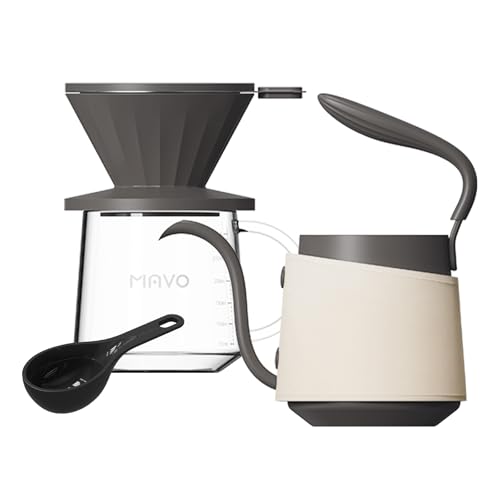
Which is exactly the trade in our
MAVO pour over coffee set
with a reusable stainless steel mesh filter. Our own record names the consequence
without the mechanism, listing as a drawback that the metal filter passes more oils
and sediment than paper. That is the aperture fact seen from the other side: a woven
or etched steel mesh has openings far larger than the pore structure of a paper
filter, so it passes more and it drains faster.
And draining faster is the part that catches people out, because it changes the
brew without changing anything you set. Swap paper for steel and keep the same grind
and the same pour, and the water spends less time in contact with the coffee, so you
will under extract and get something thin and sour while also getting more sediment
in the cup. Both effects are the same hole size. The two levers that fix it cost
nothing: grind finer, which slows the bed, or pour more slowly, which extends the
contact time directly. Record in the
MAVO pour over
coffee set review, and there is more on mesh and separation in
best yogurt strainers.
One product called a filter that is not filtering at all
Our
washing machine hair and
lint filter mesh bags, a three pack are worth including precisely because no
micron rating could describe them. The listing is clear about the mechanism: a
sticky, reusable surface with raised nubs that loose hair clings to. That is
adhesion, not sieving. Nothing is being passed through anything, so there is no pore,
no retention curve and no pressure drop.
It also means the failure mode is completely different. A sieve fails by clogging,
progressively, as the pores narrow. An adhesive collector fails by saturating: once
the nubs are covered, capture stops more or less abruptly, and rinsing restores it
fully rather than partially. Our record says it needs rinsing between loads to keep
working, and that is why. The word filter in the product name is doing marketing
work, and the specification you would actually want is a surface area, which is not
published either. Record in the
washing
machine lint filter bags review.
A word that means two unrelated things on this site
Worth flagging, since it comes up every time someone searches for it. In
filtration a micron is a micrometre, a unit of length. In vacuum and refrigeration
work a micron is a unit of pressure: one micrometre of mercury, which is a thousandth
of a torr, or about 0.133 pascals. Our
vacuum gauge kits comparison uses it in that
second sense, where a digital micron reading describes how deep a vacuum a system has
pulled, and a 500 micron target there is a pressure, not a particle. The two usages
share nothing but the word, and a search for micron rating will cheerfully mix
them.
The honest limit
Not one filter product on this site publishes a micron rating at all. Not the
faucet cartridges, not the inline hose filter, not the coffee mesh. So the practical
problem is not choosing between a nominal number and an absolute one, it is that the
number is usually missing entirely and replaced with an adjective: dense, fine,
high quality. When a number is present, assume it is nominal unless the word absolute
or a beta ratio appears next to it, because absolute is the expensive claim and
makers who have earned it say so.
Which leaves the free moves, and for filtration they are unusually effective.
Judge by flow, not by the label, because flow is the one thing you can measure
without any equipment. Time a container filling, write the number down the day you
fit the filter, and time it again later. Flow falling is the filter telling you its
remaining capacity directly, which is more honest than any interval on a box and
accounts for your water and your usage rather than an average household's. A filter
that has lost half its flow has lost far more than half its remaining life, because
the loading accelerates as the pores narrow.
Fit the coarsest thing that does the job, and stage it if you need fine. Two
filters in series, a coarse one first and a fine one after, is not an extravagance:
the coarse one takes the bulk of the loading, which is most of the mass, and the fine
one then lasts far longer than it would on its own. Cost aside, this is the only
arrangement that does not force you to choose between flow and life.
And the free one that beats the purchase: give it more area. Most consumer
filtration problems are solved not by a finer medium but by a bigger one, because
area is linear in Darcy's law while pore size is squared. A larger housing, a pleated
element instead of a wound one, or simply two in parallel will give you the retention
you wanted at the flow you had. Buying finer and then complaining about the trickle
is the common mistake, and the arithmetic in this post says it was always going to
happen.
Why Two 5 Micron Filters Are Not the Same Filter at a glance
Washing Machine Hair and Lint Filter Mesh Bags (3 Pack)
Cutting hair and lint on laundry in top-load washers
Cuts loose hair and lint on laundry
A floating helper, not a plumbed-in filter
Why you can trust this guide
We compared these picks using verified manufacturer specifications, current retailer listings, and patterns in owner feedback, alongside editorial research. We focus on measurable differences such as performance, capacity, usability, and build quality. Pickpedia does not present editorial research as laboratory testing, and we do not claim hands-on testing unless it was actually performed.
Best for Reducing visible sediment and splash from a tap
8.4/ 10 Pickpedia editorial score
A 50-piece kit of bag-style faucet filters that catch rust, sand and sediment with a dense mesh pouch and soften the splash, for kitchen and bathroom taps.
Best for Better-tasting, odor-free hose water for RVs, campers and the garden
9.2/ 10 Pickpedia editorial score
An inline RV, camper and garden hose water filter using KDF and coconut-shell activated carbon to reduce chlorine, bad taste and odor, NSF certified against NSF/ANSI 42 and 372, with a 360-degree rotating hose protector, anti-rust copper heads, a 0.5 gpm flow rate, tool-free install on standard 3/4-inch GHT hoses, and a roughly three-month service life.
BrandAQUA CREST
TypeInline hose water filter
MediaKDF + coconut carbon
CertifiedNSF/ANSI 42 and 372
ReducesChlorine, taste, odor
Flow0.5 gpm
FitsStandard 3/4 in GHT hoses
LifeAbout 3 months
Pros
Noticeably reduces chlorine, bad taste and odor
NSF certified against NSF/ANSI 42 and 372 standards
Best for Making clean, flavourful pour over coffee without paper filters
8.8/ 10 Pickpedia editorial score
A complete pour over coffee set including a pour over kettle with a heat-resistant sleeve, a coffee dripper, a glass coffee server with a measurement scale and a reusable stainless steel mesh filter, made from food-grade steel and glass, for making pour over coffee without paper filters.
BrandMAVO
TypePour over coffee set
IncludesKettle, dripper, scaled server, filter
FilterReusable stainless steel mesh
MaterialsFood-grade steel and glass
KettlePour over, heat-resistant sleeve
ServerGlass with measurement scale
ColourGrey
Pros
Complete set, ready to brew
Reusable steel filter, no paper needed
Quality steel and glass, not plastic
Scaled glass server for consistency
Heat-resistant kettle sleeve for control
Great value for a full kit
Cons
Manual method, takes a little practice
Metal filter passes more oils and sediment than paper
Best for Cutting hair and lint on laundry in top-load washers
8.4/ 10 Pickpedia editorial score
A three-pack of reusable floating mesh bags with a sticky, raised-nub surface that collects loose hair and lint during a wash cycle, best suited to top-load washers and rinsed clean between loads.
TypeReusable floating laundry hair and lint catcher