Tools & DIY 5 Cyclone Dust Collectors for Woodworking Shops
P
By the Pickpedia Team
·5 picks compared
·Last verified September 2026
Affiliate disclosure: As an Amazon Associate, Pickpedia earns from qualifying purchases. Links on this page are paid links, and we may earn a commission at no extra cost to you. This never affects our picks or scores.
Quick answer
Pick a full cyclone unit like the JET or Laguna when you run stationary machines and want strong airflow with fine filtration. For a shop vacuum setup, a separator such as the Dustopper PRO, VEVOR, or Mullet keeps chips out of your filter and suction steady.
5 Cyclone Dust Collectors for Woodworking Shops at a glance
Why you can trust this guide
We compared these picks using verified manufacturer specifications, available manuals and documentation, current retailer listings, and patterns in owner feedback, alongside editorial research. We focus on measurable differences such as performance, capacity, usability, and build quality. Pickpedia does not present editorial research as laboratory testing, and we do not claim hands-on testing unless it was actually performed.
How we chose: We compared five cyclone dust collectors across separation design, filtration, drum capacity, and shop-vac compatibility.
Cyclone dust collectors spin heavy debris into a drum before air reaches the filter, so suction stays consistent and filters stay cleaner. That two-stage action matters whether you run a standalone collector or bolt a separator onto a shop vacuum.
This roundup splits into two camps. Full cyclone units handle table saws, planers, and jointers with real airflow, while compact separators pair with an existing vac for handheld tools and quick cleanup. We grounded every note below in each maker's stated features.
Our top picks
JET's JCDC-2 leans on two-stage separation to deliver more working airflow than comparable single-stage collectors, according to its specifications. A pleated filter captures particles down to 1 micron, and a double-paddle manual cleaner knocks dust loose without opening the housing. Heavy debris drops into a 30-gallon drum fitted with quick-release levers and independent casters, so emptying stays quick. A radio frequency remote works from up to 50 feet, letting you start it across the shop, and swivel casters ease repositioning. Buyers should note the 230V single-phase requirement, which means a suitable circuit is needed before setup.
Motor2 HP
Power230V single-phase
FiltrationDown to 1 micron, pleated
Drum30 gallon
Pros
- Two-stage design boosts working airflow
- Fine pleated filtration reaches 1 micron
- Remote start works up to 50 feet away
Cons
- Needs a 230V single-phase circuit
- Large footprint for smaller shops
Check price on Amazon ›
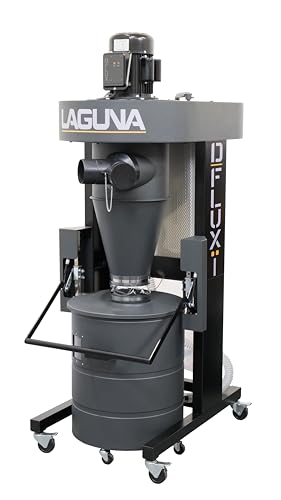
Laguna's D|flux I runs on a common 110V outlet, so many hobbyists can plug in without wiring changes. A computer-balanced, non-sparking aluminum impeller aims for smooth, safer airflow, while a magnetic starter with thermal overload protection guards the 1.5HP motor. The negative pressure bag retention system holds the collection bag firmly, and a magnetic quick-connect hose speeds hookups. Emptying is helped by a quick-release drum lid with air-strut assistance, which lifts and holds so you keep both hands free. Compared with the larger 230V units here, its 1.5HP motor suits lighter single-machine use rather than several running at once.
Motor1.5 HP
Power110V
ImpellerBalanced non-sparking aluminum
StarterMagnetic, thermal overload
Pros
- Runs on a standard 110V outlet
- Air-strut lid assist eases emptying
- Magnetic quick-connect hose speeds setup
Cons
- 1.5HP suits lighter single-machine loads
- Bag retention needs a proper seal to work well
Check price on Amazon ›
The Dustopper PRO focuses on separation rather than raw airflow, since too much CFM can create eddies that hurt capture. Third-party testing by Aerodyne Environmental, published on the maker's site, found it consistently outperformed other low-profile separators across fine sawdust, coarse sawdust, and drywall powder. A preinstalled hollow-core EPDM gasket seals to any standard 5-gallon pail, so there is no assembly, and two patented high-flow sweep elbows reduce turbulence in your ductwork. It is made in the USA. Keep in mind you must supply your own pail and vacuum, since the unit is a separator, not a complete collector.
TypeCyclone separator
FitsStandard 5-gallon pail
GasketPreinstalled hollow-core EPDM
IncludedTwo high-flow sweep elbows
Pros
- Third-party tested separation performance
- Preinstalled gasket seals without assembly
- Two sweep elbows cut ductwork turbulence
Cons
- Requires your own pail and vacuum
- Not a standalone collector
Check price on Amazon ›
VEVOR's separator pairs a transparent housing with a 13.21-gallon metal barrel, so you can watch dust collect and empty before it overflows. A stated separation rate up to 99.61% reduces how often you swap vacuum filters, per its listing. The inlet and outlet suit 4-inch commercial hoses, and a 1.97-inch adapter lets you connect standard 2-inch household vacuum hoses instead. Four casters make the barrel easy to roll, and the kit ships with multiple attachments and a wrench for setup. Reviewers note assembly and hose fitting take some patience, and the metal barrel adds weight compared with plastic-pail separators here.
Separation rateUp to 99.61%
Barrel13.21 gallon metal
Hose4-inch, 2-inch adapter
MobilityFour casters
Pros
- Transparent housing shows fill level
- Large 13.21-gallon metal barrel
- Adapts between 4-inch and 2-inch hoses
Cons
- Assembly takes some patience
- Metal barrel is heavier than plastic pails
Check price on Amazon ›
The Mullet uses a parabolic, seamless one-piece body to spin air faster, which its maker says drops over 99% of debris before it reaches your vacuum. That keeps suction strong and filters cleaner than straight-wall bucket assemblies. A rigid, cut-to-fit PVC connection replaces the usual mix of bolts, bungees, and duct tape, creating one airtight link. Included hose adapters connect to virtually all wet-dry shop vacuums and extractors regardless of size or brand. It is made in Dripping Springs, Texas. As a separator it relies on your own bucket and vacuum, and the cut-to-fit PVC step means a little trimming during install.
TypeHigh-speed cyclone separator
SeparationOver 99% of debris
ConstructionSeamless one-piece parabolic
FitUniversal vac adapters
Pros
- Parabolic body spins air for strong capture
- Airtight PVC connection, no makeshift rigging
- Adapters fit nearly any shop vacuum
Cons
- Needs your own bucket and vacuum
- Cut-to-fit PVC requires trimming at install
Check price on Amazon ›
What to look for
Full collector or separator
A standalone cyclone collector brings its own motor and impeller for stationary machines like saws and planers. A separator adds a cyclone stage to a shop vacuum you already own, catching debris before it clogs the filter. Match the type to how you actually cut and clean.
Airflow and separation
Airflow moves dust through the system, but separation determines how much lands in the drum instead of the filter. Some makers deliberately tune for separation over raw airflow, since excess turbulence can lower capture. Read both figures together rather than chasing one number.
Filtration and fine dust
Fine particles pose the biggest health concern, so pleated filters that reach around 1 micron matter for enclosed shops. Separators cut how much dust hits any downstream filter, which extends its life. Owners report cleaner air when a cyclone stage handles the heavy load first.
Power and mobility
Check the outlet you have before buying, since some collectors need a 230V single-phase circuit while others run on standard 110V. Casters, drum capacity, and quick-release lids affect how easily you empty and move the unit. These small details shape daily use more than headline specs.
Frequently asked questions
Do I need a full collector or just a separator?
If you run stationary machines like a table saw or planer, a full cyclone collector supplies the airflow they need. For handheld tools and cleanup with a shop vacuum, a separator such as the Dustopper PRO or Mullet is enough.
Will a cyclone stop my vacuum filter from clogging?
Yes, that is its main job. A cyclone spins heavy debris into a drum or pail first, so far less reaches the filter. Makers here report separating well over 99% of debris, which keeps suction steady.
What outlet does a cyclone collector need?
It varies. The Laguna D|flux I runs on a standard 110V outlet, while the JET JCDC-2 needs a 230V single-phase circuit. Confirm your wiring before you buy a larger unit.
How fine of dust do these capture?
Full collectors like the JET use pleated filters that reach down to 1 micron, targeting the fine particles that stay airborne. Separators focus on removing the bulk of debris before it reaches your vacuum's own filter.
Can a separator connect to any shop vacuum?
Most are designed to. The Mullet includes adapters for virtually all wet-dry shop vacuums, and the VEVOR ships with an adapter to fit both 4-inch and 2-inch hoses. Check your hose diameter first.
How big should the collection drum be?
Bigger drums mean fewer trips to empty. The JET uses a 30-gallon drum, the VEVOR a 13.21-gallon barrel, and pail-based separators typically fit a standard 5-gallon bucket. Match capacity to how much debris you generate.
Are these hard to assemble?
Separators are generally simpler, and the Dustopper PRO arrives with its gasket preinstalled. The Mullet uses a cut-to-fit PVC connection that needs light trimming, and reviewers note the VEVOR takes some patience to fit together.
Do cyclone separators help my filter last longer?
They do. By catching the bulk of dust before it reaches the vacuum, a separator lets filters and bags go much longer between changes. Owners point to this as a main reason to add a cyclone stage.
The verdict
JET Cyclone Dust Collector, 2-Micron Filte...
9.3/10
For a full shop that runs stationary machines, the JET JCDC-2 is our top pick thanks to two-stage airflow, 1-micron filtration, and a roomy 30-gallon drum. Home shops on a standard outlet should look at the Laguna D|flux I. If you already own a shop vacuum, the Dustopper PRO wins on tested separation, the Mullet fits nearly any vac, and the VEVOR adds a see-through housing with a larger barrel.
Check price on Amazon ›
Our top pick, secure checkout via Amazon
Note: Availability and specifications change often. Always confirm the current details on Amazon before buying.