Home ›
Pressure Cookers › Why 5 Kilograms of Meat Needs a 12 Litre Pressure Cooker
Pressure Cookers
Why 5 Kilograms of Meat Needs a 12 Litre Pressure Cooker
PBy the Pickpedia Team·7 picks compared·Last verified October 2026
Affiliate disclosure: As an Amazon Associate, Pickpedia earns from qualifying purchases. Links on this page are paid links, and we may earn a commission at no extra cost to you. This never affects our picks or scores.
This page contains affiliate links. If you buy through one we may earn a
commission, at no cost to you.
Neither, probably. If the meat goes in as one whole joint, 8 litres works and 7 does not. If
it goes in as chunks under braising liquid, the same 5 kilograms needs about 12 litres, and the
reason is the step everyone skips: a cooker's capacity converts into a quantity of food through
three numbers, not one, and the third is a packing fraction that depends on how you cut it.
The counterintuitive result is the one worth carrying away.
Cutting the meat into pieces makes it need a bigger pressure cooker, not a smaller
one.
Three conversions, and only one of them is a density
Start with mass to volume, which is the easy part. Lean muscle runs around 1,060 kilograms per
cubic metre and fat around 900, so a representative boneless cut at 1,050 makes 5 kilograms into
4.762 litres of actual material.
Bone goes the other way from what people expect. Bone is denser than meat, somewhere between
1,800 and 2,000, so a bone-in cut of the same mass takes up less room rather than more. Twenty
percent bone by mass gives 1 kilogram at 1,900, which is 0.526 litres, plus 4 kilograms of meat
at 1,050, which is 3.810, for a total of 4.336 litres. That is 8.9 percent more
compact for the identical weight. The bone costs you on the plate and saves you in the
pot.
Second conversion: the fill line. A pressure cooker is filled to two thirds for ordinary food
and one half for anything that foams, which means beans, grains, pasta, split peas and oats.
That instruction appears in the manual of every cooker ever made and on the listing of none of
the seven in this catalogue.
Apply it. Two thirds of 7 litres is 4.667 litres of usable space, and 4.762 litres of meat is
102.0 percent of it. The 7 litre cooker is over the line before a drop of water
goes in. Two thirds of 8 litres is 5.333, so the same meat is 89.3 percent and leaves 0.571
litres, which is 2.41 US cups, for liquid. That is enough: our page on
why a pressure cooker's minimum
liquid is not steam works out exactly what that cup of water is for, and the answer is not
making steam, which turns out to need under five grams.
So on two conversions the answer is 8 litres, barely. Then comes the third.
The packing fraction, which reverses the intuition
A pile of irregular solid chunks does not fill the space it occupies. Random loose packing of
irregular pieces runs around 0.60, so the same 4.762 litres of meat, cut into stewing pieces,
occupies 7.937 litres of apparent bed volume.
And the 40 percent that is not meat, 3.175 litres of gaps between the pieces, does not stay
empty in a braise. It fills with liquid. Liquid counts against the same fill line that the meat
does, because the line is about total contents and not about which ingredient they are.
Total 7.937 litres, against the 8 litre cooker's 5.333 litre line, is
148.8 percent. Half as much again as the pot allows. To get it under the line
you need 7.937 divided by two thirds, which is 11.90 litres.
That is why the answer changes with the knife. A whole joint displaces its own 4.762 litres
and sits in a puddle. The same joint in eight pieces creates three litres of void that you then
fill with stock, and the cooker has to hold both. The meat did not get bigger. The dish did.
Every conversion here is arithmetic once a density and a fill fraction are granted. The pot
geometry, 212.8 millimetres across by 159.6 deep for 6 US quarts, is taken from our own page on
pressure cooker shape so the two agree. The published inputs are 6.5 quarts with a 4 pound
chicken or 5 pound roast and the admission that rice times exclude pressure build and release on
the Ninja; 6 quarts and up to 6 servings on both Instant Pot 6 quart models, with 1200 watts and
a 120 volt supply on the Pro; 3 quarts, 700 watts and a small chicken on the Mini; 6 quarts, 13
modes, a half inch widened pot gap and the admission that neither pressure nor wattage is stated
on the Cosori; 6 quarts, a stainless rack and a 12 year warranty on the Presto; and 6.3 quarts, a
steam basket, induction compatibility and two programs on the T-Fal. Representative rather than
published: the 1,050 kilograms per cubic metre for boneless meat and 1,900 for bone, the 0.60
random loose packing fraction for irregular chunks, the two thirds and one half fill fractions,
which are the standard instruction and appear on none of these listings, the half litre of
braising liquid, the 1.2 kilogram small chicken, the 230 by 150 by 120 millimetre trussed bird,
and the 150 to 250 grams of meat a serving. Change the density and every litre moves with it
while the ratio between the whole and the chunked case, which is the point of the page, stays at
1.667 exactly.
The one mass claim in the catalogue, and it survives
A
Ninja HyperHeat 9-in-1 pressure
cooker publishes nine functions, a 6.5 quart PFAS-free ceramic nonstick pot, pressure
cooking, slow cooking, sous vide, steaming, searing and yogurt, white rice in as little as 8
minutes and quinoa in as little as 5, and one line that no other product in this category offers:
"6.5-qt capacity fits a 4-lb chicken or 5-lb roast."
That is a mass claim, which makes it the only capacity statement here that can be checked.
Check it.
Six and a half US quarts is 6.151 litres, and two thirds of that is 4.101. The 5 pound roast
is 2.268 kilograms, which at 1,050 is 2.160 litres of meat. Add a representative half litre of
braising liquid and the total is 2.660 litres, which is 64.9 percent of the
line.
The 4 pound chicken is lighter at 1.814 kilograms, but a whole bird is not solid meat. Its
body cavity is air, so a trussed chicken roughly 230 by 150 by 120 millimetres is about 2.168
litres of apparent volume, giving it an apparent density of only 837 kilograms per cubic metre.
Add the same half litre and the total is 2.668 litres, which is 65.1 percent of
the line.
Those two numbers are within three tenths of a percent of each other. A heavier roast and a
lighter chicken arrive at the same point on the fill line, because the chicken's lower density
exactly offsets its lower mass. That is not a coincidence and it is good evidence somebody
calculated the pair rather than estimating them, which is more than can be said for most capacity
claims in this aisle. Full record in our
review of the Ninja HyperHeat.
Now scale it. If 6.151 litres holds 2.268 kilograms at 65 percent of the line, then 5
kilograms at the same margin needs 6.151 times 5 divided by 2.268, which is
13.56 litres. Running the chicken instead gives 16.95, and the difference between
those two is simply that a bird is less dense than a roast.
So three honest routes give three answers, and the spread is the useful information. Eight
litres if the joint goes in whole and you use the line right up to it. Eleven point nine if you
cut it into chunks and braise. Thirteen and a half if you want the same third of the pot in hand
that the one maker who publishes a checkable number keeps. The question offered 7 or 8, and the
only version where 8 is right is the whole joint.
A serving is not a volume
An
Instant Pot Duo 6 Qt 7-in-1 electric
pressure cooker publishes seven functions, 13 smart programs, an 18/8 stainless inner pot
with a tri-ply bottom, a pressure release valve and a locking mechanism, and a capacity claim of
"6-quart capacity fits up to 6 servings".
An
Instant Pot Pro 6 Qt 10-in-1 electric
pressure cooker publishes ten functions, 28 smart programs, 1200 watts, a
120 volt 60 hertz supply, UL and ULC listing, and the same claim: "6-quart capacity for up to 6
servings".
Six servings of what? At 150 grams of meat a serving, six servings is 0.9 kilograms, which is
0.857 litres, or 16.1 percent of the two-thirds line. At 250 grams a serving it
is 1.5 kilograms, 1.429 litres, or 26.8 percent. So the claim uses somewhere between a sixth and
a quarter of the usable volume, and the rest of what fills the pot is liquid, vegetables and
whatever else goes in a stew.
Which is to say the serving figure is probably right and it is not a capacity. A serving is a
portion decision, not a volume, and nothing on either listing converts between the two. The same
trap in the other direction is the subject of our page on
why a kitchen scale beats
measuring cups, where the problem is a volume standing in for a mass. Here it is a count
standing in for a volume, and the fix is the same: weigh the thing.
The 1200 watts on the Pro is the figure that has done real work on this site, because it is
what our minimum liquid page uses to turn the problem into a clock, finding that a litre of water
and an empty pot is 470.6 kilojoules and 7.69 minutes of preheating, and that each extra cup is
94 seconds. This page takes those as settled rather than recomputing them.
And it is worth setting the Ninja's honest caveat beside them: "Rice and grain times exclude
pressure build/release." White rice in 8 minutes is a true statement about the cooking stage and
a misleading one about the kitchen, because the preheat is the larger half. That drawback line is
the most useful sentence on any of these seven listings.
The third of the pot you are told never to use
Our page on
why a pressure cooker is tall and
its pot is not works the 6 quart pot out as a cylinder 212.8 millimetres across and 159.6
deep. Put the two-thirds line on that and it sits 106.4 millimetres up a
160 millimetre pot.
The 53 millimetres above it is not wasted space. It is where the steam sits, where foam has
room to rise without blocking the vent, and where the lid's internal clearance lives. It is
mandatory headroom. But it is also advertised capacity, and on a 6 quart cooker it is
1.893 litres you are instructed not to fill.
Across the seven cookers in this catalogue the published capacities total 39.8 quarts. One
third of that is 13.27 quarts, which is 12.56 litres of collective capacity
nobody should ever use. That is not a scandal; it is how the appliance works. It is just the
reason a 6 quart cooker is a 4 quart cooker, and the reason comparing two cookers on their
headline figure compares the wrong number by a factor of 1.5.
An
Instant Pot Duo 7-in-1 Mini electric
pressure cooker shows what that does at the small end. It publishes 3 quarts, 700 watts,
seven functions, 11 smart programs, a stainless inner pot with a tri-ply bottom, UL and ULC
listing, a recipe app, and the claim that its "3-quart capacity still holds a small chicken".
Three US quarts is 2.839 litres, so the line is at 1.893. A small chicken of 1.2 kilograms at
the apparent 837 kilograms per cubic metre worked out above is 1.434 litres, which is
75.8 percent of the line, leaving 0.459 litres, or 1.9 cups, for liquid. True,
then, and used right up to the edge.
Compare that with the Ninja's 65 percent and you have two makers working to two different
conventions on the same unstated rule. Neither publishes the fill line, so neither reader can
tell that one claim has a third of the pot in hand and the other has a quarter.
Half an inch of hand room, priced in meat
A
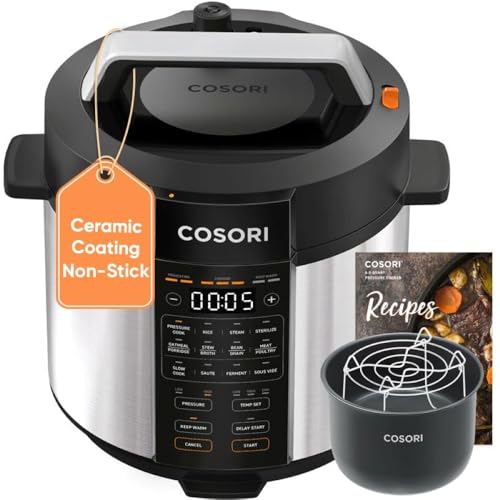
Cosori Pressure Cooker 6QT
publishes 13 cooking modes, a ceramic coated inner pot, a fingerprint resistant stainless
housing, double layer anti-scalding, overheat protection, 12 safety features, an angled steam
release, a seal and vent button placed away from the valve, sous vide and ferment modes, and one
detail that is unusual enough to be worth the algebra: "Widening the pot gap by 0.5 inches" to
make the rim easier to clean.
That half inch came from somewhere and the listing does not say where. If it came off the
pot, taking the 8.38 inch diameter down to 7.88 at the same depth, the volume falls by one minus
the square of 7.88 over 8.38, which is 11.6 percent. On a 6 quart cooker that is
0.70 of a quart, or 0.66 litres, which at 1,050 kilograms per cubic metre is
0.70 kilograms of meat.
If instead it came off the housing, the appliance is half an inch wider on the counter and the
pot is untouched. Those are the two ends of a genuine trade, and which one you got decides
whether the feature is free. The record is also right to flag what it cannot say at all: its own
drawbacks note "No explicit mention of pressure levels or wattage", which means the 13 modes
cannot be reasoned about from the listing in any way whatsoever.
Two stovetop cookers separated by 200 grams
A
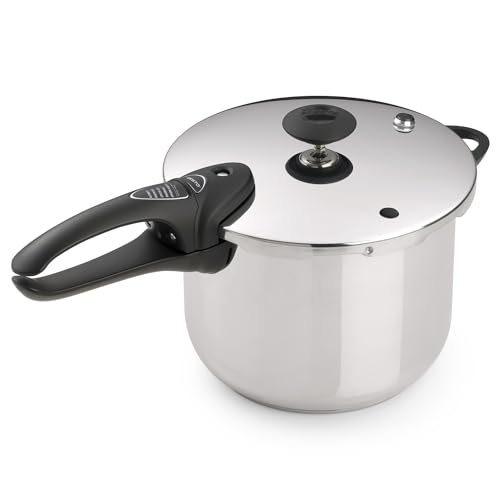
Presto 01365 6-quart stainless steel
pressure cooker publishes 6 quarts, stainless construction, a stainless steel rack, a 64 page
recipe book, full immersibility, dishwasher safety, a 12 year limited warranty and a claim of
cooking 3 to 10 times faster than traditional methods.
A
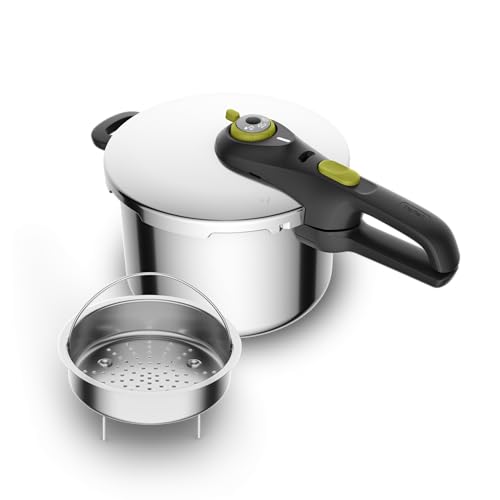
T-Fal Secure stainless steel stovetop
pressure cooker publishes 6.3 quarts, a 5 point safety system with an audible lock
confirmation, a rotating open and close mechanism, two cooking programs, a steam basket,
induction compatibility and a claim of up to 2 times faster.
Those two capacities differ by 0.3 of a quart. Put the fill line on it and the difference in
usable space is 0.2 of a quart, which is 0.189 litres, which is 0.199 kilograms of
meat. The entire capacity distinction between our two stovetop cookers is about seven
ounces of dinner, and it sits on the front of both listings as though it were a reason to choose
one.
And the T-Fal's steam basket lives on the same side of the line. A basket that holds food
above the liquid occupies volume inside the pot, and nothing publishes how much, so the 6.3
quarts is the capacity with the basket out. The Presto's stainless rack has the same property and
the same silence around it. Our roundup of
electric pressure cookers covers the category, and
the figure to take into it is not the quart number on the box but two thirds of it, minus whatever
accessory you intend to leave in.
What none of the seven publishes
Not one of these cookers publishes a maximum fill line. It is the single number that converts a
capacity into a quantity of food, it is printed inside the pot on most of them, and it does not
appear on any listing. Two publish a serving count, which is a portion rather than a volume. One
publishes a mass claim, and it is the only capacity statement in the category that can be
verified, which seems unlikely to be a coincidence.
Two publish a wattage and five do not, and one of those five says so in its own drawbacks.
None publishes an inner pot diameter or depth, which is why the pot geometry on this page had to
come from a sibling page that derived it from the capacity. None publishes the displaced volume
of an included rack or basket. And none states the stricter half-fill rule for foaming foods, even
on the models that advertise rice, bean and grain programs, where it is the rule that actually
applies: on a 6 quart cooker the half line is 2.839 litres, which at a one to three ratio of beans
to water is about 0.71 litres of dry beans.
The honest limit, and the three numbers to carry
What is exact here is every conversion once the inputs are granted. Mass divided by density is
a volume. A fill fraction times a capacity is a usable volume. A volume divided by a packing
fraction is a bed volume, and the voids are one minus the packing fraction. The ratio between the
whole joint case and the chunked case is exactly one over 0.60, which is 1.667, and it does not
depend on the density at all. The 0.3 percent agreement between the Ninja's two published claims
is arithmetic on its own numbers.
What is representative is the physical constants. The 1,050 kilograms per cubic metre for
boneless meat sets every litre figure on the page: a fattier cut nearer 1,000 makes 5 kilograms
into 5.0 litres and pushes the chunked answer to 12.5, while a very lean cut at 1,060 gives 4.717
and 11.79. The 0.60 packing fraction is the one that moves the answer most, and it is genuinely
uncertain: large even chunks pack nearer 0.64 and small ragged ones nearer 0.55, which spans 11.2
to 13.0 litres. The two thirds and one half fill fractions are the standard instruction and not a
product specification. The half litre of braising liquid, the 1.2 kilogram small chicken, the
trussed bird's dimensions and the 150 to 250 grams a serving are all in the same category.
What this page deliberately does not compute is three things. It does not give a cooking time
for 5 kilograms of anything, and that refusal is deliberate and inherited: the temperature
coefficient of the reactions that tenderise meat spans a factor of two to four per ten degrees,
which makes any such figure a range so wide it is not advice. It does not compute how long the
larger load takes to reach pressure, because that is energy divided by power and five of the
seven cookers here publish no power; what can be said from the two that do is that the
relationship is linear in the mass of contents and that our minimum liquid page has already
worked the per litre figure. And it does not say whether a 5 kilogram load cooks evenly, which
was the companion question in the vault, because that needs a thermal diffusivity through a bed
of meat and liquid and a convection pattern inside a sealed pot, and no listing could carry
either. What is safe to say is geometric: the centre of a 12 litre bed is further from the wall
than the centre of a 2 litre one, and the distance grows as the cube root of the volume, so going
from 2 to 12 litres puts the middle 1.82 times further in.
Three numbers to carry. A capacity is two thirds of what it says, so a 6 quart cooker is a 4
quart cooker and seven of them here hide 12.56 litres between them. Meat is about 1,050 kilograms
per cubic metre, so a kilogram is 0.952 litres and bone-in is more compact rather than less. And
a bed of chunks packs at about 0.60, so cutting meat up multiplies the pot you need by 1.667,
which is the whole reason the honest answer to a 5 kilogram question is nearer 12 litres than
8.
Why 5 Kilograms of Meat Needs a 12 Litre Pressure Cooker at a glance
Busy families who want quick, versatile meals without multiple appliances.
9-in-1 versatility replaces multiple appliances HyperHeat cooks up to 2x faster than traditional slow cooking 6.5-qt capacity fits a 4-lb chicken or 5-lb roast PFAS-free ceramic nonstick pot for easy cleanup Fast rice and grains: white rice in 8 minutes, quinoa in 5 minutes Space-saving design for everyday meals
Nonstick coating may wear over time Rice and grain times exclude pressure build/release No stainless steel pot option Some functions may require trial and error
Instant Pot Duo 6 Qt 7-in-1 Electric Pressure Cooker
Families and meal preppers who want a versatile, reliable multi-cooker.
7-in-1 functionality replaces multiple appliances Cooks up to 70% faster than slow cooking Stainless steel pot with tri-ply bottom for even heating and searing 6-quart capacity fits up to 6 servings 13 one-touch smart programs for convenience Easy to clean and maintain
Manual pressure release requires attention Interface is basic compared to newer models No Wi-Fi or app connectivity Slow cook function may not be as precise as dedicated slow cookers
Instant Pot Pro 6 Qt 10-in-1 Electric Pressure Cooker
Families and meal preppers who want a versatile, fast cooking appliance.
10 cooking functions in one device 28 one-touch smart programs Cooks up to 70% faster than slow methods 6-quart capacity for up to 6 servings 1200 watts for quick preheating UL and ULC listed for safety
Bulky and heavy, requires ample storage Many programs can be confusing initially Some functions (sterilize, yogurt) may be rarely used Not ideal for small households or singles
Instant Pot Duo 7-in-1 Mini Electric Pressure Cooker
Singles, couples, and small households
Seven cooking functions in one compact unit 11 one-touch smart programs for easy operation Cooks up to 70% faster than slow cooking Stainless steel inner pot with tri-ply bottom for even heating Includes free app with over 1900 recipes UL and ULC listed for safety
3-quart capacity is small for larger meals 700-watt power may heat slower than higher-watt models Slow cooker function is limited by small size No advanced features like Wi-Fi or Bluetooth
Small to medium households wanting a versatile, safe, and easy-to-clean multi-cooker.
13 cooking functions in one appliance Safety-focused design with angled steam release and 12 safety features Ceramic-coated inner pot is non-stick and dishwasher-safe Fingerprint-resistant stainless steel housing Widened pot gap for easier cleaning Includes sous vide and ferment modes, which are uncommon at this level
Ceramic coating is less durable than stainless steel 6-quart capacity may be small for large households No explicit mention of pressure levels or wattage; check listing for details Dishwasher-safe parts may still require hand washing to preserve ceramic coating
Home cooks who want fast, efficient stovetop cooking and don't mind manual control.
Cooks 3-10x faster than traditional methods Includes stainless steel rack and 64-page recipe book Fully immersible and dishwasher safe 12-year limited warranty Stainless steel construction is durable Simple, classic design
Stovetop only, requires manual heat adjustment No digital controls or preset programs May have a learning curve for beginners Takes up stovetop space
Home cooks who want a safe, stovetop pressure cooker for faster meals and meal prep.
Cooks up to 2x faster than conventional methods. 5-point security system with audible lock confirmation. Two simple cooking settings for vegetables and meat. Includes a steam basket for added versatility. Stainless steel construction is durable and induction compatible. 6.3 quart capacity suits family meals and meal prep.
Stovetop use requires monitoring and adjusting heat. Only two cooking programs, less versatility than multi-function electric models. No built-in timer or automatic shutoff. May be heavier and bulkier than some electric models.
Why you can trust this guide
We compared these picks using verified manufacturer specifications, current retailer listings, and patterns in owner feedback, alongside editorial research. We focus on measurable differences such as performance, capacity, usability, and build quality. Pickpedia does not present editorial research as laboratory testing, and we do not claim hands-on testing unless it was actually performed.
Best for Busy families who want quick, versatile meals without multiple appliances.
8.8/ 10 Pickpedia editorial score
The Ninja HyperHeat 9-in-1 Pressure Cooker combines multiple cooking functions in one appliance, promising faster cooking times with its HyperHeat technology. It has a 6.5-quart capacity, a PFAS-free ceramic nonstick pot, and can handle everything from pressure cooking to sous vide. While it excels at speed and versatility, its nonstick surface may be a concern for those who prefer stainless steel. It's a solid choice for families needing quick, everyday meals.
All-in-one Electric PressuReplace multiple appliances with one 9-in-1 multi co
Cook Up To 2x Faster*HyperHeat technology builds pressure quickly to spee
Family-sized 6.5 Qt CapaciCook for a crowd with a large-capacity pot that fits
Fast Rice And GrainsMake white rice in as little as 8 minutes or quinoa
Easy Cleanup, Pfas-free NoThe removable ceramic nonstick pot is made 100% PFAS
Pros
9-in-1 versatility replaces multiple appliances HyperHeat cooks up to 2x faster than traditional slow cooking 6.5-qt capacity fits a 4-lb chicken or 5-lb roast PFAS-free ceramic nonstick pot for easy cleanup Fast rice and grains: white rice in 8 minutes, quinoa in 5 minutes Space-saving design for everyday meals
Cons
Nonstick coating may wear over time Rice and grain times exclude pressure build/release No stainless steel pot option Some functions may require trial and error
Best for Families and meal preppers who want a versatile, reliable multi-cooker.
8.8/ 10 Pickpedia editorial score
The Instant Pot Duo 6 Qt is a popular multi-cooker that combines seven cooking functions into one appliance. It offers 13 smart programs for one-touch cooking, and its stainless steel pot is durable and good for searing. The 6-quart size suits families or meal preppers. However, it lacks some advanced features like Wi-Fi or a sous-vide mode, and its interface may feel basic to some.
7 Cooking FunctionsPressure cook, slow cook, sauté, steam, make rice, y
Customizable Smart ProgramTackle every recipe with 13 one-touch options, from
Good Food Done FasterCook up to 70% faster compared to slow cooking metho
Pro-Grade Cooking PotCrafted from stainless steel (18/8) with a tri-ply b
Family-Sized CapacityThe 6-quart capacity is perfect for up to 6 servings
Pros
7-in-1 functionality replaces multiple appliances Cooks up to 70% faster than slow cooking Stainless steel pot with tri-ply bottom for even heating and searing 6-quart capacity fits up to 6 servings 13 one-touch smart programs for convenience Easy to clean and maintain
Cons
Manual pressure release requires attention Interface is basic compared to newer models No Wi-Fi or app connectivity Slow cook function may not be as precise as dedicated slow cookers
Best for Families and meal preppers who want a versatile, fast cooking appliance.
8.8/ 10 Pickpedia editorial score
The Instant Pot Pro 6 Qt is a multi-functional electric pressure cooker with 10 cooking functions and 28 smart programs, making it a strong contender for family meals. It promises faster preheating and cooking compared to slow methods, and its 6-quart capacity suits up to six servings. While it excels in versatility, its size and feature set may be overkill for small households or beginners.
10 Cooking FunctionsPressure cook, slow cook, sous vide, sauté, steriliz
Customizable Smart ProgramTackle every recipe with 28 one-touch options coveri
Good Food Done FasterPreheat 20% faster and cook up to 70% faster compare
Family-Sized CapacityThe 6-quart capacity is perfect for up to 6 servings
Power Packed Performance1200 watts, 120 V 60 Hz, UL & ULC Listed
Pros
10 cooking functions in one device 28 one-touch smart programs Cooks up to 70% faster than slow methods 6-quart capacity for up to 6 servings 1200 watts for quick preheating UL and ULC listed for safety
Cons
Bulky and heavy, requires ample storage Many programs can be confusing initially Some functions (sterilize, yogurt) may be rarely used Not ideal for small households or singles
The Instant Pot Duo 7-in-1 Mini is a 3-quart electric pressure cooker that combines seven cooking functions in one appliance. It features 11 one-touch smart programs and a stainless steel inner pot, making it versatile for small households. While it cooks up to 70% faster than slow cooking, its small capacity limits batch cooking. It includes a free app with over 1900 recipes to help you get started.
7 Cooking FunctionsPressure cook, slow cook, sauté, steam, make rice, y
Compact Yet CapableA 3-quart capacity makes it perfect for small househ
Good Food Done FasterCook up to 70% faster compared to slow cooking metho
Pro-Grade Cooking PotCrafted from stainless steel (18/8) with a tri-ply b
Power-Packed Performance700 watts, 120 V 60 Hz, UL & ULC Listed.
Pros
Seven cooking functions in one compact unit 11 one-touch smart programs for easy operation Cooks up to 70% faster than slow cooking Stainless steel inner pot with tri-ply bottom for even heating Includes free app with over 1900 recipes UL and ULC listed for safety
Cons
3-quart capacity is small for larger meals 700-watt power may heat slower than higher-watt models Slow cooker function is limited by small size No advanced features like Wi-Fi or Bluetooth
Best for Small to medium households wanting a versatile, safe, and easy-to-clean multi-cooker.
8.8/ 10 Pickpedia editorial score
The Cosori Pressure Cooker 6QT offers a wide range of cooking functions, from pressure cooking to sous vide, in a single appliance. Its ceramic-coated inner pot and dishwasher-safe parts make cleanup easier, while the angled steam release and 12 safety features aim to reduce risk. However, the 6-quart capacity may not suit larger families, and the ceramic coating requires gentle handling to avoid chipping.
𝗦𝗮𝗳𝗲𝗿 𝗩𝗲𝗻𝘁𝗶𝗻𝗴 𝗗𝗲𝘀𝗶𝗴𝗻The Seal/Vent button away from the steam release val
𝗘𝗮𝘀𝘆 𝗧𝗼 𝗖𝗹𝗲𝗮𝗻Stainless steel, fingerprint-resistant housing, the
𝟭𝟮 𝗦𝗮𝗳𝗲𝘁𝘆 𝗙𝗲𝗮𝘁𝘂𝗿𝗲𝘀The pressure cooker is designed with a double-layer
Pros
13 cooking functions in one appliance Safety-focused design with angled steam release and 12 safety features Ceramic-coated inner pot is non-stick and dishwasher-safe Fingerprint-resistant stainless steel housing Widened pot gap for easier cleaning Includes sous vide and ferment modes, which are uncommon at this level
Cons
Ceramic coating is less durable than stainless steel 6-quart capacity may be small for large households No explicit mention of pressure levels or wattage; check listing for details Dishwasher-safe parts may still require hand washing to preserve ceramic coating
Best for Home cooks who want fast, efficient stovetop cooking and don't mind manual control.
8.8/ 10 Pickpedia editorial score
The Presto 01365 is a 6-quart stainless steel pressure cooker designed for fast, efficient cooking. It promises meals 3 to 10 times faster than traditional methods, which is a significant time-saver. It comes with a stainless steel rack and a 64-page recipe guide, and it is fully immersible and dishwasher safe for easy cleaning. The 12-year limited warranty offers peace of mind, though it's important to note that this is a stovetop model requiring a compatible burner.
Fast & Efficient CookingCooks 3, 10x faster than traditional methods, saving
Includes Rack & Recipe BooComes with stainless steel rack and 64-page instruct
12-year Limited WarrantyLong-lasting performance backed by extended manufact
Pros
Cooks 3-10x faster than traditional methods Includes stainless steel rack and 64-page recipe book Fully immersible and dishwasher safe 12-year limited warranty Stainless steel construction is durable Simple, classic design
Cons
Stovetop only, requires manual heat adjustment No digital controls or preset programs May have a learning curve for beginners Takes up stovetop space
Best for Home cooks who want a safe, stovetop pressure cooker for faster meals and meal prep.
8.8/ 10 Pickpedia editorial score
The T-Fal Secure 6.3 qt pressure cooker promises faster cooking with a 5-point safety system and simple controls. It includes a steam basket and offers two cooking programs to preserve nutrients and tenderize meat. While it requires stovetop supervision, its robust stainless steel build and induction compatibility make it a versatile kitchen tool.
Dinner In Half The TimeCook up to 2x faster* with our Secure 6.3 quart pres
Designed With Your Safetythe Secure pressure cooker features a 5-point securi
Easy To UseTwo simple cooking settings optimize the cooking tem
Pros
Cooks up to 2x faster than conventional methods. 5-point security system with audible lock confirmation. Two simple cooking settings for vegetables and meat. Includes a steam basket for added versatility. Stainless steel construction is durable and induction compatible. 6.3 quart capacity suits family meals and meal prep.
Cons
Stovetop use requires monitoring and adjusting heat. Only two cooking programs, less versatility than multi-function electric models. No built-in timer or automatic shutoff. May be heavier and bulkier than some electric models.