PBy the Pickpedia Team·7 picks compared·Last verified October 2026
Affiliate disclosure: As an Amazon Associate, Pickpedia earns from qualifying purchases. Links on this page are paid links, and we may earn a commission at no extra cost to you. This never affects our picks or scores.
This page contains affiliate links. If you buy through one we may earn a
commission, at no cost to you.
Yes, and for a stone or a rod the amount is 0.056 millimetres a year, which is why
nobody in the history of cooking has worn out a kitchen knife by sharpening it. For a
carbide pull-through used before every use it is somewhere between 15 and 45 millimetres
a year, which is the entire height of the blade. Those two answers are to the same
question, and the whole of the difference is in the sharpener rather than the
sharpening.
The good news is that the first figure is computable from one number that several of
our own listings publish, and the second is not computable from anything at all, which
turns out to be the more useful finding of the two.
What a sharpening costs, in one piece of trigonometry
A dull edge is not a rounded edge in any useful sense. It is a flat. The two bevel
planes that used to meet at a line have worn back until they no longer reach each other,
and between them sits a strip of metal some small width across. Our page on
why a cutting board is supposed to
scratch establishes the fresh figure: a newly sharpened kitchen edge has an apex
radius of about half a micrometre. By the time a knife slips on a tomato that strip is
tens of times wider.
Now the geometry, and it has exactly one surprise in it. To make the bevels meet again
you cannot grind the flat off, because grinding the flat off just makes a wider flat. You
have to retreat the edge back along the blade until the two converging planes close. How
far? The flat is as wide as the gap between the two planes at that height, and the planes
converge at the tangent of the half angle on each side, so the distance to travel is the
flat width divided by twice that tangent.
The surprise is the direction. A keener edge costs more steel, not less. At a
representative 15 micrometre flat, a 20 degree edge needs 20.61 micrometres of retreat, a
17 degree edge needs 24.53, a 15 degree edge needs 27.99 and a 12 degree edge needs 35.28.
The sharper geometry you chose because it cuts better is the geometry that eats the blade
faster every time you restore it.
The three angles our own knives publish
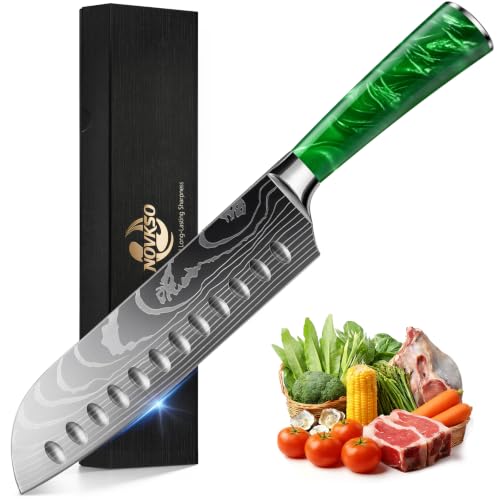
A
NOVKSO 7 inch santoku in high
carbon steel is the most completely specified blade in our catalogue for this
purpose, and the only one that publishes a thickness. Its record states HRC 60 to 61, a
2 millimetre blade and a "hand-polished 15-degree edge per side". Those three figures
together let you draw the whole cross-section.
Take the 2 millimetres as a slab for a moment. At 15 degrees a side, the bevel needed
to bring 2 millimetres of steel down to an edge stands 3.73 millimetres tall. A real blade
tapers rather than being a slab, so the true bevel is shorter than that and 3.73 is a
ceiling rather than a measurement, but it fixes the order of the thing: the sharpening
surface on this knife is a few millimetres of steel, and each sharpening takes 28
micrometres off it.
A
Sunnecko 7 inch nakiri with a 12
degree double bevel is the keenest published geometry we carry, at 0.48 pounds with a
flat edge its record correctly describes as "suited to clean up-and-down chopping rather
than a rocking motion". Twelve degrees costs 35.28 micrometres a sharpening, which is 26
percent more steel than the santoku for the same bluntness. It also makes a finer cut,
and the record is honest that "The flat edge is less natural for rock-chopping herbs or
for cutting through bone, which this knife is not built for". Every one of those is the
same choice looked at from a different side.
A
Dalstrong 8 inch forged German
chef knife takes the other end and says so plainly. Its record publishes 56 plus HRC
and a "hand-polished 16-18 degree edge per side", and then names the trade in its own
words, "favoring durability over razor-thin sharpness", with a drawback reading "16-18
degree edge angle is less acute than some Japanese knives". At 17 degrees the cost is
24.53 micrometres, which is 30 percent less steel per sharpening than the nakiri.
Our page on
why a knife edge fails on
geometry rather than hardness already works out the other half of that trade properly:
the edge's load capacity goes as the square of the tangent, so moving from 20 degrees to
15 costs 45.8 percent of it. Put the two results side by side and the choice has a price
on both sides of the ledger. Fifteen degrees gives up 45.8 percent of the edge's ability
to carry a load, and asks for 35.8 percent more steel every time you rebuild it. The
reason to do it anyway is that it cuts better, which neither number measures.
The retreat formula is exact trigonometry on two straight bevels, so the ratios between
the four angles hold whatever the bluntness is. Every angle in it is published by one of
our own listings: 12 degrees per side, 15 per side on three knives, and 16 to 18 on one.
The schedule in the second panel is the one our own sharpening guide recommends. What is
representative rather than published is the blunt flat width of 15 micrometres, which
sets the scale of every figure and nothing else, so halving it halves every number in the
second panel and leaves every ratio alone. The 50 to 150 micrometres a pass for a carbide
pull through is representative and deliberately left as a range, because no sharpener we
carry publishes a removal rate and no knife we carry publishes a blade height, which are
exactly the two numbers the question needs. The one millimetre heel step is the retreat
after 36 sharpenings and assumes the bolster blocks the stone completely rather than
partly.
Now the division the question is actually asking for
Our own guide to
how often kitchen knives should
be sharpened gives a schedule rather than a rule, and it is the right schedule:
"Light use, a few meals a week: sharpen once or twice a year. Daily home cooking: sharpen
every three to six months. Heavy prep or a professional kitchen: sharpen every week to
every few weeks."
Multiply those by 28 micrometres and the question dissolves. Twice a year is 56
micrometres a year. Four times a year is 112 micrometres a year. Weekly is 1.456
millimetres a year.
Put the first one in a lifetime frame. A knife bought today and sharpened twice a year
for forty years loses 2.24 millimetres of blade height. Sharpened four times a year for
forty years, 4.48 millimetres. On a chef knife that is a change you would struggle to
see without a straight edge to compare it against, and it is spread over a working life
longer than most kitchens.
Only the professional line gets anywhere interesting, and even there weekly sharpening
takes three and a half years to shift the edge five millimetres. Which is roughly the
observed service life of a line cook's knife, and the reason is not the arithmetic above:
it is chipping, dropping, dishwashers and regrinds after abuse. Normal sharpening is not
what retires a knife in a professional kitchen either.
Where the premise becomes true, and it is a different tool
Everything above assumes the sharpener removes the geometric minimum, which is what a
stone or a guided system does, because you stop the moment a burr forms along the whole
edge. A carbide pull-through does not work that way. Two hardened carbide edges at a fixed
angle scrape metal off, and what comes off is a visible curl of steel rather than a slurry
of micrometres. It is a cutting tool working on your knife, not an abrasive.
A
TILIBEIKA 6 piece knife set with a
block and a built-in sharpener is the product that makes this concrete, and its own
record contains both halves of the answer in two places that never meet. Its performance
text presents the design's virtue as a frequency: "Because it lives in the block, you
touch up a blade far more often before use, which keeps the whole set performing rather
than dulling in a drawer." Its drawbacks then concede the per-use cost: the sharpener "is
a pull-through type. That is brilliant for quick maintenance, but it runs coarser than a
whetstone and removes a little more metal, so it suits upkeep rather than precision
work."
Those two sentences multiply. Frequency times removal is the annual loss, and the
record states one factor as a benefit and the other as a drawback without ever putting
them in the same paragraph. Take a pull-through at a representative 50 to 150 micrometres
a pass, used before each of three hundred uses in a year, and the annual loss is 15 to 45
millimetres. That is the whole blade height of a chef knife, in a year, and it answers the
original question with an unambiguous yes.
The rest of that record is fair about what it is: 3Cr13Mov steel "with a hardness
around 50 HRC", which it describes accurately as "a mid-range, softer stainless" whose
"upside is real: it resists rust and resharpens very easily". Softer steel and a
pull-through are a consistent pairing, and the set publishes 15 degree arc-shaped factory
edges, so the retreat arithmetic runs on it. It is the frequency rather than the hardness
that does the damage.
A published schedule whose budget cannot be checked
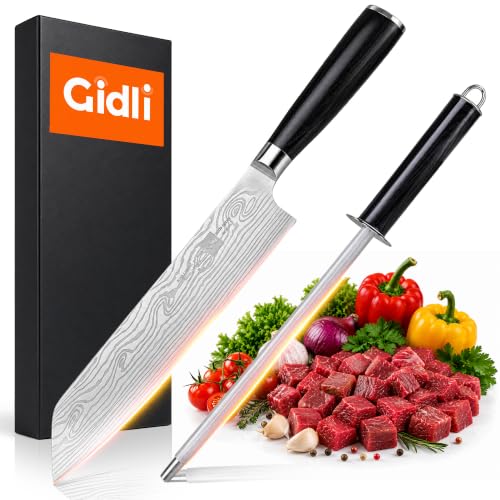
A
Gidli 8 inch chef knife shipped with
a diamond sharpener publishes something unusual and genuinely useful: a maintenance
schedule. Its record says the included "diamond steel sharpener that maintains the edge
angle with just three to four strokes weekly", and separately that "edge upkeep needs only
a few strokes each week".
Weekly is 52 sessions a year, and the distinction that matters is what the rod is made
of. Our page on
honing versus sharpening draws it correctly: a
smooth honing rod straightens an edge that has rolled over and "Nothing meaningful is
ground away, which is why honing takes only a few passes and can be done constantly
without shortening the life of the blade." A diamond rod is not that. Diamond abrades, so
three or four strokes a week is 52 abrasive sessions a year rather than 52 realignments,
and it belongs in the sharpening column of the arithmetic rather than the honing one.
How much does that schedule cost the knife? The record cannot tell you, and says so in
its own drawbacks: "Exact blade thickness, weight, and hardness are not stated". So there
is a published spending rate against an unpublished budget. Three or four light strokes
with a fine diamond rod is plausibly a few micrometres rather than tens, which would make
the whole year less steel than one proper sharpening, and that is the likely answer. It is
also a guess, and the point is that the one listing in the group that publishes a schedule
is the one that leaves out the quantity the schedule is spending.
The thing that actually ends the edge, and it is not the sharpener
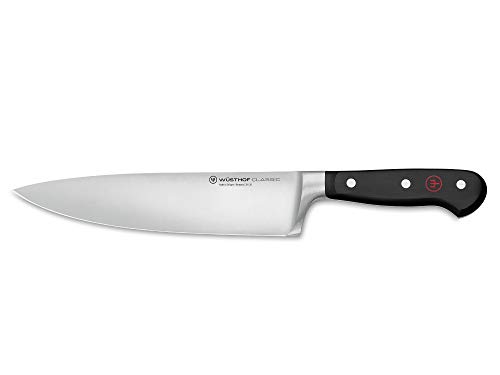
A
WUSTHOF Classic 8 inch chef
knife publishes 58 HRC, an 8 inch blade, a 5 inch handle and 8.5 ounces, and then
publishes the constraint that beats every number on this page. Its record names it twice.
The full bolster "adds weight and balance, yet blocks sharpening the blade all the way to
the heel, a minor long-term nuisance", and later, "Watch the full bolster, though, which
blocks the heel during sharpening and may need a professional to maintain the whole
edge."
Work out when that bites. The sharpened part of the edge retreats 28 micrometres each
time. The stretch behind the bolster retreats zero, because the stone cannot reach it. So
the heel stands proud of the rest of the edge by exactly the accumulated retreat, and one
millimetre of step takes 1,000 divided by 27.99, which is 36 sharpenings.
Thirty six. Against the several hundred the steel itself would allow. At the light
schedule that is eighteen years and at the daily one it is nine, and at that point the
knife needs the bolster thinned by somebody with a grinder rather than another pass on a
stone. So on this knife the sharpening lifetime is set by a feature of the handle
transition, an order of magnitude before anything about the blade, the steel or the
sharpener gets a say. Our
review of this knife has the rest of
its specification, and the bolster is a real virtue in use rather than a defect. It is
simply the binding constraint, and nothing on the listing would tell you the number.
The knife none of this can be run on
A
Victorinox Fibrox Pro 8 inch chef
knife is the honest counterpoint and worth naming, because it is a genuinely good
working knife on which not one figure in this page is available. Its record states the
gap twice and clearly: "The specs, however, list neither blade hardness nor handle
material", and "Without stated blade geometry or edge angle, tougher jobs like bone or
hard squash are hard to predict."
No steel designation, no hardness, no edge angle, no thickness. Its record also notes
that Victorinox "sells sharpeners separately to maintain the edge", so there is a
sharpening route and no geometry to compute its cost with. The arithmetic on this page
needs exactly one input, the edge angle, and this listing does not have it. That is not
unusual: of the knives we carry, four publish an angle and the rest do not, and not one
of them publishes a blade height, which is the other half of the division the question
asked for.
Our broader page on
knife steel and
hardness explained covers what the HRC figures do and do not buy, and it makes the
observation this page keeps running into: "a honing rod realigns the edge between uses. a
pull-through" is the other thing entirely. That distinction is worth more than any
hardness number on any of these listings.
The honest limit, and the only variable worth controlling
What is exact here is the trigonometry. The retreat is the blunt width over twice the
tangent of the half angle, on two straight bevels, with no approximation and no material
property anywhere in it. So every ratio between the four angles is exact, and the 35.8
percent extra cost of 15 degrees over 20 is exact, and the inverse relationship with our
own capacity result is exact.
What sets the scale and is not published is the blunt width. Fifteen micrometres is
representative of a kitchen knife that has stopped slicing tomato skin, and it is a
judgement rather than a measurement. Halve it to 7.5 and every figure in the second panel
halves: twice a year becomes 28 micrometres and forty years becomes 1.12 millimetres.
Double it to 30 and the light schedule still only costs 4.48 millimetres across forty
years. The conclusion is insensitive to it, which is the useful kind of insensitivity.
What this page deliberately does not compute is the pull-through figure, and the
refusal is the finding. The removal per pass spans at least 50 to 150 micrometres across
plausible devices, no sharpener we carry publishes one, and the frequency is entirely a
user choice, so the product of the two spans more than an order of magnitude and lands
anywhere from negligible to a blade a year. It can be bounded from one side and no more:
if your knife is visibly narrower than it was, the pull-through has already told you which
end of the range you are on.
Which leaves the one variable actually worth controlling, and it is neither the
sharpener nor the angle. It is how dull you let the knife get before you sharpen it. The
retreat is proportional to the blunt width, so a knife caught early costs proportionally
less steel, and the practice that keeps it caught early is the one our own pages already
recommend and that costs nothing: a smooth honing rod before use, which realigns and
removes nothing, and a proper sharpening only when honing stops working. Do that and a
kitchen knife loses less than a tenth of a millimetre a year, and the thing that finally
ends it will be a bolster, a dishwasher or a tiled floor.
How Much Blade a Sharpening Actually Costs at a glance
Home cooks and BBQ pitmasters who prefer a heavier, Western-style chef's knife for rock-chopping and heavy prep.
Full-tang forged German stainless steel for durability 56+ HRC hardness for good edge retention Comfortable G-10 handle with triple rivets and hybrid bolster NSF certified for professional use Versatile 8-inch blade handles a wide range of tasks Backed by US-based customer support and 3,200+ reviews
Heavier weight may not suit all users 16-18° edge angle is less acute than some Japanese knives No specific dimensions or weight provided May require regular honing to maintain edge
Everyday chopping, mincing, slicing, and dicing for home cooks who appreciate German craftsmanship.
Precision forged from high carbon stainless steel Tempered to 58 HRC for good edge retention PEtec edge claims 20% sharper and twice the edge retention Ergonomic synthetic handle resists fading Full bolster and finger guard for safety Made in Solingen, Germany with over 200 years of tradition
Full bolster can hinder sharpening Handle may be short for larger hands Not dishwasher safe; requires hand washing Weighs 8.5 oz, which may feel heavy for some
Dishwasher safe for easy cleaning Lifetime warranty against defects Trusted Swiss quality Stainless steel blade Ergonomic Fibrox Pro handle (based on product line) Versatile 8-inch chef's knife size
Exact blade steel not specified Handle material not detailed May require regular sharpening (sharpeners sold separately) Not a premium knife for enthusiasts
Why you can trust this guide
We compared these picks using verified manufacturer specifications, current retailer listings, and patterns in owner feedback, alongside editorial research. We focus on measurable differences such as performance, capacity, usability, and build quality. Pickpedia does not present editorial research as laboratory testing, and we do not claim hands-on testing unless it was actually performed.
Best for precise slicing of meat, vegetables and fruit
8.6/ 10 Pickpedia editorial score
This is a 7-inch Japanese-style Santoku knife from NOVKSO, forged from high-carbon stainless steel at HRC 60 to 61. Its 2mm blade carries a hand-polished 15-degree edge per side and a hollow oval groove that keeps food from sticking. A patterned resin handle is balanced, non-slip and moisture-proof. It arrives in a matte black gift box. Good for home and light commercial prep.
Best for Home cooks who do heavy daily vegetable and fruit prep
8.6/ 10 Pickpedia editorial score
The Sunnecko Nakiri is a 7-inch kitchen knife aimed at cooks who do heavy vegetable and fruit prep. The maker states a hand-polished 12-degree double-bevel edge, high-carbon stainless steel, and a Pakkawood handle. It weighs 0.48 lb and ships with a blade sheath. A flat straight edge suits chopping over rocking cuts.
Best for Home cooks and BBQ pitmasters who prefer a heavier, Western-style chef's knife for rock-chopping and heavy prep.
8.8/ 10 Pickpedia editorial score
The Dalstrong 8" Chef Knife is a full-tang forged German stainless steel blade with a 56+ HRC hardness and a hand-polished 16-18° edge per side. Its triple-riveted G-10 handle and hybrid bolster provide a balanced, comfortable grip for long prep sessions. Designed for rock-chopping and heavy tasks, it's NSF certified and comes with dedicated US-based support. While it's heavier than some, that heft suits cooks who prefer a substantial feel.
For Daily Home Cooking, BbThe 8" Gladiator Elite is the Western-style workhors
For The Cook Upgrading FroFull-tang forged high-carbon German stainless steel
For Pinch-grip Control AcrTriple-riveted G-10 handle with hybrid bolster deliv
For The Bbq Pitmaster, HomSlices through a pork shoulder, breaks down a whole
Gift-ready Packaging, DediEvery Dalstrong knife is backed by a dedicated US-ba
Pros
Full-tang forged German stainless steel for durability 56+ HRC hardness for good edge retention Comfortable G-10 handle with triple rivets and hybrid bolster NSF certified for professional use Versatile 8-inch blade handles a wide range of tasks Backed by US-based customer support and 3,200+ reviews
Cons
Heavier weight may not suit all users 16-18° edge angle is less acute than some Japanese knives No specific dimensions or weight provided May require regular honing to maintain edge
Best for A complete, low-maintenance everyday kitchen set or gift
8.8/ 10 Pickpedia editorial score
A six-piece kitchen knife set in rust-resistant 3Cr13Mov stainless steel with 15-degree factory edges and ergonomic handles, including a chef knife, meat cleaver, paring knife, butcher knife and scissors, in a stainless block with a built-in sharpener and a 12-month guarantee.
The Gidli chef knife is an 8-inch, factory-sharpened blade in German carbon stainless steel, paired with a diamond sharpener. It slices meat, seafood, vegetables, and fruit cleanly and handles chopping, dicing, and mincing. A natural wooden handle with non-slip grip suits pinch and handle holds. The steel resists rust with hand washing and prompt drying. Sold in a gift box, it targets home cooks upgrading from starter knives.
Best for Everyday chopping, mincing, slicing, and dicing for home cooks who appreciate German craftsmanship.
8.8/ 10 Pickpedia editorial score
The WÜSTHOF Classic 8" Chef's Knife is a precision-forged, full-tang knife made from high carbon stainless steel, tempered to 58 HRC. It features an ergonomic synthetic handle that resists fading, and the PEtec edge technology claims to deliver 20% sharper blades with twice the edge retention. This knife is designed for all-purpose tasks like chopping, mincing, slicing, and dicing. While it is a solid performer, its full bolster can make sharpening slightly more challenging, and the handle may not suit all hand sizes.
FeatureKITCHEN WORKHORSE , The WÜSTHOF 8" Classic Chef's Kn
FeatureCHEF'S KNIFE , Features an 8" long blade, 5" long ha
FeaturePRECISION FORGED , The 8" Chef's Knife is forged fro
FeatureCENTURIES OF TRADITION , Family owned for seven gene
Pros
Precision forged from high carbon stainless steel Tempered to 58 HRC for good edge retention PEtec edge claims 20% sharper and twice the edge retention Ergonomic synthetic handle resists fading Full bolster and finger guard for safety Made in Solingen, Germany with over 200 years of tradition
Cons
Full bolster can hinder sharpening Handle may be short for larger hands Not dishwasher safe; requires hand washing Weighs 8.5 oz, which may feel heavy for some
The Victorinox Fibrox Pro 8 Inch Chef's Knife is a straightforward, functional kitchen tool backed by Swiss craftsmanship. It features a stainless steel blade and a handle designed for dishwasher safety, making cleanup simple. While it lacks the prestige of high-end knives, it offers reliable performance for everyday tasks. Its lifetime warranty against defects adds peace of mind.
FeatureKnife Dimensions. Blade made out of stainless steel
FeatureTrusted Swiss quality. Expertly crafted in Switzerla
FeatureKeep your Victorinox knives maintained with our knif
Pros
Dishwasher safe for easy cleaning Lifetime warranty against defects Trusted Swiss quality Stainless steel blade Ergonomic Fibrox Pro handle (based on product line) Versatile 8-inch chef's knife size
Cons
Exact blade steel not specified Handle material not detailed May require regular sharpening (sharpeners sold separately) Not a premium knife for enthusiasts