Home ›
Toasters › Why the Ends of a Long Toaster Slot Get Half the Heat
Toasters
Why the Ends of a Long Toaster Slot Get Half the Heat
PBy the Pickpedia Team·4 picks compared·Last verified October 2026
Affiliate disclosure: As an Amazon Associate, Pickpedia earns from qualifying purchases. Links on this page are paid links, and we may earn a commission at no extra cost to you. This never affects our picks or scores.
This page contains affiliate links. If you buy through one we may earn a
commission, at no cost to you.
Because a slot has two kinds of edge in it and they work in opposite directions. The
cut edge of your half slice is thin, so it takes heat on both faces and across the rim
at once and runs away ahead of everything else. The ends of the slot do the reverse:
the flux there is almost exactly half what it is in the middle, for a reason that is
geometry and nothing else, and anything parked at the end of a slot comes out pale.
Work out how deep that pale zone is and a number falls out that we have been printing
on this site without justifying. Our own guide says a long slot should take at least a 9
inch slice. Nine inches is what is left of a 10 inch slot once the ends are subtracted,
to two decimal places.
Our own sentence, and the single product that can test it
Our best long slot toasters page says:
A truly long slot should accommodate at least a 9 inch slice without sticking
out. It is a reasonable sounding rule with no derivation anywhere on the page, which
is the kind of sentence this batch exists to test.
Testing it turned out to be harder than expected for a reason worth reporting first.
That page recommends four toasters, and exactly one of them publishes a slot length.
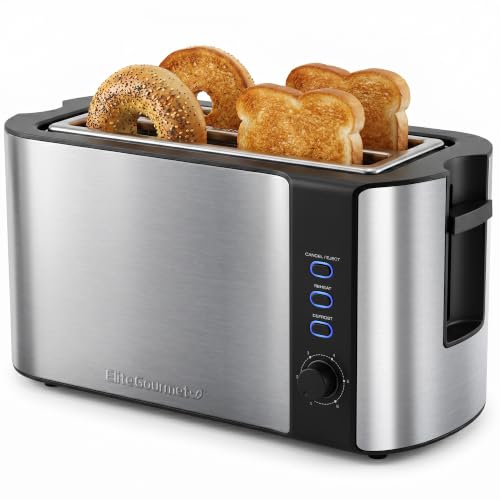
The Elite Gourmet 4-slice long
slot toaster says Two long, wide slots measure 10 inches by 1.5 inches. That
is it. The Breville BTA730XL Bit
More toaster, which is the page's second pick, describes itself as a long,
four-slice model with extra-wide slots and gives no dimension of any kind; its
only published figure is 1800 watts. The
Cuisinart 4-slice toaster
publishes a slot width of 1.5 inches and no length. So a page whose entire premise is
slot length can have its central claim checked against one of its own four
recommendations.
Where the flux goes at the end of a slot
Here is the derivation, and it needs one idea. The elements in a slot are long thin
strips running along it, so treat each one as a line source. A short piece of that strip
sends out power in all directions, and the amount that lands on a given patch of bread
falls off with the square of the distance and with the cosine of the angle it arrives
at. Add up the contributions of every piece of the strip from one end to the other and
you get the flux at that patch.
The sum comes out in a tidy form. Measure the angle from the patch to each end of
the element, taken from the perpendicular. The flux is proportional to the sum of the
sines of those two angles. A patch opposite the middle of a very long element sees both
ends at nearly 90 degrees, and the sine of 90 degrees is one, so the sum is two. That is
the maximum, and everything else is a fraction of it.
Now stand at the very end of the slot. The element runs away from you in one
direction and stops at your feet in the other, so one angle is still near 90 degrees and
the other is zero. The sum is one instead of two. The flux at the end of a slot
is half the flux in the middle, and it arrives at that figure no matter how long
or how short the slot is, no matter how powerful the element, and no matter what the
bread is. Half.
The question that actually matters is how fast it recovers, and that has an answer so
clean it looks like a trick. Walk inward from the end by a distance equal to the gap
between the bread face and the element. At that point the angle back to the end of the
element is 45 degrees, because you have gone as far along as you are away. The sine of 45
degrees is 0.7071, the far end still contributes essentially one, so the flux is 1.7071
out of 2, which is 85.4 percent.
That is the governing result. The fade at each end of a slot is one element gap deep,
and it does not depend on the slot's length at all. It depends on the slot's width.
Slot length and width are read from one product record, the only one in our catalogue
that publishes a slot length. Everything else is derived: each element is treated as a
line source, so the irradiance at a point is proportional to the sum of the sines of the
angles to the two ends of the element, which is one at ninety degrees and zero at the
end itself. The bread face to element gap is taken as half of the slot width minus the
slice thickness, the slice thicknesses are worked examples, and no listing we carry
publishes an element layout, an element length, or how far the element sits behind the
slot wall. The curves assume the element runs the full slot length, which is the best
case; an element shorter than its slot fades sooner.
Which makes our 9 inches the usable length of a 10 inch slot
Put the two published figures together. The gap between the bread face and the
element is half of what is left of the slot width once the slice is in it: the slot is
1.5 inches wide, a standard pan loaf slice is about half an inch thick, so the bread sits
half an inch from each element. The fade depth equals that gap. So the usable length is
the slot length minus twice the gap, which is the slot length minus the slot width plus
the slice thickness:
10 minus 1.5 plus 0.5 equals 9.00 inches.
Our page's figure, exactly, from the only product on the page that publishes enough
to produce it. Nine inches is not a claim about bread. It is what is left of a 10 inch
slot after the ends have been taken off, and 10 inches is the length long slot toasters
are built to. Our number survives, and I want to be plain that this is a confirmation
rather than a correction: the advice is sound and the page simply never says where it
comes from.
What makes it a genuinely good number rather than a lucky one is that a completely
separate argument lands on it too. A standard US pan loaf slice is about 4.25 to 4.5
inches across, so two of them end to end are 8.5 to 9 inches. That is why a long slot
toaster has two slots and calls itself a four slice: each slot takes two slices along its
length. Our own retro toasters page says it outright
about a different 10 inch slot, that it fits two standard slices or one long
piece, and the
Hamilton Beach 2-in-1 countertop
toaster oven and long slot says the same in its own record: The long slot holds
two regular slices or one long slice. The radiant arithmetic and the bread arithmetic
agree, and a rule of thumb that two independent routes reach is a rule you can keep.
Worth correcting one thing in my own brief for this batch while I am here. I was told
9 inches is close to the long side of a standard loaf. It is not. A US pan loaf is
roughly 8 by 4 by 4 inches, and no dimension of a single slice is 9 inches. Nine is two
slices, and that distinction is the reason the slot count works the way it does.
The result that runs backwards, and why long slots are sold for thick bread
Look again at the formula and something awkward appears. The fade depth is half the
slot width minus the slice thickness, so a thinner slice has a deeper fade. In a 1.5 inch
slot, a one inch slab of artisan sourdough sits a quarter inch from each element and
loses only half an inch of slot in total, leaving 9.5 inches usable. A thin slice of
supermarket sandwich bread at four tenths of an inch sits 0.55 inches out and leaves 8.9
inches.
So thick bread toasts more evenly along a long slot than thin bread does, which is the
reverse of the usual worry about thick bread not cooking through. Long slot toasters are
marketed for thick artisan loaves, and on this mechanism that is exactly the case they
serve best, for a reason no listing in the category states. The
Elite Gourmet long slot toaster
review has the rest of its specification, and our
Cuisinart 4-slice toaster review covers the dual
control panels, which are its real distinguishing feature.
This also answers the companion question people ask, about one side browning more
than the other. In a slot with an element on each wall, the two gaps are only equal if
the bread sits in the middle, and nothing holds it there along the slot's length.
Self-centering guides, which our own long slot page recommends and which our
retro toasters page describes as holding each slice
in the middle of the slot, act across the width. Nothing centers bread along the length.
A five inch slice in a ten inch slot can be put anywhere, and if you push it to one end
then roughly half of it is sitting in a fade.
The record that knows and cannot say
The Elite Gourmet listing is the most interesting document in this category, because
it is visibly struggling with exactly this. Its own stated chief flaw is that it
Requires toasting two slices per slot for even browning, which is inefficient for
single users. Its performance text goes further: always toast two slices per slot,
directly opposing each other, for balanced heat. Even results therefore need both slots
at once.
Those are three different instructions. Two slices per slot is four slices. Both slots
at once is two. And slices directly opposing each other describes bread facing across a
slot's width, which is not how two slices go into a 10 inch slot. The maker has worked
out that where you put the bread changes the result, and the listing cannot articulate
it. Our own page's description of that toaster inherits the same fog, saying it
demands attention to slot usage for even results, which is true and not actionable.
What is missing from every listing in the category is the element layout: how many
elements, how long each one is, how far behind the slot wall it sits, and whether a
four slice two slot machine has a shared element between the slots. Every one of those
changes the arithmetic above, and the gap is the only figure that matters and the only
one nobody prints. Slot length gets printed because it is the one thing a buyer can
picture.
The honest limit, and the free technique
Three limits. The curves assume the element runs the full length of the slot, which is
the best case and is not guaranteed; an element an inch shorter than its slot simply
shifts both fades inward by half an inch each. The flux figures are flux, not color: a 15
percent deficit in flux is not a 15 percent deficit in browning, because browning is a
threshold process that accelerates once the surface dries, which our page on
why toast will not brown in a
toaster oven works out properly, and that page is where the magnitude of the flux is
dealt with rather than its uniformity. And the slice thicknesses here are worked examples;
no bread publishes a thickness either.
So the technique, and it uses one slice and nothing else. Put a single slice of
ordinary sandwich bread in the slot pushed hard against one end, and run your usual
setting. The pale band at that end is your toaster's fade, measured directly, and on the
arithmetic above it should be close to half the slot width. Now you know two things worth
knowing: how much of your slot is real, and which end your bread should not be touching.
The second half of the technique is the fix. In a long slot, push the bread toward the
middle rather than seating it against an end, and if you are toasting one slice in a
two slot machine, put it in the middle of a slot rather than loading the slot the way the
instructions imply. Nothing centers it for you.
Why the Ends of a Long Toaster Slot Get Half the Heat at a glance
Households that enjoy thick, artisanal breads and bagels, and often toast for multiple people.
Extra-wide and long slots fit oversized breads and bagels flat Six browning settings provide a wide range of toastiness High-lift lever safely retrieves small items Slide-out crumb tray simplifies cleaning Built-in cord storage keeps counter tidy ETL certified with 1-year warranty and US-based support
No dedicated bagel setting Requires two slices per slot for even browning Plastic build may not feel premium May be bulky for small kitchens
Households that toast a variety of breads, including thick artisanal slices and bagels, and want precise control over browning.
Extra-wide slots for thick bread and bagels LED progress indicator for monitoring 'Lift & Look' to check toast without interrupting cycle 'A Bit More' button to add extra toasting time Five settings including defrost, bagel, and fruit bread Powerful 1800-watt heating for quick, even toasting
1-year warranty is limited No crumb tray with crumb brush mentioned Fruit bread setting may not be essential for all users Long footprint may take up counter space
Households that toast a variety of thick breads, bagels, and frozen items.
Extra-wide 1.5-inch slots accommodate thick breads and bagels Dual control panels with independent browning dials Dedicated reheat, defrost, and bagel functions with LED indicators Compact design fits well on countertops Stainless steel build is durable and stylish Limited 3-year warranty provides peace of mind
Uneven toasting across all four slots No cancel button or countdown timer Runs hot, may require lower settings for thin breads Only available in stainless steel finish
Hamilton Beach 2-in-1 Countertop Toaster Oven and Long Slot
Small kitchens, dorm rooms, or anyone looking to consolidate countertop appliances.
Space-saving 2-in-1 design Toasts 40% faster and evenly Five toast shades for customization Four cooking modes: bake, broil, toast, keep warm 60-minute timer with ready bell and auto shutoff Can hold a 9-inch pizza or 3/4 lb. of fries
Cannot use toaster and oven functions simultaneously No convection fan for even baking Limited capacity for larger dishes No interior light or crumb tray (confirm on listing)
Why you can trust this guide
We compared these picks using verified manufacturer specifications, current retailer listings, and patterns in owner feedback, alongside editorial research. We focus on measurable differences such as performance, capacity, usability, and build quality. Pickpedia does not present editorial research as laboratory testing, and we do not claim hands-on testing unless it was actually performed.
Best for Households that enjoy thick, artisanal breads and bagels, and often toast for multiple people.
8.8/ 10 Pickpedia editorial score
The Elite Gourmet 4-Slice Long Slot Toaster is designed for those who love thick, artisanal breads and bagels. Its extra-wide and long slots accommodate items that standard toasters can't, and the six browning settings offer genuine control. However, it requires toasting two slices per slot for best results, which may be a limitation for single users. The high-lift lever and crumb tray add convenience, but the lack of a dedicated bagel setting is a notable omission.
Extra Wide & Long Slots FiTwo long slots (10" x 1.5") fit full bagel halves fl
6 Browning Settings , FromA full dial from Level 1 (light, barely warm) to Lev
Cord Storage, Slide-out CrThe 36" cord wraps neatly into built-in base storage
Pros
Extra-wide and long slots fit oversized breads and bagels flat Six browning settings provide a wide range of toastiness High-lift lever safely retrieves small items Slide-out crumb tray simplifies cleaning Built-in cord storage keeps counter tidy ETL certified with 1-year warranty and US-based support
Cons
No dedicated bagel setting Requires two slices per slot for even browning Plastic build may not feel premium May be bulky for small kitchens
Best for Households that toast a variety of breads, including thick artisanal slices and bagels, and want precise control over browning.
8.8/ 10 Pickpedia editorial score
The Breville BTA730XL Bit More Toaster is a four-slice toaster with extra-wide slots for artisan bread and bagels. It features an LED progress indicator, a 'Lift & Look' function to check your toast without interrupting the cycle, and a 'Bit More' button to add extra time. With five settings including defrost, bagel, and fruit bread, it offers versatile toasting. The 1800-watt power and brushed stainless steel finish make it a solid choice for busy kitchens.
FeatureThe Breville Bit More toaster is a long, 4 slice toa
Extra Wide 4 Slice CapacitBreville toaster features a 4 slice capacity with wi
Variable Browning ControlThe Breville Bit More 2 Slice toaster lets you toast
Settings5 Settings, including 'A Bit More', 'Lift & Look', D
Warranty1 Year Limited Product Warranty; Power: 1800 Watts;
Pros
Extra-wide slots for thick bread and bagels LED progress indicator for monitoring 'Lift & Look' to check toast without interrupting cycle 'A Bit More' button to add extra toasting time Five settings including defrost, bagel, and fruit bread Powerful 1800-watt heating for quick, even toasting
Cons
1-year warranty is limited No crumb tray with crumb brush mentioned Fruit bread setting may not be essential for all users Long footprint may take up counter space
Best for Households that toast a variety of thick breads, bagels, and frozen items.
8.8/ 10 Pickpedia editorial score
The Cuisinart 4-Slice Toaster offers extra-wide 1.5-inch slots, dual control panels, and dedicated functions for toasting, defrosting, and reheating. Its stainless steel build and compact design make it a practical countertop choice. While it excels with thick breads and bagels, it lacks a countdown timer and may have uneven toasting across all four slices. Overall, it's a reliable option for households needing versatility.
Versatile ToasterThe compact design of this Cuisinart 4 Slice Toaster
Superior OperationWith two control panels, dual 6-setting browning dia
Extra-wide SlotsStainless steel toaster features 1.5″ wide toasting
Limited 3-year WarrantyThe Cuisinart 4 Slice Toaster comes with a limited 3
Pros
Extra-wide 1.5-inch slots accommodate thick breads and bagels Dual control panels with independent browning dials Dedicated reheat, defrost, and bagel functions with LED indicators Compact design fits well on countertops Stainless steel build is durable and stylish Limited 3-year warranty provides peace of mind
Cons
Uneven toasting across all four slots No cancel button or countdown timer Runs hot, may require lower settings for thin breads Only available in stainless steel finish
Best for Small kitchens, dorm rooms, or anyone looking to consolidate countertop appliances.
8.8/ 10 Pickpedia editorial score
The Hamilton Beach 2-in-1 Countertop Toaster Oven and Long Slot 2 Slice Toaster combines a toaster oven and a long-slot toaster in one compact unit. It offers 16.5 liters of interior space, four cooking modes, and a 60-minute timer. While it toasts faster and more evenly than many standalone toasters, its capacity is limited and it lacks some advanced features. It is a practical choice for small kitchens or those who want to declutter their countertop.
Save Space With 2 AppliancReplace your standalone toaster and countertop oven
Spacious Interior ProvidesThis Hamilton Beach toaster oven has 16.5 L of space
Toasts Faster And More EveMake toast 40% faster* and enjoy it browned just the
Easy To UseThis compact toaster oven features auto shutoff, a 6
Versatile With 4 Cooking MPrepare a variety of foods in this one multifunction
Pros
Space-saving 2-in-1 design Toasts 40% faster and evenly Five toast shades for customization Four cooking modes: bake, broil, toast, keep warm 60-minute timer with ready bell and auto shutoff Can hold a 9-inch pizza or 3/4 lb. of fries
Cons
Cannot use toaster and oven functions simultaneously No convection fan for even baking Limited capacity for larger dishes No interior light or crumb tray (confirm on listing)