Home ›
Toasters › Why Toast Will Not Brown in a Toaster Oven, and the Setting That Fixes It
Toasters
Why Toast Will Not Brown in a Toaster Oven, and the Setting That Fixes It
PBy the Pickpedia Team·3 picks compared·Last verified October 2026
Affiliate disclosure: As an Amazon Associate, Pickpedia earns from qualifying purchases. Links on this page are paid links, and we may earn a commission at no extra cost to you. This never affects our picks or scores.
This page contains affiliate links. If you buy through one we may earn a
commission, at no cost to you.
The assumption inside the question is that a toaster oven is a slow toaster, so
the fix must be more time. It is not, and more time makes it worse. A slot and an
oven cavity do not arrive at the same place at different speeds. They arrive at
two different foods, and which one you get is decided by how fast the heat lands,
not how much of it eventually does.
Toast is a race between the surface and the moisture
Browning is chemistry with a temperature threshold. The Maillard reactions and
the caramelisation that give toast its colour and smell need the surface above
roughly 150 degrees Celsius, and water sitting in bread will not let the surface
get there, because evaporating it absorbs heat at 100 degrees and holds the
temperature down until it has gone.
So toast requires a specific sequence: dry out the outer fraction of a
millimetre, get that thin layer past 150 degrees, and brown it, all while the
crumb underneath is still wet. The only way to win that race is to deliver a lot
of heat very quickly, so the surface outruns the moisture migrating up from
inside.
Deliver the same total heat slowly and the race goes the other way. Moisture
has time to move through the slice and leave from everywhere, so the whole thing
dries out together and nothing anywhere gets hot enough to brown. The result is
pale, hard, brittle and uniform, which is a rusk. It is a perfectly good thing to
be, and it is not toast.
Two numbers set the delivery rate, and the oven loses both
Radiant heat is what does the work here, and the rate at which a hot surface
radiates goes as the fourth power of its absolute temperature. That exponent is
the whole story.
A toaster element is a nichrome ribbon driven hard enough to glow, which puts
it somewhere around 1,000 kelvin as a rule of thumb. A toaster oven on a bake
setting is holding an air temperature, around 500 kelvin for a typical 230 degree
Celsius setting, and its elements cycle on and off to maintain it rather than
running flat out. Double the absolute temperature of the emitter and you multiply
its radiated flux by two to the fourth, which is about sixteen.
Then multiply by geometry. In a slot the bread stands a few millimetres from a
flat element on each face, so from the bread's point of view almost its entire
view is glowing element. On an oven rack the bread lies centimetres below a
short element, on one side only, with most of its view filled by cavity walls that
are merely warm.
The oven is not a slower slot. It arrives at a different food, because at low flux
the moisture leaves before the surface can get hot enough to brown.
Those two factors compound, and the result is that the flux at the bread face
in a slot is higher by something like an order of magnitude. That is not a
difference of degree. It is the difference between winning and losing the race in
the first section, which is why extending the time in the oven produces a drier
pale slice rather than a browner one.
Which tells you exactly what to do with the oven you already own
Stop using the toast or bake setting and use broil. A broil setting does the two
things that matter: it runs the top element continuously at full power instead of
cycling it to hold an air temperature, which raises the emitter temperature into
the glowing range, and it invites you to move the rack to the top position, which
collapses the distance. That is the slot geometry rebuilt out of the parts you
have.
Two consequences follow. It will toast one side at a time, so you flip. And it
will go from pale to burnt in well under a minute once it starts, because you have
restored the high flux that makes the shade scale steep, so you watch it rather
than set a timer. A
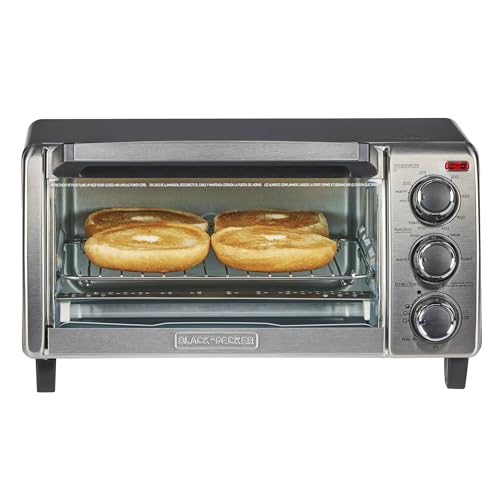
BLACK+DECKER TO1313SBD
toaster oven is a good example of a machine where this is the right technique,
because its record lists exactly the four functions involved, bake, broil, toast
and keep warm, with a 30 minute timer with a stay-on option, a removable crumb
tray, capacity for a 9 inch pizza or four slices of bread, and a 14.5 by 10.8 by
8.8 inch footprint. Its published limitations are the ones the mechanism
predicts: no convection fan, so it relies on natural airflow, and top heating
elements that need clearance, which is the distance term in physical form. Our
review of the BLACK+DECKER
TO1313SBD has the rest.
The machine that admits the argument
The strongest evidence for all of the above is a product that contains both
geometries and keeps them separate. A
Hamilton Beach 2-in-1
countertop toaster oven and long slot toaster has a 16.5 litre oven cavity
with bake, broil, toast and keep warm modes, a 60 minute timer with a ready bell
and auto shutoff, five toast shades, and room for a 9 inch pizza or three quarters
of a pound of fries. And it also has a long slot on top. The maker states it makes
toast 40 percent faster, with an asterisk on the listing, and we are reporting
that as the maker's claim rather than ours.
The interesting part is what the design concedes. This machine has a toast mode
in the oven cavity and the maker still fitted a separate slot, because the slot is
the only geometry that produces toast. Our record also notes that the two halves
cannot run at once, and that there is no convection fan. If you want both
functions and one footprint, that is the trade, and it is a sensible one. See our
review
of the Hamilton Beach 2-in-1.
The millimetre that shows up on your breakfast
One more consequence of a steep flux curve, and it explains an instruction that
looks like a quirk. An
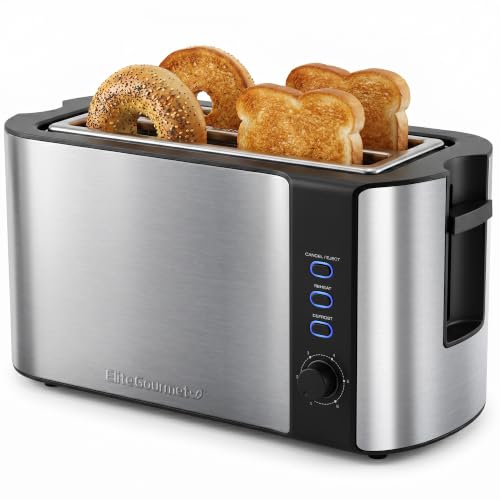
Elite Gourmet 4-slice
long slot toaster has two long slots measuring 10 by 1.5 inches, which take
full bagel halves flat, thick sourdough and Texas toast, with six browning
settings from barely warm to deep and dark, a high-lift lever, a slide-out crumb
tray, 36 inches of cord with base storage, ETL certification and a one year
warranty. And its record states that it wants two slices per slot for even
browning.
That reads like a limitation and it is really the geometry again. A slot is
built so a slice sitting squarely between the two elements is at the designed
distance from each. One thin slice has room to lean, so one face ends up a
millimetre or two nearer than the other, and when the flux is high enough to brown
bread in ninety seconds, a millimetre of lean is a visible shade of difference. Two
slices fill the gap and hold each other at the intended spacing. The published
limitations are no dedicated bagel setting and that plastic build, and the full
record is in our
review of the Elite
Gourmet long slot toaster, with the field in
best long slot toasters. The rest of the
buying decision, slot count, slot width, dials against screens and dual
controls, is set out in
choosing
a toaster and is not repeated here.
The honest limit
If you own a toaster oven and your toast is pale, you do not need to buy
anything. Switch to broil, move the rack to the top slot, leave the door
positioned as the manual says for broiling, watch it, and turn the slice over.
That costs nothing and it addresses both terms in the physics at once. Nine times
out of ten that is the end of the problem.
Buy a dedicated slot toaster or a 2-in-1 for the reason that actually holds up,
which is that a single purpose machine with a fixed geometry does one thing
repeatably, every morning, without you supervising it. That is a convenience
argument, not a quality ceiling, and it is worth being clear about which you are
paying for. If counter space is tight, the honest comparison is between a toaster
oven plus the broil technique and a 2-in-1, not between a toaster oven and a
toaster.
And the limit that no machine solves. None of these listings publishes an
element temperature, a wattage per square inch of element, or a flux figure, so
there is no specification you can compare across brands to predict browning. The
numbers in this post are worked illustrations from standard radiation physics with
representative temperatures, not measurements of these products. What you can
compare is the geometry, which is visible: how close the elements sit to the bread,
and how much of the bread they face. On this question that tells you more than any
figure on the box.
Why Toast Will Not Brown in a Toaster Oven, and the Setting That Fixes It at a glance
Small kitchens, dorms, or individuals needing a compact toaster oven for toast, pizza, and reheating.
Compact size fits small spaces Accommodates 9-inch pizza or 4 slices of bread Four functions: bake, broil, toast, keep warm Removable crumb tray for easy cleanup Stay-on option for longer tasks Stainless steel finish looks modern
30-minute timer may be too short for some recipes No convection fan, relies on natural airflow Outer surfaces get hot, requires careful handling Top heating elements need clearance, limiting food height
Hamilton Beach 2-in-1 Countertop Toaster Oven and Long Slot
Small kitchens, dorm rooms, or anyone looking to consolidate countertop appliances.
Space-saving 2-in-1 design Toasts 40% faster and evenly Five toast shades for customization Four cooking modes: bake, broil, toast, keep warm 60-minute timer with ready bell and auto shutoff Can hold a 9-inch pizza or 3/4 lb. of fries
Cannot use toaster and oven functions simultaneously No convection fan for even baking Limited capacity for larger dishes No interior light or crumb tray (confirm on listing)
Households that enjoy thick, artisanal breads and bagels, and often toast for multiple people.
Extra-wide and long slots fit oversized breads and bagels flat Six browning settings provide a wide range of toastiness High-lift lever safely retrieves small items Slide-out crumb tray simplifies cleaning Built-in cord storage keeps counter tidy ETL certified with 1-year warranty and US-based support
No dedicated bagel setting Requires two slices per slot for even browning Plastic build may not feel premium May be bulky for small kitchens
Why you can trust this guide
We compared these picks using verified manufacturer specifications, current retailer listings, and patterns in owner feedback, alongside editorial research. We focus on measurable differences such as performance, capacity, usability, and build quality. Pickpedia does not present editorial research as laboratory testing, and we do not claim hands-on testing unless it was actually performed.
Best for Small kitchens, dorms, or individuals needing a compact toaster oven for toast, pizza, and reheating.
8.8/ 10 Pickpedia editorial score
The BLACK+DECKER TO1313SBD is a compact toaster oven designed for small kitchens, fitting a 9-inch pizza or 4 slices of bread. It offers four cooking functions, a 30-minute timer with stay-on, and a removable crumb tray for easy cleanup. Its stainless steel finish and straightforward controls make it a practical choice for basic toasting and baking needs.
FeatureACCOMMODATES 9-INCH PIZZA OR 4 SLICES OF BREAD , Des
FeatureFOUR VERSATILE COOKING FUNCTIONS , Select from bakin
FeaturePRECISION 30-MINUTE TIMER WITH STAY-ON OPTION , The
FeatureCONVENIENT REMOVABLE CRUMB TRAY , The slide-out crum
FeatureCOMPACT AND CONTEMPORARY DESIGN , Measuring 14.5" x
Pros
Compact size fits small spaces Accommodates 9-inch pizza or 4 slices of bread Four functions: bake, broil, toast, keep warm Removable crumb tray for easy cleanup Stay-on option for longer tasks Stainless steel finish looks modern
Cons
30-minute timer may be too short for some recipes No convection fan, relies on natural airflow Outer surfaces get hot, requires careful handling Top heating elements need clearance, limiting food height
Best for Small kitchens, dorm rooms, or anyone looking to consolidate countertop appliances.
8.8/ 10 Pickpedia editorial score
The Hamilton Beach 2-in-1 Countertop Toaster Oven and Long Slot 2 Slice Toaster combines a toaster oven and a long-slot toaster in one compact unit. It offers 16.5 liters of interior space, four cooking modes, and a 60-minute timer. While it toasts faster and more evenly than many standalone toasters, its capacity is limited and it lacks some advanced features. It is a practical choice for small kitchens or those who want to declutter their countertop.
Save Space With 2 AppliancReplace your standalone toaster and countertop oven
Spacious Interior ProvidesThis Hamilton Beach toaster oven has 16.5 L of space
Toasts Faster And More EveMake toast 40% faster* and enjoy it browned just the
Easy To UseThis compact toaster oven features auto shutoff, a 6
Versatile With 4 Cooking MPrepare a variety of foods in this one multifunction
Pros
Space-saving 2-in-1 design Toasts 40% faster and evenly Five toast shades for customization Four cooking modes: bake, broil, toast, keep warm 60-minute timer with ready bell and auto shutoff Can hold a 9-inch pizza or 3/4 lb. of fries
Cons
Cannot use toaster and oven functions simultaneously No convection fan for even baking Limited capacity for larger dishes No interior light or crumb tray (confirm on listing)
Best for Households that enjoy thick, artisanal breads and bagels, and often toast for multiple people.
8.8/ 10 Pickpedia editorial score
The Elite Gourmet 4-Slice Long Slot Toaster is designed for those who love thick, artisanal breads and bagels. Its extra-wide and long slots accommodate items that standard toasters can't, and the six browning settings offer genuine control. However, it requires toasting two slices per slot for best results, which may be a limitation for single users. The high-lift lever and crumb tray add convenience, but the lack of a dedicated bagel setting is a notable omission.
Extra Wide & Long Slots FiTwo long slots (10" x 1.5") fit full bagel halves fl
6 Browning Settings , FromA full dial from Level 1 (light, barely warm) to Lev
Cord Storage, Slide-out CrThe 36" cord wraps neatly into built-in base storage
Pros
Extra-wide and long slots fit oversized breads and bagels flat Six browning settings provide a wide range of toastiness High-lift lever safely retrieves small items Slide-out crumb tray simplifies cleaning Built-in cord storage keeps counter tidy ETL certified with 1-year warranty and US-based support
Cons
No dedicated bagel setting Requires two slices per slot for even browning Plastic build may not feel premium May be bulky for small kitchens