PBy the Pickpedia Team·5 picks compared·Last verified October 2026
Affiliate disclosure: As an Amazon Associate, Pickpedia earns from qualifying purchases. Links on this page are paid links, and we may earn a commission at no extra cost to you. This never affects our picks or scores.
This page contains affiliate links. If you buy through one we may earn a
commission, at no cost to you.
Because you have two separate visual systems and the red light is only talking
to one of them. Your cones, which run in daylight and carry colour, are still 6
percent sensitive at 660 nanometres. Your rods, which carry everything you can see
in the dark, are 0.031 percent sensitive there, which is 3,200 times down from
their own peak and is for practical purposes blind. So a deep red beam hands your
cones enough to read a map by and hands your rods almost nothing, which leaves
their dark adaptation intact.
Then the part that follows from it and is more useful than the answer itself. One
lumen of deep red light costs your dark adaptation about 0.013 of what one lumen of
green costs it. That is a factor of 183 between two beams that a listing describes
only by colour name, and the lumen figure on the box cannot show it to you, because
the lumen is defined by the cone curve and the rods are the thing at risk. We carry
one light whose colour choice is its headline feature, and on this arithmetic it
offers the three worst colours and not the one that works.
Two systems, not one dimmer
The retina runs two photoreceptor populations with different jobs and different
spectral tuning.
Cones are the daylight system. There are around six million, concentrated in the
central fovea, they give you colour and fine detail, and the combined sensitivity of
the three types peaks at 555 nanometres, in the yellow green. They need a lot of
light and they respond fast.
Rods are the night system. There are around 120 million, spread across the
periphery and absent from the very centre of your gaze, they carry no colour
information at all, and their sensitivity peaks at 507 nanometres, shifted toward
blue green. They are enormously more sensitive than cones, to the point where a
fully dark adapted rod system can respond to a handful of photons.
Two consequences fall straight out of that and both are worth knowing. The first
is why you cannot see a faint star by looking straight at it and can see it by
looking slightly to one side: the centre of your gaze has no rods. The second is the
colour shift, which is the reason this page exists. Because the two curves peak at
different wavelengths, the relative brightness of two colours changes as the light
level falls. Reds darken dramatically and blue greens hold up. A red flower and a
green leaf that look equally bright at noon do not look equally bright at dusk, and
the leaf wins.
The number that makes red work
Put the two curves side by side at the wavelength of a deep red LED, around 660
nanometres.
The cone curve, which is the standard photopic luminous efficiency function, is at
0.061 there, so 6.1 percent of its peak value. The rod curve, the scotopic function,
is at 0.000313, so 0.031 percent of its peak. Divide one by the other and the rods
are getting 0.0051 of what the cones are getting, relative to their own maxima.
Now convert that into the thing you actually want to know, which is the rod cost
of a published lumen. A lumen is 683 times the photopic function times the radiant
watts. Rod drive is conventionally 1700 times the scotopic function times the same
watts. So rod drive per lumen is 1700 over 683, which is 2.489, multiplied by the
ratio of the two functions. Scale the answer so a 555 nanometre source comes out at
exactly 1, which it does almost perfectly, since 2.489 times 0.402 is 1.001.
Run four beams through it:
Deep red at 660 nanometres: 2.489 times 0.000313 divided by 0.061, which is
0.0128.
Green at 530 nanometres, a typical green LED: 2.489 times 0.811 divided by 0.862,
which is 2.34.
A cool white LED around 6000 kelvin: about 2.0, because a cool white is built from
a blue pump and therefore carries a lot of short wavelength energy that rods see
well.
A warm white around 3000 kelvin: about 1.3.
So deep red is 78 times gentler than a 555 nanometre source and 183 times gentler
than a green beam of the same published lumens. That is the answer to the question
and it is a very large number, which is why the technique survives in astronomy,
aviation, submarines and darkrooms rather than just in folklore.
Curve shapes are the standard CIE photopic and scotopic luminous efficiency
functions, drawn to shape rather than plotted point by point. The table is computed
from tabulated values of those two functions. No listing we carry publishes a
wavelength except one, and none publishes a scotopic figure.
The correction: green is not a night colour
There is a claim that usually travels alongside this one, and I had it in my own
notes for this page before working it through: that the same spectral shift explains
why a green beam looks brighter than a white one of the same measured output at
night, so green is the night-friendly alternative to white. The first half is
technically true and far smaller than it sounds. The second half is backwards.
Look at the table. Green at 2.34 against cool white at 2.0 is a ratio of 1.2.
That is a twenty percent difference, which is nothing you would notice and nothing
worth designing a product around. The reason is that a cool white LED is not a
neutral comparison: it is made by pumping a phosphor with a blue die, so it is
already rich in exactly the short wavelengths the rods are most sensitive to. Its
scotopic content is high. Against a warm white at 1.3 the green does win more
clearly, by a factor of 1.8, and against an old incandescent source even more. But
against the cool white that modern lights actually emit, the green advantage
substantially disappears.
And in the direction that matters, green is worse than both whites. A green beam
costs your dark adaptation 2.34 per lumen against warm white's 1.3. If your purpose
is to keep your rods adapted, green is the wrong choice, and it is wrong by nearly a
factor of two against the gentlest white you can buy.
So why do lights have green beams? Because green is not on the list for night
vision reasons. It sits close to the cone sensitivity peak, which means it produces
more lumens per watt than any other colour, and it penetrates haze and foliage
better than white while reading clearly against vegetation. Those are efficiency and
contrast arguments, and they are good arguments. They are not dark adaptation
arguments, and no listing we carry claims they are. The confusion is the reader's to
avoid.
The light whose colours are the feature, and what it does not have
An
ERITOM rechargeable EDC
flashlight with white, UV and green beam is the one product in our catalogue
where the choice of emitter colour is the headline, so it is the one to test this
against. Its record publishes a 1000 lumen white, a colour temperature of 5700 to
6200 kelvin, separate UV and green beams, seven modes, 36 selectable brightness
levels across high, medium, low and ultra-low, a stated 22 hour ultra-low runtime, a
hidden waterproof USB-C port and a magnetic base.
Read that against the table and three things follow. The 5700 to 6200 kelvin
white is squarely the cool white case, so it is the costliest of the whites for dark
adaptation at about 2.0 per lumen. The green does not improve on it meaningfully,
coming in at 2.34, which is marginally worse. And the UV is not a night vision
option at all in either direction, because the eye's lens absorbs most of it before
it reaches the retina, so what you see from a UV source is fluorescence from
whatever you point it at rather than the beam.
What the light does have, and what genuinely matters here, is the 36 level
ultra-low mode. Output is the dominant variable and colour is the refinement, so a
light that can go very dim is doing more for your night vision than a light with an
extra emitter. Its record is candid that "lumen and runtime figures are
maker-stated" and that "compact turbo output usually steps down as it warms", both
true. The gap, for this subject, is that the listing publishes a maximum of 1000
lumens and no minimum, so the one specification that would tell you whether
ultra-low is genuinely low is missing. Details in our
ERITOM
EDC flashlight review.
The light that does have the right colour is the smaller one.
FOSFIS 500 lumen
rechargeable EDC clip-on flashlight publishes a dual-bead LED with seven modes
"including red and red-blue flashing", 500 lumens maximum, 120 metres of beam
distance, IP68, about 53 grams and a stated 22 hours on low. The red mode is almost
certainly there as a signalling and marker feature rather than as a dark adaptation
feature, and it does not matter why it is there. On the arithmetic above, that red
mode is the single most night-friendly setting across every light we carry, by
roughly two orders of magnitude per lumen. Our
FOSFIS
EDC flashlight review has the rest. The honest caveat is that no listing
publishes the wavelength of a red mode, and a red-orange emitter at 620 nanometres
is roughly twenty times worse than a deep red one at 660, so "red" on a box could
mean either.
The only listing on the site that publishes a wavelength
Which brings us to the exception, and it is worth dwelling on because it shows
what the category could look like.
A
365nm rechargeable UV black
light flashlight names a number. Its specification reads "UV wavelength: 365nm",
its title carries it, and its summary explicitly contrasts that with "a typical 395nm
black light". Across 1,412 published products this is the only one that tells you
where on the spectrum its light sits, and the distinction it draws is a real one
rather than marketing.
Here is why 365 beats 395 for the job, which the listing asserts without
explaining. At 395 nanometres a meaningful fraction of the output is inside the
visible range, so you see a violet glow from the beam itself, and that glow lands on
the same surface you are trying to inspect and washes out the faint fluorescence you
are looking for. At 365 nanometres the emission is almost entirely outside what the
eye responds to, so you see the fluorescence against a dark background rather than
against a violet one. Signal against background, not output. The listing's claim that
365 is "purer" is correct and for a better reason than purity.
There is also a point here that sharpens the whole page. Short wavelength sources
are the case where the lumen figure is most misleading about rod effects, because the
cone curve collapses faster than the rod curve does as you move toward violet. A
violet source therefore produces very few lumens for a great deal of rod stimulation,
so a light that reads as nearly zero lumens can still be doing real damage to your
adaptation. That is the structural flaw in using lumens at night, in its most extreme
form. Its record is properly firm that the light "must never be aimed at human or pet
eyes", which is the thing to act on. Our
365nm UV
black light review covers it.
Why the output number matters more than the colour, with the arithmetic
Colour is the refinement. Output is the whole game, and our two lanterns show how
badly the published figures miss it.
Start from what you are aiming at. Full moonlight gives roughly 0.25 lux, and that
is ample to move around by once you are adapted. A lantern radiates in roughly every
direction, call it 12.6 steradians. To deliver 0.25 lux at a metre and a half you
need 0.25 times 1.5 squared, which is 0.5625 candela, and 0.5625 times 12.6 is about
7.1 lumens. Seven lumens. That is the correct size of a light that will not undo
your adaptation.
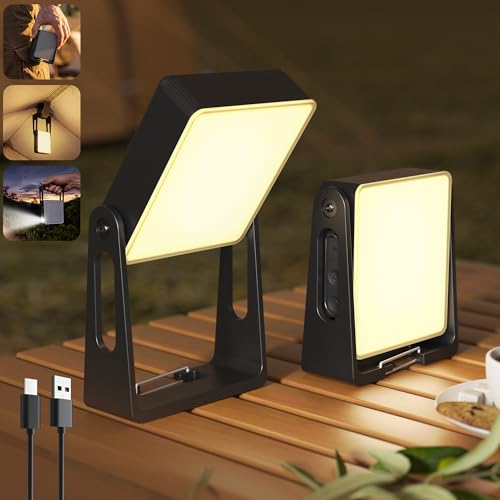
Now a
rechargeable dimmable LED
camping lantern 2 pack, which publishes 300 lumens, stepless dimming, three
colour temperatures, a 4000mAh cell and up to seven hours on its brightest setting.
At full output that is 300 over 12.6, which is 23.8 candela, giving 10.6 lux at a
metre and a half, which is 42 times full moonlight. To reach the 7 lumen figure you
need to dim it to 2.4 percent of maximum. So the stepless dimming is the genuinely
important specification on this product, and whether it is useful depends entirely
on a number the listing does not publish: the minimum output. Stepless down to 20
percent is a different product from stepless down to 2 percent, and both are
described the same way. Our
dimmable
camping lantern review notes that its runtime figures are maker stated, which
they are.
And the case that shows the scale of the mismatch. A
RadiantFlux rechargeable
solar camping lantern publishes 4000 lumens, a 6600mAh cell, three light modes,
IP65, solar and Type-C charging and a USB output for charging a phone. Four thousand
lumens into 12.6 steradians is 317 candela, which is 141 lux at a metre and a half,
or 564 times full moonlight. To get to the 7 lumen target you would need 0.18 percent
of its maximum, and it publishes three modes rather than a dimmer, so its lowest
setting is almost certainly far above that. Its record is straightforward that
"per-mode runtimes are not specified", which is the related gap. None of this makes
it a bad lantern. It makes it a work light and a power bank, which is what its
listing is really describing, and 4000 lumens at a campsite table after dark is a
specification pulling against the purpose. See our
RadiantFlux
solar camping lantern review.
The clock you are protecting
One more set of figures, because they explain why this is worth any care at all.
Dark adaptation is not a dimmer sliding open. It is a chemical process:
rhodopsin, the pigment in your rods, is bleached by light and has to be
regenerated, and the regeneration has a half time of roughly five minutes. Four or
five half lives gets you most of the way, which is why full dark adaptation takes 20
to 30 minutes. The cone branch of the curve finishes in about five to seven minutes
and then the rod branch takes over, which is the kink people notice as their vision
suddenly improving again after they thought it had settled.
What you gain across that half hour is about a millionfold increase in
sensitivity, six orders of magnitude. What it costs to discard is one brief look at
a white beam. Half a second of bright white light and you are back near the start of
the curve, so you spend half a second and repay 1,800 seconds. A ratio of 3,600 to
one is why the habit of handling a light carefully at night is not fussiness, and
why the cost is asymmetric in a way almost nothing else is: being careful costs you
nothing, and one lapse costs you the whole evening's adaptation.
The honest limit
Not one flashlight or lantern listing we carry publishes a wavelength for a
coloured mode, only colour names, and the single exception above is a UV inspection
light rather than a general purpose one. Nobody publishes a scotopic figure or an
S over P ratio, which is the specification that would answer this question directly
and which exists and is used in street lighting work. Nobody publishes a minimum
output, which on the arithmetic above matters more than the maximum everybody leads
with. So the numbers on this page are computed from the standard sensitivity
functions and from published colour temperatures and lumen figures, not measured on
any of these lights.
Our own post on
whether more lumens mean a
headlamp shines further had part of this right already and deserves the credit.
Writing about a lantern's modest output, it says the job "is not to illuminate
anything. It is to be a visible warm object on a table while leaving people's night
vision intact, and 1000 lumens pointed at a dinner would be a fault rather than a
feature". Both halves are correct, and the arithmetic above supplies the figure
behind the instinct: the target is around seven lumens, and both of our lanterns
publish maxima more than forty times that.
Which leaves the free techniques, and they are worth more than any purchase here.
Turn the light down before you turn it on, not after, because the damage is done in
the first instant. Point it at the ground or at what you are doing rather than
anywhere near another person's face, since a beam that never enters an eye costs that
eye nothing. Close or cover one eye when you have to use a bright white light, which
preserves adaptation in the other and is the oldest trick in this subject. And if you
have no red light at all, a layer or two of red cellophane or a red balloon stretched
over the lens does the same job as a red emitter, because what you need is not a red
source but the absence of everything below 600 nanometres, and a filter achieves that
by subtraction for the cost of nothing.
Why Red Light Does Not Ruin Your Night Vision at a glance
RadiantFlux Rechargeable Solar Camping Lantern, 6600mAh, 4000LM
camping and blackout lighting with backup power
Solar and Type-C charging cover trail and home
No 5V wall adapter included in the box
Why you can trust this guide
We compared these picks using verified manufacturer specifications, current retailer listings, and patterns in owner feedback, alongside editorial research. We focus on measurable differences such as performance, capacity, usability, and build quality. Pickpedia does not present editorial research as laboratory testing, and we do not claim hands-on testing unless it was actually performed.
Best for everyday carry users wanting white, UV, and green in one light
8.4/ 10 Pickpedia editorial score
ERITOM's flat EDC flashlight combines a 1000 lumen white LED with UV and a green beam in one pocket body. The maker states seven modes, a memory function, and 36 selectable brightness levels stored across high, medium, low, and ultra-low. A built-in battery charges through a hidden waterproof USB-C port, and a magnetic base frees your hands. It measures 4.2 by 0.99 by 0.63 inches and weighs 3.14 ounces.
White output1000 lumens
Color temp5700 to 6200K
Extra beamsUV and green
Ultra-low runtime22 hours
Charge to 50%30 minutes
Charge to 100%110 minutes
Dimensions4.2 x 0.99 x 0.63 in
Weight3.14 oz
Pros
Three light sources cover white, UV, and green in one tool
Turbo reaches a stated 1000 lumens for bright tasks
Ultra-low mode stretches runtime to a stated 22 hours
Hidden waterproof USB-C port avoids a fragile flap
Magnetic base frees your hands during close work
Flat body carries better than a round torch
Cons
36-level programming adds a learning curve
Lumen and runtime figures are maker-stated
Compact turbo output usually steps down as it warms
Best for Everyday carry and hands-free working light
8.6/ 10 Pickpedia editorial score
The FOSFIS EDC flashlight suits everyday carry, camping and emergencies. It reaches up to 500 lumens and 120 metres, weighs about 53 grams and measures 1.18 by 1.18 by 2.36 inches. A dual-bead LED system gives seven modes, including red and red-blue flashing. A magnetic clip frees your hands, Type-C charging takes about 1.5 hours and IP68 handles wet conditions.
Best for pet owners hunting hidden dried urine stains
8.6/ 10 Pickpedia editorial score
This 365nm UV flashlight targets pet urine detection with a purer ultraviolet output than a typical 395nm black light. The maker states it reveals dried stains on carpets, floors, and furniture that are invisible to the eye. A USB-C rechargeable battery and a real-time LCD percentage keep it ready, while the aluminum alloy body and wrist strap suit home, outdoor, and professional inspection use.
UV wavelength365nm
Battery displayReal-time LCD percentage
ChargingUSB-C rechargeable
BodyAluminum alloy
Water resistanceSealed waterproof design
CarryWrist strap
CoolingUpgraded heat dissipation
Primary usePet urine detection
Pros
True 365nm output the maker states beats a 395nm black light
Reveals dried pet urine invisible to the naked eye
Real-time LCD shows remaining battery percentage
USB-C rechargeable with a built-in battery
Impact-resistant aluminum alloy with a wrist strap
Best for campers wanting versatile folding table and tent lighting
8.6/ 10 Pickpedia editorial score
This is a two pack of rechargeable LED camping lanterns built around a 4000mAh battery and a 300 lumen output. Each unit folds flat, mounts on a 360 degree rotating stand, and offers stepless dimming plus three color temperatures. A side LED works as a handheld flashlight. Owners get up to seven hours on the brightest setting and an elastic clip for hanging.
Best for camping and blackout lighting with backup power
8.4/ 10 Pickpedia editorial score
The RadiantFlux is a rechargeable LED camping lantern that doubles as a power bank. It states 4000 lumens, a 6600mAh cell, three light modes, and an IP65 waterproof rating. Solar and Type-C charging keep it topped up, while a USB output charges a phone in a pinch. Hanging loops, a magnetic back, and a 1/4-20 thread add mounting options. It suits camping, outages, and all-weather outdoor use.
Battery6600mAh
Brightness4000 lumens (maker-stated)
Light modes3
Waterproof ratingIP65
ChargingSolar and Type-C input
OutputUSB port for phone charging
MountingLoops, magnetic back, 1/4-20 thread
IncludedUSB charging cable
Pros
Solar and Type-C charging cover trail and home
Built-in 6600mAh power bank tops up a phone
Three modes balance brightness and runtime
IP65 rating handles rain and damp
Magnet, loops, and tripod thread mount it anywhere