PBy the Pickpedia Team·5 picks compared·Last verified October 2026
Affiliate disclosure: As an Amazon Associate, Pickpedia earns from qualifying purchases. Links on this page are paid links, and we may earn a commission at no extra cost to you. This never affects our picks or scores.
This page contains affiliate links. If you buy through one we may earn a
commission, at no cost to you.
Less effective is the phrase that sends people wrong, because it sounds like a
percentage. Lose ten percent of your cleaning and you shrug. What actually happens
is that a fixed quantity of what you put in is spent on the water before any of it
reaches your clothes, and that quantity depends on where you live rather than on
how dirty the load is.
Which turns the whole thing into a question about the shape of the dose. If you
pour from a bottle you can pour more. If your detergent arrives as one sheet or
one pod, the dose is the product, and there is nothing to add. Our own
guide to choosing a
gentle everyday detergent says soft water needs less detergent and hard water
needs more, which is fine advice for a bottle and impossible advice for a sheet.
This page is the arithmetic that fills that gap.
Weigh the two things against each other
Water hardness is published in grains per gallon, and one grain per gallon is
17.1 milligrams per litre expressed as calcium carbonate. Ten grains per gallon,
which is ordinary hard water across large parts of the country, is therefore 171
milligrams in every litre.
A high efficiency front loader uses something like 15 gallons, which is 57
litres, so that wash carries about 9.7 grams of dissolved calcium and magnesium
into the drum before you add anything. An older top loader filling to 35 gallons
carries about 22.7 grams.
Now weigh the dose. None of the three sheet and pod listings we carry publishes
the mass of a single dose, which is the one number this calculation needs, but one
of them lets you derive it. A pack of
Wash'd laundry detergent
sheets with three stain-fighting enzymes publishes that it is 95 percent
lighter than jugs. A liquid jug delivers roughly 44 grams per load once you count
the water it is carried in, so 95 percent lighter puts one sheet at around two
grams of actual material.
Two grams of detergent, nine point seven grams of dissolved mineral. In the top
loader, two against twenty two point seven. That is the answer to the question, and
it is not a percentage.
Why the same box works at one address and not at another. One sheet is about two
grams of material walking into a wash that already contains ten to twenty three
grams of dissolved mineral.
What the mineral actually does, and what it does not
Calcium and magnesium ions carry two positive charges, and the workhorse
surfactants in most detergents carry a negative one. Put them in the same water
and some of the surfactant pairs off with the mineral and drops out as an insoluble
scum instead of lifting soil. The detergent is not weakened, it is partly spent.
The industrial answer is a builder, which is a compound whose job is to grab the
mineral first and hold it in solution so the surfactant survives. And here is the
part that makes the sheet arithmetic unavoidable, because builders work in roughly
one-to-one proportions by the mole rather than catalytically. Tying up 9.7 grams of
hardness in that front loader takes about 10 grams of sodium carbonate, which is
washing soda, or about 25 grams of sodium citrate, or around 30 grams of a zeolite.
Every one of those is heavier than the entire two gram sheet, before a single
milligram of surfactant, enzyme or fragrance is accounted for.
Be fair about the consequence, though, because the alarming version of this is
not true. Modern formulas lean on nonionic surfactants, which calcium does not
precipitate, so a sheet in hard water does still clean. What you lose is the
anionic share, and what you gain is a slow accumulation: calcium soaps and scale
deposit on the fibres wash after wash, which is the grey, stiff, faintly sour
towel that nobody can account for. It is not a cleaning failure you can see in one
load. It is a deposit you notice after a year.
Reading three fixed-dose listings in that light
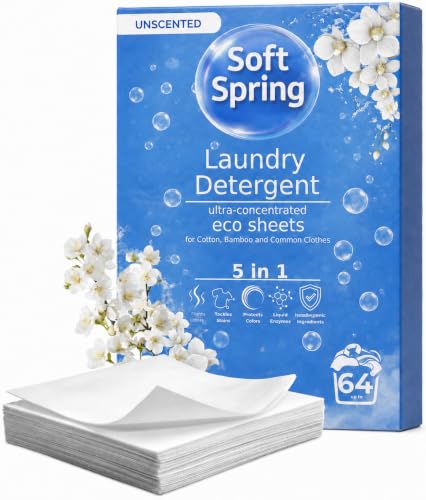
A box of
unscented laundry
detergent sheets with liquid enzymes is honest about the format in a way worth
noticing. The record lists liquid enzymes, fully fragrance-free, free of dyes and
heavy fillers, dissolving in hot or cold, and its own weaknesses are that it may
under-dissolve in very cold cycles and that heavy grease may need pre-treatment.
No heavy fillers is the phrase to hold next to the chart above: fillers are where
builder lives in a powder, and a product whose selling point is not carrying them
is telling you it is not a hard water product. Worth flagging one thing we hit
while reading the listing, because it is the sort of inconsistency that tells you
how load counts are arrived at: the product is sold as 64 loads in its own title
and the specification says up to 60 loads, stated. Our
review
of the unscented enzyme sheets records what is published, and our
guide to detergent
sheets for travel covers the case where the format is exactly right, which is
when weight matters more than water chemistry.
The Wash'd sheets above are the better formulation read on their own terms.
Three named enzymes is a real specification, not a marketing adjective: protease
for protein, lipase for fats, mannanase for the sticky gums in food and cosmetics,
plus no optical brighteners, dyes, parabens, phthalates or 1,4-dioxane, and a
hypoallergenic claim. The record also says enzyme results vary with soil and load,
which is true and is the subject of the next section. Details in our
review
of the Wash'd enzyme sheets.
A box of
WBM Home 10-in-1 laundry
pods in a 128 count states the structural problem in its own list of
limitations, which is rare enough to be worth praising: a fixed dose is less
flexible than liquid. Everything else on the record is reasonable, with 128 pods in
four boxes of 32, hot and cold dissolving, a plant-based amber fall fragrance,
recyclable packaging, and the frank admission that the cleaning claims are maker
stated. A pod carries more material than a sheet, which helps, but it is still one
quantity for every load and every address. See our
review
of the WBM 10-in-1 pods.
The second mechanism, which costs nothing to fix
An enzyme is a catalyst. That one word changes how you should run a wash,
because a catalyst is not consumed by the reaction. A protease cuts a protein
chain, lets go, and goes to work on the next one. So the amount of soil an enzyme
removes is not set by the dose at all. It is set by the rate multiplied by the
time.
Both terms are under your control and neither costs anything. Enzyme rate rises
steeply with temperature, roughly doubling for every 10 Celsius you add, until you
pass the point where the protein itself comes apart and the activity falls off a
cliff. Detergent enzymes are engineered to peak somewhere in the warm range, which
means a cold wash runs them slowly and a very hot wash can destroy the thing you
paid for.
Put numbers on it. A 30 minute quick cycle at 60 Fahrenheit against a 90 minute
normal cycle at 100 Fahrenheit is about 22 Celsius of difference, which is roughly
four and a half times the rate, over three times the duration. Ten to fifteen times
the enzymatic work, from the same sheet, for the price of pressing a different
button. That is the single largest free lever in this whole article, and it is why
a quick wash with an expensive enzyme detergent can lose to a long cool wash with
a cheap one.
Where a powder genuinely earns its place
If the chart above describes your address, the format has to change rather than
the brand. A tub of
Kinetic Essentials
plant-based enzyme laundry detergent powder is the shape that can hold the
answer, and its record says so directly: a concentrated powder with protease and
amylase, mineral-based builders described as helping it clean where hard water
limits detergents, hot or cold cycles, low suds for HE and standard machines, and
no parabens, phosphates, chlorine, dyes, MIT or BIT. Builders in a powder are
possible because a powder can be dosed by volume and can afford the mass. Two
honest notes from the same record: no phosphates means the builder is doing the
job with something less effective per gram than the phosphates that used to do it,
and powder may need pre-dissolving in a cold cycle, which bears directly on the
timing argument above. Our
review
of the Kinetic Essentials enzyme powder has the rest.
And a tub of
Kinetic Essentials enzyme
and oxygen laundry booster powder is the add-on version of the same idea,
pairing protease and amylase with oxygen-based cleaning and the same mineral-based
builders, stated to work hot or cold and to rinse low-suds. The oxygen half is a
different chemistry from everything above: a percarbonate releases hydrogen
peroxide when it meets water, which bleaches colour out of a stain rather than
lifting it off, and it is both temperature and time dependent in the same way the
enzymes are. Its record is clear that it is an add-on rather than a standalone
detergent, that oxygen agents favour colour-safe fabrics, and that it means an
extra step on laundry day. More in our
review
of the enzyme and oxygen booster, and our existing
guide to using a
laundry booster covers when to reach for one.
The honest limit
Start by finding out whether any of this applies to you, because it is free.
Your water utility publishes its hardness, usually in grains per gallon or in
milligrams per litre, and the number is wildly different between neighbouring
regions. If you are at two grains per gallon then the chart above is 1.9 grams of
mineral in a front loader wash, the whole problem disappears, and a sheet is simply
a good product that happens to be light.
If you are at ten or fifteen, the cheapest effective answer is not a better
detergent. It is about ten grams of washing soda in the drum, which is a couple of
teaspoons, bought by the pound, alongside whatever you already use. That ties up
the mineral so your detergent does the job it was formulated for, and it is the
same mechanism the expensive powders are selling you in a nicer box.
Then press the longer, cooler cycle rather than the quick one, and start the
machine on a short soak if it offers one. Nothing in this article beats giving a
catalyst more time. And the thing that does not work, which is the whole reason the
question gets asked: using two sheets. Two sheets doubles the surfactant and the
enzymes and adds no builder worth having, which means you pay twice to fix a
problem that is not about surfactant at all.
Why One Detergent Sheet Cannot Fix Hard Water at a glance
Kinetic Essentials Enzyme and Oxygen Laundry Booster Powder
boosting detergent on odor-heavy loads
Combines enzymes with oxygen cleaning
An add-on, not a standalone detergent
Why you can trust this guide
We compared these picks using verified manufacturer specifications, current retailer listings, and patterns in owner feedback, alongside editorial research. We focus on measurable differences such as performance, capacity, usability, and build quality. Pickpedia does not present editorial research as laboratory testing, and we do not claim hands-on testing unless it was actually performed.
Wash'd Laundry Detergent Sheets use three enzymes, protease, lipase, and mannanase, to break down proteins, fats, and sticky stains from body fluids, dairy, grass, cooking oil, and cosmetics. Free of optical brighteners, dyes, parabens, phthalates, and 1,4-dioxane, they are hypoallergenic and gentle on sensitive skin. Pre-measured sheets work in any washer, hot or cold, in 100% recyclable, septic-safe packaging.
Best for travel and low-waste fragrance-free laundry
8.4/ 10 Pickpedia editorial score
These unscented laundry detergent sheets pack liquid enzymes into lightweight, pre-measured strips that replace bulky liquid jugs. The maker states up to 60 loads of cleaning on clothes, towels, and delicates in hot or cold cycles. Fully fragrance-free and free of dyes and heavy fillers, they dissolve fast, slip into a bag, and cut plastic waste for travelers, students, and home use.
Best for Households wanting pre-measured, scented laundry dosing
8.4/ 10 Pickpedia editorial score
WBM Home laundry pods pack ten cleaning actions into a single dose. You get 128 pods total, sold as four boxes of 32. The maker states they lift tough stains and odors, work in hot or cold water, and carry a plant-based amber fall fragrance. Packaging is described as recyclable and plastic-free. A practical choice for households that want grab-and-go dosing and a warm seasonal scent.
Kinetic Essentials is a concentrated plant-based laundry powder using protease and amylase enzymes to break down protein stains, sweat, and food residue. Mineral-based builders help it work in hard water, and enzymes stay active in hot or cold cycles. It rinses low-suds and clean in HE and standard machines, without harsh fragrance, parabens, phosphates, chlorine, dyes, or MIT and BIT.
FormConcentrated powder
EnzymesProtease and amylase
WaterHard water rated
TemperatureHot or cold cycles
MachinesHE and standard
SudsLow-suds, clean-rinsing
FragranceNo harsh fragrance
Free fromParabens, phosphates, chlorine, dyes, MIT, BIT
Pros
Protease and amylase target sweat and stains
Works in hard water, per the maker
Enzymes stay active in cold cycles
Low-suds formula rinses clean
Suits HE and standard machines
Free of parabens, phosphates, and dyes
Cons
Fragrance-free leaves no lingering scent
Powder may need pre-dissolving in cold cycles
Enzymes not ideal for untreated wool or silk
Performance claims are maker-stated, not lab-verified
Kinetic Essentials Laundry Booster is a plant-based add-on that strengthens your regular detergent. It combines protease and amylase enzymes with oxygen-based cleaning agents to break down stains and odor at the source. Mineral-based builders support hard-water washing, enzymes stay active hot or cold, and the low-suds powder rinses clean without parabens, phosphates, chlorine, dyes, or MIT and BIT.
FormPowder booster
UseAdd alongside detergent
EnzymesProtease and amylase
Extra actionOxygen-based cleaning
WaterHard water supported
TemperatureHot or cold washes
SudsLow-suds, clean-rinsing
Free fromParabens, phosphates, chlorine, dyes, MIT, BIT