PBy the Pickpedia Team·6 picks compared·Last verified October 2026
Affiliate disclosure: As an Amazon Associate, Pickpedia earns from qualifying purchases. Links on this page are paid links, and we may earn a commission at no extra cost to you. This never affects our picks or scores.
This page contains affiliate links. If you buy through one we may earn a
commission, at no cost to you.
For a sealed headphone running comfortably inside its limits, much less than people
claim. For anything that does not seal your ear, far more than an equaliser can reach,
and the gap is about 110 decibels at 50 hertz rather than a matter of taste.
The reason is that an equaliser and a driver are working in different currencies.
An equaliser moves a curve. A driver has to move air, and the way it does that is by
moving a distance. How much distance a given loudness costs is decided almost entirely
by how the earbud is coupled to your ear, and hardly at all by anything on the
specification sheet. So the honest answer to the question is that the headphone barely
matters and the seal matters enormously, which is not the answer either side of the
argument usually gives.
Start by granting the point, because most of it is true
An equaliser applies a linear filter. If a headphone's deviation from the target is
a minimum phase magnitude error, which most of it is, then inverting that error with a
filter genuinely removes it, phase and all. That is not a workaround or an
approximation. It is the same correction, applied earlier in the chain.
So for two sealed headphones playing at a sensible level, well inside what their
drivers can do, a measured equaliser really does collapse most of the audible
difference between them. The remaining differences are in things a filter cannot
touch, and the question is what those things are and how big they get.
Our own page on why 100 watts
is not twice as loud as 50 already names the first one for loudspeakers: output
"is limited by cone excursion and cabinet volume long before any amplifier runs out".
That sentence is the entire argument of this page, moved from a living room to an
ear, where the volumes involved are a few thousand times smaller and the consequences
are correspondingly stranger.
What a seal is worth, in decibels
Here is the first equation, and it is the surprising one. A driver sitting on a
genuinely closed volume does not radiate sound at all in the usual sense. It compresses
the trapped air. The pressure it makes is the adiabatic stiffness of that air,
1.4 times atmospheric or 141,855 pascals, multiplied by the volume it sweeps and
divided by the volume it is compressing.
Notice what is missing: there is no frequency anywhere in it. A sealed driver makes
the same pressure from the same movement at 20 hertz as at 2,000, which is why a
properly sealed in-ear bud has bass that simply continues downward until something
else stops it.
Put numbers in. The residual volume between an earbud and an eardrum is about one
cubic centimetre. An 11 millimetre driver has a cone area of 95 square millimetres.
Reaching 100 decibels in that volume takes 0.21 micrometres of movement, which is
about a fifth of a thousandth of a millimetre, and is nothing. Give that driver the
0.3 millimetres of travel a micro driver of its size typically has and the arithmetic
says 163 decibels, flat.
Nobody reaches 163 decibels, and the reasons are distortion, the leak that always
exists, and the fact that no real suspension stays linear to its mechanical limit.
That is the point rather than an objection. A sealed driver has so much bass headroom
on paper that it is never the thing that runs out, which is exactly why fit dominates
measured bass on the same pair of buds by more than 10 decibels and why everyone who
has swapped eartips already knows it.
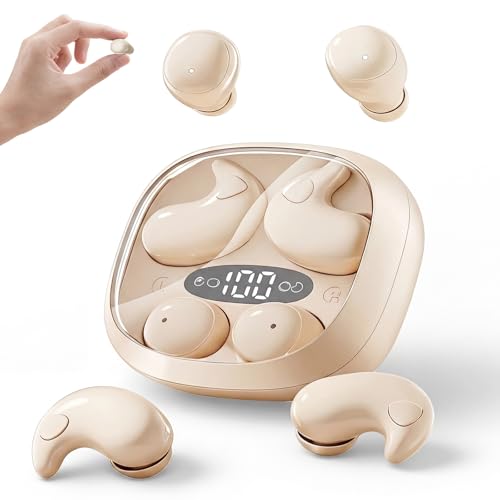
There is only one listing in our earbud catalogue that describes a seal at all. A
set of
ultra flat sleep earbuds for
side sleepers lists "Soft seal dampens outside noise" among its strengths, and it
is a bedtime bud whose own drawbacks say the "Sound is soothing rather than detailed
hi-fi". So the single sealed product on the shelf is the one not aiming at sound
quality, and every bud that is aiming at it has given the seal away. That is a finding
about the catalogue and about the market it reflects.
Take the seal away and the frequency arrives squared
Now the second equation, and it is where the question gets answered. An unsealed bud
is not compressing a volume. It is a small source radiating into open air a short
distance from your ear canal, and for that the pressure is the air density times the
cone area times pi times the square of the frequency times the displacement, divided
by the distance.
The frequency is squared. That single exponent is the whole difference between the
two designs. Halve the frequency and the same movement makes a quarter of the
pressure, which is 12 decibels down per octave. Put the other way round: holding a
level as you descend costs four times the travel every octave, and the travel is
finite.
A
Baseus Bowie MC2 Air clip on
open ear earbud is the right product to run that on, because it publishes the one
acoustic figure the arithmetic needs: "11mm custom dynamic drivers with
titanium-coated diaphragms". At 0.3 millimetres of travel and 20 millimetres from the
canal, an 11 millimetre driver tops out at 105.6 decibels at a thousand hertz, 77.6 at
two hundred, 65.6 at one hundred, and 53.5 at fifty.
Compare that with the 163 flat decibels of the sealed case and the gap at 50 hertz
is 109.6 decibels, which is a factor of about 302,000 in pressure. Nothing an equaliser
does is within six orders of magnitude of that.
The record states the conclusion correctly and without the magnitude. Its drawbacks
say "Bass will not match sealed in-ear buds" and its performance text says "bass will
never hit as hard as a sealed tip delivers", and then adds the sentence that matters
most: "The main points come from the open-ear design itself, not this particular pair."
That is exactly right, and 110 decibels is what "not this particular pair" is worth.
The record also credits a "SuperBass 2.0 mode" for a fuller low end, and on this
arithmetic such a mode can only be an equaliser boost, which means it is spending
travel the driver does not have and will reach its limit before the boost does.
The sealed equation is the adiabatic compression of a trapped volume and the open one
is the standard small source result, which is why the frequency appears squared in the
second and not at all in the first. The three driver diameters, 11, 13 and 16
millimetres, are the only acoustic figures our open earbud listings publish. Everything
else is representative rather than published: the 0.3 millimetre peak travel is typical
for a micro driver of this size and nothing states it, the 20 millimetre radiating
distance is a stand in for however far the bud sits from the canal entrance, the one
cubic centimetre residual volume is the usual figure for a sealed bud, and the 75 to 85
decibel band is ordinary listening rather than anyone's specification. Change any of
them and all three lines move together: the 12 decibels per octave slope, the 2.90 and
6.52 decibel gaps between the lines, and the 0.242 and 0.543 octaves those gaps buy are
fixed by the diameters alone.
So what does the hardware buy? Diameter, squared, and about half an octave
Area goes as the square of diameter, and area is the only term in the open equation
that a buyer gets to choose. Our catalogue happens to publish three driver sizes,
which makes this unusually concrete.
A
Defunc True LITE II open fit
wireless earbud publishes "a 13mm dynamic driver, relatively large for an earbud".
Thirteen over eleven, squared, is 1.397, so it is 2.90 decibels louder than the 11
millimetre bud everywhere: 56.4 decibels at fifty hertz instead of 53.5.
A pair of
JabNecter open ear
headphones publishes 16 millimetre drivers and 25 grams. Sixteen over eleven,
squared, is 2.116, so it is 6.52 decibels louder: 60.0 decibels at fifty hertz.
Convert those into the currency that means something. At a 12 decibel per octave
slope, 2.90 decibels is 0.242 of an octave and 6.52 decibels is 0.543. So the 13
millimetre bud reaches the 11 millimetre bud's fifty hertz ceiling at 42.3 hertz, and
the 16 millimetre bud reaches it at 34.3. Five millimetres of extra diameter is worth
a little over half an octave of extension.
That is a real gain and it is a small one, and it is the honest size of the "does
the hardware matter" question for this class of product. Half an octave. Against which
the seal is worth 109.6 decibels, or 9.1 octaves at the same slope, which is more than
the entire audible range.
The JabNecter record also contains the single best sentence in the category on this
subject. It says the lack of isolation and deep bass "is the physics of an open design,
not a fault", and then flags the tension in its own marketing: "The maker highlights
bold sound and bass, yet open-ear audio is inherently less isolated and less
bass-heavy than sealed options." A record that notices its own product's claim pulling
against its own product's physics is doing the job properly.
One bud on the shelf whose ceiling cannot be worked out at all
A set of
Defunc True Basic wireless
earbuds uses a "patented MultiTip semi-in-ear shape with soft silicone ear wings"
that "sits securely without pushing into the ear canal", and its drawbacks say "Open
fit means lighter bass". Both true. But the listing publishes no driver diameter, and
without a diameter there is no area, and without an area the open equation has nothing
to work on.
So of four unsealed listings, three publish the number this arithmetic needs and
one does not, and none of the four publishes the other number it needs, which is the
travel. Not one earbud we carry states an excursion, a sensitivity in decibels per
milliwatt, or a frequency response. The diameter is published because it is easy to
measure and sounds impressive. It is also the smaller half of the product that decides
the answer, since area scales as the square of a quantity that varies by 45 percent
across the catalogue while travel is unstated and varies by rather more.
The other thing an equaliser cannot do is subtract
This is where the second question comes in, the one about wearing open headphones
near an air conditioner, and it is the same arithmetic read from the other end.
An equaliser can add music. It cannot remove noise, because the noise does not pass
through it. An open coupling provides essentially zero decibels of passive attenuation
by design, so whatever is in the room arrives at full strength and the only lever you
have is to put the music above it, band by band.
Work that against the ceilings. A room with a unit running in it sits somewhere
around 60 decibels, and most of that energy is low frequency. At a hundred hertz the 11
millimetre bud's ceiling is 65.6 decibels, which is 5.6 decibels over the noise, and
5.6 decibels of margin is audible as a change in tone and not as bass. At fifty hertz
its ceiling is 53.5, which is 6.5 decibels under the noise. Below the noise is below the
noise. There is no equaliser curve, no bass boost mode and no fit adjustment that
recovers a signal you are not generating.
Which means the answer to "how do people handle it" is that they stop trying to win
that band. Raise the whole level and the midrange and treble come clear of the noise
long before the bass does, because the noise falls with frequency and the bud's ceiling
rises with it. The two curves pull apart, and content that lives above a few hundred
hertz, speech, podcasts, most vocal music, works fine. Bass heavy material does not,
and no amount of processing changes that.
A
Poly Blackwire 3325 stereo USB
headset is the opposite case and the only product here with cushions on both ears.
Its record says "Stereo with cushions on both ears gives passive isolation and makes
the headset usable for more than voice", which is the correct mechanism named in the
correct order: the isolation comes first and the usefulness follows from it. Its
drawbacks then say "Stereo covers both ears, so no room awareness", which is the same
fact counted as a cost, and both entries are right because it is a trade and not a
feature.
That record also deserves crediting for something it does not do. It states plainly
that there is "no frequency response, driver size or microphone pickup pattern anywhere
on the listing" and that "We have reported that absence rather than filling it with
plausible-sounding figures." That is the correct response to a missing specification
and it is rarer than it should be. It also means this is the one headphone on the shelf
whose behaviour cannot be estimated even roughly, because a cushioned over ear cup is
somewhere between the sealed and open equations and which end it sits nearer is decided
by the pad seal, which nobody measures and everybody's head changes.
What I deliberately did not calculate
Distortion. It belongs in this argument and I have left it out on purpose.
An equaliser is linear and a driver near its travel limit is not. The region where
a bass boost is asking for most of the available excursion is exactly the region where
the suspension stiffens, the motor leaves its uniform field and harmonic distortion
climbs steeply. So a boost that flattens the response on a measurement sweep can
manufacture audible distortion at the same time, and the two effects are invisible to
each other on a frequency response plot.
I cannot put a number on it from what our records contain. Not one listing publishes
a total harmonic distortion figure at any level or frequency, which means any estimate
would be a guess dressed as arithmetic. What I can say is the direction, and the
direction is that the equaliser setting which looks most successful on paper is the one
most likely to sound worst, which is the opposite of how people usually report their
results.
The honest limit
Three of the inputs above are published and the rest are not. The 11, 13 and 16
millimetre diameters are published. The 15 degree, 25 gram and 4.9 gram figures are
published and irrelevant to this. Everything else is representative: 0.3 millimetres of
peak travel is typical for micro drivers of this size and no listing states it, the 20
millimetre radiating distance stands in for a bud's offset from the canal entrance and
varies with ear shape, the one cubic centimetre residual volume is the conventional
figure for a sealed bud, and the 60 decibel room and 75 to 85 decibel listening band
are ordinary conditions rather than anyone's specification.
What none of those assumptions can move is the structure. The 12 decibels per
octave is an exponent, not a measurement. The 2.90 and 6.52 decibel gaps between the
three buds come from the diameters alone and are exact. The 0.242 and 0.543 octaves
those gaps buy follow from the exponent. And the sealed case has no frequency term in
it at all, which is why the seal wins by a margin no choice of driver can approach.
So the answer. If you are comparing two sealed headphones at a reasonable volume, an
equaliser gets you most of the way and the hardware matters much less than the hobby
believes. If one of them does not seal, the equaliser is being asked to supply
displacement rather than gain, and it will fail silently by clipping the driver instead
of the signal. Our page on
open ear
versus sealed headphones puts it in words already, that sealed designs "deliver
sound open-ear physically cannot match", and the only thing this page adds is how much
of a mismatch "cannot" is. It is 110 decibels at fifty hertz, and the choice of driver
inside the open design is worth half an octave of it.
Why EQ Cannot Give an Open Earbud Bass at a glance
People who take calls on both a computer and a phone through one headset
Three connections: USB-C, USB-A via adapter, and 3.5mm for mobile
No frequency response, driver size or mic pattern published
Why you can trust this guide
We compared these picks using verified manufacturer specifications, current retailer listings, and patterns in owner feedback, alongside editorial research. We focus on measurable differences such as performance, capacity, usability, and build quality. Pickpedia does not present editorial research as laboratory testing, and we do not claim hands-on testing unless it was actually performed.
Best for Comfortable bedtime listening for side sleepers
8.4/ 10 Pickpedia editorial score
A two-in-one set of ultra-flat, lightweight sleep earbuds for side sleepers, with a more in-ear and a flat pair in one charging case, a pressure-free fit and a gentle seal for white noise, podcasts and meditation.
Best for All-day comfort and staying aware of your surroundings
8.8/ 10 Pickpedia editorial score
Clip-on open-ear earbuds weighing 4.9 grams each, with soft air cushions and a flexible C-ring fit, 11mm titanium-coated drivers with SuperBass 2.0, a four-mic AI array for clear calls, up to 40 hours total playtime and IP67 waterproofing.
Best for Staying aware of your surroundings while listening on the go
8.6/ 10 Pickpedia editorial score
An open-fit, semi in-ear wireless earbud built around comfort and awareness: it rests in the ear without sealing the canal, so you hear your music and your surroundings at once, ideal for commuting, running near traffic and shared spaces. It pairs a 13mm dynamic driver for fuller sound with Bluetooth 6.0, low latency, ENC for clearer calls, IPX4 sweat and splash resistance, up to 20 hours of total playtime with the case, and companion app support. Understood as an aware everyday earbud rather than a sealed noise-blocking one, it is comfortable and likeable.
BrandDefunc
FitOpen-fit semi in-ear
Driver13mm dynamic
Bluetooth6.0, low latency
CallsENC noise reduction
Water resistanceIPX4 (sweat, splash)
PlaytimeUp to 20h total with case
AppCompanion app support
Pros
Open-fit design keeps you aware of traffic and surroundings
Very comfortable to wear for hours with no canal pressure
13mm driver gives fuller, balanced sound for the open format
ENC clear calls and low-latency Bluetooth 6.0 for synced video
IPX4 handles sweat and rain for workouts and bad weather
Up to 20 hours total playtime and companion app support
Cons
Open design gives no noise cancellation or deep isolation
Bass feels lighter and more outside noise comes through in loud places
IPX4 covers sweat and splashes but not swimming
Can leak a little sound at high volume in very quiet rooms
Best for Staying aware and comfortable while listening, with clear calls
8.8/ 10 Pickpedia editorial score
Lightweight 25-gram open-ear wireless headphones that keep your ears open for awareness, with a 220-degree rotatable boom mic and ENC noise cancellation for clear calls, 16mm Hi-Fi drivers, Bluetooth 5.4 with a 33-foot range and dual-device switching, hybrid touch and button controls, and a charging dock giving about 10 hours of playtime with a roughly 2-hour recharge.
BrandJabNecter
TypeOpen-ear wireless
Weight25 g
Mic220° boom mic, ENC (left-side)
Drivers16mm Hi-Fi
Bluetooth5.4, 33 ft, dual-device
ControlsTouch + multi-function button
Battery~10h play; dock, ~2h recharge
Pros
Open design keeps you aware of surroundings, safer for cycling
Very light at 25 grams, comfortable all day and in workouts
Strong calls with a boom mic and ENC noise cancellation
Bluetooth 5.4 with a 33-foot range and dual-device switching
Hybrid touch and button controls plus a tidy charging dock
About 10 hours of playtime, 2-hour recharge
Cons
Open design cannot isolate noise or deliver deep sealed-in bass
Not for immersive, isolated listening or maximum bass
Best for Comfortable, aware all-day listening and calls
8.6/ 10 Pickpedia editorial score
Wireless earbuds with Defunc's patented MultiTip semi-in-ear open-fit design, Bluetooth 6.0, quad microphones, IPX4 water resistance and up to 22 hours of total playtime, made for comfortable, aware all-day listening.
BrandDefunc
TypeTrue wireless earbuds
FitPatented MultiTip semi-in-ear open fit with ear wings
Best for People who take calls on both a computer and a phone through one headset
8.6/ 10 Pickpedia editorial score
A stereo wired headset with USB-C, an included USB-A adapter and 3.5mm mobile connectivity, a flexible boom mic, 180 degree pivoting speakers and a dedicated Microsoft Teams button.
BrandPoly
Model2-214017-333
Wearing styleStereo, hi-fi
Computer connectionUSB-C
AdapterUSB-C to USB-A, included
Mobile connection3.5 mm
MicrophoneFlexible boom
Speaker articulation180 degree pivot
AdjustmentFully adjustable headband
CushionsPadded headband, soft ear cushions
PlatformMicrosoft Teams version, dedicated Teams button