Home ›
Video & Audio › Why 100 Watts Is Not Twice as Loud as 50 Watts
Video & Audio
Why 100 Watts Is Not Twice as Loud as 50 Watts
PBy the Pickpedia Team·4 picks compared·Last verified October 2026
Affiliate disclosure: As an Amazon Associate, Pickpedia earns from qualifying purchases. Links on this page are paid links, and we may earn a commission at no extra cost to you. This never affects our picks or scores.
This page contains affiliate links. If you buy through one we may earn a
commission, at no cost to you.
No. Doubling the power adds three decibels, and three decibels is a change most
people describe as slightly louder rather than louder. The step that listeners
usually call twice as loud is about ten decibels, and ten decibels is ten times the
power, so the honest answer to the question is that you would need something near a
500 watt amplifier to make a 50 watt one sound twice as loud, driving the same
speaker in the same room.
That is only half of it, though, and the second half is the part that decides
what you should actually buy. Loudness is not a property of the amplifier. It is
the sum of two terms: how efficiently the speaker converts watts into sound, and
the logarithm of how many watts you send it. The first term is a constant called
sensitivity, it is published as decibels at one watt at one metre, and it swamps
any amplifier decision you are likely to make.
The two terms, and which one you can actually move
Write it out. Sound pressure level at one metre equals the sensitivity plus ten
times the logarithm of the power in watts. Everything about the question falls out
of that single line.
Put one watt in and the logarithm term is zero, so the speaker produces exactly
its published sensitivity. Double to two watts and the term is ten times the
logarithm of two, which is three decibels. Go to four watts and it is six. Ten
watts gives ten. A hundred watts gives twenty. Each doubling is worth the same
three decibels no matter where you start, which is why going from 50 to 100 watts
and going from 500 to 1000 watts buy you the identical, modest improvement.
Now put the other term next to it. Consumer speakers commonly sit somewhere
between 84 and 94 decibels at one watt at one metre, and a six decibel spread
inside that range is ordinary. Six decibels is four doublings of power. So choosing
an 87 decibel speaker over a 93 decibel one commits you to buying four times the
amplifier forever, in exchange for nothing. Work it the other way and the
arithmetic is brutal: a 93 decibel speaker on 10 watts hits 103 decibels at a
metre, and an 87 decibel speaker needs just under 40 watts to arrive at the same
103. The drawing below is that sentence as a graph.
Two speakers six decibels apart in sensitivity, plotted against amplifier power.
The quieter one needs four times the watts to arrive at the same level, and the
gap is fixed by the speaker rather than by the amplifier.
The two lines in that drawing are parallel because the power term is added to
the sensitivity rather than multiplied by it. Parallel lines never meet. No
amplifier you can buy closes a sensitivity gap; it only slides you along your own
line. That is the single most useful thing to know before spending money on
either component.
Why a 50 watt amplifier running at one watt still runs out
If three watts is enough for comfortable listening, why does anyone sell a 300
watt amplifier? Because music is not a steady tone, and the rating is not about
loudness at all. It is about peaks.
The ratio between the loudest instant and the average level is the crest factor.
Recorded music typically runs ten to twenty decibels of it, more on a sparse
acoustic recording and less on something heavily compressed. Ten decibels of crest
factor means the peaks demand ten times the average power. Twenty decibels means a
hundred times. So an amplifier sitting at a one watt average needs ten watts of
instantaneous headroom to pass a modest peak cleanly, and a hundred watts to pass a
large one. The rating is sized for the loudest tenth of a second in the track, and
the average draw during the rest of it is a tiny fraction of that.
This is why amplifier power still matters while being almost irrelevant to
loudness. Run out of headroom and the peak does not get quieter; it gets clipped,
the waveform tops flatten, and you hear harsh edges and a hardening on
transients. The fix is headroom, not volume. And headroom is exactly what
sensitivity buys you for free: every three decibels of speaker sensitivity halves
the watts your peaks need.
What our own audio products publish, and what they leave out
Here is the honest position across the site, and it is not flattering. Not one
published product on ThePickpedia gives a sensitivity figure in decibels at one
watt at one metre. The number that governs loudness is absent from every listing we
carry.
What one of them does publish is the power side, properly specified. A
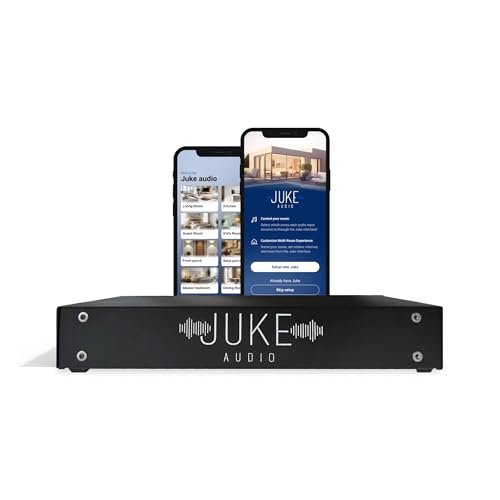
Juke Audio Juke-6 six zone
amplifier states 40 watts per channel into 8 ohms across up to twelve channels,
and separately states impedance stability down to 2 ohms per channel. Both halves
of that are meaningful, and the second half is rarer than the first. Forty watts
into 8 ohms is about 17.9 volts across the load drawing 2.24 amps. Hold the voltage
and drop the load to 2 ohms and the same swing asks for 8.94 amps and would deliver
160 watts, which is why a current limit stated as an impedance floor is the useful
way to publish this. For distributed audio the 40 watts is ample, because the
arithmetic above says 40 watts is 16 decibels above the one watt figure, and a
ceiling speaker only has to fill a room rather than win an argument. Our own record
flags that the listing states no manufacturer warranty, which is a real gap on an
installed component, and that the 40 watts suits distributed audio rather than a
main listening room. Both of those are fair. Full details in our
Juke Audio Juke-6
review.
Then the silence, and one listing is worth singling out because it is total. An
Andover Audio Spinbase 2
turntable speaker base publishes no power rating, no driver details and no
dimensions at all, on a product a turntable has to physically sit on top of. Its
amplification is named Dual Direct Drive and never explained. Our own record lists
every one of those as a drawback, which is the right call, and it means there is no
way to place this product anywhere on the graph above. See our
Andover Audio
Spinbase 2 review.
At the small end the question changes shape rather than going away. A
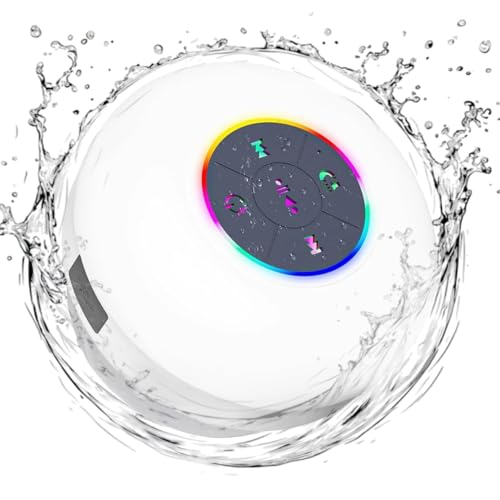
Luzsco Bluetooth shower
speaker publishes no power and no sensitivity, and for a sealed single driver
mini enclosure both figures would be close to meaningless anyway: its output is
limited by cone excursion and cabinet volume long before any amplifier runs out,
and the published figure that actually constrains it is the IPX4 rating, which our
record is careful to state is splash resistant rather than waterproof. Details in
the Luzsco
shower speaker review. The same applies to a pair of
Defunc True Basic open fit
earbuds, where the listing publishes 22 hours of total playtime and the fit, and
the honest driver of perceived loudness and bass is that an open fit does not seal
the ear canal, so low frequencies leak out and no amount of power replaces the
seal. Our record says exactly that, in its own words, as a drawback. See the
Defunc True Basic review.
In both cases the right reading is that sensitivity is the wrong question for a
sealed portable, and the sealing surface is the real one.
One thing we have said on this site that needs a number attached
Our speaker selector switches
guide compares its picks across "zone count, power handling, impedance
protection, and wiring compatibility", and it does explain the load problem rather
than leaving it hanging. It says plainly that "each added pair lowers the total
load your amp sees, which can overheat it", and it is honest enough to add that
"the impedance protection can slightly reduce output to attached speakers, so
demanding listeners may notice less headroom at high volume". That is correct on
both counts and we should not pretend otherwise.
What is missing is the size of the word slightly, and this page can supply it,
because the cost of that protection is measured in decibels. The cheap way to
protect an amplifier from a low load is a resistor in series with each zone. Put a
4 ohm resistor in front of an 8 ohm speaker and the speaker receives the fraction
8 over 12, squared, of the power, which is 0.444, which is 3.5 decibels down. A
2 ohm resistor costs 1.9 decibels. Translate that through the graph above: 3.5
decibels is most of the way to halving your available power, so the switch that
lets you add a second room has quietly taken a step and a half of amplifier
doubling away from both rooms. It also raises the source impedance the driver
sees, which loosens the electrical damping on the woofer and is heard as a softer,
less controlled bass rather than as lower volume.
That is also the clearest way to read the Juke-6 against a selector switch. The
switch solves the problem by throwing power away. The Juke-6 solves it by giving
each zone its own amplifier channel and publishing an impedance floor instead, so
nothing is dissipated in a resistor. We do not carry a speaker selector switch as a
published product, only that guide, so there is no listing to check this against on
our own site.
The honest limit
Nobody in this part of the market publishes sensitivity, so the number this
whole page turns on is not available to you on any product we list. If you are
buying passive speakers from a maker who does publish it, the figure is worth more
than any amplifier comparison you could run. If you are not, treat the watts as a
headroom specification and stop reading them as a loudness specification.
And then do the free thing first, because it is worth more than the upgrade.
Sound level falls with distance, about six decibels per doubling in the open, so
halving your listening distance is worth the same as four times the amplifier and
costs nothing. Putting a speaker against a wall couples it to the boundary and
typically returns a few decibels in the bass for free; putting it into a corner
couples it to two or three surfaces and returns more, at the cost of some
muddiness you may or may not mind. Lifting a speaker off a soft surface and onto
something rigid stops the cabinet losing energy into the furniture. Pointing it at
your head rather than past it is worth several decibels at the top end on its own,
because dispersion narrows with frequency.
Taken together, placement and distance routinely move the level at your ear by
more than the difference between any two amplifiers you were choosing between. Do
all of that, listen, and only then decide whether you have a power problem. If
peaks still harden up when you turn it up, that is a headroom problem and more
watts is the right answer. If it is simply not loud enough at any setting without
hardening, the speaker is the component you are fighting, and no amplifier will
move its line.
Why 100 Watts Is Not Twice as Loud as 50 Watts at a glance
We compared these picks using verified manufacturer specifications, current retailer listings, and patterns in owner feedback, alongside editorial research. We focus on measurable differences such as performance, capacity, usability, and build quality. Pickpedia does not present editorial research as laboratory testing, and we do not claim hands-on testing unless it was actually performed.
Best for Homes with passive in-ceiling or in-wall speakers already installed, run from Apple or Spotify devices
8.8/ 10 Pickpedia editorial score
A six-zone, twelve-channel amplifier delivering 40 watts per channel into 8 ohms, with each zone appearing individually in AirPlay 2 and Spotify, plus Bluetooth and DLNA, and support for simultaneous streams from different users.
Best for Anyone wanting a complete record setup on one shelf, with no separate amplifier or speaker stands
8.6/ 10 Pickpedia editorial score
A powered speaker base designed to sit under a turntable, using patented ISOGroove anti-feedback technology, with a built-in phono input plus Bluetooth, analog, optical digital and USB, and an IR remote for input, volume and tone.
BrandAndover Audio
ModelSpinbase 2
Part numberAAMD4SB2BK01NA
TypePowered speaker base for turntables
Anti-feedbackISOGroove, patented
AmplificationDual Direct Drive
Phono inputYes
WirelessBluetooth
Wired inputsAnalog, optical digital, USB music files
RemoteIR, for input, volume and tone
GrillHeathered fabric wrap
FinishBlack
DimensionsNot published on the listing
Power ratingNot published on the listing
Warranty1 year manufacturer
Pros
Patented ISOGroove technology lets a turntable sit directly on top
Built-in phono input, so no separate preamp is needed
Bluetooth, analog, optical digital and USB inputs as well
IR remote covers input, volume and tone
Tone controls, not just volume
Heathered fabric wrap grill reads as furniture
One box replaces a phono stage, amplifier and speakers
Warranty clearly stated at 1 year from the manufacturer
Cons
No dimensions published, on a product a turntable must physically fit
No power rating or driver details given
Dual Direct Drive amplification is named but not explained
Single enclosure means narrower stereo separation than spaced speakers
No isolation measurement published for the anti-feedback claim
Best for Splash-proof music in the shower, pool or outdoors
8.6/ 10 Pickpedia editorial score
A compact, lightweight Bluetooth shower speaker with a suction cup mount and a built-in LED, rated IPX4 splash-proof (the maker states it is not waterproof), for showers, pools, beaches and float trips.
BrandLuzsco
TypePortable Bluetooth shower speaker
Water ratingIPX4 splash-proof (not waterproof)
ConnectionBluetooth wireless
MountSuction cup for smooth surfaces
LightBuilt-in LED
SizeCompact, lightweight mini
ColourWhite
Pros
Suction cup mounts it hands-free anywhere smooth
IPX4 splash-proof for showers and poolside
Bluetooth keeps your phone away from water
Light and portable for beach, pool and floats
Built-in LED adds fun
Very affordable and giftable
Cons
IPX4 is splash-proof only, not waterproof or submersible
Best for Comfortable, aware all-day listening and calls
8.6/ 10 Pickpedia editorial score
Wireless earbuds with Defunc's patented MultiTip semi-in-ear open-fit design, Bluetooth 6.0, quad microphones, IPX4 water resistance and up to 22 hours of total playtime, made for comfortable, aware all-day listening.
BrandDefunc
TypeTrue wireless earbuds
FitPatented MultiTip semi-in-ear open fit with ear wings