Home ›
Kettles › Why Coffee Brews 15 Degrees Below the Kettle
Kettles
Why Coffee Brews 15 Degrees Below the Kettle
PBy the Pickpedia Team·7 picks compared·Last verified October 2026
Affiliate disclosure: As an Amazon Associate, Pickpedia earns from qualifying purchases. Links on this page are paid links, and we may earn a commission at no extra cost to you. This never affects our picks or scores.
This page contains affiliate links. If you buy through one we may earn a
commission, at no cost to you.
One hundred degrees, and then falling at about two and a half kelvin a minute. But that
is the easy half of the question and it is not where the temperature goes.
The water leaves the kettle at whatever the kettle says. It then passes through a cold
dripper, a cold filter and 20 grams of cold coffee on its way into a cold glass server, and
by the time it is sitting in the bed it is 15.55 kelvin below the figure on the display. A
kettle that controls temperature to the degree has had its entire precision spent fifteen
times over before the first drop arrives.
That is the useful answer, and it also settles a second question people ask a lot, which
is why a cup from a shop can taste underdeveloped. The thermal problem is a home problem. A
cafe's bigger batch loses less.
The mixing arithmetic, which is just a weighted average
A
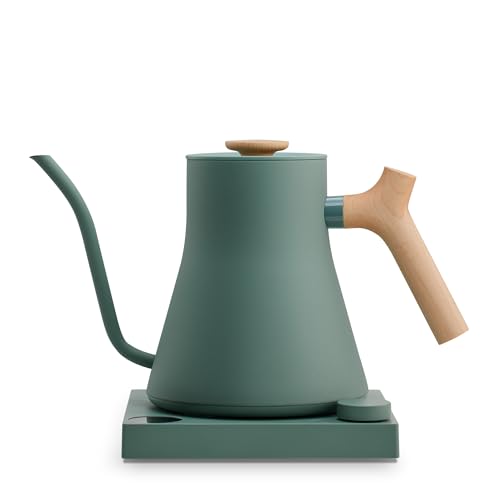
Fellow Stagg EKG Pro electric
gooseneck kettle publishes 0.9 liters, to-the-degree temperature control, a Guide Mode
with presets, a built-in brew stopwatch, and the two targets this argument needs: "Set exact
targets like 205 degrees F for coffee or 180 degrees F for green tea." Two hundred and five
Fahrenheit is 96.1 degrees Celsius, and that is the number on the display.
Now the pour. Heat capacity is mass times specific heat, and when two bodies mix the
result is the average weighted by those capacities. Three hundred and twenty grams of water
at 4.186 kilojoules per kilogram per kelvin is 1.3395 kilojoules per kelvin.
On the other side of the ledger, at room temperature: a glass server of about 300 grams
at 0.84 is 0.2520, a steel dripper and mesh filter of about 120 grams at 0.50 is 0.0600, and
20 grams of dry grounds at about 1.6 is 0.0320. Together, 0.3440 kilojoules per kelvin,
which is 25.7 percent of the water's.
So the temperature in the bed is 1.3395 times 96.1 plus 0.3440 times 20, all divided by
1.6835, which is 80.55 degrees.
Fifteen and a half kelvin, gone, before extraction has started.
Rinse the same equipment with boiling water first so that it begins at 90 degrees instead
of 20, and the same arithmetic gives 94.86 degrees, a loss of 1.24 kelvin. The rinse recovers
14.3 of the 15.5. There is no other single action in pour-over technique with that
leverage.
Three numbers worth putting on one scale
The reason this matters is not the 15.5 on its own. It is the 15.5 against the two things
people do try to control.
The dial resolves one kelvin, as published. A minute of standing around with the kettle
open removes 2.42 kelvin, taking a loss coefficient of 2.0 watts per kelvin for a 0.9 liter
stainless kettle 76 kelvin above a 20 degree room. And the brewer removes 15.55, all at
once, at the instant of the pour.
The brewer is 15.5 times the resolution of the instrument bought specifically to control
this variable, and it is the equivalent of six and a half minutes of dithering compressed
into one second. The dial is not useless. It is simply downstream of a much larger term that
nothing on any of these listings mentions.
The mixing calculation is exact arithmetic on heat capacities: conserving heat between two
bodies gives the weighted average of their temperatures, so the 80.55 and the 94.86 follow
from the masses and specific heats with no modelling in between. Water is 4.186 kilojoules
per kilogram per kelvin, taken from our own kettle wattage page. The published inputs are the
205 and 180 degree Fahrenheit settings, the 140 to 208 Fahrenheit range, the 0.9 and 1.0 and
1.5 liter capacities, the 1,200 and 1,100 and 1,000 watt elements, the five, seven and three
to six minute boil claims, and the four components of the pour over set. Representative rather
than published: every mass on the cold side, because not one listing in this category
publishes the mass of a dripper, a server or a filter, and those masses are the whole of the
15.55 kelvin. A server of 200 grams instead of 300 gives a loss of 12.1 kelvin and one of 400
gives 18.8, so read the direction and the order of magnitude as firm and the exact figure as
proportional to an assumption. Also representative: the specific heats of 0.84 for borosilicate
glass, 0.50 for stainless and 1.6 for dry grounds, the loss coefficient of 2.0 watts per kelvin
behind the kettle cooling rate, the 2 grams of water per gram of coffee retained by the spent
bed, and the activation energy band of 20 to 40 kilojoules per mole behind the extraction rate
ratio. The 19.5 percent extraction yield is a target, not a measurement.
What 15.5 kelvin does to the coffee
Dissolution rates follow an Arrhenius dependence, exponential in inverse absolute
temperature, and our page on
why steam cannot get hotter than
100 degrees sets out that pattern and the conventional way of handling it in food work.
For coffee solubles the activation energy usually lands somewhere between 20 and 40
kilojoules per mole.
Run the ratio between 369.25 kelvin and 353.70. At 20 kilojoules per mole the hotter water
extracts 1.33 times faster. At 30 it is 1.54 times. At 40 it is 1.77.
So call it one and a half. Which means a recipe written for three minutes of contact at
96 degrees needs 4.0 to 5.3 minutes at 80.6 to arrive in the same place, and nobody brewing
to a timer gives it that. The cup is not wrong because the grind is wrong. It is short
because the clock ran out at a temperature the recipe was not written for.
And the fix is not to turn the dial up. Pushing the kettle from 205 to 212 Fahrenheit
recovers 3.9 kelvin of the 15.55, which is a quarter of it, and does so by boiling the water,
which brings its own problems. Rinsing the brewer recovers 14.3 kelvin for the cost of thirty
seconds and a kettle full of water you were boiling anyway.
The equipment that supplies the thermal mass
A
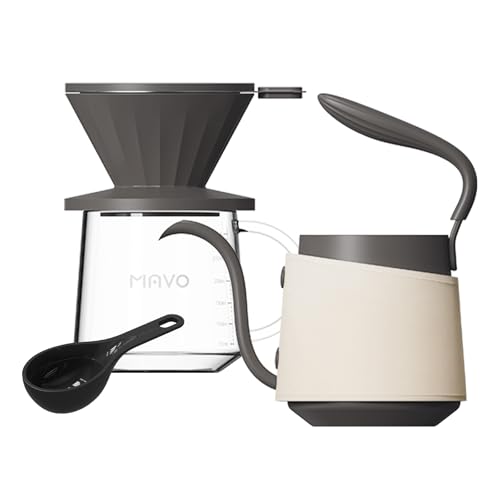
MAVO pour over coffee maker set
is the clearest case, because it publishes the whole cold side as a list: "a pour over kettle,
a coffee dripper, a glass coffee server with a measurement scale, and a reusable stainless
steel filter mesh". Food-grade stainless for the carafe and filter, glass and steel for the
dripper and server, and a heat-resistant sleeve on the kettle.
Every item on that list is a term in the 0.3440. And not one of them has a published mass.
Four components, materials named for all of them, and no figure anywhere that would let a
buyer work out what the pour is going to lose. That gap runs across the category, which is
why the masses above are assumptions and why the figcaption spells out what happens when they
move: a 200 gram server gives a loss of 12.1 kelvin and a 400 gram one gives 18.8.
The set is also right about the part it does address. Its record notes that the reusable
mesh "lets more coffee oils and a little fine sediment through than paper does", which is a
filtration property and is correctly separated from everything else. Steel versus paper
changes what gets through. It does not change the temperature, except insofar as a steel mesh
is a few more grams on the cold side than a paper cone.
Our roundup of
pour-over coffee makers for more brew control is
the place to compare them, and the one question worth adding to that comparison is how heavy
the thing is, because that is the variable this page is about and it is the one nobody
publishes.
A kettle claim that checks out, and a conflation that does not
A
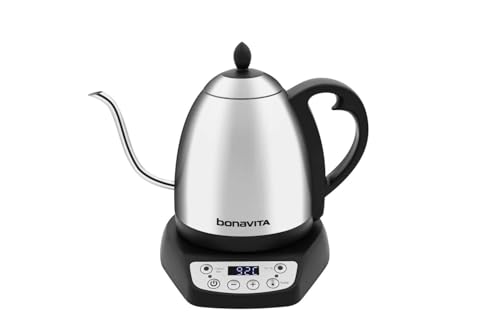
Bonavita 1L digital variable
temperature gooseneck kettle publishes 1200 watts, a range of 140 to 208 degrees
Fahrenheit, which is 60 to 98 Celsius, six presets, a 60-minute hold, 304 stainless steel, and
a speed claim: it "brings water to a boil in about five minutes".
That one is checkable and it survives. One liter from 20 to 100 degrees is 334.9
kilojoules. At 1200 watts that is 279 seconds, so 4.65 minutes at perfect efficiency. Five
minutes therefore implies about 93 percent of the element reaching the water, which is exactly
what an immersed element in a stainless body should manage. It is the only speed claim in this
category that is published alongside its own wattage and comes out consistent, and it deserves
to be said.
The same record then makes a mistake that our site has already taken apart in another
aisle. One field says "1-degree temperature accuracy" and another says control "runs in
1-degree increments". Those are not the same statement. An increment is resolution, which is
how finely the display divides the world, and accuracy is how close the reading is to the
truth. Our page on
whether a 1 gram display means
a 1 gram accurate scale works through that distinction in detail, and everything it says
about a scale applies here unchanged. A kettle that steps in single degrees has told you about
its display, not about its sensor.
Which is worth knowing precisely because of the 15.55 above. If the sensor is two kelvin
out, that is 13 percent of the brewer's error and it is invisible. The dial's problem is not
that it is imprecise. It is that it is measuring the wrong end of the process.
A ceiling that does not exist at altitude
The Bonavita's top setting is 208 Fahrenheit, which is 97.8 degrees Celsius, and the
listing publishes no altitude setting.
At 1,609 meters, which is 5,280 feet, water boils at about 94.4 degrees Celsius, so 202
Fahrenheit. The top six degrees Fahrenheit of that kettle's published range cannot be reached
there by any means, because the water leaves as steam instead. A kettle set to 208 in Denver
will heat until it boils, sit at 202, and never satisfy its own controller.
The Stagg handles this, and it is the only product in the category that does. Among the
settings its record lists are "boil scheduling, hold mode, altitude, and chime". An altitude
setting is the correct response to exactly this problem: it tells the controller where the
boiling point is so the dial and the physics agree.
There is one oddity in the Stagg's own write-up worth flagging, because it denies the
existence of a part the feature requires. Its summary says it "lacks a built-in thermometer
(not needed due to digital control)", and its drawbacks repeat "No built-in thermometer (but
digital display shows temp)". Digital control of a temperature is a feedback loop around a
temperature sensor. A kettle cannot hold 205 Fahrenheit to the degree without measuring it.
What the listing presumably means is that there is no dial thermometer in the lid, which is a
reasonable thing to say and not what it says.
The one feature that acts on the right variable
Of the nine kettles here, exactly one publishes a property that changes the cooling rate
rather than the heating rate. A
Secura stainless steel double wall
electric kettle publishes 1.0 liter, 1000 watts, a fully stainless interior and
"Double-wall construction keeps exterior cool and retains heat".
Retains heat is the operative half. A double wall roughly halves the loss coefficient, so
on the same arithmetic as above the drift falls from about 2.42 kelvin a minute to about 1.21.
In the currency of this page that is 6.4 minutes of grace instead of 3.2, which is useful if
you brew two cups in sequence and irrelevant to the 15.55 if you do not rinse the dripper.
A
Breville BKE820XL IQ kettle
approaches the same problem electrically instead: 7 cups, which is 57 ounces or 1.686 liters,
five presets including one for French press, and a keep-warm function that "maintains the
water temperature for 20 minutes". Twenty minutes against the Bonavita's sixty, and its own
drawbacks name that as the limitation.
Nobody publishes what a hold draws, which is a pity because it is a small number and an
interesting one. Holding a liter at 96.1 degrees against a loss coefficient of 2.0 watts per
kelvin takes about 152 watts continuously, which is 12.7 percent of a 1200 watt element. A
hold is not the kettle reheating. It is the kettle idling at an eighth of its power, and that
is the figure that tells you whether an hour of hold is a reasonable thing to ask of it.
Two speed claims that do not survive their own arithmetic
Here is where the records get interesting, and both problems are the same shape: a boil
time published without the wattage that would support it, or alongside one that will not.
An
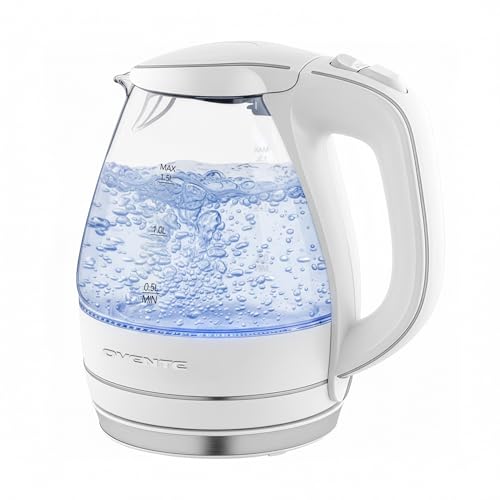
OVENTE 1.5L glass electric kettle
publishes 1100 watts, 1.5 liters, borosilicate glass, a 360-degree base, and "Boils water in
7 minutes or less".
One and a half liters from 20 to 100 degrees is 502.3 kilojoules. Seven minutes is 420
seconds, so the claim requires 1,196 watts delivered into the water. That is 8.7 percent above
its own published element, at perfect efficiency, with nothing left over for the glass or the
base. The claim is achievable at a fill of 1.379 liters, so it is true of 92 percent of the
kettle and not of the kettle.
It also publishes "50% more efficient than stovetop kettles" with no burner named, and gas
and electric hobs sit far enough apart that there is no arrangement of numbers that makes that
checkable in either direction.
A
Cosori stainless steel electric
kettle is the harder case, and it is the only one of these where the published figure is
not merely optimistic but unavailable. It publishes 1.5 liters, a seamless 304 stainless
interior, a two-level lid, shutoff 30 seconds after boiling, and "Quick boil in 3-6 minutes for
1.5L". It publishes no wattage at all.
Work backwards. The same 502.3 kilojoules in three minutes needs 2,790 watts. Our page on
whether kettle wattage really matters
establishes the ceiling that blocks it: a standard North American outlet on a 15 amp circuit
allows 1,800 watts at the absolute maximum. The fast end of this kettle's own published range
needs 1.55 times the entire circuit.
Even at that ceiling, with 100 percent of it reaching the water, 1.5 liters takes 279
seconds, which is 4.65 minutes. So everything from 3 to 4.65 minutes of a published 3-to-6
range cannot happen on the supply the appliance is sold for, and the half of the range that
can is the slow half. Our roundup of
temperature control kettles is the place to
compare the controllable ones, where a published wattage is the figure that makes a boil time
mean anything.
Why a shop's cup can taste thin, which is a different fault
The obvious explanation for an underdeveloped cup from a cafe is that their water cooled
on the way in, and the arithmetic says the opposite. The water's heat capacity grows with the
dose and the brewer's does not, so a bigger brew loses proportionally less.
Take a 60 gram dose with 960 grams of water into a larger brewer, say a 450 gram server
and 180 grams of steel. The water is now 4.0186 kilojoules per kelvin against a cold side of
0.564, and the result is 86.73 degrees. A loss of 9.37 kelvin instead of 15.55. A cafe batch
starts 6.2 kelvin better off than your single cup does, and that is before anyone rinses
anything.
So if the cup is thin, look at the ratio rather than the temperature, because strength and
extraction are two separate numbers and the ratio moves one and not the other. Twenty grams
of coffee taken to a 19.5 percent extraction yield has dissolved 3.90 grams of solids, however
much water went through it. At one part coffee to fifteen parts water, 300 grams in, about 40
retained by the spent bed, the beverage weighs 260 grams and carries 1.500 percent dissolved
solids. At one to seventeen, 340 in and 300 out, the same 3.90 grams is 1.300 percent.
Identical extraction, 13.3 percent weaker. A cup brewed that way is not underextracted at
all. It is correctly extracted and thin, and those two faults taste different: thin is flat
and watery, underextracted is sour and hollow. Our comparison of
a coffee maker versus pour over covers the control
side of this, and the useful addition is that the two faults have different fixes. Thin wants a
tighter ratio. Sour wants a hotter bed or a longer contact, and the hotter bed is the 14.3
kelvin sitting in a rinse.
The honest limit
What is exact here is the mixing. Conserving heat between two bodies gives the average of
their temperatures weighted by their heat capacities, so the 80.55 and the 94.86 follow from
masses and specific heats with no modelling in between. The two boil-time arithmetics are
exact too, because they are an energy divided by a published power, and the 2,790 watts and the
1,196 watts are what the claims require rather than what anything delivers.
What is representative, and it is the load-bearing assumption of the whole page, is every
mass on the cold side. No listing in this category publishes the mass of a dripper, a server,
a filter or a kettle, and those masses are the entire 15.55 kelvin. The figures used here are
ordinary for glass and steel equipment of that size, and the sensitivity is worth repeating: a
200 gram server gives a loss of 12.1 kelvin and a 400 gram one gives 18.8. The direction and
the order of magnitude are firm. The exact number is proportional to a guess, and it would stop
being a guess the moment anyone printed a weight.
Also representative: the loss coefficient of 2.0 watts per kelvin behind the 2.42 kelvin a
minute and the 152 watt hold, the specific heats of 0.84 for borosilicate and 1.6 for dry
grounds, the 2 grams of water per gram of coffee retained by a spent bed, and the activation
energy band of 20 to 40 kilojoules per mole. That last one is why the extraction ratio is given
as 1.33 to 1.77 rather than as a single figure, and anyone quoting one number out of that band
is overstating what is known.
What this page deliberately does not compute is a flavor outcome. Extraction yield is a mass
fraction and taste is not, and the mapping between them depends on the bean, the roast and the
water, none of which any product here publishes. Nor has it tried to compute the temperature
profile during the brew, which would need a flow rate through the bed and a bed permeability,
and the only product that publishes anything adjacent is a pour-over set describing its filter
as metal. The 19.5 percent is a target that the industry uses, not a measurement of
anything.
And the residue is three sentences. Rinse the dripper and the server with the water you
already boiled, because it is worth 14.3 of the 15.5 kelvin and nothing else is close. Treat
the dial as a sensible last adjustment rather than the main one, and remember a published
increment is not a published accuracy. And if you live high up, check whether your kettle knows
it, because exactly one of the nine here has somewhere to tell it. Our roundup of
gooseneck kettles is where to compare the pouring
hardware itself.
Why Coffee Brews 15 Degrees Below the Kettle at a glance
Fellow Stagg EKG Pro Electric Gooseneck Kettle - Pour-Over
Pour-over coffee and tea enthusiasts who value precise temperature control and brewing customization.
To-the-degree temperature control Precision gooseneck spout for controlled pours Built-in brew timer and Guide Mode presets Scheduling and customizable settings (hold mode, altitude, chime) Intuitive full-color display Ergonomic handle and stylish design
Small capacity (0.9 liters) No built-in thermometer (but digital display shows temp) Wood handle may require extra care Higher-end feature set may be overkill for casual users
Bonavita 1L Digital Variable Temperature Gooseneck Electric
Home pour-over coffee and specialty tea brewing
1-degree temperature accuracy 6 preset temperatures for convenience 1200-watt fast heating (boil in ~5 min) 60-minute temperature hold Gooseneck spout for precise pouring 304 stainless steel and BPA-free materials
Not cordless Only 1-liter capacity No automatic shut-off mentioned in specs LED panel may be bright in low light
Secura Stainless Steel Double Wall Electric Kettle Water
Small households or individuals who prioritize water purity and safety.
100% stainless steel interior, no plastic contact with water Double-wall construction keeps exterior cool and retains heat Cordless design with 30-inch power cord for flexibility Auto shut-off and boil-dry protection for safety ETL approved BPA-free cool-touch exterior
No water level window 1000W power may result in slower boiling 1.0L capacity may be small for larger families Water level lines only visible from inside
Tea and coffee lovers who want preset temperature settings and a keep warm function for small to medium batches.
Five preset temperature settings for different beverages Keep warm function holds temperature for 20 minutes Cordless design with 360-degree base for easy pouring Auto shut off and boil dry protection for safety Brushed stainless steel finish looks sleek Cord storage keeps counter tidy
Only 7-cup capacity may be small for large households No manual temperature adjustment, only presets Keep warm function only lasts 20 minutes No water level window or markings mentioned
Everyday hot water needs like tea, coffee, and instant meals.
Boils water in 7 minutes or less Auto shut-off and boil-dry protection Stylish borosilicate glass with blue LED 360-degree rotary base with cord storage 50% more efficient than stovetop kettles 2-year warranty and US-based support
No temperature control 1100W may be slower than higher wattage kettles Glass body may be fragile if dropped Cord length not specified
Plastic-conscious households wanting a simple, safe electric kettle
Seamless 304 stainless steel interior, no plastic contact Two-level lid for safe pouring and easy cleaning Automatic shutoff 30 seconds after boiling Boil-dry protection for safety Blue LED indicator shows boiling status Quick boil in 3-6 minutes for 1.5L
No temperature presets No keep-warm function Boil time varies (3-6 min) Only available in silver
Why you can trust this guide
We compared these picks using verified manufacturer specifications, current retailer listings, and patterns in owner feedback, alongside editorial research. We focus on measurable differences such as performance, capacity, usability, and build quality. Pickpedia does not present editorial research as laboratory testing, and we do not claim hands-on testing unless it was actually performed.
Best for Pour-over coffee and tea enthusiasts who value precise temperature control and brewing customization.
8.8/ 10 Pickpedia editorial score
The Fellow Stagg EKG Pro is a 0.9-liter electric gooseneck kettle designed for pour-over coffee and tea. It offers to-the-degree temperature control, a high-res LCD, scheduling, and a built-in brew timer. Its precision spout and ergonomic handle aim to improve your pour technique. While it lacks a built-in thermometer (not needed due to digital control) and has a modest capacity, it excels in customization and precision.
1) The Ultimate Pour-overDesigned for pour-over perfection, the precision spo
2) Tailored To Your RoutinThe full-color display offers an intuitive interface
3) Pour Like A ProA precision gooseneck spout ensures a slow, controll
4) Effortless PrecisionWith to-the-degree temperature control and a quick h
5) Brew With ConfidenceGuide Mode lets you select a preset temperature for
Pros
To-the-degree temperature control Precision gooseneck spout for controlled pours Built-in brew timer and Guide Mode presets Scheduling and customizable settings (hold mode, altitude, chime) Intuitive full-color display Ergonomic handle and stylish design
Cons
Small capacity (0.9 liters) No built-in thermometer (but digital display shows temp) Wood handle may require extra care Higher-end feature set may be overkill for casual users
Best for Making clean, flavourful pour over coffee without paper filters
8.8/ 10 Pickpedia editorial score
A complete pour over coffee set including a pour over kettle with a heat-resistant sleeve, a coffee dripper, a glass coffee server with a measurement scale and a reusable stainless steel mesh filter, made from food-grade steel and glass, for making pour over coffee without paper filters.
BrandMAVO
TypePour over coffee set
IncludesKettle, dripper, scaled server, filter
FilterReusable stainless steel mesh
MaterialsFood-grade steel and glass
KettlePour over, heat-resistant sleeve
ServerGlass with measurement scale
ColourGrey
Pros
Complete set, ready to brew
Reusable steel filter, no paper needed
Quality steel and glass, not plastic
Scaled glass server for consistency
Heat-resistant kettle sleeve for control
Great value for a full kit
Cons
Manual method, takes a little practice
Metal filter passes more oils and sediment than paper
Best for Home pour-over coffee and specialty tea brewing
8.8/ 10 Pickpedia editorial score
The Bonavita 1L Digital Variable Temperature Gooseneck Kettle offers 1-degree temperature accuracy across a wide range, with six presets for convenience. Its 1200-watt heating element boils water quickly, and the 60-minute hold keeps your chosen temperature steady. Built from 304 stainless steel and BPA-free plastics, it is designed for durability and safety. This kettle is ideal for pour-over coffee and tea enthusiasts who value precision.
FeaturePrecision Temperature - Fine-tune your brew with 1-d
FeaturePrecision Quality - Crafted from 304 stainless steel
FeaturePrecision Timing - With 1200 watts of power, your wa
FeaturePrecision Heat Hold - Enjoy up to 60 minutes of temp
Pros
1-degree temperature accuracy 6 preset temperatures for convenience 1200-watt fast heating (boil in ~5 min) 60-minute temperature hold Gooseneck spout for precise pouring 304 stainless steel and BPA-free materials
Cons
Not cordless Only 1-liter capacity No automatic shut-off mentioned in specs LED panel may be bright in low light
Best for Small households or individuals who prioritize water purity and safety.
8.8/ 10 Pickpedia editorial score
The Secura SWK-1001DB is a 1.0-liter electric kettle with a 100% stainless steel interior, double-wall construction, and a cool-touch exterior. It offers cordless convenience and safety features like auto shut-off and boil-dry protection. While it lacks a water level window, the interior markings keep water away from plastic. Performance is adequate for small batches, but the 1000W heating power may be slower than higher-wattage models.
FeatureComes with 100% stainless steel interior. Water leve
FeatureCordless design allows for easy filling, traveling a
Feature1.0 Liter Capacity, Double-Wall Construction Boils W
Pros
100% stainless steel interior, no plastic contact with water Double-wall construction keeps exterior cool and retains heat Cordless design with 30-inch power cord for flexibility Auto shut-off and boil-dry protection for safety ETL approved BPA-free cool-touch exterior
Cons
No water level window 1000W power may result in slower boiling 1.0L capacity may be small for larger families Water level lines only visible from inside
Best for Tea and coffee lovers who want preset temperature settings and a keep warm function for small to medium batches.
8.8/ 10 Pickpedia editorial score
The Breville BKE820XL IQ Kettle is a 7-cup (57 oz) cordless kettle with five pre-programmed temperature settings for different tea types and French press coffee. It includes a keep warm function that maintains the water temperature for 20 minutes, and a 360-degree base with cord storage. While it offers convenience and precision, its capacity is smaller than some larger kettles, and it lacks variable temperature control beyond the presets.
FeatureWith a 7 cup capacity, the Breville IQ Kettle is a s
5 Varietal SettingsBreville's practical kettle is for tea and coffee lo
Keep Warm ButtonNo more racing to pour your water before it cools; O
Cordless ConvenienceNeed to pour hot water into mugs on the other side o
Settings5 Pre-programed Settings, Auto shut off and boil dry
Pros
Five preset temperature settings for different beverages Keep warm function holds temperature for 20 minutes Cordless design with 360-degree base for easy pouring Auto shut off and boil dry protection for safety Brushed stainless steel finish looks sleek Cord storage keeps counter tidy
Cons
Only 7-cup capacity may be small for large households No manual temperature adjustment, only presets Keep warm function only lasts 20 minutes No water level window or markings mentioned
Best for Everyday hot water needs like tea, coffee, and instant meals.
8.8/ 10 Pickpedia editorial score
The OVENTE 1.5L Glass Electric Kettle combines a sleek borosilicate glass body with practical features like auto shut-off and boil-dry protection. It boils water quickly, thanks to its 1100W power, and its 360-degree base adds convenience. While it lacks temperature controls, it's a solid choice for basic hot water needs.
FeatureA BLEND OF STYLE & DURABILITY , The OVENTE KG83 Kett
FeatureENJOY HOT WATER ANYTIME , This attractive glass elec
FeatureCONVENIENCE AT ITS FINEST , Enjoy peace of mind with
FeatureUS-BASED CUSTOMER SERVICE LETS YOU BUY WITH CONFIDEN
Pros
Boils water in 7 minutes or less Auto shut-off and boil-dry protection Stylish borosilicate glass with blue LED 360-degree rotary base with cord storage 50% more efficient than stovetop kettles 2-year warranty and US-based support
Cons
No temperature control 1100W may be slower than higher wattage kettles Glass body may be fragile if dropped Cord length not specified
Best for Plastic-conscious households wanting a simple, safe electric kettle
8.8/ 10 Pickpedia editorial score
The Cosori Stainless Steel Electric Kettle is a 1.5L appliance focused on clean water and durability. Its seamless 304 stainless steel interior avoids plastic contact, and the two-level lid helps with safe pouring and easy cleaning. It boils quickly, with an LED indicator and automatic safety shutoffs. A solid choice for those who want a simple, no-frills kettle without plastic in the water path.
𝑬𝑵𝑱𝑶𝒀 𝑪𝑳𝑬𝑨𝑵 𝑾𝑨𝑻𝑬𝑹The seamless inner shell has no crevices for dirt to
2-𝑳𝑬𝑽𝑬𝑳 𝑳𝑰𝑫Open the lid to 45° using the button to avoid hot wa
𝑸𝑼𝑰𝑪𝑲 𝑩𝑶𝑰𝑳Bring 6 cups / 1.5 liters of water to a rolling boil
𝑺𝑨𝑭𝑬 𝑻𝑶 𝑼𝑺𝑬The kettle automatically shuts off 30 seconds after
Pros
Seamless 304 stainless steel interior, no plastic contact Two-level lid for safe pouring and easy cleaning Automatic shutoff 30 seconds after boiling Boil-dry protection for safety Blue LED indicator shows boiling status Quick boil in 3-6 minutes for 1.5L
Cons
No temperature presets No keep-warm function Boil time varies (3-6 min) Only available in silver