PBy the Pickpedia Team·4 picks compared·Last verified October 2026
Affiliate disclosure: As an Amazon Associate, Pickpedia earns from qualifying purchases. Links on this page are paid links, and we may earn a commission at no extra cost to you. This never affects our picks or scores.
This page contains affiliate links. If you buy through one we may earn a
commission, at no cost to you.
Not because of the enamel. I went into this expecting the answer to be the glass
coating reaching its limit, and the arithmetic says the opposite with some force: at
480 degrees Fahrenheit an enamel coating still holds 71 percent of the compressive
stress that protects it. The coating is not the part that is running out of
margin.
Two other things are. The first is a temperature difference rather than a
temperature, and it is not published anywhere by anyone. The second is a polymer knob
or handle, and the giveaway is a coincidence hiding in plain sight: silicone is
commonly rated to 230 degrees Celsius, which is 446 Fahrenheit, and the commonest
published ceiling in the whole category is 450.
Why the coating has margin to spare
Vitreous enamel is a glass, fused onto the iron in a furnace at something near 800
degrees Celsius. What happens next is the whole reason enamelled cast iron works at
all. As the pot cools, the iron contracts faster than the glass does, because cast iron
expands at about 11.8 parts per million per kelvin and enamel at about 9.5. The iron
shrinking under a coating that does not want to shrink as much squeezes that coating,
and the coating ends up in compression.
Compression is exactly what a glass wants. Glass has no mechanism for yielding, so
it fails when a flaw is pulled open, and squeezing a flaw shut stops it running. Put
numbers on the squeeze. The stress is the enamel's modulus times the expansion
difference divided by one minus its Poisson ratio: 70 gigapascals times 2.3 parts per
million, divided by 0.78, which is 0.206 megapascals for every kelvin of cooling. From
800 degrees to 20 is 780 kelvin, so the finished coating carries roughly 161
megapascals of compression.
Now heat the pot up again and you give some of that back, because you are undoing
part of the cooling. Going to 480 Fahrenheit, which is 248.9 Celsius, is a 229 kelvin
rise, and 229 times 0.206 is 47 megapascals. So 114 megapascals remain, which is 71
percent of the original.
And there is the problem with the obvious theory. To relieve the coating's
protection completely you would have to take the pot back to the temperature it was
fired at. There is no domestic oven anywhere near that, and the published ceiling takes
away less than a third of the margin. The enamel is not the answer.
Computed from handbook properties: cast iron expanding at 11.8 parts per million per
kelvin against vitreous enamel at 9.5, an enamel modulus of 70 gigapascals, a Poisson
ratio of 0.22, a firing temperature near 800 degrees Celsius and a working tensile
strength of 40 megapascals for a glass with ordinary surface damage. The four ceilings
marked are read from our own product records. The 40 megapascal figure is the one
genuinely uncertain input and it moves the crossing by about 20 Fahrenheit either way.
The thing that is actually close to failing is a difference
Our page on why a thick
tumbler cracks before a thin one has the correct frame for this already, and it
deserves the credit rather than a repeat: glass does not break from heat, it breaks from
a difference in heat. An enamel coating is a glass, so the same relation applies, and
the number that should be on the side of a Dutch oven is a temperature difference.
The stress a sudden surface temperature step puts into the coating is its modulus
times its own expansion coefficient times the step, over one minus Poisson: 70
gigapascals times 9.5 parts per million divided by 0.78, which is 0.853 megapascals per
kelvin. What it has to work with is its inherent working tensile strength, around 40
megapascals for a glass with ordinary surface wear, plus whatever residual compression
is still there.
So the capacity falls as the pot heats, because the heat is eating the prestress.
Cold, the coating can take 201 megapascals, which is a 236 kelvin step. At 480
Fahrenheit it can take 154, which is a 181 kelvin step. And a 480 Fahrenheit pot put
under a 20 degree tap receives a 229 kelvin step. Two hundred and twenty nine against a
capacity of one hundred and eighty one. That one fails.
Set the two expressions equal and the crossover is at a pot temperature of 206
degrees Celsius, which is 403 Fahrenheit. Below 403, a hot pot under a cold tap
survives. Above it, it does not. Which puts the category's published ceilings of 450 and
480 in an interesting place: just above the point where the commonest user error stops
being survivable. That is the shape of a liability figure rather than a material
property, and it means the number is doing a different job from the one it appears to be
doing.
Our two existing Dutch oven guides both give the right instruction and neither gives
a reason. The
guide
to choosing enamelled cast iron says: "Do not subject it to sudden temperature
changes, no cold water into a hot pot, which can crack the coating." Correct hazard,
correct instruction. And our page on
cooking
with a Dutch oven repeats it. Neither mentions an oven temperature rating at all,
which, given everything above, is arguably the right editorial instinct: the delta
matters and the absolute number mostly does not.
The pot in our catalogue that proves the knob theory by breaking it
So if the coating has margin and the real hazard is a difference, what is the
published ceiling describing? On most enamelled pots it is a bolted-on part, and
usually the lid knob. Phenolic resin, the dark brown material on older lids, softens
around 190 degrees Celsius, which is 374 Fahrenheit. Silicone is commonly rated to 230,
which is 446. Those two numbers bracket almost every published ceiling in the category,
and the 450 figure in the question is the silicone number to within four degrees.
Except that the pot we carry does not fit. A
Best Choice Products 6 quart
enamelled cast iron Dutch oven publishes a real figure, which is unusual and
welcome: its record states it is "built to reach and hold temperatures up to 480 degrees
Fahrenheit". And in the same record, two paragraphs later, it states that it is finished
"with a brushed metal lid handle".
A metal handle has no polymer ceiling, so the 480 cannot be a knob limit. Nor is it
the coating, by the arithmetic above. Nor is it stated to be a thermal shock figure,
because the record never mentions one. So the one record in our catalogue that publishes
a number gives no reason for it anywhere, and the number sits 77 Fahrenheit above the
cold-tap crossover. The record is honest about the hazard in its care section, telling
you to use "cooling before washing to avoid thermal shock", which is exactly right and is
the instruction that makes the 480 safe. Our
Best Choice
Dutch oven review has the dimensions.
Alongside it, an Overmont
5.5 quart enamelled cast iron Dutch oven publishes no oven temperature at all, in
any prose field, and instead names the hazard directly: avoid "sudden extreme
temperature changes that can crack enamel". Taken against everything above, the pot with
no number is the better informed listing of the two. It describes a difference, and a
difference is what the coating responds to. Its record also leads on the feature that
most affects how the pot is used, the self-basting lid where "Condensation collects and
drips continuously back onto the food", and names a triple-layer enamel
coating with no thickness given, which is the figure that would let anyone check the
stress numbers above. Our
Overmont Dutch oven
review has the rest.
Two nonstick sets show what a ceiling looks like when the maker says which part
The clearest evidence that these figures are system ratings rather than material
properties comes from outside enamelled iron entirely, from two sets in our own
catalogue whose records are unusually specific.
A T-fal Ultimate hard
anodized nonstick pots and pans set has this in its record: "Several lids come
included, oven-safe to 350 degrees F." Read it carefully. The 350 belongs to the lids.
The record then adds, with evident awareness, that "the oven temperature limits stay
moderate next to some rival cookware" and that the specifications "don't detail their
material or ergonomics" for the handles. So the published ceiling on that set is a
property of its glass-and-knob lids and the record declines to say what the pans
themselves are rated to, because the listing does not say. Our
T-fal set
review has the induction limitation, which matters more to most buyers.
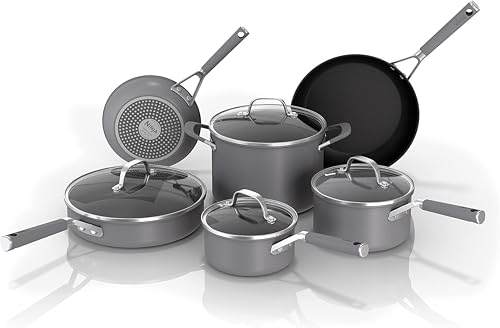
And a Ninja NeverStick
Professional hard anodized 10 piece set does the thing every maker should do: "Oven
safety runs to 500 degrees F, lids and handles included." That one clause converts a
number into a specification, because it names the scope. Its lids are described as
"Tempered glass lids" with "a 13-mm-thick stainless steel rim", and tempered glass is the
other way of putting a compressive prestress into a glass, which our tumbler page works
out at around 173 kelvin of survivable step. Different route, same trick, and it is why
that set can claim 500 when the other claims 350. Our
Ninja
NeverStick review covers the utensil restrictions, which its own record is admirably
blunt about: "aggressive scrubbing does not mean metal utensils or the dishwasher".
So within one catalogue there are four published ceilings, 350, 450, 480 and 500,
and the two records that explain themselves both explain themselves in terms of
attached parts. That is the answer to the question. The number on an enamelled Dutch
oven is the temperature of the least heat-tolerant thing screwed to it, and the pot
itself is almost never that thing.
The honest limit, and the free technique
The limit is that every material property on this page is a handbook figure rather
than a published one. No listing we carry states an enamel thickness, an expansion
coefficient, a firing temperature, a knob material or a maximum temperature difference.
The 40 megapascals of working tensile strength is the softest input of the lot, because
the tensile strength of a glass is set by its worst surface flaw rather than by its
chemistry, and a pot that has been scrubbed for five years is not the pot that left the
factory. Moving that input between 30 and 50 megapascals moves the cold-tap crossover by
about 20 Fahrenheit either way, which is honest uncertainty on a number I would not
want anyone treating as a threshold.
Then the free techniques, and they fall out of the arithmetic cleanly. First, if the
ceiling on your pot is a knob, unscrew it. Almost every enamelled lid knob is held by a
single machine screw through the lid, and makers of the better pots sell a stainless
replacement for exactly this reason. A thirty second change raises the published
ceiling of the whole pot, which tells you better than anything how little the number
had to do with the pot.
Second, and more useful: take the lid off for the hot part. Bread baked in a Dutch
oven wants the lid on for the steamy first stage and off for the browning stage, which
is already how every recipe does it, and the lid-off stage is the hot one. The pot
itself is iron and glass and does not care.
Third, the one that actually prevents damage. Let the pot cool before it meets water,
which both of our own guides already tell you and which the arithmetic now puts a number
on: you need the pot below about 200 degrees Celsius before a cold tap is safe, and a
heavy cast iron pot takes a long time to get there. If you must wash it sooner, use warm
water, because the hazard is the difference. Warm water at 50 degrees against a 200
degree pot is a 150 kelvin step rather than a 180 kelvin one, which is the whole
difference between inside and outside the capacity line in the drawing.
And one myth to put down. Preheating an empty enamelled pot hard, which people do to
get a better sear, is the genuinely risky operation, and it is risky for a reason that
has nothing to do with the oven rating. An empty pot has nothing absorbing the heat, so
the iron's own temperature runs far above what the setting suggests and does so unevenly,
which is a difference again. Put the fat in first, keep the heat moderate, and let the
iron's thermal mass do the work it is there for.
Why an Enameled Dutch Oven Stops at 450 Degrees at a glance
T-fal Ultimate Hard Anodized Nonstick Pots and Pans Set
Everyday cooking on gas, electric, or ceramic stovetops.
Titanium nonstick coating is durable and easy to clean. Comprehensive 14-piece set covers a wide range of cooking needs. Heavy-gauge construction for stability and longevity. Oven-safe up to 400°F (lids 350°F). Limited lifetime warranty. Includes steamer insert for healthy cooking.
Not induction compatible. Oven temperature limits are moderate. Lids have a lower heat limit than the pots. No specific details on handle comfort or heat resistance.
Ninja NeverStick Professional Hard-Anodized 10 Piece Pots &
Home cooks who want durable nonstick performance with oven versatility and even heating.
10-year guarantee on nonstick coating Oven safe to 500°F including lids and handles Heavy-gauge 4.5 mm aluminum base for even heat Stainless steel handles, double-riveted for strength Tempered glass lids with thick stainless steel rims Includes 10 pieces covering a wide range of cooking tasks
Requires hand washing and gentle utensils Shared lid between fry pan and sauté pan may be inconvenient Nonstick coating will wear over time despite care No induction compatibility mentioned (confirm if needed)
Why you can trust this guide
We compared these picks using verified manufacturer specifications, current retailer listings, and patterns in owner feedback, alongside editorial research. We focus on measurable differences such as performance, capacity, usability, and build quality. Pickpedia does not present editorial research as laboratory testing, and we do not claim hands-on testing unless it was actually performed.
Best for Family braises, stews, roasts and one-pot cooking on any surface
9.0/ 10 Pickpedia editorial score
A 6-quart enamelled cast-iron Dutch oven with thick, heat-retaining cast iron, a glossy easy-care enamel finish, a heavy moisture-sealing lid, stovetop, oven and grill compatibility up to 480 degrees Fahrenheit, and dual handles, in a family-sized mushroom-beige design.
BrandBest Choice Products
TypeEnamel cast-iron Dutch oven
Capacity6 quarts
MaterialCast iron, enamel finish
Heat ratingUp to 480 degrees Fahrenheit
Use onStovetop, oven, grill
SizeAbout 14 x 11.25 x 7.5 in
ColourMushroom beige
Pros
Thick cast iron for even, lasting heat
Enamel interior needs no seasoning
Moves from stovetop to oven to grill
Heavy lid seals in moisture and flavour
Family-sized 6-quart capacity
Excellent value for enamelled cast iron
Cons
Heavy, especially when full
Enamel can chip and needs gentle care
Best with wooden or silicone utensils, hand-washing
Best for Braises, stews, soups, roasts and no-knead bread for a family
9.2/ 10 Pickpedia editorial score
A 5.5QT enameled cast iron Dutch oven for families of three to five, with heavy-duty cast iron for even heat and strong retention, a self-basting lid for moist results, a no-seasoning triple-layer enamel coating, stove-to-table styling, and an included cookbook and potholder.
BrandOvermont
TypeEnameled cast iron Dutch oven
Capacity5.5 quarts (families of 3 to 5)
MaterialHeavy-duty cast iron
CoatingTriple-layer enamel, no seasoning
LidHeavy self-basting
UseHob and oven, stove-to-table
IncludesCookbook and cotton potholder
ColourGlossy green
Pros
Heavy cast iron holds heat for tender, even cooking
Self-basting lid keeps food moist
Triple-layer enamel, no seasoning, easy clean
Hob to oven to table, and looks smart
Comes with a cookbook and potholder
Built to last a lifetime
Cons
Heavy, a two-hand lift when full
Enamel can chip; avoid metal utensils and thermal shock
Costs more than a basic pot (but lasts far longer)
Best for Everyday cooking on gas, electric, or ceramic stovetops.
8.8/ 10 Pickpedia editorial score
The T-fal Ultimate Hard Anodized Nonstick Pots and Pans Set is a 14-piece collection designed for everyday cooking. It features a titanium nonstick coating that promises longer-lasting durability, and the heavy-gauge construction aims for stability and even heating. The set includes a wide range of pots and pans, from fry pans to a Dutch oven and steamer, making it a comprehensive choice for most kitchens. However, it is not compatible with induction cooktops, and the oven temperature limits are moderate.
Heavy Gauge ConstructionBuilt to stand the test of time. Titanium Non-stick
Our Pots And Pans Set Non8 inch and 10.25 inch fry pans, 11.5 inch fry pan wi
Elevate Your Cooking ExperThis pots and pans set can withstand oven temperatur
Pros
Titanium nonstick coating is durable and easy to clean. Comprehensive 14-piece set covers a wide range of cooking needs. Heavy-gauge construction for stability and longevity. Oven-safe up to 400°F (lids 350°F). Limited lifetime warranty. Includes steamer insert for healthy cooking.
Cons
Not induction compatible. Oven temperature limits are moderate. Lids have a lower heat limit than the pots. No specific details on handle comfort or heat resistance.
Best for Home cooks who want durable nonstick performance with oven versatility and even heating.
8.8/ 10 Pickpedia editorial score
The Ninja NeverStick Professional Hard-Anodized 10 Piece Set is built with a heavy-gauge aluminum base for even heating and a proprietary nonstick coating that resists scratching and high heat. It includes a versatile range of pots and pans, all oven safe to 500°F, making it a strong choice for home cooks who want reliability and easy cleanup. However, the nonstick surface is not indestructible and requires hand washing and proper utensil use to maintain its performance. The set's generous 10-year guarantee reflects confidence in its durability, but you must follow care instructions to keep it in top shape.
10 Year GuaranteeNeverStick Technology is an exclusive nonstick coati
Oven SafeEasily go from stovetop to oven to finish cooking me
Premium DesignStainless-steel handles are ergonomically designed f
Improved Heat RetentionThe heavy-gauge 4.5 mm aluminum base is designed to
10-year guarantee on nonstick coating Oven safe to 500°F including lids and handles Heavy-gauge 4.5 mm aluminum base for even heat Stainless steel handles, double-riveted for strength Tempered glass lids with thick stainless steel rims Includes 10 pieces covering a wide range of cooking tasks
Cons
Requires hand washing and gentle utensils Shared lid between fry pan and sauté pan may be inconvenient Nonstick coating will wear over time despite care No induction compatibility mentioned (confirm if needed)