PBy the Pickpedia Team·4 picks compared·Last verified October 2026
Affiliate disclosure: As an Amazon Associate, Pickpedia earns from qualifying purchases. Links on this page are paid links, and we may earn a commission at no extra cost to you. This never affects our picks or scores.
This page contains affiliate links. If you buy through one we may earn a
commission, at no cost to you.
Because a thick wall keeps the outside cold for longer while the inside is already
hot, and glass does not break from heat. It breaks from a difference in heat. The
inner surface tries to expand, the cold outer skin refuses to let it, and the outer
skin ends up in tension, which is the one kind of load glass is bad at.
The arithmetic is unusually satisfying here, because it predicts the exact thing
everybody has experienced. Pouring boiling water into a room temperature glass
applies an 80 kelvin step. A thin soda lime wall needs about 87 kelvin to fail. A
thick one needs only about 62. So 80 falls between them, which is why thin glasses
usually survive, thick ones usually crack, and the whole business feels like luck
rather than physics. It is not luck. You are standing in the gap.
Strong in compression, weak in tension
Glass has no mechanism for yielding. A metal under too much load slides its
crystal planes past each other and deforms permanently, which blunts cracks and
absorbs energy. Glass is an amorphous solid with no planes to slide, so when the
stress at the tip of a flaw exceeds what the bonds can take, the flaw simply runs.
That gives glass a strange pair of strengths. In compression it is extremely
strong, several hundred megapascals or more, because squeezing a crack closed stops
it propagating. In tension it is weak and, more importantly, inconsistent, because
its tensile strength is not really a material property at all. It is set by the worst
flaw on the surface. Pristine glass fibre can reach several gigapascals. A tumbler
that has been through a dishwasher a hundred times and has microscopic scratches all
over it is worth perhaps 30 to 50 megapascals. Everything on this page uses 40, and
that choice is why your results will vary from your neighbour's with the same
glass.
So the whole question becomes: when you pour, which part goes into tension? And
the answer is the part that stays cold, which is the outside. The hot inner surface
wants to expand and is in compression, where glass is strong. The cold outer surface
is being stretched by the expanding material behind it, and that is where the crack
starts. This is worth knowing because it is counterintuitive in a useful way: the
damage begins on the surface that never touched the hot water.
Two numbers decide it, and one of them is the whole reason borosilicate exists
The stress a temperature difference generates in a constrained surface layer is
the elastic modulus, times the thermal expansion coefficient, times the temperature
difference, divided by one minus Poisson's ratio. Three of those four are material
properties, so each glass has a fixed stress per kelvin.
Soda lime glass, which is ordinary window and tumbler glass: expansion
coefficient 9.0 parts per million per kelvin, modulus 70 gigapascals, Poisson's
ratio 0.22. That gives 70e9 times 9.0e-6 divided by 0.78, which is 808 kilopascals
per kelvin. Call it 0.808 megapascals for every kelvin of difference across the
wall.
Borosilicate glass: expansion coefficient 3.3 parts per million per kelvin,
modulus 64 gigapascals, Poisson's ratio 0.20. That gives 64e9 times 3.3e-6 divided
by 0.80, which is 264 kilopascals per kelvin, or 0.264 megapascals.
Divide one by the other: 0.808 over 0.264 is 3.06. Borosilicate develops just
under a third of the stress for the same temperature difference, and almost all of
that advantage is the expansion coefficient rather than the stiffness.
Now convert to the thing you can act on. At a working tensile strength of 40
megapascals, soda lime fails at 40 divided by 0.808, which is a 49.5 kelvin
difference. Borosilicate fails at 40 divided by 0.264, which is 151 kelvin. And a
boiling water pour into a room temperature glass is an 80 kelvin step. Fifty is less
than eighty. A hundred and fifty is comfortably more. That single comparison is the
entire reason laboratory glassware and ovenware are borosilicate, and it is a far
better reason than any listing gives.
Glass does not break from heat, it breaks from a difference in heat, and the cold
outer skin is the part pulled apart. Computed from published handbook properties for
soda lime and borosilicate glass at an assumed working tensile strength, not measured
on any product.
Where thickness actually comes in, and how much it is worth
Now the thickness question, carefully, because the standard explanation is
directionally right and skips a step that matters.
The standard explanation is that a thick wall develops a steeper gradient so it
sees more stress. The hole in it is this: for a genuinely instantaneous surface
temperature step, the peak surface stress does not depend on thickness at all. The
instant the surface jumps to 100 degrees, it is constrained by a bulk that is still
at 20, and that is true whether the bulk is two millimetres thick or two hundred. So
thickness cannot enter through an idealised step.
What makes it enter is that real heat transfer is not instantaneous. Hot water
delivers heat to the glass surface at a finite rate, set by a heat transfer
coefficient, and the glass carries it away inward at a rate set by its conductivity.
The ratio of those two is the Biot number: the heat transfer coefficient times the
thickness, divided by the thermal conductivity.
Glass conducts at about 1.0 watts per metre per kelvin. Free convection of
near-boiling water against a solid runs somewhere around 1000 watts per square metre
per kelvin. So for a 2 millimetre wall the Biot number is 1000 times 0.002 divided by
1.0, which is 2.0. For a 6 millimetre wall it is 6.0.
A low Biot number means the surface heats slowly compared with how fast the wall
can even out, so the surface never gets far ahead of the bulk and the peak stress
falls well short of the idealised value. A high Biot number means the surface heats
fast compared with the wall's ability to even out, so the peak stress approaches the
idealised value. Using the standard approximation that the peak stress fraction is
the Biot number divided by the Biot number plus about 1.5, the thin wall reaches
0.571 of the ideal stress and the thick wall 0.800.
Divide those: 0.800 over 0.571 is 1.40. So the thick glass is about 40 percent
worse, and the honest answer to the question is "yes, and by less than you would
guess from how reliably it happens". Forty percent is enough, because of where the 80
kelvin pour sits. Dividing the 49.5 kelvin failure difference by each fraction, the
thin wall needs an applied step of 86.7 kelvin to fail and the thick wall needs 61.9.
Eighty is between them. A 40 percent difference in stress is decisive here only
because the everyday insult happens to land in the gap.
There is a second thickness effect, in time rather than stress, and it is larger.
Thermal diffusivity is conductivity divided by density times specific heat, which for
soda lime glass is 1.0 divided by 2500 times 840, or 4.76e-7 square metres per
second. The time for a wall to even out is roughly its thickness squared divided by
that. For 2 millimetres: 4e-6 over 4.76e-7, which is 8.4 seconds. For 6 millimetres:
3.6e-5 over 4.76e-7, which is 75.6 seconds. Three times the thickness, nine times the
duration, because it goes as the square. So the thick glass is not only more stressed,
it is held there nine times longer, and a crack only needs one unlucky flaw during
that window.
One refinement the usual story misses entirely, and it is where tumblers actually
break. A heavy tumbler is rarely uniformly thick. It is typically a thin wall on a
deliberately thick base, and those two sections develop completely different
gradients on completely different timescales, so they try to expand by different
amounts while rigidly joined. That junction is also a geometric stress concentrator.
If you have broken tumblers this way, look at where they went: it is usually a ring
at the base rather than a vertical split up the wall, and that is differential
expansion between two thicknesses rather than a gradient through one.
Tempering is a different trick entirely
Which brings us to the third bar on the chart, because it reaches the same place
by a route that has nothing to do with expansion coefficients.
Tempered glass is heated close to softening and then cooled rapidly at the
surfaces. The surfaces solidify first and the interior contracts afterwards, which
leaves the finished part with its surfaces locked in compression and its core in a
balancing tension. Fully tempered glass carries at least 69 megapascals of surface
compression and commonly around 100.
Now the consequence. Any tensile stress applied from outside has to cancel that
compression before it can put the surface into net tension and open a flaw. So the
effective tensile capacity is the inherent 40 megapascals plus roughly 100
megapascals of prestress, or about 140 in total. Divide that by soda lime's 0.808
megapascals per kelvin and you get 173 kelvin. Tempered ordinary glass therefore
tolerates a slightly larger temperature step than borosilicate does, using the same
high expansion glass, purely because it was cooled cleverly.
And the trade-off, which is the thing to understand before trusting it. The core is in
tension, at roughly half the surface compression, so there is a large amount of
stored elastic energy in the part. While the compressive skin is intact, nothing can
reach that core and the glass is tough. Once a crack does penetrate past the
compression layer into the tension zone, the stored energy drives it to branch, and
branch again, until the whole piece dices into small fragments in a few
milliseconds. That is why tempered glass does not crack and carry on, and why a
chipped edge or a deep scratch is a much more serious matter on tempered glass than
on annealed glass: the chip has already breached the only part that was protecting
you.
Our three borosilicate products, and what each publishes
The worklist for this article warned that only one of our products names
borosilicate and that the page might have to be abandoned for lack of support. Three
do, and the term appears 95 times across 25 published pages, so the opposite problem
turned out to be true: the word is everywhere and the reason for it is nowhere.
A set of
FlexiTuff borosilicate glass
food storage containers publishes five containers and five lids, 35.2 ounces
each, 8.2 by 6.3 by 2.7 inches, airtight leak-proof lids, BPA-free borosilicate, and
microwave and freezer safe. In its pros it claims the set "Handles temperature
changes", which on everything above is the correct claim for the material and is
worth 151 kelvin rather than 49.5.
And then the thing worth flagging, which its own record flags first: the cons say
"Only microwave and freezer safety stated". So here is a borosilicate container whose
single distinguishing material property is thermal shock tolerance, and whose
listing declines to state an oven rating. Microwave and freezer are the two
undemanding cases. The oven is the one where borosilicate earns its place over soda
lime, and it is the one the listing is silent on. A reader could reasonably conclude
from the material that it is ovenproof and should not, because the listing does not
say so. Our
FlexiTuff
borosilicate glass food storage containers review has the detail.
A
Zulay Kitchen glass electric
kettle publishes 1.7 litres, 1500 watts, a "Borosilicate glass and stainless
steel" body, auto shut-off, boil-dry protection, a cool-touch handle and a 360 degree
cordless base. A kettle is the clearest case for this material in a kitchen, because
it does the 80 kelvin step twice a day for years, and fatigue from repeated
sub-critical thermal cycling is real for glass even when no single cycle breaks it.
The record's cons are sensible and physical: glass "shows limescale, wants regular
descaling" and is "less knock-proof than metal or plastic". The second is the one that
connects to this page, because mechanical surface damage is what sets glass's tensile
strength, so a knocked and scratched kettle has a lower thermal shock threshold than a
new one even though its material has not changed. See our
Zulay Kitchen glass
electric kettle review.
A corrupted record in our own database
An
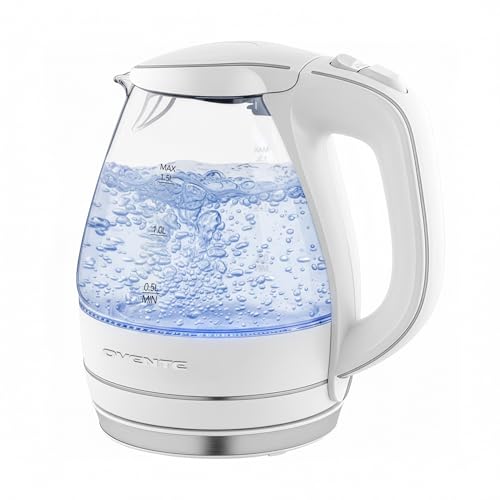
OVENTE 1.5L glass electric
kettle belongs here for the material, publishing a borosilicate body, 1100 watts,
1.5 litres, auto shut-off, boil-dry protection and a 360 degree rotary base. Those
figures are read from its summary and pros, deliberately, because its specifications
field is unusable and that is worth reporting.
All four entries in that product's specification list carry the label "Feature"
rather than a field name, and all four values are Amazon bullet headings truncated
mid-word: "A BLEND OF STYLE and DURABILITY , The OVENTE KG83 Kett", "ENJOY HOT WATER
ANYTIME , This attractive glass elec", "CONVENIENCE AT ITS FINEST , Enjoy peace of
mind with", and "US-BASED CUSTOMER SERVICE LETS YOU BUY WITH CONFIDEN". Its pros
field is also stored as one unbroken run of text where every other product on the
site uses one claim per line.
That is the same corruption pattern already identified in our four dishwasher
product records, and it had not been noticed outside that category. It means this
product publishes no capacity, no wattage and no material in any structured field, and
a reader who reads only the specification table learns nothing about it at all. The
figures are recoverable from the prose, which is what this page did, and the record
needs rebuilding. Our
OVENTE 1.5L glass
electric kettle review is where that shows.
The tempered case we carry, and a spec that undercuts itself
A
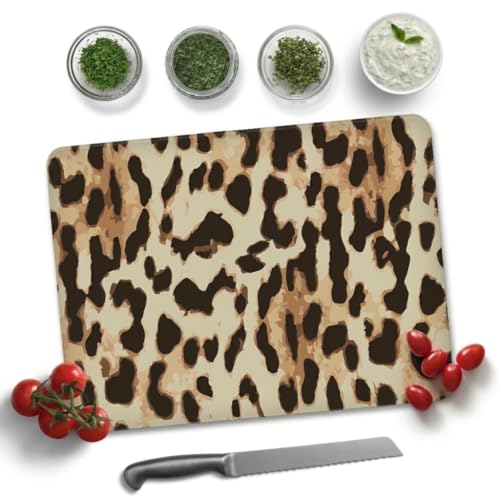
Leopard tempered glass
cutting board is our one tempered product, at 16 by 12 inches on non-slip rubber
feet, and it demonstrates both halves of the tempering trade.
Its specification field says, simply, "Heat: Heat resistant". Its cons field says
"Heat resistant, not proof against thermal shock". The cons are right and the
specification is the kind of claim this whole page exists to take apart, because heat
resistance and thermal shock resistance are different properties and tempered glass
has a great deal of one and a moderate amount of the other. On the arithmetic above
its tempering is worth about 173 kelvin of step, which is genuinely good, and the
reason the cons are still correct is the failure mode: when tempered glass does go, it
goes completely and into fragments, so "resistant until it is not" is a fair
description and a bare "heat resistant" is not.
Worth adding one thing the listing does not. A glass board accumulates exactly the
kind of surface damage that sets tensile strength, because a knife is a
scratch-generating instrument and the record itself notes the board is "loud under a
blade" and that "hard glass can dull knives faster". Chips at the edge are the
specific hazard for a tempered part, since the compressive skin is the only thing
holding the core's stored energy in check. Our
Leopard
tempered glass cutting board review covers the rest.
Our own page, and the sentence that gives the right material the wrong reason
Our
guide to
choosing glass food storage containers for meal prep reaches the right
recommendation and supports it with the wrong facts. Under a heading telling you to
favour borosilicate, it says: "Borosilicate resists staining and odors that plastic
absorbs over time. It is also BPA-free, making it a cleaner choice for storing food
day after day."
Every clause there is true and not one of them is about borosilicate. All glass is
chemically inert, so all glass resists staining and odours. All glass is BPA-free,
because BPA is a monomer used in certain plastics and glass contains no polymer at
all. Soda lime glass does every single thing that sentence credits to borosilicate,
and does it just as well. So the guide recommends the right material while listing
only properties that would equally justify the ordinary one, and omits the single
property that is genuinely unique to it, which is the factor of 3.06 in thermal
stress.
The same guide does get one thing right in a way worth keeping: it says to "Look
for microwave and freezer safe glass that handles temperature changes. That lets you
freeze a batch and reheat it in the same dish." That is the correct use case and it
is exactly the one borosilicate is for, since going from a freezer to a microwave is
a large and fast temperature step. The guide just needs to connect the two.
The pages of ours that already had it right
Two deserve the credit, and both are roundups rather than guides. Our kettles
roundup says of a glass model that "borosilicate glass resists thermal shock and lets
you see the water and its level at a glance", and lists "resists thermal shock" among
its pros. Correct, correctly attributed to the material, and the right property named.
Our pizza stones coverage is better still, distinguishing materials by this exact
property: "cordierite tolerates the fierce temperatures of a grill and shrugs off
thermal shock, while clay and ceramic suit steady home-oven baking". That is thermal
shock resistance used as a genuine selection criterion between two materials, which is
precisely how it should be used.
And our general storage comparison,
glass versus plastic food
storage containers, gets the practical instruction right: "The catch is thermal
shock: moving glass straight from the freezer into a hot oven can crack it, so let
frozen glass thaw a bit or follow the maker's guidance." Right advice, right hazard,
and the only thing missing is why thawing works, which is that it reduces the
temperature difference rather than the temperature. Thermal shock does not care how
hot your oven is. It cares about the gap.
The honest limit
Not one product we carry publishes an expansion coefficient, a maximum temperature
differential, a tempering stress, or a wall thickness. Three name borosilicate and
none says what that buys. Twenty one published pages of ours use the phrase thermal
shock and none explains it. So the figures here are handbook properties for the two
glass families and a stated assumption about working tensile strength, and the one
genuinely uncertain input is that strength, which depends on how scratched your
particular glass is and could reasonably be anywhere from 30 to 50 megapascals. That
moves the soda lime threshold between about 37 and 62 kelvin, which is a wide band and
is itself part of the answer to why this feels unpredictable.
The free techniques beat the purchase comfortably, because every one of them works
on the temperature difference rather than on the glass. Warm the glass first: half an
inch of hot tap water, swirled and poured away, brings the whole wall up together and
takes perhaps 40 kelvin straight off the step. Pour slowly and down the side rather
than straight onto the base, which spreads the arriving heat over more area and avoids
the thick base entirely. Let boiling water stand for a minute, since dropping from
100 to 90 degrees removes an eighth of the difference for no effort. Never put a glass
straight from the fridge under a hot tap, which is the same insult with the sign
reversed and the cold glass starting further away. And put a metal spoon in a glass
before pouring, which is the old trick and does genuinely work, not by magic but by
conducting heat away from the first contact point and spreading it, which lowers the
local gradient while the pour is in progress.
Then the one that matters most and is free in a different sense: stop running thin
glassware through a dishwasher loaded against other glass. Tensile strength here is a
surface flaw property, not a material property, so every chip and scratch is a
permanent reduction in the temperature step that glass will ever survive again. A
scratched soda lime tumbler is not the same object it was when you bought it, and no
amount of careful pouring gives that back.
Why a Thick Tumbler Cracks Before a Thin One at a glance
Everyday hot water needs like tea, coffee, and instant meals.
Boils water in 7 minutes or less Auto shut-off and boil-dry protection Stylish borosilicate glass with blue LED 360-degree rotary base with cord storage 50% more efficient than stovetop kettles 2-year warranty and US-based support
No temperature control 1100W may be slower than higher wattage kettles Glass body may be fragile if dropped Cord length not specified
Leopard Tempered Glass Cutting Board, Large 16 x 12 Inch Non-Slip
cooks who want a board that also serves
Large 16 by 12 inch non-porous surface
Hard glass can dull knives faster
Why you can trust this guide
We compared these picks using verified manufacturer specifications, current retailer listings, and patterns in owner feedback, alongside editorial research. We focus on measurable differences such as performance, capacity, usability, and build quality. Pickpedia does not present editorial research as laboratory testing, and we do not claim hands-on testing unless it was actually performed.
The FlexiTuff 10-piece set includes five borosilicate glass containers and five airtight lids. Each rectangular container holds 35.2 ounces and measures 8.2 by 6.3 by 2.7 inches, sized for meal prep and larger portions. The glass is BPA-free and durable, the lids are leak-proof, and the set is microwave and freezer safe. An easy-to-clean design suits daily kitchen use.
Best for Fast, everyday boiling for tea, coffee and instant meals
9.0/ 10 Pickpedia editorial score
A 1.7 litre, 1500W electric kettle with a borosilicate glass body and stainless steel components, auto shut-off and boil-dry protection, a cool-touch handle, a 360-degree cordless base and a spout scale filter, backed by a lifetime guarantee.
Best for Everyday hot water needs like tea, coffee, and instant meals.
8.8/ 10 Pickpedia editorial score
The OVENTE 1.5L Glass Electric Kettle combines a sleek borosilicate glass body with practical features like auto shut-off and boil-dry protection. It boils water quickly, thanks to its 1100W power, and its 360-degree base adds convenience. While it lacks temperature controls, it's a solid choice for basic hot water needs.
FeatureA BLEND OF STYLE & DURABILITY , The OVENTE KG83 Kett
FeatureENJOY HOT WATER ANYTIME , This attractive glass elec
FeatureCONVENIENCE AT ITS FINEST , Enjoy peace of mind with
FeatureUS-BASED CUSTOMER SERVICE LETS YOU BUY WITH CONFIDEN
Pros
Boils water in 7 minutes or less Auto shut-off and boil-dry protection Stylish borosilicate glass with blue LED 360-degree rotary base with cord storage 50% more efficient than stovetop kettles 2-year warranty and US-based support
Cons
No temperature control 1100W may be slower than higher wattage kettles Glass body may be fragile if dropped Cord length not specified
This is a large tempered glass cutting board measuring 16 by 12 inches, with a decorative leopard print. It suits cooks who want a non-porous surface that doubles as a serving board. The maker states it will not absorb odors or stains, resists heat, and stays put on rubber feet. It wipes clean fast and is described as scratch resistant versus plastic.
MaterialTempered glass
Size16 by 12 inches (about 40 by 30 cm)
DesignLeopard print, decorative
FeetNon-slip rubber
SurfaceNon-porous, stain resistant
HeatHeat resistant
Pros
Large 16 by 12 inch non-porous surface
Doubles as a stylish serving board
Non-slip rubber feet keep it steady
Heat resistant and can guard countertops
Wipes clean and resists odors and stains
More scratch resistant than plastic, per the maker