Why an Airtight Box Does Not Stop Bread Going Stale
PBy the Pickpedia Team·4 picks compared·Last verified October 2026
Affiliate disclosure: As an Amazon Associate, Pickpedia earns from qualifying purchases. Links on this page are paid links, and we may earn a commission at no extra cost to you. This never affects our picks or scores.
This page contains affiliate links. If you buy through one we may earn a
commission, at no cost to you.
Not in the way the question assumes, and the reason is that staling is not drying.
A loaf going hard on your counter is not losing water. Its starch is
recrystallising, which is a process driven by time and temperature and completely
indifferent to whether there is air around it. An airtight box addresses the loss of
water, which is a different thing happening at the same time, and in a warm kitchen
it makes the third thing, mould, more likely rather than less.
So there are three separate processes and a container touches exactly one of them.
Getting that straight is worth more than any purchase, because it also explains the
two pieces of bread advice that sound wrong and are right: the fridge is the worst
place for bread, and the freezer is completely fine.
What the oven did, and what cooling undoes
Start in the oven, because staling is the oven running backwards.
Raw starch is packed into granules in tight, ordered, semi-crystalline layers.
Add water and heat past about 60 degrees and those granules swell and burst, the
ordered structure is destroyed, and the long starch molecules disperse into a soft
hydrated gel. That is gelatinisation, and it is what turns dough into crumb. The soft
texture of fresh bread is starch held in a disordered, water-swollen state.
Disordered is not where starch wants to be. From the moment the loaf leaves the
oven, those molecules begin re-associating into ordered crystalline regions again.
That is retrogradation, and it happens in two stages with two different starch
fractions. Amylose, the straight-chain fraction, recrystallises within hours and is
responsible for the loaf firming up on the first day. Amylopectin, the branched
fraction, recrystallises over days and is responsible for the rest. Crystalline
starch is rigid, so as the fraction of crystallised starch rises, the crumb gets
firmer.
Notice what is absent from that description. No water left the loaf. The crumb got
harder because its starch changed phase, and a sealed bag cannot prevent a phase
change.
The detail that decouples firmness from dryness
Here is the piece that makes the rest of this page work, and it is the thing most
explanations leave out.
When starch crystallises it does not crystallise dry. The double helices that form
exclude water as they pack, so the water that was inside the swollen starch gets
pushed out into the surrounding gluten network. It stays in the loaf. It just moves.
So a stale loaf contains almost exactly as much water as it did when fresh,
redistributed from the starch to the protein matrix, and the eating experience is
firmer and perceived as drier because water bound in a gluten network reads as dry in
the mouth while water in swollen starch reads as moist. Firmness and moisture
content are separate measurements that happen to correlate in your perception and not
in the loaf.
Two consequences follow immediately. A loaf that feels dry can still be wet enough
to grow mould, which is otherwise baffling. And keeping water in with a seal cannot
stop the firming, because the water was never going anywhere.
Why the fridge is the worst choice, with the shape of the curve
Crystallisation needs two things to happen, and they want opposite temperatures.
It needs nucleation, the formation of the first tiny ordered seeds, and nucleation
gets easier as temperature falls, because the molecules are less agitated and more
likely to stay put once aligned. And it needs growth, molecules diffusing to a
nucleus and joining it, and growth gets harder as temperature falls, because
diffusion slows.
Multiply a term that rises as it gets colder by a term that falls as it gets colder
and you get a hump with a maximum somewhere in the middle. Where the maximum sits
depends on the two endpoints. At the cold end is the glass transition temperature of
the bread system, which at typical crumb moisture of 35 to 45 percent is somewhere
around minus 10 degrees Celsius; below that, molecular mobility effectively stops and
nothing can crystallise however much it would like to. At the warm end is the melting
point of the amylopectin crystals, around 60 degrees, above which crystals come apart
as fast as they form.
The maximum therefore lands between minus 10 and 60, and for bread it comes out
close to 4 degrees Celsius. Which is the temperature of a refrigerator. A domestic
fridge is, by unlucky coincidence, set almost exactly to the worst possible
temperature for storing bread, and that is the whole answer to the second question
this page addresses.
The same curve makes the freezer the right answer and for a reason worth stating
precisely. The freezer is not slow. At minus 18 degrees you are below the glass
transition, and the process does not proceed slowly, it does not proceed. That is a
qualitative difference from refrigeration, not a quantitative one, and it is why
frozen bread thawed after a month is genuinely fresh rather than slightly stale.
Staling, drying and moulding are three independent processes with three different
drivers. An airtight container addresses the middle one, does nothing to the first,
and pushes the third the wrong way. Curve shape is the standard nucleation times
growth behaviour, drawn to shape from published transition temperatures.
Mould runs on water activity, not water content
The third process has its own driver and it is not the one people assume.
Microbes cannot use water that is chemically tied up. What matters to them is
water activity, written a sub w, which is the vapour pressure of the water in the
food divided by the vapour pressure of pure water at the same temperature. Pure water
is 1.0. A food with its water bound to sugars, salts and polymers has a lower value
even at the same total moisture.
The thresholds are well established. Most spoilage bacteria need 0.91 or above.
Most moulds need about 0.80. The most tolerant xerophilic moulds manage down to 0.61,
which is about the limit of life. Bread sits at roughly 0.94 to 0.96.
So bread is comfortably above the mould threshold and there is no realistic way to
change that. To get a loaf below 0.80 you would have to dry it to the point of being
a cracker. This is why bread moulds and crackers do not, and it has nothing to do
with how much water either contains in absolute terms.
Now the airtight container. In a sealed box the water evaporating from the loaf
cannot leave, so the air inside reaches equilibrium with the crumb, which means it
sits at a relative humidity around 95 percent, and that moisture is held against the
crust. The crust is the part of the loaf that was dry, around 5 to 10 percent
moisture against the crumb's 40, and the mould spores on it were previously sitting
somewhere too dry to germinate. Seal the box and you raise the crust's water activity
to the crumb's. You have not added water to the loaf. You have moved the dry part of
it into the wet regime.
And that same equilibration is what destroys a crusty loaf. The crust is crisp
because it is dry and glassy. Bring it to 95 percent humidity and it absorbs water,
passes its own glass transition, and goes leathery. Which is exactly the trade our own
bread box roundup describes without naming the mechanism.
Our two bread bags, and three contradictions between them
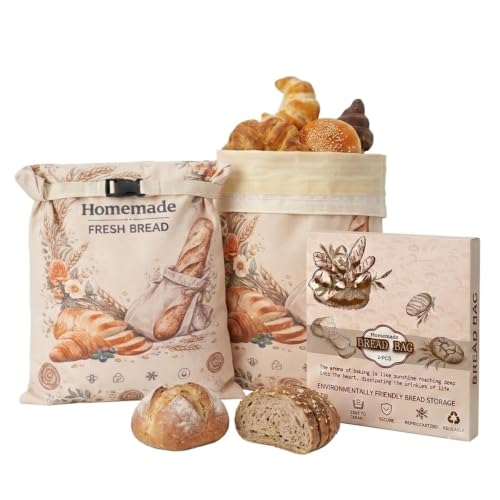
We carry no bread box at all, which is worth recording, but we do carry two
beeswax bread bags, and read against the above they disagree with each other and with
themselves.
A
beeswax reusable bread bag XL
with zipper closure publishes cotton with a beeswax, jojoba oil and tree resin
lining, an extra-large size for artisan loaves, a zippered fold-over closure, and
under Storage: "Pantry, fridge, freezer". Its pros include a "Breathable beeswax
lining aims to protect crust".
Three problems. First and most importantly, that specification recommends the
fridge, and the fridge is the worst available temperature for bread by the curve
above. It is also directly contradicted by our own guide, which tells readers to skip
the fridge. One of the two is wrong and it is not our guide.
Second, the same listing claims the lining is "breathable" and the closure "seals
securely". Those are opposing properties and the product cannot have both at once in
any useful degree. The breathability is the genuinely valuable feature here, for
exactly the reason in the last section: a semi-permeable wrap lets enough vapour
escape to keep the crust below the crumb's water activity while slowing bulk water
loss, which is the only storage approach that addresses two of the three processes at
once. A secure seal undoes it.
Third, its cons say "Freezer results depend on loaf moisture", which is vague
where it could be useful. On the mechanism, freezing works regardless of loaf
moisture as long as you get below the glass transition, and what actually varies with
moisture is the glass transition temperature itself: wetter crumb has a lower one, so
a very moist loaf needs a colder freezer to be genuinely stable. That is a real
caveat and it is not what the listing says. Our
beeswax reusable
bread bag XL review has the detail.
Its sibling is cleaner.
LURKA beeswax bread bags with
cotton linen publishes a removable beeswax liner, a cotton-linen outer, 13 by 17
inches, a roll-top plus buckle closure, and two useful admissions in its cons: "Built
for countertop use, not freezing" and "Roll-top offers less seal than a zipper".
Both of those are more honest than they look. Countertop rather than freezer is
the correct default on the curve above, since the counter is on the falling flank and
the fridge is on the peak. And a roll-top offering less seal than a zipper is listed
as a drawback when it is arguably the feature: less seal means the crust can stay
drier than the crumb, which is what keeps a crust crisp and what keeps crust water
activity down. Note also that these two siblings flatly disagree on freezing, one
listing the freezer as a storage location and the other excluding it. See our
LURKA beeswax
bread bags review.
Where airtight is exactly right, which is the contrast worth having
None of this is an argument against airtight containers. It is an argument about
what they are for, and we carry the case where they are the correct answer.
A set of
DWELLZA KITCHEN flour and
sugar containers publishes four 3.6 litre canisters with side-locking lids and a
silicone seal, and says those lids "keep air and water out to hold food fresh". For
flour and sugar that claim is correct, and the reason is that none of the three
processes on this page applies to them in the way it applies to bread.
Flour has not been gelatinised, so its starch is still in its original crystalline
state and has nothing to retrograde from. Dry flour sits at a water activity around
0.6, which is at or below the limit for even xerophilic moulds, so it is genuinely
shelf stable, and the thing a seal protects it from is picking water up from a humid
kitchen and crossing that threshold in the wrong direction. The other real hazards are
insects and oxidative rancidity of the germ oils in wholemeal, and a seal helps with
both.
So the same feature, an airtight lid, is correct for flour and misdirected for
bread, because the foods are on opposite sides of the water activity threshold and
only one of them has gelatinised starch in it. That is the distinction the category
name hides, and no listing draws it. Worth noting the capacity figure checks out: 3.6
litres is 3.80 US quarts, and the listing says 3.8 qt. Our
DWELLZA KITCHEN
flour and sugar containers review covers the rest.
The one appliance that reverses it, and the limit of that
Retrogradation is reversible and almost nothing else about food spoilage is, which
makes this the most useful practical fact on the page.
The amylopectin crystals melt at around 60 degrees Celsius. Get the crumb above
that and the crystalline regions come apart, the starch returns to its disordered
hydrated state, and the bread is soft again. That is what is happening when you toast
a stale slice or warm a stale loaf briefly in an oven, and it is why the result is
genuinely better rather than just hot.
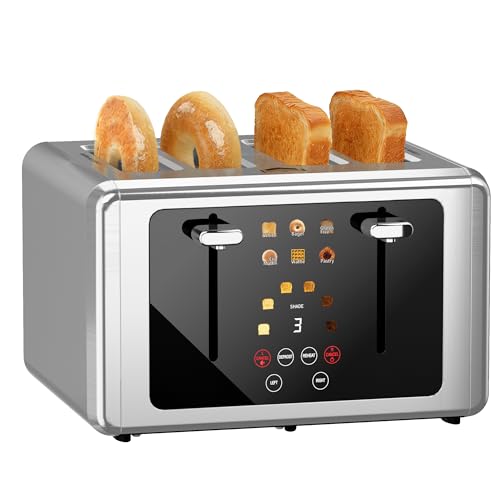
A
WUNLY smart digital 4-slice
touchscreen toaster publishes six presets from Bagel to Reheat, dual independent
controls, 1.5 inch extra-wide slots, a colour touchscreen with live progress, and
smart Defrost and Reheat. Those last two are the relevant ones and they are doing
different jobs. Defrost is for bread below its glass transition, where you need to
warm the slice through before browning it or you get a scorched outside and a frozen
middle. Reheat is a short, low cycle designed to raise the crumb temperature without
further browning, which on the mechanism above is precisely a retrogradation reversal
rather than a cooking step.
And the limit, which is the honest half. Melting the crystals restores texture and
does nothing for water that has genuinely evaporated, so reheating reverses staling
but not drying. Worse, every heating cycle drives off more water, which is why a loaf
can be refreshed a few times and then cannot: you are repeatedly fixing the
reversible problem while making the irreversible one worse. That is also why
refreshed bread goes hard again faster than it did the first time, since it is now
staling from a lower moisture content, which raises its glass transition and shifts
the whole curve. Our
WUNLY smart digital
4-slice toaster review has the specification, and its own cons are fair that it is
"Larger and more complex than a basic two-slice".
Our own guide, and the premise to correct
Our
guide to keeping homemade
bread fresh on the counter arrives at four pieces of advice and three of them are
right. It is worth separating the conclusions from the reasoning, because the
reasoning is wrong throughout and the conclusions mostly survive anyway.
The guide's best moment is this: "Refrigeration stales bread faster than the
counter. Keep loaves at room temperature for daily eating, and reserve the freezer
for longer storage only." That is entirely correct, it is the single most
counterintuitive fact in this subject, and the guide states it without hedging.
Credit where it is due.
Its second good moment is "Keep it covered but breathing. Bread needs a little
airflow. A breathable cover shields the loaf while letting it breathe, better than
sealed plastic on the counter." Also right, and right for the reason in the water
activity section: breathable keeps crust activity below crumb activity.
The premise to correct runs through the rest. The guide opens with "the counter can
dry it out fast" and advises storing a cut loaf cut-side down because "That protects
the exposed crumb from drying too quickly", and tells you that "Reducing extra open
space around the loaf helps keep it from drying out". Every one of those treats the
loaf's problem as water loss. It is not. The loaf is firming because its starch is
recrystallising, and it would do that in a sealed jar with no moisture loss
whatsoever. The cut-side-down advice is still worth following, because the cut face
genuinely does lose water faster than crust does and that loss is real and
irreversible, but it does not slow staling and the guide implies it does.
The guide also says "Warm bread releases steam that turns to moisture. Let a loaf
cool fully before covering it, or you trap dampness that softens the crust." Correct,
and the mechanism is the same equilibration described above: sealing a warm loaf puts
its crust at the crumb's water activity immediately, which both softens the crust and
starts the mould clock early.
Our bread box roundup, and the claim it makes twice
Our bread boxes roundup states the thing this page exists to correct, and states it
in two places. Its introduction says "A good bread box slows staling by giving loaves
a calm spot with steady airflow". Its buying guide says "Airtight plastic bins with
gaskets slow staling on soft sandwich bread."
Neither is true as written. A box does not slow staling, because staling is a
phase change in the starch and a container has no access to it. What the first
sentence is reaching for is protection from drying and from physical damage, both
real. What the second is reaching for is that a sealed box keeps a soft sandwich loaf
from drying out, which it does, and the loaf still firms up on exactly the same
schedule.
The same roundup then gets the hard part right, which is why this is a correction
rather than a dismissal. It says: "Vented bamboo boxes let a little air move, which
suits crusty artisan loaves that turn soggy when sealed. Airtight plastic bins with
gaskets slow staling on soft sandwich bread. Choose by what you bake most, because
the wrong match either dries out crust or traps moisture." Set aside the word staling
and that paragraph is an accurate account of the water activity trade-off, including
both failure directions. The recommendation is sound and only the label on the
mechanism is wrong.
One claim in that roundup is worth testing rather than accepting, and it belongs in
this report. One pick is recommended for its "airtight seal and a freshness dial". A
dial on a sealed box can only be adjusting ventilation, which is to say it adjusts how
airtight the box is, which means the product is sold on a seal and then sold again on
a control for defeating the seal. That is not incoherent, it is the trade-off above
made adjustable, and it is a genuinely sensible feature. It is just not a freshness
control, because freshness in the sense people mean it is set by the starch.
What our vacuum sealing page already covers
Our
page on what
vacuum sealing really does handles the axis this page does not, and the division
is clean enough to state. That page is about oxygen: fats going rancid, coffee going
stale in the oxidative sense, cut fruit browning. It is correct that removing air
slows those, correct that it does not sterilise, and unusually good on freezer burn,
which it describes as "really just dehydration and oxidation".
Nothing on that page touches starch, and nothing on this page touches oxidation. A
vacuum seal does not slow retrogradation either, for the same reason a box does not,
and a vacuum-sealed loaf at 4 degrees will stale faster than an unwrapped one at 20.
The two mechanisms are independent and both pages are needed.
The honest limit, and the routine that beats every purchase here
No listing we carry publishes a water activity, a moisture content, or any storage
temperature guidance beyond a location name, and one of the two bread bags names the
worst location available. Across our published pages, water activity, retrogradation
and gelatinisation appear zero times, and the two places the site discusses bread
staling both attribute it to the wrong process. So there is no specification to choose
on and this page cannot invent one.
What it can give you is a routine that acts on the actual mechanism, and it is free
and better than any container.
Decide at the point of baking or buying how much you will eat in two days, and
freeze the rest immediately, sliced. Not after it starts to firm, immediately, because
freezing stops retrogradation where it is rather than reversing it, so a loaf frozen
fresh thaws fresh and a loaf frozen on day three thaws as a day-three loaf. Slicing
first matters because you then toast single slices from frozen rather than thawing and
refreezing the whole thing.
Keep the two days' worth on the counter in something breathable rather than sealed,
cut face down, and accept that it will firm a little, because the counter is the
second best temperature available and the only better one is below minus 10.
Never use the fridge for bread. That is the one instruction on this page with no
trade-off attached: it is slower than the counter, worse than the freezer, and there
is no case in which it is the right choice for a loaf.
And when a loaf has firmed, toast it or warm it briefly rather than throwing it
out, remembering what that does and does not fix. The texture comes back because the
crystals melt. The water does not come back, so do it once rather than repeatedly, and
use the loaf's last day for the things that want dry bread anyway, which is the oldest
answer in this subject and the reason croutons, breadcrumbs, bread pudding and
panzanella all exist.
Why an Airtight Box Does Not Stop Bread Going Stale at a glance
A busy family kitchen wanting convenience and two shades at once
Touchscreen with live progress and countdown
Larger and more complex than a basic two-slice
Why you can trust this guide
We compared these picks using verified manufacturer specifications, current retailer listings, and patterns in owner feedback, alongside editorial research. We focus on measurable differences such as performance, capacity, usability, and build quality. Pickpedia does not present editorial research as laboratory testing, and we do not claim hands-on testing unless it was actually performed.
Best for eco-conscious home bakers storing artisan sourdough
8.6/ 10 Pickpedia editorial score
This is a reusable beeswax bread bag sized XL for artisan loaves, sourdough, bagels, and baguettes sliced to fit. It suits eco-minded home bakers who want a breathable, washable alternative to plastic. Made from cotton infused with a beeswax, jojoba oil, and tree resin blend, it uses a zippered fold-over closure and stores flat for tidy drawers.
MaterialCotton with beeswax blend lining
Lining blendBeeswax, jojoba oil, tree resin
SizeExtra Large (XL)
ClosureZippered fold-over
StoragePantry, fridge, freezer
CleaningDamp cloth or cool water, air dry
ReusableYes, hand-washable
Best fitsSourdough, baguettes, bagels, croissants
Pros
Extra-large fit for artisan loaves and sourdough
Breathable beeswax lining aims to protect crust
Reusable cotton cuts single-use plastic
Zippered fold-over closure seals securely
Folds flat for tidy storage
Gift-ready printed patterns
Cons
Wax lining cannot go in a washing machine or dishwasher
Hot water must be avoided to protect the wax
Freezer results depend on loaf moisture
Beeswax color varies by season as stated by the maker
Best for home bakers storing loaves on the counter
8.6/ 10 Pickpedia editorial score
The LURKA 2-pack pairs a beeswax-lined inner liner with a cotton-linen outer bag for countertop bread storage. It suits home bakers keeping sourdough, artisan loaves, and rolls fresh between servings. Each 13 by 17 inch bag uses a roll-top plus buckle closure, and the removable liner rinses clean, offering a reusable alternative to plastic and paper.
Best for organizing baking staples in matching canisters
8.4/ 10 Pickpedia editorial score
DWELLZA KITCHEN flour and sugar containers are a set of four matching 3.6L (3.8 qt) canisters for pantry staples. Side-locking lids with a black silicone seal keep air and water out to hold food fresh. Made from food-grade, BPA-free plastic, they stack to save space and are dishwasher safe. Reusable labels and a marker are included so you can switch contents anytime.
Best for A busy family kitchen wanting convenience and two shades at once
8.8/ 10 Pickpedia editorial score
A smart 4-slice toaster with a colour LED touchscreen, live progress tracking and countdown, dual independent controls to toast two shades at once, six presets, 1.5 inch extra-wide slots, smart Defrost and Reheat, a mute option, memory function, full-length crumb tray and a stainless steel body.
BrandWUNLY
TypeSmart 4-slice toaster
ControlColour LED touchscreen
Slots4, dual independent controls
Slot width1.5 inch extra-wide
Presets6 (Bagel to Reheat)
BodyStainless steel
ExtrasMute, memory, auto shut-off
Pros
Touchscreen with live progress and countdown
Dual controls toast two shades at once
Six presets from Bagel to Reheat
1.5 inch wide slots fit bagels and thick bread
Mute option, memory and easy-clean crumb tray
Stainless body, auto shut-off, 365-day guarantee
Cons
Larger and more complex than a basic two-slice
Digital electronics versus a simple mechanical toaster