Home ›
Cold Frames › Why a Winter Greenhouse Needs Mass, Not Glazing
Cold Frames
Why a Winter Greenhouse Needs Mass, Not Glazing
PBy the Pickpedia Team·5 picks compared·Last verified October 2026
Affiliate disclosure: As an Amazon Associate, Pickpedia earns from qualifying purchases. Links on this page are paid links, and we may earn a commission at no extra cost to you. This never affects our picks or scores.
This page contains affiliate links. If you buy through one we may earn a
commission, at no cost to you.
Badly, and the reason is not the snow. A pop-up greenhouse fails in winter because of
what it does not have inside it, and the missing thing is weight. An unheated enclosure
has no night-time temperature elevation at all, because elevation is heat going in divided
by heat leaking out, and after dark the heat going in is zero. Whatever the glazing is
made of, by dawn the inside is the same temperature as the outside unless something in
there was storing heat.
Which turns the usual advice inside out. Double glazing, extra film layers and sealing
the gaps all change how fast the inside cools, not where it ends up. The only thing that
changes where it ends up is mass, and a light structure standing on paving with trays on
wire shelves has essentially none.
The day is the part that works, and it is worth 17 kelvin
Start with the half of the cycle that does behave as people expect, because it also
produces the most satisfying check on this whole page.
A
Backyard Discovery Aggie cedar cold
frame publishes an unusually complete set of figures: 48 inches long by 28.5 wide and
32.25 high, 94.79 pounds, a double-wall polycarbonate lid, and a wax hinge that its record
says opens "when temperatures exceed 70F and closes it again as things cool".
Those dimensions give a lid and footprint of 0.8825 square metres and side walls of
3.1833. Put a representative loss coefficient on each surface, 2.9 watts per square metre
per kelvin for three quarter inch cedar and 3.6 for double-wall polycarbonate, and the
whole frame loses 12.41 watts for every kelvin it sits above the garden.
Now the sun. Clear winter midday on a horizontal surface is around 300 watts a square
metre, and polycarbonate passes about 80 percent of it, so 211.8 watts arrives inside.
Divide by 12.41 and the frame runs 17.07 kelvin above the outside air.
On a 5 degree Celsius winter day that is 22.1 inside, which is 71.8 degrees Fahrenheit.
The hinge opens above 70. That threshold is not a round number somebody picked. It is
within two degrees of where this frame's own published geometry puts it at midday in
winter, which means the wax was chosen to open at the point this specific design starts
cooking what is inside it. Its record gets the reasoning exactly right in words:
"Seventy degrees Fahrenheit is a sensible threshold: warm enough that the frame genuinely
needs venting, cool enough that it opens before damage rather than after." The arithmetic
agrees and says where the number came from.
Every dimension here is published by our own listings: 48 by 28.5 by 32.25 inches and
94.79 pounds for the cedar frame, 35.43 by 14.57 by 27.56 for the two tier cabinet, and
the 70 Fahrenheit hinge threshold. The structure of the argument is exact: an enclosure
with no heat input has no steady state elevation, stored heat decays exponentially with a
time constant of store over loss, and a surface exchanging radiation with a body at its
own temperature nets zero. What is representative rather than published is every thermal
property, because no cold frame or greenhouse we carry publishes a U value, an R value or
a glazing thickness: the 2.9 for cedar, 3.6 for double wall polycarbonate and 5.5 for the
PVC cabinet, the 0.20 metres of coupled soil at 800 kilograms a cubic metre and 1.8
kilojoules per kilogram per kelvin, the 300 watts a square metre of winter sun at 80
percent transmission, and the 25 kelvin clear sky depression. Halve the coupled soil depth
and the cedar frame's time constant falls from 6.27 hours to 3.33 and its dawn residue
from 14.75 percent to 2.7, which weakens the frost margin and makes the comparison with
the tray-based frame starker rather than gentler. The direction never changes, because the
store appears only in the numerator and the two frames differ in it by more than an order
of magnitude.
Then the sun goes, and the only question is the time constant
After sunset the frame has no heat source. So it cools from wherever it was, and the
shape of the cooling is an exponential whose time constant is the heat stored inside
divided by the rate it leaks.
What is stored inside? Not the air, which is negligible. The soil. A cold frame sitting
on the ground is thermally welded to the top fifth of a metre or so of growing medium, and
over the Aggie's 0.8825 square metre footprint that is 141 kilograms of moist compost at
about 1.8 kilojoules per kilogram per kelvin, which is 254 kilojoules per kelvin. Add
roughly half the structure's own 94.79 pounds and the store comes to about 280 kilojoules
per kelvin.
Divide by the 12.41 watts per kelvin and the time constant is 22,564 seconds, which is
6.27 hours. A twelve hour winter night is 1.914 time constants, so 14.75 percent of
whatever elevation the frame had at dusk is still there at dawn. From ten kelvin at dusk
that is one and a half kelvin at sunrise.
One and a half kelvin is a real and useful number. It is the difference between frost
and no frost on a marginal night, and it is the entire thermal case for an unheated frame
after dark. It is also not warmth in any sense a gardener would recognise from the
daytime figure, and it exists because of the soil rather than because of the lid.
Our own record credits the wrong term, by a factor of 8.7
Here is where the arithmetic disagrees with something we have published. The Aggie's
performance text says: "Double-wall polycarbonate is the right glazing for season
extension. The air gap between walls insulates, so the frame holds overnight warmth
better than a single sheet of glass or film."
The first sentence is right. The second attributes the overnight behaviour to the
glazing, and the glazing is the small term.
A
Beipoo 2 tier wooden greenhouse cold
frame is the perfect control, because it is the same idea built the other way. It
publishes 35.43 inches long by 14.57 deep and 27.56 high, fir rather than cedar, high
transparency PVC rather than double-wall polycarbonate, and, crucially, a cabinet on legs
with removable slatted shelves. Its own overview states the design intent precisely:
"rather than protecting a patch of soil, it holds trays and pots at two working
heights".
Run both numbers. Area-weighted, the cedar frame loses 3.05 watts per square metre per
kelvin and the fir cabinet loses 5.50, a factor of 1.80. That is the comparison both
records make. Now the stores: 280 kilojoules per kelvin against perhaps 18 for a cabinet
holding trays on slats, a factor of 15.6. That is the comparison neither record makes, and
it is 8.7 times larger.
In time constants it is brutal. The cedar frame cools with a 6.27 hour constant. The
two tier cabinet cools with a 1,324 second one, which is 22 minutes, so a twelve hour
night is 32.6 time constants and the inside is at garden temperature before the washing up
is done.
So the Beipoo's drawback, "PVC panels insulate less than double-wall polycarbonate, so
overnight heat retention is weaker", is true and is pointing at the wrong thing. The
retention is weaker because the frame is deliberately not touching the ground. The thing
that makes it genuinely useful, two levels of working height in a 35 inch footprint, is
the same thing that removes 94 percent of its thermal store. That is a real trade and a
good one for propagation in spring. It is not a winter structure, and the glazing is not
why.
What a cover actually does after dark, and it is radiation
If an unheated enclosure cannot raise the night temperature, why does covering plants
visibly prevent frost? Because the thing it stops is not conduction. It is the view of the
sky.
On a clear night the atmosphere radiates downward like a body roughly 25 kelvin colder
than the air at ground level, and a leaf facing it radiates upward into that gap. Put the
numbers in: a leaf at 273.15 kelvin with an emissivity of 0.95, against a sky radiating
like 248.15, loses 95.61 watts a square metre and gets almost nothing back.
Nothing replaces that except convection from the surrounding air, so the leaf settles
below air temperature by 95.61 divided by the convective coefficient. In dead still air
that is about 9.56 kelvin, at a moderate coefficient 6.37, and in a light breeze 3.82.
Which is why frost forms on a clear calm night when the thermometer in the shed reads
three degrees above freezing, and why a windy night at the same temperature is safe.
Now put any cover over it, including a single sheet of film with no insulating value
whatsoever. The leaf now exchanges radiation with the underside of the cover, which is
close to air temperature, so the net goes to nearly zero and the depression disappears. A
cover does not make a plant warm. It stops the plant being colder than the air it is
standing in, and that is worth between about four and ten kelvin on exactly the nights
that matter.
Which is the honest answer to the original question. A pop-up greenhouse in winter is
worth real frost protection, that protection comes from blocking the sky rather than from
holding heat, and it works the first night and every night without needing mass, glazing
or a seal. What it will not do is give you a growing season.
The snow, which is the other half of the question
Take the Aggie's published weight seriously, because it is the only weight in this
group and it makes the snow case computable.
Wet snow runs 300 to 400 kilograms a cubic metre once it has settled and taken rain.
Twenty centimetres of it is 60 to 80 kilograms a square metre, which over the Aggie's
0.8825 square metre lid is 52.95 to 70.60 kilograms, or 589 to 785 pascals.
The frame itself weighs 94.79 pounds, which is 42.99 kilograms. So a single moderate
snowfall can place more weight on the lid than the entire structure weighs, by up to 64
percent. On a cedar and steel frame with a double-wall polycarbonate panel that is
survivable and the five year warranty its record publishes suggests the maker thinks so
too. On a fibreglass-rod and film structure of a few kilograms it is the collapse load, and
it arrives overnight with nobody watching.
The Beipoo cannot be checked, and that is the finding. It publishes three dimensions and
no weight anywhere in its record, so its snow margin, its wind margin and its ballast are
all uncomputable. Not one cold frame or greenhouse product we carry publishes a snow load
rating of any kind.
The drawback that is actually the answer
The Aggie's record lists this as its first drawback: "94.79 pounds, so effectively a
fixed installation."
For a winter question that is the most valuable property the product has, and it is
doing two separate jobs at once. The same mass that makes it immovable is the mass that
holds the dawn temperature up, and it is also the ballast. Work the wind: the broad side is
0.9988 square metres, and at 15 metres a second with a drag coefficient of 1.2 the force is
165 newtons, which is 16.84 kilograms force against 42.99 kilograms of frame. A ratio of
0.392 means it stays where it is with nothing holding it down. Our page on
choosing a
patio umbrella and anchoring it works the wind loading on a garden structure through
properly, and this page takes its method rather than repeating it.
A light structure gets the opposite answer. The two tier cabinet presents 0.63 square
metres and takes 10.62 kilograms force in the same wind, which on an unpublished weight is
unknowable but is certainly a large fraction of it. Which is where a
10 pack of ZOOFOX heavy duty
ground stakes earns its place in this answer rather than any greenhouse accessory: 15.8
inch galvanised steel at 0.47 inches thick, ribbed to resist pull-out, with a loop for a
guy line. Its own record is honest about where it stops, saying "Big structures in storms
need extra anchoring" and "No stake replaces proper anchoring of a big structure in a
storm". For a pop-up frame the stakes are not an accessory. They are the substitute for the
94.79 pounds a light structure does not have, and they only replace the ballast half of
it, never the thermal half.
What would actually make it a winter greenhouse
Go back to the equation at the top. Elevation is heat in over loss out, so if you want
an elevation after dark you need heat in. Our roundup of
greenhouse heaters for frost free winter growing
is the category that supplies it, and the arithmetic says how much: to hold the Aggie 5
kelvin above a winter night takes 5 times 12.41, which is 62 watts, continuously, for
twelve hours, which is 0.74 kilowatt hours a night.
Sixty two watts for a four by two foot frame. Scale that to a walk-in structure with ten
times the envelope and it is 620 watts all night. That single division is why unheated
winter growing is mostly a myth and heated winter growing is mostly a utility bill, and it
needs no product data at all.
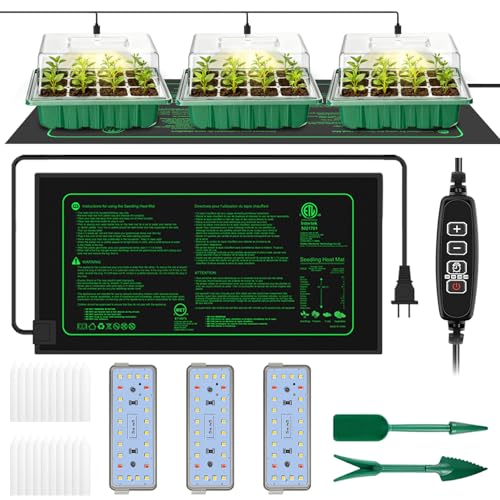
The only product in our catalogue that supplies heat to a growing space is a
Kokopro seed starter kit with grow
lights and a heat mat, which holds 70 to 85 Fahrenheit and measures 10.2 by 8.07 by
6.69 inches. It is also, in its own words, for "indoor use only and must not be immersed",
so it is not a cold frame heater and should not be pressed into service as one. Our page on
whether heat mats make seeds
germinate faster works through what bottom heat does and does not do, and makes the
distinction this page keeps leaning on: soil temperature and air temperature are different
quantities, and it is the soil one that matters to a seed.
A
VEVOR 12 inch greenhouse circulation
fan rated 1800 CFM is worth naming for the opposite reason: it solves the day problem
rather than the night one, and it solves it for a structure far larger than a frame.
Eighteen hundred cubic feet a minute is 0.85 cubic metres a second, and the Aggie's entire
internal volume is 0.72 cubic metres, so this fan would exchange the whole frame more than
once a second. Its real use is the 17 kelvin daytime rise in a walk-in house, where the
alternative to venting is the same cooking problem the wax hinge exists to prevent. Its
record also already flags a published internal contradiction in its own drawbacks, that
"The listing's size attribute conflicts with the stated fan diameter", which we reported
before this page and which still stands. Our page on
why a fan's CFM rating is not
the breeze you feel covers what that airflow figure does and does not promise.
The honest limit, and the one change that works
Three things on this page are exact and they are the three that carry the argument. An
enclosure with no heat input has no steady state temperature elevation. Stored heat decays
exponentially with a time constant equal to the store divided by the loss. And a surface
exchanging radiation with a body at its own temperature nets zero, which is why a cover
removes the sky depression completely rather than partly.
Everything thermal is representative and has to be, because not one cold frame or
greenhouse product we carry publishes a U value, an R value or a glazing thickness. The
2.9 for cedar, the 3.6 for double-wall polycarbonate, the 5.5 for the PVC cabinet, the 0.2
metres of coupled soil, the 300 watts a square metre of winter sun and the 25 kelvin sky
depression are all assumptions. Halve the coupled soil depth and the cedar frame's time
constant falls from 6.27 hours to 3.33 and its dawn residue from 14.75 percent to 2.7,
which makes the gap against the tray-based frame wider rather than narrower. Double the
glazing performance and the 1.80 factor becomes 1.3, which makes the mass term more
dominant still. The conclusion is robust in the direction that matters and the specific
hours are not.
What this page deliberately does not compute is the collapse load of any actual
structure, because that needs a tube wall thickness, a material and a joint detail and not
one listing publishes any of them. The snow weight is computable and the strength it is
pushing against is not, which means the right output is a weight rather than a verdict.
Which leaves the practical answer, and it costs nothing. If the goal is frost
protection, the cover does that on its first night and the material barely matters, so
clear the snow off it before it accumulates and stake it against the wind. If the goal is
a growing season, the glazing choice is the wrong lever entirely. Put the frame on soil
rather than on paving, which is the single biggest change available and the one nobody
sells, and if you want it to still be above ambient at dawn, fill the inside with
something heavy and dark. A row of water-filled bottles inside the frame adds its own mass
to the store at the top of this page, and water holds 4.186 kilojoules per kilogram per
kelvin, which is more than twice what the soil does per kilogram. Twenty litres of water
is 83.7 kilojoules per kelvin added to a 280 store, which lengthens the time constant by
30 percent and lifts the dawn residue from 14.75 percent to 21.2. That is a bigger
overnight gain than any glazing upgrade in this category, and the bottles are already in
your recycling.
Why a Winter Greenhouse Needs Mass, Not Glazing at a glance
Greenhouses and sheds where heat and humidity need managing unattended
Automatic start and stop on temperature or humidity thresholds
Noise only specified as at or below 60 dB
Why you can trust this guide
We compared these picks using verified manufacturer specifications, current retailer listings, and patterns in owner feedback, alongside editorial research. We focus on measurable differences such as performance, capacity, usability, and build quality. Pickpedia does not present editorial research as laboratory testing, and we do not claim hands-on testing unless it was actually performed.
Best for Season extension where nobody is home at midday to vent a closed frame
9.4/ 10 Pickpedia editorial score
A 4 by 2 foot cedar cold frame with a double-wall polycarbonate lid on a heat-sensitive wax hinge that opens above 70F and closes as it cools, backed by a five year warranty.
Best for Patios and small gardens needing two levels of protected growing space
8.4/ 10 Pickpedia editorial score
A two tier fir wood cold frame with high-transparency PVC panels, an openable roof vent, removable slatted shelves, drainage holes and a magnetic door latch.
BrandBeipoo
ModelBPG5004-007
Part numberBPG5004
Tiers2, with removable shelves
Dimensions35.43 x 14.57 x 27.56 in
BodySolid fir wood
GlazingHigh-transparency PVC panels
RoofSlanted, with openable top window
VentingManual, adjustable roof vent
DrainageDrainage holes with slatted shelves
DoorMagnetic latch
AssemblyPre-drilled holes
ColourGrey
Pros
Two tiers of growing space in a 35 inch footprint
Slanted roof catches light from more angles and sheds rain
Removable shelves for taller plants or full interior volume
Drainage holes and slatted shelves manage water and airflow together
Magnetic door latch keeps animals out
High-transparency PVC panels pass light well
Pre-drilled holes for assembly
Solid fir wood construction
Cons
PVC panels insulate less than double-wall polycarbonate
Roof vent is manual, so a hot day while you are out is a risk
Fir is a softwood, so the finish carries the protection
Best for Anchoring tents, trampolines, tarps and more in most ground
9.2/ 10 Pickpedia editorial score
A 10-pack of heavy-duty galvanized steel ground stakes, each about 15.8 inches long with a ribbed non-slip surface, a built-in loop for ropes and a sharp driving tip, for anchoring tents, trampolines, tarps, netting, tie-outs and more in soft or hard ground.
Best for Peppers, chillies and anything else that needs bottom heat to germinate
8.8/ 10 Pickpedia editorial score
A three tray seed starting kit with a far-infrared heat mat holding 70 to 85F, extra large 1.96 inch cells at 1.85 inch depth, three grow lights, an intelligent controller with four timing settings and heightened humidity domes.