Home ›
Home & Kitchen › Why a Spray Cleaner Leaves the Wall Before It Works
Home & Kitchen
Why a Spray Cleaner Leaves the Wall Before It Works
PBy the Pickpedia Team·3 picks compared·Last verified October 2026
Affiliate disclosure: As an Amazon Associate, Pickpedia earns from qualifying purchases. Links on this page are paid links, and we may earn a commission at no extra cost to you. This never affects our picks or scores.
This page contains affiliate links. If you buy through one we may earn a
commission, at no cost to you.
Yes, and the interesting part is hiding in the word "sit". On a horizontal surface
a sprayed cleaner sits and the instruction works. On a vertical one a thin watery film
does not sit, it drains, and the arithmetic says it clears a hand sized area in about
three seconds. So every label that tells you to apply and wait is quietly assuming a
fluid property, and a formulation that lacks that property will have left the surface
before the waiting starts. The property has a name, it is the one thing a "clinging
gel" claim is actually about, and it is absent from every cleaning listing on this
site.
Two jobs with opposite requirements
A trigger sprayer and a wall want contradictory things from the same liquid.
To atomise, a liquid has to be forced through an orifice a few tenths of a
millimetre across, fast, and break into droplets on the way out. A thick liquid will
not do that: it either refuses to pass, which is a jammed trigger, or it comes out as a
rope rather than a spray. So the nozzle wants a thin liquid.
To work, the liquid has to stay where you put it for as long as the job takes. A
cleaner's whole mechanism is reagent in contact with soil over time, which we work out
in detail in
why one cleaner
cannot cut grease and dissolve limescale: the reactions involved are consumed
stoichiometrically, so what you get out is set by how much reagent you deliver and how
long it stays. A liquid that runs to the floor delivers its reagent to the floor. So
the wall wants a thick liquid.
Those two requirements are not a compromise to be split. They are opposite ends of a
scale, and the only way to have both is a liquid whose thickness is not a fixed
property.
How fast a film actually leaves
Put a number on the losing case first, because it is worse than it feels.
A film of liquid clinging to a vertical wall is held up by nothing except the
viscous resistance of its own flow. Its weight acts down the wall, and the shear stress
that weight applies at the wall is simply the density times gravity times the film
thickness. For water at a tenth of a millimetre that is 1,000 times 9.81 times
0.0001, which is 0.98 pascals. That is a very small stress, which sounds reassuring,
and it is not, because water's resistance to it is smaller still.
The standard result for a film draining down a vertical plate gives the velocity at
the free surface as the density times gravity times the square of the thickness,
divided by twice the viscosity. For that tenth of a millimetre film of water: 1,000
times 9.81 times 1 times 10 to the minus 8, divided by 0.002, which is 0.049 metres per
second. Forty nine millimetres a second. Spray a 150 millimetre band and the top of it
is bare in three seconds.
Now the part that catches people out, and it is the most useful line on this page.
The velocity goes as the square of the thickness. So spraying more does not help; it
makes things worse. Triple the film to three tenths of a millimetre and the surface
speed goes up ninefold, to 440 millimetres per second, and the band clears in three
tenths of a second. The instinct when a cleaner runs off is to use more of it, and
more of it leaves faster.
Worked from the standard gravity driven film on a vertical plate, with water at 0.001
pascal seconds, and a nozzle shear rate taken as eight times the mean velocity over
the orifice diameter for a 0.4 millimetre orifice at 10 metres per second. No cleaning
product we carry publishes a viscosity, a yield stress or a film thickness, so the gel
curve is a worked power law rather than a measurement of any particular bottle.
The property that resolves it, and the two numbers that define the gap
What makes the two jobs compatible is a fluid whose apparent viscosity depends on
how hard it is being sheared. Thin while something is pushing it, thick when nothing
is. The general name is shear thinning, and the special case where the viscosity
becomes effectively infinite below some stress is a yield stress fluid.
The reason this works is that the two jobs happen at shear rates that are nowhere
near each other, and the gap is enormous. Take the nozzle first. A trigger sprayer
orifice is around four tenths of a millimetre, and to atomise you need something like
ten metres per second through it. The wall shear rate inside a tube is roughly eight
times the mean velocity divided by the diameter, which is eight times ten divided by
0.0004, or two hundred thousand reciprocal seconds.
Now the wall. A film creeping under its own weight at the sort of speed you would
want, say ten micrometres per second across a one millimetre layer, is a shear rate of
one hundredth of a reciprocal second. For a true yield stress fluid holding still it is
exactly zero.
So the two jobs are separated by six to seven decades of shear rate, and that is the
whole opportunity. A shear thinning fluid is commonly described by a power law, where
the apparent viscosity goes as the shear rate raised to the power of the flow index
minus one. For a thickened gel the index is often around nought point two, so the
viscosity falls as the shear rate to the power of nought point eight. Across six
decades that is ten to the power of four point eight, which is a factor of sixty three
thousand. The same liquid, sixty three thousand times thicker on the wall than in the
nozzle, with nothing switching and nothing added.
And the yield stress needed is almost embarrassingly small. A film does not flow at
all while its own weight stress stays below the yield stress, and the weight stress for
a one millimetre layer is 9.8 pascals. Ten pascals is about the pressure of a gram
spread over a square centimetre. Hold ten pascals and a millimetre thick layer will sit
on a vertical wall until you remove it.
Reading three of our own listings as fluids
A
True Fresh heavy duty mold
stain remover gel is the only product on this site whose listing describes a
rheological property, and it describes it twice. Its specification row for application
reads that it clings to vertical surfaces, and its first stated advantage is that the
cling gel stays put on vertical seals and walls. The record also states a form of gel,
a volume of 7 ounces, a concentrated formula, and that scrubbing is not required. What
the product acts on, and whether it does, is outside the scope of this page, and the
subject belongs in our existing
guide to removing
mold stains from washer seals and grout, which already covers it. This page is
only interested in whether the gel stays on the wall, and the listing's claim that it
does is a claim about a yield stress above about ten pascals, which is entirely
plausible for a gel and which the listing cannot be faulted for not quantifying because
nobody in the category does.
Two further things on that record are rheology rather than chemistry and are worth
separating out. Its own drawback that deep stains may need a longer dwell or a repeat
is a statement about contact time, which is the quantity a yield stress exists to buy,
and it is the honest counterweight to the single use action claimed elsewhere on the
same listing. And the 7 ounce volume gives a coverage figure the listing does not: 7
ounces is about 207 millilitres, which at a one millimetre film covers 0.21 square
metres, and at half a millimetre covers 0.41. That is a genuinely useful number and it
falls straight out of a published one. Record in our
True Fresh mold
stain remover gel review.
Against it, a
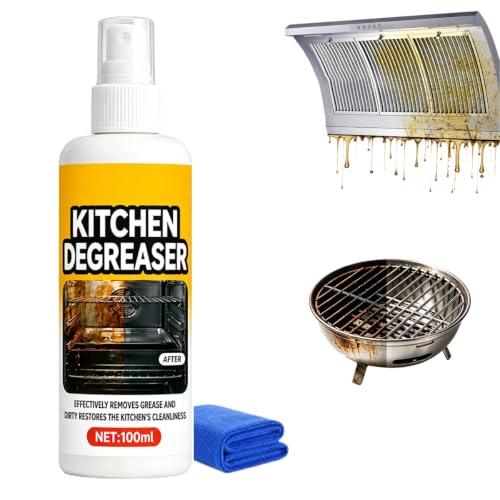
heavy duty kitchen degreaser
and grease cleaning spray publishes a form of spray and wipe, a routine of spray,
wait, wipe and rinse, and a surface list that includes oven interior walls and doors.
Its own drawback list says that no volume, ingredients or dwell time are listed.
Oven walls and doors are vertical, and the published routine includes a wait. So
this is precisely the product whose label asks you to let a liquid sit on a vertical
surface while publishing nothing about whether it can. It may well be thickened; many
degreasers are, and the absence of a number is not evidence of absence. But the one
specification that decides whether the published routine is physically available on the
surfaces it names is missing, and it is missing alongside the dwell time it would
govern. Its record is right that the facts are maker stated. Our
kitchen
degreaser review records what is published, and
our guide to degreasing
an oven, stovetop and grill gives the correct sequence, saying that a degreaser
works best when it sits briefly before wiping. That is right, and the missing clause is
the one this page supplies: on a vertical surface, briefly is as long as you get unless
the formulation was built for it.
And the extreme case, which is in the catalogue under a completely different
heading. A
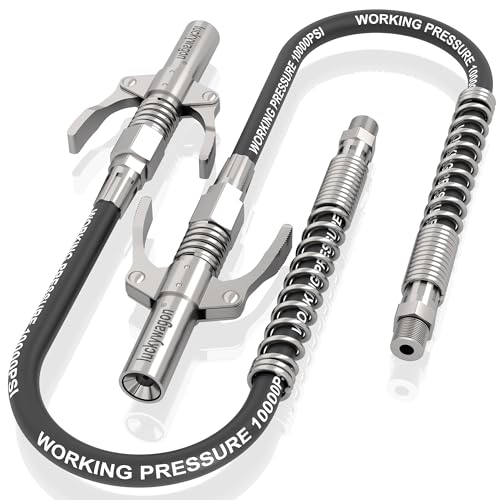
luckywagon 12 inch flexible
grease gun coupler hose kit exists because of this property and for no other
reason. Grease is a yield stress fluid by design: a soap thickener holds a base oil in a
structure that will not flow at all under its own weight, which is why a bearing stays
greased against gravity for years, and which is also why you cannot pour it. A whole
tool exists to supply the stress the fluid refuses to supply for itself.
Work out how much of that stress the hose itself demands. The pressure needed to get
a yield stress fluid moving through a tube is four times the yield stress times the
length, divided by the diameter. Take a bearing grease with a yield stress around a
thousand pascals, a 12 inch hose, which is 0.305 metres, and a three millimetre bore:
four times 1,000 times 0.305 divided by 0.003, which is 407,000 pascals, or about 59
pounds per square inch. A lever operated grease gun commonly reaches ten thousand. So
the hose is a tiny fraction of the pressure budget and the real pressure is set by the
fitting and the bearing, which is the right answer and is reassuring.
What is not reassuring is that the record's own first drawback is that no pressure
rating is stated. A flexible component in a line that can see several hundred bar, sold
with no stated limit, is a genuine gap, and it is the sort of gap that matters more on a
hose than on almost anything else in a toolbox. The record also notes that the exact
weight is not listed and that thread sealing may need tape. Details in our
luckywagon
grease gun coupler hose review.
What a cling claim is worth, and what a power claim is not
Two marketing phrases come out of this with very different standing, and it is worth
saying which is which.
"Clinging gel" is a real claim. It asserts a yield stress, it is testable with a
wall and a stopwatch, and it is the difference between a cleaner that gets its stated
dwell time and one that does not. A product that says it stays on a vertical surface is
telling you something specific about its formulation, and the claim either survives
contact with a shower wall in the first ten seconds or it does not.
"Powerful spray" is usually not a claim about anything. There is no property called
power in a liquid. If it means a higher reagent concentration, that is a different
specification and nobody publishes it either. If it means the spray pattern is forceful,
that is a nozzle property and it works against the cleaning: a higher nozzle velocity is
a higher shear rate, which on a shear thinning fluid means a thinner film arriving at
the wall, and on a Newtonian one means more of it bouncing off and running down.
There is also a middle case worth naming. A foaming cleaner is a third solution to
the same problem, and it works differently again: a foam is a gas dispersed in liquid,
and the liquid films between bubbles are held by surface tension in a structure that
resists flow, so a foam has an effective yield stress without needing a polymer
thickener. That is why oven and bathroom products so often foam, and it is a rheology
decision presented as a texture.
Problems in our own records
Two worth reporting.
The first is category wide and total. Across the 21 cleaning products we publish,
not one states a viscosity, a yield stress or a film thickness, and only one mentions
its flow behaviour at all, in the form of a cling claim with no number attached. So the
property that determines whether a product can follow its own instructions is absent
from the entire category. This matters more here than most missing specifications,
because unlike a chemical concentration it is a property a buyer could verify in ten
seconds if anyone told them it existed.
The second is a mismatch between a product's form and its own stated routine. The
degreaser publishes a four step routine with a wait in it, and a surface list in which
the two most prominent entries, oven interior walls and doors, are vertical. Whether
those are compatible is unanswerable from the listing. The two facts sit three rows
apart on the same record and neither one qualifies the other.
The honest limit, and the free technique that beats the purchase
The specification that would settle this is a yield stress in pascals, or failing
that a sag resistance, and no cleaning listing on this site or anywhere near it gives
you one. What you can do instead is test it for nothing, before the job: spray a patch
on a vertical tile, start counting, and see whether the top of the patch is still wet at
thirty seconds. A product with a yield stress will still be there at ten minutes. A
Newtonian one is gone before you finish counting to five. That single test tells you
more than the whole front label.
Then the technique that beats the purchase, which is to stop asking the wall to hold
the liquid and ask a cloth instead.
A cloth holds liquid by capillary action in its pores, and the capillary pressure in
a pore is twice the surface tension divided by the pore radius. For water against a
twenty micrometre pore that is about 7,000 pascals, against the ten pascals of film
weight the wall has to fight. So a cloth holds the liquid roughly seven hundred times
more firmly than gravity pulls at it, which means a damp cloth is a yield stress fluid
you already own. Spray the cloth, press it against the surface, and leave it there. The
contact time becomes however long you choose to leave it, the reagent stays in contact
instead of travelling, and the thing that was impossible on a vertical surface becomes
trivial. This is what a poultice is, and it is why it is still the technique of choice
for stubborn marks on vertical stone. Our
guide to reusable
microfibre cleaning cloths covers the cloths themselves.
Two corollaries follow and both save effort. If a surface can be laid flat, lay it
flat, because the entire problem on this page is a component of gravity along the
surface and it goes to zero at horizontal. And if a cleaner is running off, the answer
is never more of it: a thicker film drains as the square of its thickness, so the extra
product reaches the floor faster than the first lot did. Use a cloth, or use something
with a yield stress, and stop trying to win an argument with gravity using a liquid that
has nothing to argue with.
Why a Spray Cleaner Leaves the Wall Before It Works at a glance
We compared these picks using verified manufacturer specifications, current retailer listings, and patterns in owner feedback, alongside editorial research. We focus on measurable differences such as performance, capacity, usability, and build quality. Pickpedia does not present editorial research as laboratory testing, and we do not claim hands-on testing unless it was actually performed.
Best for Removing set-in mold stains from seals and grout
8.4/ 10 Pickpedia editorial score
True Fresh Mold Stain Remover Gel targets mold stains, grime, and black spots on washer seals, grout, caulking, tiles, and tubs. The 7 oz gel clings to vertical surfaces without running, so you apply, wait, and rinse with no scrubbing. The maker states one use restores discolored seals and describes a concentrated, fragrance-free formula made with simple ingredients. It suits front-loader owners and bathrooms fighting stubborn moisture stains.
Best for spray-and-wipe grease cleanup on cooking surfaces
8.2/ 10 Pickpedia editorial score
This heavy duty kitchen degreaser spray targets grease across cooking areas. Use it on counters, stovetops, oven interiors, and grill grates, then wipe or rinse as needed. The maker states it helps lift grease with less rubbing on ovens, stoves, grills, trays, and racks. Positioned for both indoor and outdoor cooking cleanup, it fits a spray-and-wipe routine before and after busy cooking sessions.
Best for reaching tight grease fittings without slipping
8.6/ 10 Pickpedia editorial score
The luckywagon Grease Gun Coupler Hose Kit helps mechanics and equipment owners reach tight fittings without mess. A 6-jaw locking coupler grips grease zerks securely and releases with one hand. A 12-inch flexible hose reaches awkward points on tractors, trailers, and lawn equipment. Alloy steel construction resists wear, and it fits standard 1/8-inch NPT grease guns. Ships as a 2-pack.