Home ›
Tools & DIY › Why a Lopper Rated for 2 Inches Stalls on a 2 Inch Branch
Tools & DIY
Why a Lopper Rated for 2 Inches Stalls on a 2 Inch Branch
PBy the Pickpedia Team·5 picks compared·Last verified October 2026
Affiliate disclosure: As an Amazon Associate, Pickpedia earns from qualifying purchases. Links on this page are paid links, and we may earn a commission at no extra cost to you. This never affects our picks or scores.
This page contains affiliate links. If you buy through one we may earn a
commission, at no cost to you.
There is a reason this question keeps getting asked and keeps getting answered
with brand names. The thing that decides whether a branch is easy is not the brand
and barely the steel. It is geometry, and specifically it is where in the jaw the
wood is allowed to sit, which the wood decides and you do not.
Work that through and you get a result that is worth knowing before you spend
anything: doubling the branch diameter roughly quadruples the force you have to
put into the handles. Not doubles. Quadruples. Which is why a tool that sailed
through last year's growth feels broken on this year's.
A lopper has no single mechanical advantage
A lopper is a pair of levers. The force at the blade is the force in your hands
multiplied by the length from the pivot to your grip, divided by the length from
the pivot to the point where the blade is pressing on the wood. That second
distance is the one nobody prints, and it is not a property of the tool. It is set
by the branch.
Here is why. The gap between the two jaws grows the further you go from the
pivot, which is simply what happens when two arms open about a hinge. So a branch
can only sit at a distance where the gap is already at least as wide as the branch
is. Take a head with roughly three and a half inches of cutting edge that opens
about two and a half inches at the tip. The gap at any point is then about 0.71
times the distance from the pivot. A half inch twig can nest right down at 0.7
inches from the pivot. A two inch limb cannot get closer than about 2.8 inches,
because that is the first place along the blade where the jaw is two inches
open.
Now put a handle on it. A 26 inch lopper with a four inch head gives you about
22 inches from pivot to grip. For the twig, the ratio of lever arms is 22 divided
by 0.7, which is about 31. For the two inch limb it is 22 divided by 2.8, which is
about 8. The branch that needs the most force gets a quarter of the leverage, and
it gets it for a reason that no amount of better steel addresses.
Same tool, same hands, same blade. The only thing that changed is how far down
the jaw the wood is allowed to go, and that is set by the wood.
Which is where the square comes from
Two things move in opposite directions at once. The force needed at the blade
goes up roughly in proportion to the diameter, because the blade has to sever a
longer line of fibres. The leverage you have goes down in proportion to the
diameter, because the branch is pushed further out along the jaw. Multiply them
together and the force your hands must supply grows with the square of the
diameter.
So from one inch to two inches is four times the squeeze. From one inch to one
and a half is about two and a quarter times. That is the whole experience of
pruning compressed into one line, and it explains the specific complaint behind
this question: the tool does not degrade gracefully as the wood gets thicker, it
falls off a cliff.
Reading our own catalogue with that in hand
An
extendable anvil lopper
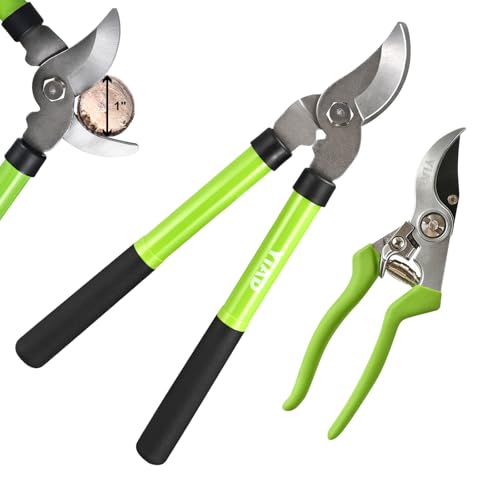
that adjusts from 26 to 36 inches publishes a cut capacity of up to 2 inches,
a compound action lever the maker states multiplies hand force up to 4X, a
telescopic handle with six locking positions, reach up to 9 feet, heat treated
carbon steel at 48 to 52 HRC and soft TPR grips. Two things on that record are
worth holding together.
The first is that the 4X is explicitly up to. A compound linkage exists
precisely because a plain pivot has the problem described above, and the way it
helps is by having a ratio that changes through the stroke rather than a ratio
that is high everywhere. A single multiplier printed on a box is therefore one
point on a curve, and the listing does not say which point. The second is the
gap: its own record notes that the blade length is not specified. Blade length is
the number the whole calculation above runs on, so a capacity of 2 inches without
a blade length is not a checkable claim. Our
review
of the extendable anvil lopper lists what is and is not published, including
that the weight is missing too.
On the telescopic part, our existing
guide to choosing a
lopper for thick and high branches treats the 26 to 36 inch adjustment as
straight gain, and that needs a caveat we did not give it. Going from 22 to 32
inches of lever does raise the ratio by about 45 percent on paper. But the same
tube bends roughly three times as far under the same hand force, because bending
grows with the cube of the length and 32 over 22 cubed is about three. Travel that
goes into the handle flexing does not go into closing the jaw. Add that you are
now squeezing with your arms above your head rather than braced at your chest, and
the paper gain is mostly spent before it reaches the wood. Reach and capacity
really do fight.
A
3 piece garden set with a
gear assisted anvil lopper, a 360 degree grass shear and a retractable saw
shows the same pattern with smaller numbers and is more honest for it: the lopper
is rated to 1.5 inches with a 3 speed gear the maker says gives 3X force and up to
50 percent less effort, on 65MN carbon steel with a PTFE coating. Rating it at 1.5
rather than 2 inches is the realistic call given the square law, and the saw in the
box is the tell. Somebody designing that kit knew where the lopper runs out. Its
record is also straightforward that the exact weights and blade lengths are not
listed and that the 3X is a maker claim. See our
review of
the 3 piece garden tool set.
And a
2-piece SK-5 steel bypass
lopper and pruning shears set states the trade directly on its own record: a
15 inch lopper at 0.91 lb with 8 inch shears at 0.6 lb, Teflon coated SK-5 blades,
PP and TPR grips with a one click lock, and in its own limitations, that the short
handle trades leverage for reach. A 15 inch lopper gives you maybe 11 inches of
lever, so every ratio in this article roughly halves. That is the right tool for
getting into a congested shrub and the wrong one for storm wood, and the listing
does not pretend otherwise. More in our
review of
the SK-5 bypass lopper and shears set.
The product that admits the mechanism in its specification
The clearest confirmation that this is real comes from a tool that took your
hands out of the loop. A set of
cordless electric pruning
shears with a 1.35 inch cut publishes a 370W brushless motor, an LCD cut
counter, two 2000mAh packs rated for over 2,400 cuts, an SK7 blade with a spare
and a whetstone, and this line: two gears setting the opening to either 0.9 inches
or 1.75 inches.
Think about why that control exists. A motor turning a fixed screw or cam has
its own force curve, and running the jaw out to 1.75 inches costs force in exactly
the way described above. Rather than hide it, the design gives you a narrow gear
for small work where the geometry is favourable and a wide gear for thick work
where it is not. And then notice that the wide gear opens to 1.75 inches while the
published cutting capacity is 1.35. The jaw opens wider than the tool can cut, by
about four tenths of an inch, which is the clearest possible statement that opening
and cutting are two different numbers. We flag that as a contradiction in the
listing rather than a fault in the tool: it is the specification telling the truth
by accident. Our
review of the
cordless electric pruning shears notes that the capacity and cut count figures
are maker stated, and that larger branches may need several passes.
At the other end, a pair of
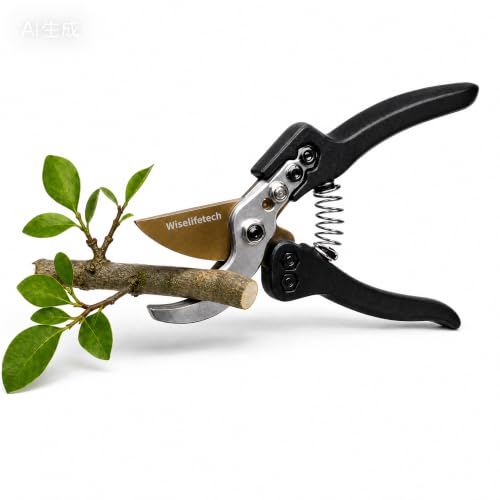
SK5 bypass pruning shears,
8 inch, for roses publishes a coated SK5 blade, a spring return, a thumb lock
and 0.53 lb, and its record states that no exact cut capacity is given. On the
arithmetic here that absence is defensible. An 8 inch shear has about 5 inches of
lever and a jaw that opens perhaps three quarters of an inch, so the capacity is
whatever one hand can do against a ratio of roughly ten, which varies more between
two people than between two brands. Details in our
review
of the SK5 bypass shears.
The honest limit, and it is free
Everything that actually helps with a thick branch is a technique, not a
purchase, and all of it follows from the drawing above.
Push the branch as deep into the jaw as it will physically go before you
squeeze. Most people cut where the branch first touches the blade, which is near
the tip, and then pull. Moving the same branch from the tip to half way down the
blade roughly doubles the force at the edge for free, and on a borderline cut it
is the difference between a cut and a crush.
Then reduce the diameter instead of fighting it. Because the demand goes as the
square, taking two slices off the sides of a two inch limb to leave an inch and a
half of wood in the final cut cuts the required squeeze by more than half. Three
easy cuts beat one impossible one, and nibbling costs nothing but time.
Do not twist to free a stuck blade. On a bypass head the two edges have to pass
each other within a fraction of a millimetre, and a bent blade never passes
cleanly again, which turns every future cut into a crush. Back the tool out, open
it, reseat deeper.
And know where the cliff is. Past about an inch and a half of live hardwood the
square law has already won, and no lever, gear or telescopic handle gets it back.
That is a saw, which does not care about diameter in anything like the same way
because it removes wood a little at a time instead of all at once. We covered the
technique in
using a
pruning saw safely for cleaner cuts, and the one line in our existing
guide to
loppers and shears that holds up best is the one that says thicker trunks need
a saw rather than force. The best tool for cutting thick branches easily turns out
not to be a lopper at all.
Why a Lopper Rated for 2 Inches Stalls on a 2 Inch Branch at a glance
SK5 Bypass Pruning Shears, 8 Inch Garden Hand Pruners for Roses
Clean cuts on roses, flowers, and small live stems
Bypass blade cuts live stems cleanly
Built for small growth, not thick limbs
Why you can trust this guide
We compared these picks using verified manufacturer specifications, current retailer listings, and patterns in owner feedback, alongside editorial research. We focus on measurable differences such as performance, capacity, usability, and build quality. Pickpedia does not present editorial research as laboratory testing, and we do not claim hands-on testing unless it was actually performed.
Best for Reaching and cutting thick, high branches from the ground
8.6/ 10 Pickpedia editorial score
This extendable anvil lopper handles branches up to 2 inches thick. A patented compound-action lever multiplies hand force up to 4X, the maker states, so thick limbs part with less effort. The telescopic handle adjusts from 26 to 36 inches across six locking positions, reaching growth up to 9 feet high. Soft TPR grips absorb shock. It suits orchard owners, seniors, and anyone clearing storm-damaged limbs.
Best for A versatile one-buy kit for general yard upkeep
8.2/ 10 Pickpedia editorial score
This 3 piece garden set bundles a gear-assisted anvil lopper, a 360 degree rotating grass shear, and a retractable hand saw. The lopper uses a 3-speed gear that the maker says delivers 3X cutting force to sever branches up to 1.5 inches. The shear head swivels across 16 positions for edging, and the saw retracts into its handle for storage. All three use 65MN carbon steel with a PTFE anti-rust coating.
Best for gardeners wanting the lightest possible bypass tools
8.4/ 10 Pickpedia editorial score
This two-piece set combines a 15-inch bypass lopper with 8-inch pruning shears, both using SK-5 high carbon steel and a Teflon coating that the maker says resists sap and rust. The tools weigh 0.91 and 0.6 lbs, making them among the lighter garden clippers available. Slip-resistant PP and TPR grips and a one-click safety lock target seniors, women, and those with arthritis.
Blade materialSK-5 high carbon steel
Blade coatingTeflon
Lopper length15 inches
Shears length8 inches
Lopper weight0.91 lb
Shears weight0.6 lb
Handle materialPP and TPR
SafetyOne-click lock and finger guard
Pros
Both tools are notably light at 0.91 and 0.6 lbs
SK-5 heat-treated steel aims for strong clean cuts
Teflon coating resists sap and rust per the maker
Short lopper handle reaches tight branch gaps
Slip-resistant PP and TPR grips ease fatigue
One-click lock and finger guard add safety
Cons
Three-times cutting claim is maker-stated
Weight figures come from the listing, not our scale
Best for gardeners retiring manual loppers for powered cutting
8.4/ 10 Pickpedia editorial score
These cordless electric pruning shears use a 370W brushless motor rated to cut branches up to 1.35 inches, making trimming easier for gardeners who tire of manual loppers. An LCD screen shows power and counts cuts. Two 2000mAh batteries deliver over 2,400 cuts. The upgraded SK7 blade ships with a spare blade and a whetstone, plus multiple safety measures.
Best for Clean cuts on roses, flowers, and small live stems
8.4/ 10 Pickpedia editorial score
These SK5 bypass pruning shears handle everyday trimming of rose canes, flower stems, herbs, and small branches. The 8 inch frame stays compact for precise cuts, while the coated SK5 blade shears live stems cleanly like scissors. A spring reopens the handle after each cut, and a thumb lock keeps them closed in storage. At 0.53 lb, they carry easily for deadheading and quick garden work.