Home ›
Home & Kitchen › Why a Dehumidifier Setpoint Belongs to the Coldest Wall
Home & Kitchen
Why a Dehumidifier Setpoint Belongs to the Coldest Wall
PBy the Pickpedia Team·5 picks compared·Last verified October 2026
Affiliate disclosure: As an Amazon Associate, Pickpedia earns from qualifying purchases. Links on this page are paid links, and we may earn a commission at no extra cost to you. This never affects our picks or scores.
This page contains affiliate links. If you buy through one we may earn a
commission, at no cost to you.
There is no answer in percent until you say how cold the coldest surface in the room is, because
the number on the dial is a property of that surface and not of the room.
Condensation and mould happen on a wall, a window reveal, a tiled corner or the back of a wardrobe,
and relative humidity at a surface is the room's vapour pressure divided by the saturation pressure
at the surface's own temperature. Which produces a result worth carrying around: a room sitting at
a perfectly comfortable 55 percent at 20 degrees has an 80 percent wall at 14 degrees
and a streaming one at 10.7.
Invert that and you get the answer in the units the question asked for. To hold the coldest
surface at 75 percent you need the room at 58 percent for a 16 degree wall, 51 for a 14 degree
wall, 45 for a 12 degree wall and 39 for a 10 degree wall. Six kelvin of wall temperature
is nineteen points on the dial, which is 3.15 points per kelvin.
And that number is the reason the free interventions work. Warming a cold wall by two degrees,
by pulling the furniture off it, is worth about six points of setpoint.
The relation, and why a comfortable room still grows mould
Use the Magnus expression for saturation vapour pressure and everything follows in one line. At
20 degrees the saturation pressure is 2.3334 kilopascals, so a room at 55 percent carries a vapour
pressure of 1.2834 kilopascals and a dew point of 10.69 degrees.
That vapour pressure is the same everywhere in the room. What changes from place to place is the
saturation pressure, because that depends only on temperature.
So divide the one by the other at each surface:
A wall at 18 degrees sits at 62.3 percent. At 16, 70.7. At
14, 80.4. At 12, 91.7. At 10.69, exactly 100 and
visibly wet.
Eighty percent sustained is roughly where surface mould becomes possible, and that threshold is
a convention from building physics rather than anything a product publishes, which makes it the
softest input on this page. On it, a 55 percent room has already reached the line six degrees down
a cold wall.
Our guide to
dealing
with damp and condensation gets this right in words: "It happens when too much moisture in the
air meets cold surfaces", and "Keep the home reasonably and evenly heated in cold weather, since
very cold surfaces attract condensation." Both correct. What follows is the arithmetic those two
sentences were owed.
Surface humidity is the room's vapour pressure over
the saturation pressure at the surface, so a comfortable 55 percent room has an 80 percent wall at
14 degrees. Inverted, the setpoint moves 3.15 points for every kelvin of wall temperature, which is
what warming a cold wall is worth.
The setpoint, in the units the question asked for
Run the relation backwards. Fix the surface at 75 percent, which leaves a margin under the 80
percent line, and solve for the room:
A 16 degree wall allows a room at 58.3 percent. A
14 degree wall, 51.3. A 12, 45.0.
A 10, 39.4.
That is the whole answer, and it explains why the advice people are given varies so wildly. The
figure most often quoted, somewhere around 50 percent, is correct for a wall at about 14 degrees,
which is an ordinary internal wall in a heated house in winter. It is far too generous for an
uninsulated external corner at 10 degrees and needlessly strict for a well-insulated room where
nothing is below 16.
The dial does not know which house it is in. You do, and a surface thermometer
pointed at the coldest corner converts the guess into a number.
And it puts a value on the interventions that need no equipment. Our own damp guide says "Leave
gaps behind furniture on cold external walls so air can circulate." At 3.15 points per kelvin, a
wardrobe moved off a wall that warms two degrees as a result is worth six points on the setpoint,
which is more than most people are willing to move the dial. The same page's "Wipe condensation off
windows in the morning" is doing something different and also real: it removes liquid water from
the room before it evaporates back into it.
How much water a machine actually moves
Now the capacity side, because the two halves of the question are usually conflated. A
CLEVAST compact dehumidifier with a drain
hose publishes a dual semiconductor system removing up to 700 millilitres of
moisture per day, a rating of up to 500 square feet, dimensions of 8.8 by 4.9 by
13.5 inches, tank drainage with auto shut-off or a continuous hose, a real-time humidity display, a
brushless motor with a sleep mode and timer, and a seven colour ambient light.
Take the room it is rated for. Five hundred square feet at a 2.4 metre ceiling is 111.5 cubic
metres. Air at 20 degrees and 55 percent holds 9.486 grams of water per cubic metre, so
the air in that room carries 1,058 grams of water vapour. The machine's whole
daily output is 66 percent of it.
Which sounds like a reasonable match and is not, because the room is not a sealed box. At half
an air change an hour, a very ordinary figure for a house, 55.7 cubic metres of outside air come in
every hour. Outside at 10 degrees and 80 percent holds 7.506 grams a cubic metre, so that exchange
removes 1.980 grams a cubic metre, which is 110 grams an hour, which is 2,647 grams a
day.
The building out-dehumidifies the machine 3.78 to one, for nothing, in cool
weather. Which answers a second question in the vault, how to remove humidity from a room
without a dehumidifier, in one line: in winter you already are, and the machine's job is to handle
the surplus your own activities add on top.
The ventilation comparison, and what it costs
Push that further with a machine built to move air rather than water. A
TOOLBOOX 970CFM air scrubber publishes
up to 970 cubic feet a minute through three-stage HEPA-grade filtration, a rotomolded polyethylene
shell, a foldable handle with lockable wheels, a stackable interlocking design and operation as a
negative air machine.
Nine hundred and seventy cubic feet a minute is 1,648 cubic metres an hour. Run
as a negative air machine on the same 10 degree, 80 percent outside air, that removes 3,263 grams of
water an hour, or 78,310 grams a day.
A hundred and twelve times the dehumidifier's daily output. Ventilation is not
a weak alternative to dehumidification. It is two orders of magnitude stronger, and it is what the
building is already doing slowly.
The bill arrives in kelvin rather than in grams. Bringing in 1,648 cubic metres an hour of 10
degree air and holding the room at 20 needs 5,521 watts of heating. That is the
honest trade, and it is why nobody ventilates a damp room continuously in winter: the fastest dryer
in the house is also the one that empties the heating. The useful version is short bursts after the
moisture is generated, which is exactly what an extractor fan is for. Our page on
why an air cleaner's square footage is a
time does the same conversion for particles rather than water, and the move is the same one:
turn an area rating back into the air change rate somebody chose. Full record in our
review of the TOOLBOOX air scrubber, including
the limit its own listing is careful about: it is "General dust control, not hazardous-material
remediation".
Why a thermoelectric unit is weakest where it is needed most
The CLEVAST's record names a limitation without quantifying it: semiconductor units "work best
in warmer conditions and lose effectiveness in the cold". Here is the number.
A thermoelectric dehumidifier condenses water on a cold face, and the rate tracks the difference
between the room's vapour pressure and the saturation pressure at that face. Hold the face at a
representative 5 degrees for both cases:
In a 20 degree room at 55 percent, the driving difference is 1.2834 minus
0.8716, which is 0.4118 kilopascals.
In a 12 degree room at 70 percent, it is 0.9801 minus 0.8716, which is
0.1085.
A factor of 3.80 less driving force in the cold room, and the cold room is
precisely where the surface humidity problem is worst, because every surface in it is nearer the
dew point. The machine is weakest in the conditions that create the job. That is not a design fault
so much as thermodynamics, and the right response is the one the arithmetic above already
suggested: warm the surface rather than chase the air.
Which is also most of the answer to the question in the vault about a continuous dehumidifier
that randomly fills its bucket and stops. A machine running against a small driving force fills
slowly and unevenly, and the rate it fills at is a reading on the room rather than on the machine.
More in our
review of the CLEVAST
dehumidifier.
One of our own ratings that its own record contradicts
Worth flagging, because the two statements are in the same record. The CLEVAST is rated "up to
500 square feet", and its drawbacks read "Modest 700ml/day capacity, small spaces only" and "Not
for large rooms, serious damp or basements".
The arithmetic says which to believe. Seven hundred millilitres spread over 500 square feet is
15.1 grams per square metre per day. One ten minute shower releases somewhere
between 300 and 700 grams of water into a room. So the machine's entire day is roughly one
shower, and the 500 square feet is not a dehumidification figure at all. The drawback is
right and the area rating is a different kind of claim wearing the same units. We are flagging it
rather than deleting it, because it is plainly the maker's own number, and the useful correction is
the one the record already contains two lines further down.
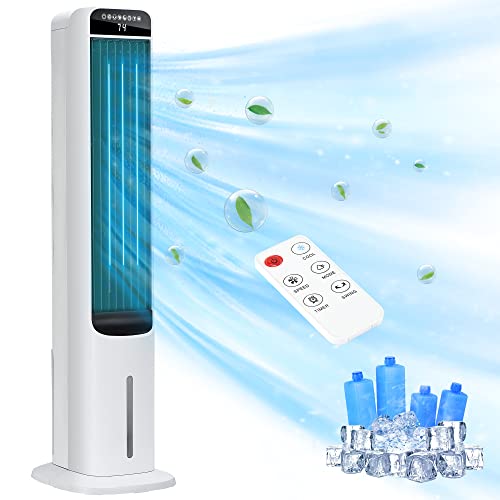
The same conflation in the other direction is in the same catalogue. A
41 inch evaporative air cooler tower
fan publishes a 4 litre detachable tank, three speeds, four modes, 120 degree
oscillation, four reusable ice packs, honeycomb pads, an 80 watt draw, ETL listing and a rating for
spaces up to about 300 square feet in dry conditions.
Its whole function is to evaporate that tank. One tankful is 4,000 grams of water, which
is 5.71 days of the dehumidifier's output, in the opposite direction, and it is rated for a
smaller room. Its own drawbacks are completely straight about it: "An evaporative cooler, NOT an air
conditioner", and "Works poorly in humid weather and adds humidity". Both true, and our page on
why an evaporative cooler
runs out of degrees in humid air owns the cooling side of that argument properly. See also our
review of the evaporative cooler
tower.
The stain and the cause are different products
A
True Fresh heavy duty mold stain remover
gel publishes a 7 ounce concentrated, fragrance-free cling gel for washer seals, front loading
drums, grout, shower caulking, tiles, tubs and fridge rubber, designed to stay put on vertical
surfaces and work without scrubbing.
Its own first drawback is the sentence that matters here: "Removes stains but does not prevent
regrowth." That is exactly the right division of labour, and the arithmetic above says what the
other half of the job is. Seven ounces is 207 millilitres; a washing machine door seal of about 60
centimetres diameter and 3 centimetres of working width is 566 square centimetres, so at a
representative half millimetre of gel one bottle is about seven seal treatments.
Which is a useful number precisely because the record stops at "should stretch across many jobs".
More in our
review of the True Fresh mold
stain gel.
The maintenance version of the same job is a
flowcheer 24 pack of washing machine
cleaner tablets, published as one slow-dissolving tablet per empty cycle, 24 tablets framed as
a year of monthly care, HE and standard compatible and septic safe. Its drawbacks are equally
honest, "Maintenance tool, not a deep rescue" and "Heavy seal grime may need manual wiping", which
is the correct order of operations: the gel for the stain that is there, the tablet for the month
ahead, and the setpoint for the reason either was needed. Details in our
review of the
flowcheer washer tablets.
The honest limit, and what it leaves to somebody else
What is exact here is the psychrometry. Surface relative humidity is the room's vapour pressure
divided by the saturation pressure at the surface, and every figure in the first two panels follows
from the Magnus expression with no free parameters at all. The 3.15 points per kelvin, the 3.80
factor on the thermoelectric driving force, and the 5.71 days between one cooler tank and one
dehumidifier day are exact. The 15.1 grams a square metre comes from two published numbers on one
record. The 1,648 cubic metres an hour and the 5,521 watts follow from one published airflow and
standard air properties.
What is representative rather than published is a short list that moves the absolute answers
without touching the structure. The 80 percent surface threshold for mould and the 75 percent
target are building physics conventions, and shifting the target to 80 percent moves every setpoint
up by about four points together, leaving the 3.15 per kelvin untouched. The 2.4 metre ceiling, the
half air change an hour, and the 10 degree 80 percent outside air are all assumptions, and the
leakage figure in particular is the one that varies most between houses: a tight modern flat at
0.2 changes an hour loses only 1,059 grams a day and the machine becomes the larger term, while a
draughty one at 1.0 removes 5,294 and the machine becomes a rounding error. The fixed 5 degree cold
face on the thermoelectric comparison is ours, because no listing publishes a cold side temperature
or a depression.
Three things this page deliberately does not compute. It does not predict whether mould will
grow, or how fast, which needs a species, a substrate, a nutrient supply and a time of wetness
model, and which is the real limit on the central result: the arithmetic says where the surface
humidity sits and nothing about what grows there. It does not compute a dehumidifier's actual
removal rate in any specific room, because every listing states its capacity at an unstated test
condition and the rate roughly halves for a modest drop in temperature, so the published figure is
a ceiling rather than a rate. And it does not address damp that is not condensation. A leak, rising
damp, a structural fault or mould over a large area is a different problem with a different fix,
and our own damp guide is right that it "needs the source fixed" and deserves professional advice
rather than a setpoint.
Three numbers to carry. Surface humidity is the room's vapour pressure over the saturation
pressure at the surface, so measure the coldest corner before you touch the dial. The setpoint
moves 3.15 points for every kelvin of wall temperature, which is why warming a cold surface beats
drying the air. And ventilation at 970 cubic feet a minute removes 112 times what a compact
dehumidifier does in a day, for 5.5 kilowatts of heat, so the fastest dryer in the house is the one
you should run in short bursts rather than continuously.
Why a Dehumidifier Setpoint Belongs to the Coldest Wall at a glance
flowcheer Washing Machine Cleaner Tablets for Pet Hair, 24 Pack
monthly washer upkeep in pet homes
Built specifically for pet-hair-heavy homes
Residue and odor claims are maker-stated
Why you can trust this guide
We compared these picks using verified manufacturer specifications, current retailer listings, and patterns in owner feedback, alongside editorial research. We focus on measurable differences such as performance, capacity, usability, and build quality. Pickpedia does not present editorial research as laboratory testing, and we do not claim hands-on testing unless it was actually performed.
Best for Everyday damp in a small bedroom, bathroom or closet
8.4/ 10 Pickpedia editorial score
A compact, quiet semiconductor dehumidifier that removes up to 23 oz (700ml) of moisture per day for small rooms up to 500 square feet, with a real-time humidity display, tank drainage with auto shut-off or a continuous drain hose, a quiet brushless motor with sleep mode and timer, and a slim design.
BrandCLEVAST
TypeSemiconductor dehumidifier
RemovalUp to 23 oz (700ml) per day
CoverageUp to 500 sq ft (small rooms)
DrainageTank with auto shut-off, or drain hose
DisplayReal-time humidity
MotorQuiet brushless DC, sleep mode, timer
Size8.8 by 4.9 by 13.5 inches
ColourWhite
Pros
Quiet semiconductor removal, no compressor
Two drainage options: tank or continuous hose
Real-time humidity display
Quiet enough for a bedroom, with sleep mode and timer
Best for Clearing fine dust on big renovation and workshop jobs
8.8/ 10 Pickpedia editorial score
A heavy-duty air scrubber and negative air machine that moves up to 970CFM through three-stage HEPA-grade filtration to capture airborne dust on renovation and workshop jobs, in a rotomolded shell with an auto-foldable handle, lockable 360 degree wheels, UV-C technology and a stackable design.
Best for Low-cost portable spot cooling in small rooms in dry conditions
8.4/ 10 Pickpedia editorial score
A 41-inch tower evaporative air cooler combining a fan, humidifier and swamp cooler, with 3 speeds, 4 modes, 120 degree oscillation, 4 reusable ice packs, honeycomb pads, a 4-litre tank, remote and LED panel with a 12-hour timer, an 80-watt draw and ETL listing, for spaces up to about 300 square feet in dry conditions.
Best for Removing set-in mold stains from seals and grout
8.4/ 10 Pickpedia editorial score
True Fresh Mold Stain Remover Gel targets mold stains, grime, and black spots on washer seals, grout, caulking, tiles, and tubs. The 7 oz gel clings to vertical surfaces without running, so you apply, wait, and rinse with no scrubbing. The maker states one use restores discolored seals and describes a concentrated, fragrance-free formula made with simple ingredients. It suits front-loader owners and bathrooms fighting stubborn moisture stains.
flowcheer washer tablets are built for homes with dogs and cats, targeting the pet hair, trapped odors, and detergent buildup that normal cycles miss. The slow-dissolving tablets activate in water to loosen residue in hidden spots like the outer drum, pipes, and rubber seals. One tablet per empty cleaning cycle, with 24 tablets for a year of monthly care.