Home ›
Home & Kitchen › Why 99 Percent Coverage Costs 4.6 Times the Floor
Home & Kitchen
Why 99 Percent Coverage Costs 4.6 Times the Floor
PBy the Pickpedia Team·5 picks compared·Last verified October 2026
Affiliate disclosure: As an Amazon Associate, Pickpedia earns from qualifying purchases. Links on this page are paid links, and we may earn a commission at no extra cost to you. This never affects our picks or scores.
This page contains affiliate links. If you buy through one we may earn a
commission, at no cost to you.
Because it cannot tell, and the reason it cannot tell is a piece of probability rather than a
broken sensor. If each patch a machine sweeps lands more or less independently of the ones before
it, then the fraction of the floor covered after sweeping a total area S over a room of area A is
one minus the exponential of minus S over A. That curve has no knee, no completion
signal and no end, and it produces a result worth carrying around: reaching 95 percent
coverage takes three passes over the whole floor, and 99 percent takes 4.6.
Then one line of calculus answers the question as asked. The chance that the next patch swept is
new ground is exactly the fraction still missed. At 95 percent coverage, nineteen
of every twenty square metres the machine does from then on is re-cleaning. At 99 percent it is
ninety nine out of a hundred. From the inside, those two situations are
indistinguishable, which is the whole of why a robot stops looking finished and starts
being finished at no particular moment.
The one table worth remembering
Invert the law and the sweep needed is the negative natural logarithm of the fraction you are
still missing. Six entries cover every argument anyone has about this:
Half the floor costs 0.69 passes. Ninety percent costs 2.30.
Ninety five costs 3.00. Ninety nine costs 4.61. Ninety nine point
nine costs 6.91.
Two things fall straight out of that. Every further factor of ten off the missed fraction
costs a flat 2.30 passes over the entire floor, because that is the natural logarithm of
ten, and the increments never fall, no matter how far you go. And the step from 90 percent to
99 percent is exactly double the work for nine points of coverage, because the
logarithm of a hundred is twice the logarithm of ten. There is no diminishing-returns curve to find
the sweet spot on. There is a constant price per decade, charged forever.
Random coverage is exponential, so 95 percent of a
floor costs three passes over all of it and 99 percent costs 4.6. The chance that the next patch
swept is new ground equals the fraction still missed, which is why a machine at 95 percent and a
machine at 99.9 feel exactly the same from the inside.
A listing that publishes enough to test its own claim
This catalogue carries no robot vacuum at all, which is worth saying plainly before using
anything as a stand-in. The only machine we stock that covers an area on its own is a
Neptunova Pro cordless robotic pool
cleaner, and it happens to publish the three figures the arithmetic needs together, which is
unusual enough to be the reason it is here: a rated area of up to 2,150 square feet, a runtime of
150 to 180 minutes, and AI sonar navigation rated by the maker for up to 99 percent
coverage. It adds a 180 watt brushless motor, a stated 45,000 pascals of suction, tank
style tracks that climb walls and scrub the waterline, three modes, auto parking at the pool edge
and a 2 litre filter basket.
So test it. 2,150 square feet is 199.74 square metres and 180 minutes is 10,800 seconds, so an
overlap free route has to sweep 0.0185 square metres a second. At a representative
28 centimetre track that is 6.6 centimetres a second, a slow and entirely plausible crawl.
A random route reaching the same 99 percent has to sweep 4.61 times as much, which is
0.0852 square metres a second, or 30.4 centimetres a second on the same track.
Now read it the other way, because that is where the runtime comes in. A random route travelling
at the overlap free speed would need 4.61 times 180 minutes, which is 13.8
hours, against a published battery of three. So the claim to plan an efficient
route rather than, in the listing's own words, "bumping around randomly", and the claim to a three
hour runtime, are the same claim stated twice. The factor between them is not a marketing
number. It is the 4.61 that 99 percent costs. Full record in our
review of the Neptunova Pro, whose
runtime is written as "up to 150 to 180 minutes", a range inside an "up to", so the honest reading
of it is 150.
Why a map changes the shape of the error, not just the size
Here is the part that decides what you should actually do, and it is a different kind of
mathematics rather than a bigger number.
A machine that navigates randomly leaves a missed area that decays exponentially
with how long it runs. Give it a second pass and you halve what it left, roughly, and a third and
you halve it again. Time genuinely buys coverage.
A machine that builds a map leaves a missed area that is a constant. It misses
what its map excludes: the strip under a sofa its bumper cannot enter, the triangle behind a chair
leg, the room past a threshold it will not climb. None of that shrinks with running time at all,
because the machine is not failing to reach it by chance, it is declining to reach it by plan.
So a second pass halves what a random machine left and changes nothing on a mapped
one. Which reframes a question several people in the vault are asking from the other
direction: when a robot cannot get over a doorway strip, the fix is the strip. Running the machine
longer, buying a longer battery, or scheduling a second cycle addresses an exponential that is not
the problem. The geometry is.
And it says something about the 99 percent on the listing above. A mapping machine's 99 percent
is a statement about its map, not about a sweep, and the two are tested completely differently. One
is falsified by a stopwatch. The other is falsified by looking under the furniture.
Two of our records lead with the number that is not the constraint
The same habit shows up on the machines a person pushes, and here two published pairs settle it
without any assumption at all.
A
Qimedo Cordless Electric Mop M3
publishes three speeds at 400, 600 and 800 revolutions a minute, two 21 volt batteries, a stated
420 minutes of continuous low speed running, a 2.5 hour charge, a removable
450 millilitre tank, a 50 inch telescopic pole, an LED head light and a display
that prompts a recharge below 25 percent.
Divide the two published numbers. 450 millilitres over 420 minutes is 1.07 millilitres
per minute of running. A press to spray pump of the kind its own record describes delivers
something in the range of one to five millilitres a second while pressed, so the tank is between a
minute and a half and seven and a half minutes of actual spraying inside seven hours of spinning.
The runtime is not the thing that stops you. The tank is, and it is not on the front of the
listing. More in our
review of the Qimedo
M3 and the category view in
how to choose a cordless electric spin
mop.
The same division on a different machine. A
GARYOG cordless window vacuum
squeegee publishes 2000 pascals of suction, a 280 millimetre soft rubber blade, a 2,200
milliamp hour battery giving up to 40 minutes, a removable transparent
150 millilitre dirty water tank, a 31 to 40 inch extendable pole and 1.1
pounds.
150 millilitres over 40 minutes is 3.75 millilitres per minute. At a
representative 15 millilitres recovered per square metre of sprayed glass, that tank holds 10
square metres of glass, which a 280 millimetre blade moving at a third of a metre a second clears
in about two minutes. The battery is sized for twenty tanks. Its own record is
honest about the tank being "modest for very big jobs"; the arithmetic says modest by a factor of
twenty against the number printed beside it. See our
review of the GARYOG window vacuum.
What a person actually sweeps, for scale
Worth doing, because the robot arithmetic above is easy to mistake for a statement about speed.
A
24 inch flat floor mop with a 360 degree
swivel head and four microfiber pads publishes a screwless aluminium frame, plastic covered
edges, a pole extending from 80 to 155 centimetres and four pads for wet or dry work.
Twenty four inches is 0.6096 metres. At an unhurried 0.8 metres a second that is
0.488 square metres a second, which is 26.4 times the sweep rate
the pool cleaner needs to finish its own rated area in its own rated time. A person is not slower
than a robot. A person is twenty six times faster and unwilling, and that is the entire value
proposition of the category, stated honestly.
Its own drawbacks name the limit on that figure: "Exact head width beyond the 24 inch name is
unstated." So the 0.6096 metres is a product name rather than a measurement, and the real swept
width is whatever the pad is minus the frame. More in our
guide to choosing a flat floor
mop, and the robot side of the same job is in
best robot mops.
The one product here that addresses knowing rather than doing
An
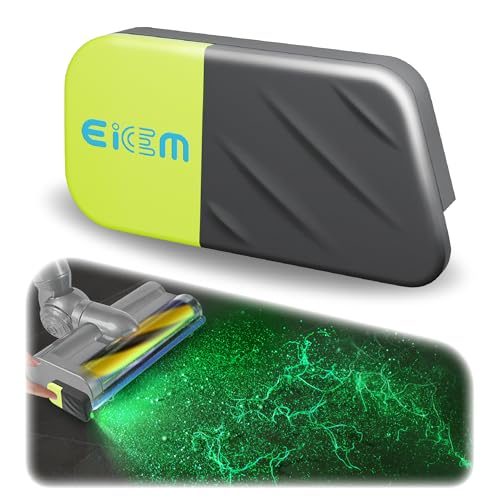
EICEM green vacuum dust detection light
attachment clips to a vacuum head and rakes a low green beam across the floor so fine debris
casts a shadow. Our page on
why a bag is the filter and a cyclone is
not already uses this product for a different argument, the head against the filter, and quotes
the four word drawback that makes it useful: "Adds visibility, not suction."
It earns a third mention here for a reason neither of those pages needs. The coverage law gives
you the total area a random machine has missed and tells you absolutely nothing
about where. There is no term in it for position. So the only instrument that can
answer the question the owner is actually asking, which patch did it miss, is one that looks at the
floor, and the simplest such instrument in this catalogue is a raking light that takes nothing
from the machine and adds no suction. Its own second caveat is the right one for a device that works by
shadow: "Contrast fades in bright rooms." Details in our
review of the EICEM detection
light.
The honest limit, and what it leaves out
What is exact here is the law and every ratio inside it. The 2.3026 passes per decade, the
factor of two between 90 and 99 percent, the 4.6052, and the identity that the new ground fraction
equals the missed fraction are all consequences of the exponential and do not depend on any number
being right. The 1.07 and 3.75 millilitres per minute are exact, because each is one published
volume divided by one published time on the same listing. The 199.74 square metres and the 10,800
seconds are published conversions.
What is representative rather than published is a short list and one item on it matters more
than the rest. The 28 centimetre track width is an estimate, because no pool cleaner in this
catalogue publishes one, and every speed in the third panel scales inversely with it: assume 40
centimetres instead and both speeds fall by 30 percent while the 4.61 between them does not move.
The 0.8 metres a second walking sweep, the 15 millilitres a square metre of recovered water and the
one to five millilitres a second spray rate are all typical values. And the model itself assumes
each newly swept patch lands independently of the ones before, which no real machine does. A
bump and turn robot is strongly correlated over short distances, which makes it locally better than
this law and globally no better at all, because the correlation decays long before the room
does.
Three things this page deliberately does not compute. It does not compute the size or
shape of the patches a random machine leaves behind, because the law has no position in it
and the distribution is precisely what the owner sees. That is the gap, and naming it is more
useful than guessing at it. It does not compute coverage for any robot vacuum, because this
catalogue does not carry one and borrowing a figure from a pool cleaner for a carpet would be a
different claim wearing the same arithmetic. And it does not evaluate the sonar navigation itself,
because that is a claim about a method rather than a published quantity, and the only thing the
numbers can say about it is what this page said: it is worth a factor of 4.61, and the battery
beside it is the proof that the machine is relying on having it.
Three numbers to carry. Random coverage costs 2.30 passes over the whole floor for every factor
of ten you want off the missed fraction, so 95 percent is three passes and 99 is 4.6. The chance
the next patch is new ground equals the fraction still missed, which is why no machine can feel the
difference between nearly done and done. And a mapped robot's misses are a constant rather than an
exponential, so when yours leaves the same strip every time, the thing to change is the strip.
Why 99 Percent Coverage Costs 4.6 Times the Floor at a glance
EICEM Green Vacuum Dust Detection Light Attachment
spotting hidden dust and pet hair while vacuuming
Reveals hidden dust and pet hair
Adds visibility, not suction
Why you can trust this guide
We compared these picks using verified manufacturer specifications, current retailer listings, and patterns in owner feedback, alongside editorial research. We focus on measurable differences such as performance, capacity, usability, and build quality. Pickpedia does not present editorial research as laboratory testing, and we do not claim hands-on testing unless it was actually performed.
Best for Owners of larger pools who want powerful, hands-off cleaning
9.0/ 10 Pickpedia editorial score
A powerful cordless robotic pool cleaner built around a 180W brushless motor and a stated 45,000Pa of suction that lifts wet leaves, twigs and fine sand, guided by AI sonar navigation for up to 99% coverage. It climbs walls and scrubs the waterline on tank-style tracks, offers Floor, Wall and Full-Coverage modes, runs 150 to 180 minutes with auto-parking, and empties from a large 2 litre easy-clean basket. A genuinely time-saving cleaner for inground and above-ground pools up to 2,150 square feet, with sensible notes on matching it to your pool.
BrandNeptunova
TypeCordless robotic pool cleaner
Motor180W brushless
Suction45,000Pa (stated)
NavigationAI sonar, up to 99% coverage
ClimbingWalls and waterline
Runtime150 to 180 minutes
Pool sizeUp to 2,150 sq ft
Pros
Strong 180W brushless motor and stated 45,000Pa suction lift heavy debris
AI sonar navigation maps the pool for up to 99% coverage
Climbs walls and scrubs the waterline, not just the floor
Three modes and cordless, free-moving operation
150 to 180 minute runtime with auto-parking when low
Large 2 litre filter basket that rinses clean easily
Cons
Battery-powered, so it recharges between cleans and has a per-cycle limit
Designed for pools up to 2,150 sq ft; match it to your pool
Heavy debris loads may need more than one cycle or a mid-clean empty
Cleans the pool but does not manage water chemistry
Best for cordless powered scrubbing across a whole home
8.4/ 10 Pickpedia editorial score
This is a cordless electric spin mop with three speed modes topping out at 800 RPM. It suits people who want powered scrubbing without a cord, across floors, bathrooms and corners. Two 21V batteries are included, and the maker states up to 420 minutes of low-speed runtime. A removable 450ml tank, LED head light and 50-inch telescopic pole round out the design.
Best for Streak-free shower glass, windows and condensation
8.8/ 10 Pickpedia editorial score
A cordless electric window vacuum with 2000Pa suction and a soft 280mm rubber blade for streak-free cleaning, a 31 to 40 inch extendable pole for high glass, a 2200mAh battery giving up to 40 minutes runtime, a removable 150ml transparent tank and a complete kit including a spare blade, spray bottle and cloths.
BrandGARYOG
TypeCordless window vacuum squeegee
Suction2000Pa
Blade280mm (11 in) soft rubber, spare included
Pole31 to 40 in extendable
Battery2200mAh, up to 40 min
Tank150ml removable, transparent
Weight1.1 lb
SurfacesWindows, mirrors, shower glass, tiles, car
Best for Wide, quick cleaning on hardwood and tile
8.2/ 10 Pickpedia editorial score
This 24 inch flat floor mop pairs a sleek aluminum frame with a 360 degree swivel head for hardwood, tile, and tight corners. The wide head carries plastic-covered edges to protect furniture and walls. Its pole extends from 80cm to 155cm to fit different heights, and four gray microfiber pads handle both dry and wet jobs. The maker describes a smooth, streak-free glide.
Mop width24 inch flat head
FrameHigh-quality aluminum, no visible screws
Head360 degree swivel
Edge protectionPlastic-covered edges
Pole range80cm to 155cm (31 to 61 in)
Pads included4 gray microfiber
UseDry and wet cleaning
SurfacesHardwood, tile, and more
Pros
Wide 24 inch head covers floors quickly
360 degree swivel reaches corners and under furniture
Screwless aluminum frame glides smoothly
Plastic-covered edges protect walls and furniture
Pole extends from 80cm to 155cm for most heights
Four microfiber pads included for wet and dry use
Cons
Listing omits pad wash instructions and mounting details
Exact head width beyond the 24 inch name is unstated
Heavy dried-on messes may need a pre-soak first
Specs are maker-stated, not independently verified
Best for spotting hidden dust and pet hair while vacuuming
8.0/ 10 Pickpedia editorial score
This is the EICEM vacuum dust detection light, a universal green attachment that highlights hidden dust and pet hair as you clean. The maker states it mounts on the right side of your vacuum head with two included bases for easy switching. It fits upright, stick, and canister vacuums from brands like Dyson, Shark, Bissell, Tineco, Eureka, and more.