PBy the Pickpedia Team·8 picks compared·Last verified October 2026
Affiliate disclosure: As an Amazon Associate, Pickpedia earns from qualifying purchases. Links on this page are paid links, and we may earn a commission at no extra cost to you. This never affects our picks or scores.
This page contains affiliate links. If you buy through one we may earn a
commission, at no cost to you.
The edge of its range is not a place. A quoted wireless range is a link budget written
in the wrong units, and once you convert it back two things fall out that change how you
shop. The whole spread of published range figures across every no-WiFi baby monitor in
this catalogue is 6.02 decibels, which is about two plasterboard walls. And moving the
parent unit one room closer buys you the same 6.02 decibels for nothing.
The walkie talkie case is stranger still, and it is the clearest demonstration in
consumer electronics of a specification that is true and useless at the same time.
Thirty miles is a statement about the Earth
A
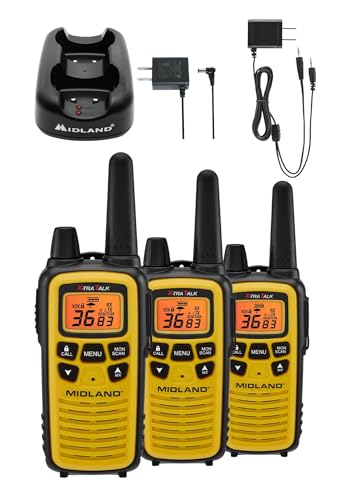
Midland LXT630VP3 three pack of FRS
walkie talkies publishes "up to 30 miles" and, to its credit, immediately qualifies
it. Our own record quotes the asterisk and reads it correctly: Midland states "longer
range communication in open areas with little or no obstruction", and the record adds
that "FRS is line of sight. Hills, buildings and trees all cut it, and in ordinary terrain
real usable range is a small fraction of the headline."
That is right, and the useful version of it is a number. The distance to the horizon
from a height h is the square root of twice the Earth's radius times h, which for a
6,371 kilometre Earth comes to 3.5696 times the square root of the height in metres, in
kilometres. Radio bends very slightly downward in the atmosphere, which raises the
constant to about 4.124.
Put two people holding radios at hand height, say 1.5 metres. Each one can see 4.371
kilometres of horizon geometrically, so the pair reaches 8.742 kilometres, which is 5.432
miles. With refraction it is 10.101 kilometres, or 6.277 miles.
Now solve the other way. For 30 miles, which is 48.28 kilometres, with one radio still
at hand height, the other has to be 151.3 metres up on the geometric figure or 109.9
metres with refraction. That is a ridge, a tower, a tall building or an aircraft. It is
not two people in a field, and it is not a campsite, a ski area or a worksite.
The surplus the radio is not allowed to spend
Here is the part that makes the figure genuinely strange rather than merely optimistic.
At 30 miles the radio is not struggling. It has an enormous amount of signal left
over.
FRS runs at 2 watts, which is plus 33 decibel-milliwatts. Free space path loss at the
462 megahertz band centre over 48.28 kilometres is 119.42 decibels. So a receiver with
nothing in the way would be getting minus 86.42 decibel-milliwatts, against a sensitivity
for a narrowband handheld of around minus 118. That is 31.58 decibels of unspent margin,
which is a factor of 1,440 in power.
Spend all of it on distance instead and set the received level to minus 118. The path
loss allowed becomes 151 decibels, which puts the distance at 1,833 kilometres, or 1,139
miles.
So the published 30 miles is 1.6 percent of what the electronics can actually reach.
The other 98.4 percent is blocked by the ground. Which means the headline figure is not
measuring the radio at all, and no choice between two handhelds can move it, because what
is limiting it is the shape of the planet.
Our record's framing turns out to be exactly the right one: "The practical way to read
it is as a ranking tool between models rather than a distance you will achieve." The
arithmetic says it is not even much of a ranking tool, because every radio in the service
is pinned at the same 2 watt ceiling and therefore at the same horizon.
The horizon is exact geometry on a sphere of 6,371 kilometres, giving 3.5696 times the
square root of the height in metres, and the 4.124 variant is the standard refraction
correction. The path losses are the free space formula at the published band centres, and
the decibel conversions between the published range figures are exact, because 20 times
the logarithm of a distance ratio is what a free space link does regardless of anything
else. The published inputs are the 30 miles on both walkie talkies and the 1,000, 1,200
and 2,000 foot figures on the monitors. What is representative rather than published is
every radio parameter, because not one baby monitor we carry publishes a transmit power,
an antenna gain or a receiver sensitivity, and neither walkie talkie publishes a
sensitivity either: the 2 watts is the regulatory ceiling for the service, the 100
milliwatts and minus 90 dBm are typical for a 2.4 gigahertz video link, the minus 118 dBm
is typical for a narrowband handheld, and the 3 and 12 decibel wall figures are the middle
of commonly published ranges. Move the sensitivity by 10 decibels and every margin in the
third panel moves by 10, which is three plasterboard walls, while the 6.021 decibel spread
between products does not move at all, because it is a ratio.
A published figure that does not agree with itself
While converting those records something else fell out, and it is in both of them.
Thirty six times 121 is 4,356. The published combination count is 2,662, and 2,662 is
exactly 22 times 121. Twenty two is the real channel count of the FRS service.
So the two figures in the same record disagree by a factor of 1.636, and the one that
is internally consistent with the service points to 22 channels rather than 36. Both
numbers cannot be right, and the combination count is the one that checks out. Nothing
about either record would reveal that without the multiplication, and we carry the same
pair of claims on two separate products.
The eight pack is otherwise the better documented of the two and worth saying so. It
publishes a 3 year warranty on the radios against 90 days on the headsets, a twelve-fold
gap, and our record reads it exactly right: "that gap tells you exactly which component
the manufacturer expects to fail first." It also publishes four desktop chargers for eight
radios, which the record flags as a planning problem rather than burying. Those are real
specifications that mean something, and they are on the listing where the 30 miles also
is.
Now the baby monitor, where the number does convert into something useful
A quoted range indoors is a different animal, because the limit is not the horizon. It
is walls, and walls are a budget you can actually compute.
A
5 inch 720p no-WiFi pan tilt zoom
baby monitor publishes the highest figure in our catalogue and publishes it carefully:
"Open-area range is rated up to 2,000 feet, though walls and interference will reduce that
in practice", over "a private FHSS direct link that keeps video off the internet".
Convert it. At the 2.44 gigahertz band centre, with a typical 100 milliwatt transmitter,
the free space path loss over 609.6 metres is 95.89 decibels, so the receiver sees minus
75.89 decibel-milliwatts. Against a sensitivity of around minus 90 for a video link that
is 14.1 decibels of margin, which is what an honest open-field measurement looks like:
enough to be repeatable, not enough to be fantasy.
Now bring the parent unit to where you actually sit. Every halving of distance buys
6.02 decibels, so the margin grows as you come in: 20.2 decibels at 300 metres, 29.8 at
100, 40.2 at 30, 46.3 at 15 and 49.8 at 10.
And then spend it on walls. An interior plasterboard wall costs about 3 decibels at
this frequency and a solid brick or concrete one about 12. So at 15 metres, which is a
realistic distance from a nursery to a living room, you have 46.3 decibels, which is 15
plasterboard walls or 3.9 concrete ones. At 30 metres it is 13 and 3.3.
That is the number worth having. It explains the common experience that a monitor rated
for 2,000 feet drops out through two floors of a Victorian terrace while a monitor rated
for a third of that works fine across a modern house. The floors are concrete and the
house is plasterboard, and the range figure never mentioned either.
The spread between products is two walls
Here is the result that should change what anyone does with a monitor listing.
A
VTech no-WiFi baby monitor
publishes a 1,000 foot range, and is admirably direct about what that is: our record quotes
it as "The 1000ft range is a specification, though actual range varies with walls and
interference", with a drawback simply reading "Range may be affected by walls".
A
Buradin 1080p no-WiFi pan tilt
monitor publishes a 1,200 foot figure alongside a 5000mAh battery, with its own record
noting that "Range figures like 1200 feet are maker-stated and depend on walls and
interference".
An
ALIOBC AI video baby monitor with a
5 inch parent unit publishes 1,000 feet and goes further than any of them on
disclosure: "Detection accuracy and range figures are maker-stated, not lab-verified, and
range drops with walls and interference."
Convert those three against the 2,000 foot machine. Twenty times the logarithm of 1,200
over 1,000 is 1.584 decibels. Twenty times the logarithm of 2,000 over 1,000 is 6.021.
So the entire top-to-bottom spread of the specification buyers compare across this
category is 6.02 decibels. Two plasterboard walls. And the 1,000 versus 1,200 foot
difference, which looks like a 20 percent advantage on a listing page, is 1.58 decibels,
which is half a wall.
Meanwhile halving the distance between the two units buys 6.02 decibels on its own. One
room closer is worth the whole product difference, and it is free. Our guide to
choosing a baby monitor
that works without Wi-Fi already says the qualitative half of this correctly, noting
that "open-area range figures assume clear line of sight. walls and floors cut it down."
Three decibels and twelve decibels are the sizes of "cut it down".
The four quantities nobody publishes
A range figure is made of four things: the transmit power, the antenna gain at each
end, the receiver sensitivity, and the loss between them. The listing gives you a
consequence of all four and none of the four.
Not one baby monitor in this catalogue publishes a transmit power. Not one publishes an
antenna gain. Not one publishes a receiver sensitivity. Not one publishes a wall figure.
Neither walkie talkie publishes a sensitivity either. Which means the conversion above had
to supply all of them from typical values, and that is the honest limit of this page rather
than a complaint about the products.
What is striking is how good the disclosure is on everything else. Four of these records
explicitly label the range figure as unverified and warn about walls, and one of them,
a
GoodBaby 5 inch no-WiFi monitor with
a stated 1,000 foot range, states the general principle in one line: "All specs here,
including battery hours and range, are maker-stated rather than tested by us." That is the
right thing to say. The gap is that four records disclaim the number and none of them
converts it, and converting it is the only way to make it actionable.
The same shape appears one order of magnitude down. A
Pebblebee Clip 5 Bluetooth tracker
tag publishes a range "quoted at up to 500 feet or 150 metres", and our page on
how Bluetooth item trackers
actually work notes the category figure as "usually within about 200 feet on a clear
line of sight". Twenty times the logarithm of 500 over 200 is 7.96 decibels, so those two
quoted ranges differ by less than three plasterboard walls, in a device whose whole job is
to be findable from the other side of a sofa.
Why the antenna cannot rescue it either
One tempting response is to improve the antenna rather than the distance, and it has a
ceiling that is smaller than people expect. Our page on
why foil behind a
router helps one band and nulls the other works out the limit properly: a flat
conducting sheet behind an antenna can add at most 6.02 decibels, and only at exactly a
quarter wavelength, which is 30.7 millimetres at 2.4 gigahertz.
Notice that 6.02 appears again, and it is not a coincidence. Six decibels is a factor of
two in voltage and four in power, and it is the natural size of almost every easy intervention in
radio: a perfect reflector behind an antenna, a halving of distance, and the entire spread
of published range figures in this category are all the same 6.02 decibels. Two
plasterboard walls is the unit of currency, and it is worth knowing that everything on the
table trades at roughly one or two of them.
Which is why the honest advice is boring. A monitor two rooms away through plasterboard
has about fifteen walls of margin and will not drop out. The same monitor through a
concrete floor has under four, and the fix is not a different monitor, because a different
monitor is half a wall to two walls better at most. The fix is a shorter path: the parent
unit on the stair landing rather than in the basement, which is worth more than every
range figure in the category added together.
The honest limit, and what to ask instead
What is exact here is the geometry and the conversions. The horizon is the square root
of twice the Earth's radius times the height, and the 3.5696 and 4.124 constants follow
from it with no product input. Free space path loss is the standard formula at the
published band centres. And the decibel differences between published range figures are
exact, because twenty times the logarithm of a distance ratio is what a free space link
does whatever the hardware is.
What is representative is every radio parameter, and there are four of them. The 2 watts
is the regulatory ceiling for FRS rather than a published figure. The minus 118 dBm
handheld sensitivity and the minus 90 dBm video sensitivity are typical rather than stated
by any listing we carry. The 100 milliwatt monitor transmitter is typical. And the 3 and 12
decibel wall losses are the middle of commonly published ranges, which vary with
construction by several decibels either way.
Those matter asymmetrically, which is the useful thing about them. Move the sensitivity
by 10 decibels and every margin in the third panel moves by 10, which is three plasterboard
walls, and that is a big change to the absolute answer. But the 6.02 decibel spread between
products does not move at all, because it is a ratio of two published distances and nothing
else enters it. So the absolute margins here should be read as order-of-magnitude and the
comparison between products should be read as exact.
What this page deliberately does not compute is anything about interference, which is
the other half of real-world dropouts and is not a path loss problem at all. A neighbour's
network, a microwave oven and a cordless phone all raise the noise floor rather than
lowering the signal, and no listing publishes a signal to noise requirement, so the margin
figures above are against thermal noise alone and are therefore optimistic in a busy
block.
Which leaves the question worth asking a seller, and it replaces the range figure
entirely. Not how far does it reach. Ask what it transmits at and what the receiver needs,
because those two numbers and a tape measure will tell you whether it works in your house,
and the quoted distance never will. And if nobody will tell you, the free experiment is
better than any specification: put the parent unit where you intend to sit and walk the
camera to the nursery. Whatever it does on that walk is the only measurement that
matters.
What a Quoted Wireless Range Is Measuring at a glance
Parents seeking a private, no-WiFi monitor with long battery life.
No WiFi or cloud, ensuring privacy. 19-hour video battery life. Sound-activated screen saves battery. Night vision and 2x zoom. Temperature sensor and lullabies. Two-way talkback.
No WiFi or app support. 2.8-inch screen is small. Digital zoom may reduce image quality. Range may be affected by walls.
Anyone who wants a tracker they can hear across a room, and recharge rather than replace
130 decibel siren with an ultra-bright LED strobe
No manufacturer's warranty, stated on the listing
Why you can trust this guide
We compared these picks using verified manufacturer specifications, current retailer listings, and patterns in owner feedback, alongside editorial research. We focus on measurable differences such as performance, capacity, usability, and build quality. Pickpedia does not present editorial research as laboratory testing, and we do not claim hands-on testing unless it was actually performed.
Best for Families on campsites, ski slopes and hikes who want weather alerts included
8.4/ 10 Pickpedia editorial score
A three pack of licence-free FRS radios with 36 channels, 121 privacy codes, NOAA weather scan and alerting, and dual power from included rechargeable packs or AAA cells.
BrandMidland
ModelLXT630PAX3VP3
Part numberLXT630X3VP3
Pack size3 radios
ServiceFRS, licence free
Channels36, with channel scan
Privacy codes121 CTCSS, up to 2,662 combinations
Stated rangeUp to 30 miles in open areas with little or no obstruction
WeatherNOAA scan across 10 WX channels, plus alerting
PowerRechargeable packs included, or 3 AAA cells not included
Silent modeTurns off all tones
Dimensions1 x 2 x 7 in
ColourYellow
WarrantyNot published, contact Midland
Pros
Three radios with three rechargeable packs, clips and a desktop charger
Dual power, so AAA cells work when the pack is flat
NOAA Weather Scan across 10 weather channels
Weather Alert sounds an alarm for severe weather in your area
36 FRS channels with 121 privacy codes
Silent operation turns off all tones
High-visibility yellow faceplate
No licence and no network needed
Cons
The 30 mile range applies only to open, unobstructed ground
AAA batteries for the backup power mode are not included
No warranty period published on the listing
Privacy codes reduce interference, they do not encrypt
Best for Restaurants, retail floors and event teams kitting out a whole shift at once
8.4/ 10 Pickpedia editorial score
An eight-radio licence-free FRS pack with concealed headsets, belt clips and rechargeable battery packs for every unit, 36 channels with 121 CTCSS codes, NOAA weather scan and alert, and a 3 year warranty on the radios.
BrandMidland
ModelLXT600BBX4-MFN
Part numberLXT600BBX4
Pack size8 radios
ServiceFRS, licence free
Channels36, with channel scan
CTCSS codes121
Channel optionsUp to 2,662
Quoted rangeUp to 30 miles in open areas with little or no obstruction
WeatherNOAA Weather Scan across 10 WX channels, plus alert
HeadsetsConcealed, 8 included
PowerRechargeable battery packs, 8 included
Charging4 desktop chargers, 4 AC adapters
Radio size6 x 1.5 x 1.5 in
ColourBlack
Warranty3 years radios, 90 days headsets
Pros
Eight radios with a concealed headset and belt clip for every unit
Rechargeable battery packs included for all eight
3 year warranty on the radios
Licence free, so no paperwork before use
36 FRS channels with channel scan for activity
121 CTCSS codes giving up to 2,662 channel options
NOAA Weather Scan across 10 weather band channels, plus severe weather alert
Silent operation turns off all tones during service
Discreet black finish suitable for customer-facing use
Cons
Only four desktop chargers and four AC adapters for eight radios
Headsets carry just 90 days of warranty against the radios' 3 years
The 30 mile range applies to open ground with no obstruction
CTCSS codes are not encryption, others on your channel can still hear you
FRS power limits mean indoor range through walls is modest
Best for parents who want private, app-free monitoring on a dedicated screen
8.2/ 10 Pickpedia editorial score
This baby monitor skips WiFi entirely, using a private FHSS direct link to a 5-inch 720P parent screen. Open-area range is rated up to 2,000 feet. It offers remote 350 degree pan, 108 degree tilt, 2x zoom, two-way talk, VOX sound alerts, four lullabies, and temperature alerts. The 3,000mAh parent unit lasts up to 24 hours in standby.
Best for Parents seeking a private, no-WiFi monitor with long battery life.
8.8/ 10 Pickpedia editorial score
The VTech VM819 is a dedicated baby monitor that avoids WiFi and cloud connections for privacy. It offers a 2.8-inch screen, night vision, two-way talk, lullabies, and a temperature sensor. Its standout feature is the 19-hour battery life for video monitoring. However, it lacks WiFi connectivity and smart features, which may be a limitation for some.
Your Baby's Nursery StaysThe VM819 never connects to WiFi, the internet, or a
See Every Detail, Day AndThe 2.8-inch LCD delivers a real-time view with no s
Wake Up Only When Your BabSound-Activated Screen Mode keeps the parent unit da
Monitor All Night WithoutThe 2,600mAh rechargeable battery delivers up to 19
Soothe Your Baby And KnowTwo lullabies and two ambient sounds (white noise an
Pros
No WiFi or cloud, ensuring privacy. 19-hour video battery life. Sound-activated screen saves battery. Night vision and 2x zoom. Temperature sensor and lullabies. Two-way talkback.
Cons
No WiFi or app support. 2.8-inch screen is small. Digital zoom may reduce image quality. Range may be affected by walls.
Best for parents who want private app-free nursery viewing
8.4/ 10 Pickpedia editorial score
Buradin makes a self-contained 1080P baby monitor that skips WiFi and apps entirely. A 5-inch parent screen pairs with a pan-tilt camera offering 330-degree pan, 100-degree tilt, and 4X zoom. Built-in features include two-way talk, infrared night vision, a temperature sensor, eight lullabies, and VOX. The maker cites a 5000mAh battery and 1200-foot range. Setup stays local and private.
Screen5-inch 1080P display
Video1080P
Battery5000mAh built-in
Pan330 degrees
Tilt100 degrees
Zoom4X
Range1200FT stated
ExtrasVOX, temperature sensor, 8 lullabies
Pros
WiFi-free design keeps viewing private and account-free
Large 5-inch 1080P screen for clear nursery views
Camera pans 330 degrees and tilts 100 degrees
4X zoom pulls in close detail on the crib
Two-way talk, night vision, and temperature sensor included
Eight lullabies help soothe without walking in
Cons
No remote viewing when away from the home
Range and battery figures are maker-stated only
Single-camera coverage may not suit larger homes
Facts reflect the listing, not independent lab testing
Best for parents wanting an active pan-tilt camera with local and remote modes
8.6/ 10 Pickpedia editorial score
The ALIOBC baby monitor works locally without WiFi or remotely through the app. It suits parents wanting privacy at home and remote checks away. The maker lists a 5-inch 2K parent unit with 1000ft range, a 1080p pan-tilt-zoom camera, AI cry and motion detection, two-way talk, invisible night vision, a charging dock, and microSD support up to 256GB.
Best for parents wanting a private, app-free monitor with long battery life
8.6/ 10 Pickpedia editorial score
The GoodBaby 5-inch monitor is a Wi-Fi-free system built around privacy and simplicity. It pairs a large 5-inch LCD parent screen with a remote pan-tilt-zoom camera, using secure FHSS technology that needs no apps or internet. The maker states up to 30 hours of battery in VOX mode, plus infrared night vision, a temperature sensor, two-way talk, and 8 built-in lullabies.
Best for Anyone who wants a tracker they can hear across a room, and recharge rather than replace
8.4/ 10 Pickpedia editorial score
A rechargeable Bluetooth tracker with a 130dB siren, LED strobe, an alert mode that shares your location to a chosen circle, IP66 water resistance and compatibility with either Apple Find My or Google Find Hub.
BrandPebblebee
ModelClip 5 Hotline Pink
Alert volume130 dB
Visual alertUltra-bright LED strobe
NetworksApple Find My or Google Find Hub
Bluetooth rangeUp to 500 ft, 150 m
BatteryRechargeable, USB-C
Battery lifeUp to 12 months per charge
Water resistanceIP66
Weight10 g
Safety modeSiren, strobe and location sharing to a Safety Circle
SubscriptionFree tier, optional Alert Live upgrade
PackagingRecyclable, responsibly sourced
ColourHotline Pink
WarrantyNone from the manufacturer, per the listing
Pros
130 decibel siren with an ultra-bright LED strobe
Rechargeable over USB-C, quoted at up to 12 months per charge
No disposable coin cells to buy and replace
Works with Apple Find My or Google Find Hub
Alert Safety Mode with a free tier
IP66 water resistant
Light at 10 grams
Recyclable, responsibly sourced packaging
Cons
No manufacturer's warranty, stated on the listing
Not a GPS tracker despite the listing calling it one
Apple or Google network, not both at once
Real-time location sharing needs the paid Alert Live tier
Beyond 500 feet you depend on other people's phones