Tools & DIY How to Choose a Masonry Drill Bit Set for Home Use
P
By the Pickpedia Team
·1 picks compared
·Last verified October 2026
Affiliate disclosure: As an Amazon Associate, Pickpedia earns from qualifying purchases. Links on this page are paid links, and we may earn a commission at no extra cost to you. This never affects our picks or scores.
The right masonry set saves a drawer full of single bits. Match material range, sizing, and shank type to the jobs you actually do.
Look at the material range
Carbide-tipped bits cross many surfaces, from glass to brick. A versatile carbide masonry drill bit set lets one box handle tile, stone, wood, and cement instead of buying separate kits.
Check the size spread
Good sets cover small anchor holes through larger fixings. Look for sizes from around 1/8 up to 1/2 inch, and value sets that double the sizes you use most, like 1/4 and 5/16 inch.
Understand wet versus dry
Glass, tile, and stone usually need water to cool the tip and clear dust. Wood, brick, and cement can go dry. Following this keeps the carbide sharp and the bit lasting longer.
Match the shank to your drill
Most home sets use a round or 3-flat shank for standard chucks. Heavy concrete work leans on SDS hammer bits instead. Confirm your drill type before assuming a set fits every job.
Drill at the right speed
Hard materials want moderate speed and steady pressure, not high revs. Let the flutes clear dust. Pushing too fast overheats the tip and dulls the carbide before its time.
The bottom line
Choose by material range, size spread, and shank fit, then respect the wet-and-dry rules. A well-matched carbide set covers most household drilling in one box.
How to Choose a Masonry Drill Bit Set for Home Use at a glance
Why you can trust this guide
We compared these picks using verified manufacturer specifications, current retailer listings, and patterns in owner feedback, alongside editorial research. We focus on measurable differences such as performance, capacity, usability, and build quality. Pickpedia does not present editorial research as laboratory testing, and we do not claim hands-on testing unless it was actually performed.
Our top picks
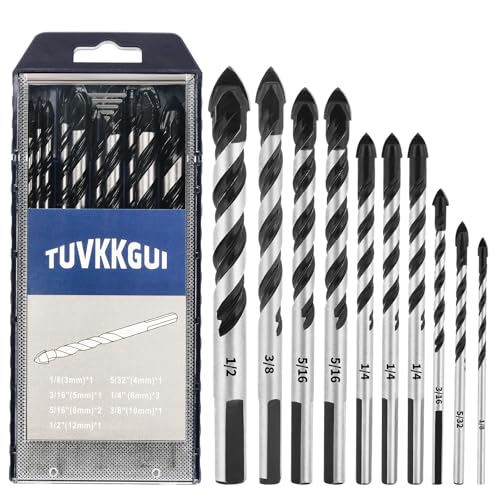
This Tuvkkgui 10-piece set covers a wide mix of materials with carbide-tipped bits. Seven sizes from 1/8 to 1/2 inch drill glass, tile, marble, metal, stone, wood, plastic, brick, and cement. A YG6 alloy head rated to 92.8 hardness and a double U-groove aid fast cutting and dust removal. A 3-flat shank grips most drills.
Pieces10
Sizes1/8 to 1/2 inch
Distinct sizes7
HeadYG6 alloy
Head hardnessUp to 92.8
Shank40r alloy, 3-flat
FluteDouble U-groove
Wet materialsGlass, tile, stone, metal
Pros
- Carbide tips cut many materials
- Seven sizes from 1/8 to 1/2 inch
- Doubled 1/4 and 5/16 inch sizes
- Double U-groove clears dust fast
- 3-flat shank fits most drills
- Clear wet and dry material guidance
Cons
- Facts are maker-stated, not lab-tested
- Not aimed at heavy concrete drilling
- No mention of SDS or hammer use
- Some materials require added water
Read our full review → Check price on Amazon ›
Note: Availability and specifications change often. Always confirm the current details on Amazon before buying.